A Texas DWI case usually takes several months, not a few weeks. Simple cases resolved by plea often finish in 4 to 8 months, while cases that go to trial commonly take 6 to 12 months or longer.
If you were arrested recently, you're probably checking your phone, replaying the traffic stop, and wondering what happens to your license, your job, and your future. That reaction is normal. You often don't care about the legal system until you get pulled into it.
The hard part is that a Texas DWI case doesn't move on just one timeline. It often begins with urgent deadlines in the first days after arrest, then settles into a long stretch of waiting, evidence review, court settings, and negotiation. If the DWI involved a wreck, there may also be a separate injury claim or lawsuit running at the same time.
The question isn't only how long does a DWI case take in Texas from start to finish. The better question is what happens during that time, what can slow it down, and what you should do early so you don't lose ground.
Your DWI Arrest The First Question on Your Mind
The first night after a DWI arrest feels chaotic. You may have bonded out, gotten home late, and sat at the kitchen table with paperwork you barely remember receiving. Then the practical questions start. Can you still drive? When is court? Is this over in a month, or are you dealing with this all year?
For many people, the stress isn't just about the charge. It's about everything attached to it. Work schedules. Child pickups. Professional licensing. Insurance. If there was an accident, the pressure gets worse because now you're also worried about injuries, property damage, and whether someone will sue.
What most new clients are really asking
When someone asks how long their DWI case will take, they usually mean several things at once:
- How long until court starts: They want to know when they'll have to stand in front of a judge.
- How long until driving is affected: They need to know whether they can still get to work.
- How long until the case is over: They want a finish line, even if it's not a perfect one.
- How long life stays on hold: They need to plan for family, finances, and employment.
A lot of confusion comes from mixed terms. Some people use DUI and DWI interchangeably because they've seen other states use different labels. If you've been comparing internet results from different places, a basic explanation of what is a DUI in Florida can help show why state-specific terminology matters and why Texas timelines should be read carefully.
Most anxiety comes from not knowing whether silence means the case is getting better or getting worse. In many DWI cases, it simply means the system is moving slowly.
A realistic starting point
A Texas DWI case usually follows a recognizable path. There is an arrest. There is a separate license issue. There are early settings. Then comes the long middle, where the defense reviews the stop, the testing, the paperwork, and the prosecution's evidence. After that, the case ends one of a few ways: dismissal, negotiated resolution, or trial.
That path is predictable even when the calendar isn't.
If you're looking for certainty, the honest answer is that no lawyer should promise a fast ending. What works is early action, clean decision-making, and a strategy that matches the facts. What doesn't work is waiting for the first court date and assuming nothing important happens before then.
The Two Parallel Tracks Criminal Case and License Hearing
Right after a Texas DWI arrest, you're not dealing with one case. You're dealing with two separate tracks that start from the same event but move for different reasons.
One track is the criminal case. That is the state's prosecution of the DWI allegation itself. The other is the administrative process over your driver's license, commonly called the ALR, or Administrative License Revocation process.

The criminal track
The criminal case decides whether the state can prove the DWI charge and what legal outcome follows. That may include dismissal, a plea, diversion if available, or a trial. This side of the case usually takes longer because it involves evidence review, motion practice, negotiation, scheduling, and sometimes witness issues.
The license track
The ALR track is different. It focuses on whether the state can suspend your driving privileges. It has its own deadlines, its own hearing process, and its own practical consequences. You can have progress in one track and problems in the other.
That separation matters. A person can do well on the criminal side and still face a license problem. The reverse can also happen.
Why this distinction matters early
People often make a costly mistake here. They wait for the first criminal court setting and assume that's when the case begins. It isn't. Action is often needed long before then, especially on the license side.
If you're trying to decide when representation matters most, this guide on when to hire a DWI lawyer in Texas is useful because the early window is where preventable mistakes often happen.
For a broader overview of defense work in criminal cases, some readers also benefit from seeing how firms describe criminal defense services in practical terms. The key point is that DWI defense is not just showing up in court. It starts with deadlines, records, evidence, and timing.
Practical rule: Treat the criminal case and the license case as connected, but never assume one automatically fixes the other.
A calm approach helps here. Gather every paper you received. Save your bond paperwork. Write down what happened while it's fresh. Then get legal advice early enough to protect both tracks.
Stage One From Arrest to First Appearance in Court
You leave jail with bond papers in your hand, your car may still be in impound, and the first question is usually simple. How long until I have to be in court, and what has to happen before then?
The honest answer is that the case splits immediately into timing questions. On the criminal side, many misdemeanor DWI cases get a first court date roughly 20 to 40 days after arrest, while felony cases may take longer before an initial setting appears. On the license side, the deadline comes much faster. A driver usually has only 15 days after arrest to request an administrative license revocation hearing, according to this Texas DWI court process overview.
That gap causes real confusion. A client may think, "My court date is weeks away, so I have time." For the license case, that assumption can cost you.
The first month sets the tone
The early stage is less about courtroom drama and more about avoiding preventable damage. Deadlines, paperwork, bond terms, and basic facts matter. If the arrest involved a crash, this is also the period when insurance notices, vehicle photos, and witness information can affect a later civil claim.
I tell clients to treat the first month like evidence preservation. Small details disappear fast. Tow records get harder to find. Recollections fade. Video from nearby businesses may be overwritten.
Here is the checklist I want handled right away:
- Track the ALR deadline immediately: Do not wait for the criminal court date to deal with your license.
- Save every paper you received: Bond conditions, notice forms, temporary driving permits, towing paperwork, and inventory sheets all belong in one place.
- Write down your account of the stop and arrest: Include where you were, what you ate or drank, what field tests were requested, and what the officer said.
- Follow bond conditions exactly: Missed check-ins, drinking violations, or travel problems can create new issues before the defense gets traction.
- Address the practical fallout early: If a crash happened, keep photos, insurance information, and repair estimates because those facts may matter outside the criminal case too.
For a more detailed action plan, see this guide on the first 48 hours after a DWI arrest in Texas.
What the first court setting usually means
The first appearance is usually an administrative step, not a final turning point. In many courts, the defense still needs reports, body camera footage, dash camera footage, lab records, and maintenance records before giving sound advice about trial risk, plea options, or dismissal chances.
That first setting still matters. It shows which court has the case, how that court manages resets, and how quickly the prosecutor's office tends to produce evidence. Those details affect the overall timeline more than clients expect.
Felony cases often move slower at the front end because prosecutors may need more time for formal charging decisions, indictment procedure, or additional investigation. Misdemeanor cases usually become visible on the docket sooner, but that does not mean they finish sooner. A fast first setting and a fast resolution are two different things.
Stage Two The Long Pre-Trial Road
A lot of clients hit this stage and get uneasy. The arrest is over, the first court date has come and gone, and now the case seems to slow to a crawl. That is normal. Pre-trial is usually the longest part of a Texas DWI case because the evaluation happens here, in the office, in the evidence, and in repeated court settings.
One Texas DWI source reports that the pretrial stage can last up to 6 months, that a trial can add 3 to 6 more months or longer, and that the average case closes in about 10 months, with 68% of cases taking 6 to 17 months, according to this Texas DWI timeline breakdown.

What happens during pre-trial
Pre-trial usually means the defense is building the case before anyone makes a smart decision about a plea or a trial. That work often includes:
- Reviewing discovery: police reports, body camera footage, dash camera footage, breath or blood records, lab paperwork, and maintenance logs
- Testing the legal issues: whether the stop was lawful, whether the arrest was supported, whether testing procedures were followed, and whether statements can be challenged
- Negotiating with the prosecutor: identifying proof problems, discussing possible reductions or dismissal issues, and measuring trial risk
- Appearing at reset settings: many courts move DWI cases in increments while both sides gather and assess the evidence
This stage runs on two tracks at once. The criminal case is moving through court, while the license suspension case may already be set, decided, or creating deadlines of its own. If the arrest involved a wreck, insurance claims and potential civil exposure can also start developing during the same window. Clients are often dealing with all three problems at once, even though only one of them shows up on the criminal docket.
Why pre-trial takes time
Most of the delay comes from evidence and scheduling, not from inactivity. Blood results may still be pending. Video may arrive late or in pieces. Officers may be unavailable for a hearing date. Some counties reset DWI cases several times before they are ready for a serious negotiation or motion hearing.
A short comparison shows how the timeline changes:
| Case activity | Effect on timing |
|---|---|
| Early evidence review | Can identify strengths and weak points sooner |
| Motion practice | Often adds time, but may improve the defense position |
| Plea discussions | Can shorten the case if the facts and goals are clear |
| Trial preparation | Commonly pushes the timeline much farther out |
A longer pre-trial period is not automatically bad. In some cases, waiting for body camera footage, lab material, or officer testimony gives the defense a fair chance to spot problems that matter. In other cases, delay creates room for a better negotiated result.
The main trade-off is simple. A fast resolution may reduce stress, but speed has a price if the evidence has not been fully reviewed. In DWI cases, rushed decisions can affect the criminal charge, the driver's license case, and, when there was a crash, the civil case too.
Why Timelines Vary Factors That Delay or Speed Up Your Case
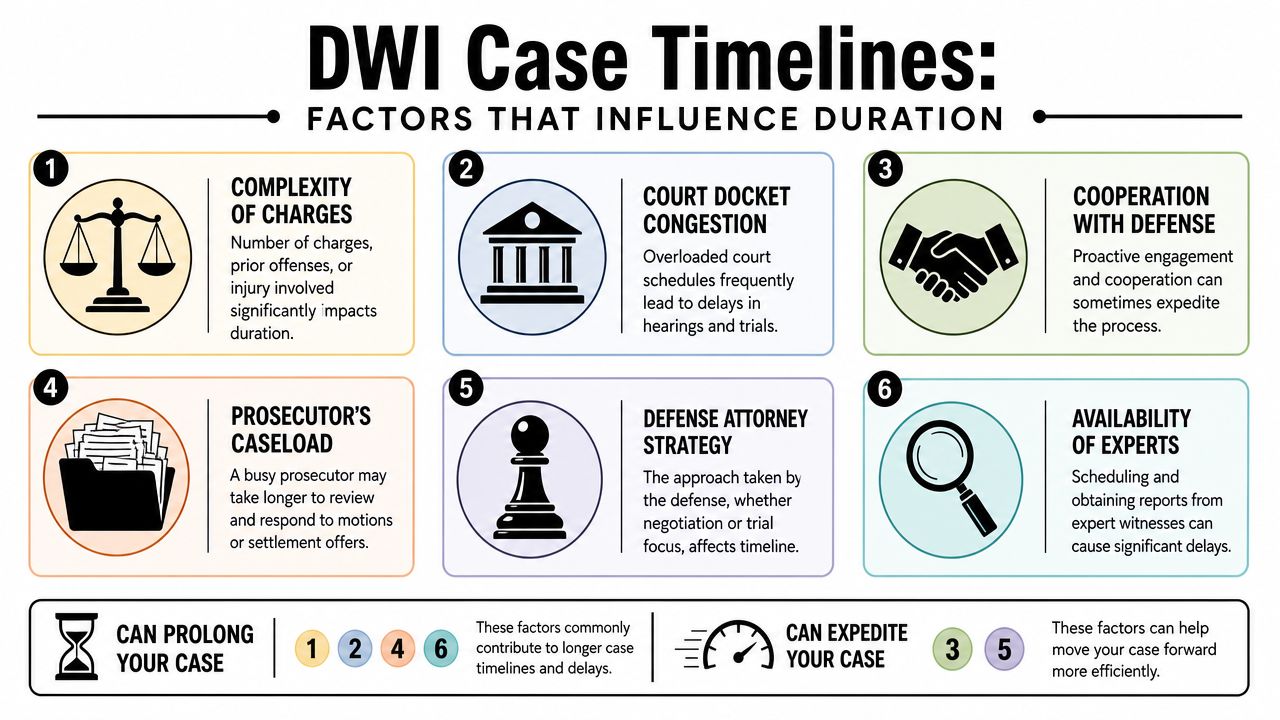
Two drivers can be arrested on the same weekend, in the same county, and still finish on very different schedules. One case may be resolved in a few months. The other may still be active a year later. That usually comes down to four things: the charge level, the evidence, the court's calendar, and the defense strategy.
One Texas DWI resource reports that 68% of cases took between 6 and 17 months, with a small fraction extending past 21 months (Texas DWI proceeding timelines). That range matches what defense lawyers see in practice. A case that is headed toward a plea usually moves faster than a case with suppression issues, lab problems, or trial settings that keep getting bumped.
A fast timeline is not always a good timeline.
If the criminal case is moving quickly, your lawyer still has to ask whether the State has produced the video, whether the blood paperwork is complete, whether the stop can be challenged, and whether anything said in the criminal case could affect the separate ALR license fight. If there was a wreck, timing also matters for insurance claims and potential civil exposure. Statements made too early can create problems in more than one forum.
What usually speeds a case up
Some cases move faster because there is less to investigate and fewer pressure points.
- Early agreement on case posture: If both sides see the strengths and weaknesses early, negotiation can start sooner.
- Simple misdemeanor facts: A routine first-offense case with no crash, no injuries, and no unusual evidentiary issue often takes less court time.
- Prompt client follow-through: Fast responses to lawyer requests, bond conditions, classes, and records requests help prevent avoidable resets.
- Limited motion practice: Fewer legal disputes usually mean fewer hearings to schedule.
What usually slows a case down
Other cases take longer because they require more scrutiny, more witnesses, or more coordination.
- Felony DWI allegations: Prior convictions, repeat-offender treatment, or injury-related charges usually add procedure and review time.
- Scientific or legal challenges: Blood testing, breath testing, retrograde extrapolation, and stop issues often require motions, expert review, or officer testimony.
- Court congestion: Some courts have fuller dockets, fewer trial slots, or more frequent resets.
- Crash-related investigations: If the DWI involved a collision, the criminal case may move alongside property damage claims, injury claims, and questions about fault.
- Hard decisions about resolution: A client considering trial should expect a longer path than a client who decides early to seek a negotiated result.
Clients often ask whether delay means the case is getting worse. Usually, it means the case is being worked.
The real trade-off
The main question is not how fast the case can end. The true question is whether ending it fast serves your interests. A quick plea may reduce stress and cost. It can also close off defenses that would have come to light only after full discovery review or motion practice. On the other hand, fighting every issue in a weak case can increase expense without changing the outcome.
That is why timing decisions should be tied to the facts, not panic. In some cases, pushing for an early resolution makes sense. In others, waiting for records, video, lab material, or a hearing date puts the defense in a stronger position. The same careful approach matters if you are also trying to judge your odds of a dismissal in Texas DWI cases, because the answer often depends on what the evidence shows after the case has been fully developed: how often DWI cases are dismissed in Texas.
Stage Three Reaching the Finish Line and Common Outcomes
You have been to several court settings. The ALR case may already be over, or it may have ended months ago. Now the question becomes simple and urgent: how does this end, and how much longer will it take?
The answer depends on the type of resolution, the court's calendar, and the strength of the evidence after the case has been fully reviewed. Texas practice guides commonly describe first-offense DWI cases resolved by plea as taking about 4 to 8 months and cases that go to jury trial as taking about 6 to 12 months or longer.Texas DUI case timeline
The common ways cases end
Most DWI cases finish in one of four ways:
| Outcome | How it usually affects timing |
|---|---|
| Dismissal | Timing varies. Some dismissals happen after early review, others only after motions, missing witnesses, or proof problems develop |
| Negotiated plea | Usually the most predictable path to closure |
| Trial | Usually the longest path because preparation, witness coordination, and court scheduling take time |
| Diversion-style resolution | Depends on the county, the charge, and whether the person qualifies |
A dismissal is the outcome clients ask about first, and for good reason. It can happen if the stop was unlawful, the testing has problems, a witness issue weakens the case, or the prosecutor cannot prove the charge cleanly. But in real practice, dismissals are earned through record review, video analysis, legal challenges, and patience. They are not something any careful lawyer should promise at the first meeting.
If you want a closer look at that issue, this guide on how often DWI cases are dismissed in Texas gives added context.
Plea, dismissal, or trial
A plea ends the criminal case faster in many situations because both sides agree on a result without the time and uncertainty of trial. That can be the right call where the evidence is strong, the offer is reasonable, and the client needs a definite answer to protect work, family, or immigration concerns. It also means giving up the chance to keep pressing legal and factual defenses.
Trial takes longer and carries more risk. It also preserves the right to force the State to prove the case in open court. In some files, that is exactly what should happen, especially where the stop, the field sobriety testing, the breath or blood evidence, or the officer's credibility can be challenged in a serious way.
The driver's license track matters here too. A person can win the ALR hearing and still choose between a plea and trial in criminal court. A person can also lose the ALR case and later get a favorable result in the criminal case. The two tracks affect each other in practical ways, but one does not automatically decide the other.
The same is true if the arrest involved a crash. Finishing the criminal case does not necessarily end the broader problem. A plea, a conviction, or even facts developed during the criminal case can affect insurance claims and any civil lawsuit that follows.
The finish line is not just the first date the case can be closed. It is the point where the result makes sense in light of the evidence, the license consequences, and any accident-related exposure.
When a DWI Involves a Crash Facing a Separate Civil Lawsuit
A crash changes the timeline in a very practical way. You may be defending the DWI in criminal court, dealing with the ALR license case, and at the same time facing an insurance claim or civil lawsuit from the other driver, a passenger, a pedestrian, or a family member.

Criminal liability and civil liability are not the same
These cases run on separate tracks, and they do not end at the same time.
The criminal case is about whether the State can prove a DWI offense beyond a reasonable doubt. A civil case is about whether someone claims you caused a crash and owes money for medical bills, lost wages, vehicle damage, pain, or other losses. The burden of proof is different. The goals are different. The timeline is usually different too.
That difference matters early. Statements made to police, bond conditions, body camera footage, blood test records, and plea paperwork can all affect the civil side. I tell clients to treat the crash case as part of the overall defense strategy from day one, not as a problem to address later.
A common example is a rear-end collision where the other driver reports neck or back injuries after the arrest. The prosecutor may focus on intoxication evidence and the criminal charge. The insurance carrier and any civil lawyer will focus on fault, medical treatment, preexisting conditions, and the dollar value of the claim. Those issues overlap, but they are not identical.
Civil terms that matter in a crash case
If a DWI involved an accident, these terms come up often:
- Negligence: A claim that someone failed to use reasonable care and caused harm.
- Comparative fault: Texas follows a fault-allocation system under Texas Civil Practice & Remedies Code Chapter 33. If the injured person shares responsibility for the crash, that can reduce recovery and, in some cases, block it.
- Damages: The money sought for losses tied to the collision, including medical expenses, lost income, property damage, and noneconomic harm recognized by law.
- Statute of limitations: The filing deadline for a civil lawsuit. Missing it can end the claim, even if the facts are strong.
- Exemplary damages: In some cases, Chapter 41 of the Texas Civil Practice & Remedies Code controls whether additional punitive-type damages may be pursued and what limits apply.
What usually makes the civil timeline longer
Civil cases often outlast the criminal case for a simple reason. The injured party may still be treating, waiting on records, or trying to determine the full value of the claim. A criminal case can resolve with a plea or dismissal while the civil side is still in the evidence-gathering stage.
Insurance also slows things down. Carriers investigate coverage, request recorded statements, review medical records, and argue over fault and causation. If the injuries are significant, settlement talks may not get serious until treatment is further along. If no agreement is reached, a lawsuit can add many more months.
That is why clients need a dual-track view of timing. One court date in the DWI case does not tell you where the crash claim stands.
Practical steps if there was a crash
The right next step depends on which side of the case you are on.
If you are the person charged with DWI, do these things early:
- Do not discuss fault casually: Statements to insurers, the other driver, or social media can become evidence.
- Preserve documents: Keep the crash report, insurance information, photos, repair estimates, towing records, and medical paperwork.
- Coordinate the defense: The criminal case, ALR hearing, and civil exposure should be evaluated together.
- Review insurance coverage promptly: Policy limits, notice requirements, and exclusions can affect the civil side.
If you were injured in the crash, the priorities are different:
- Get medical care and follow up: Treatment records often become a central part of the claim.
- Document losses: Keep records of missed work, prescriptions, mileage, and out-of-pocket costs.
- Use caution with insurer communications: Early settlement pressure usually serves the carrier's timetable, not yours.
- Get legal advice if the injuries are serious: That matters even more in multi-vehicle crashes, commercial vehicle cases, or fatalities.
The key point is simple. A DWI case with a crash is often not one case. It is a criminal prosecution, a license case, and sometimes a civil damages case moving on separate schedules and affecting each other in real ways.