A car crash can change your life in seconds, but you don't have to face recovery alone.
That line usually speaks to people hurt on Houston roads, but the same truth applies on a construction site. One moment you're doing your job. The next, you're on the ground, in an ambulance, or sitting in an emergency room trying to understand what just happened. Your paycheck may stop. Bills don't. And people around you may already be pointing fingers.
If you're searching for a Houston construction accident lawyer, you probably need more than a slogan. You need clear answers about your rights, your options, and what Texas law allows. You may also be wondering whether this is a workers' compensation case, a personal injury claim, or both. That confusion is normal.
This guide walks through the process in plain English. It explains liability, comparative fault, damages, and the statute of limitations under Texas law, including Texas Civil Practice & Remedies Code Chapters 33 and 41. It also covers a point many injured workers never hear early enough: in Texas, some employers are non-subscribers, which means you may have the right to sue directly for losses that workers' comp doesn't cover, including pain and suffering.
Your Life Changed in an Instant on a Construction Site
A lot of injured workers remember the same details. The noise. The rush. A foreman yelling for help. A hard hat rolling across the ground. Then the days after the accident blur together with scans, prescriptions, calls from work, and questions from insurance adjusters.
Construction work carries real danger. According to the Bureau of Labor Statistics, 1 in 5 occupational fatalities and 1 in 10 non-fatal workplace injuries occur in the construction industry, which shows how much risk workers face on these job sites according to this construction injury summary citing BLS data.
That statistic matters, but your case is personal. You may be dealing with a crushed hand, a back injury after a fall, a head injury from a falling object, or breathing problems after dangerous exposure. Some workers also need help to understand silica and asbestos risks because not every construction injury is sudden. Some develop after repeated contact with hazardous materials.
What many workers feel in the first week
- Physical pain: You're trying to recover while your body is still in shock.
- Money stress: Missing even one paycheck can put rent, groceries, and car payments at risk.
- Job fear: You may worry that reporting the truth will cost you your position.
- Legal confusion: People throw around terms like workers' comp, negligence, liability, and settlement before you've even had time to heal.
You don't have to sort out every legal issue on your own while you're injured.
A simple example helps. A worker on a Houston commercial build gets hit by unsecured materials dropped from an upper level. His employer says to file paperwork. The general contractor says it wasn't their crew. Another company controlled the lift. An insurer asks for a statement. That worker isn't just hurt. He's caught in a system that can get complicated fast.
That's where knowledge matters. Once you understand who may be responsible and what claims may be available, you can make better decisions about medical care, income loss, and your next steps.
What a Houston Construction Accident Lawyer Does for You
A Houston construction accident lawyer does much more than file papers. The job is to find out what happened, preserve proof, identify every responsible party, and push back when insurers or contractors try to minimize your claim.
A good lawyer also helps you avoid common mistakes early. That includes giving recorded statements too soon, signing broad medical authorizations, or accepting a quick payment before the full impact of the injury is known.
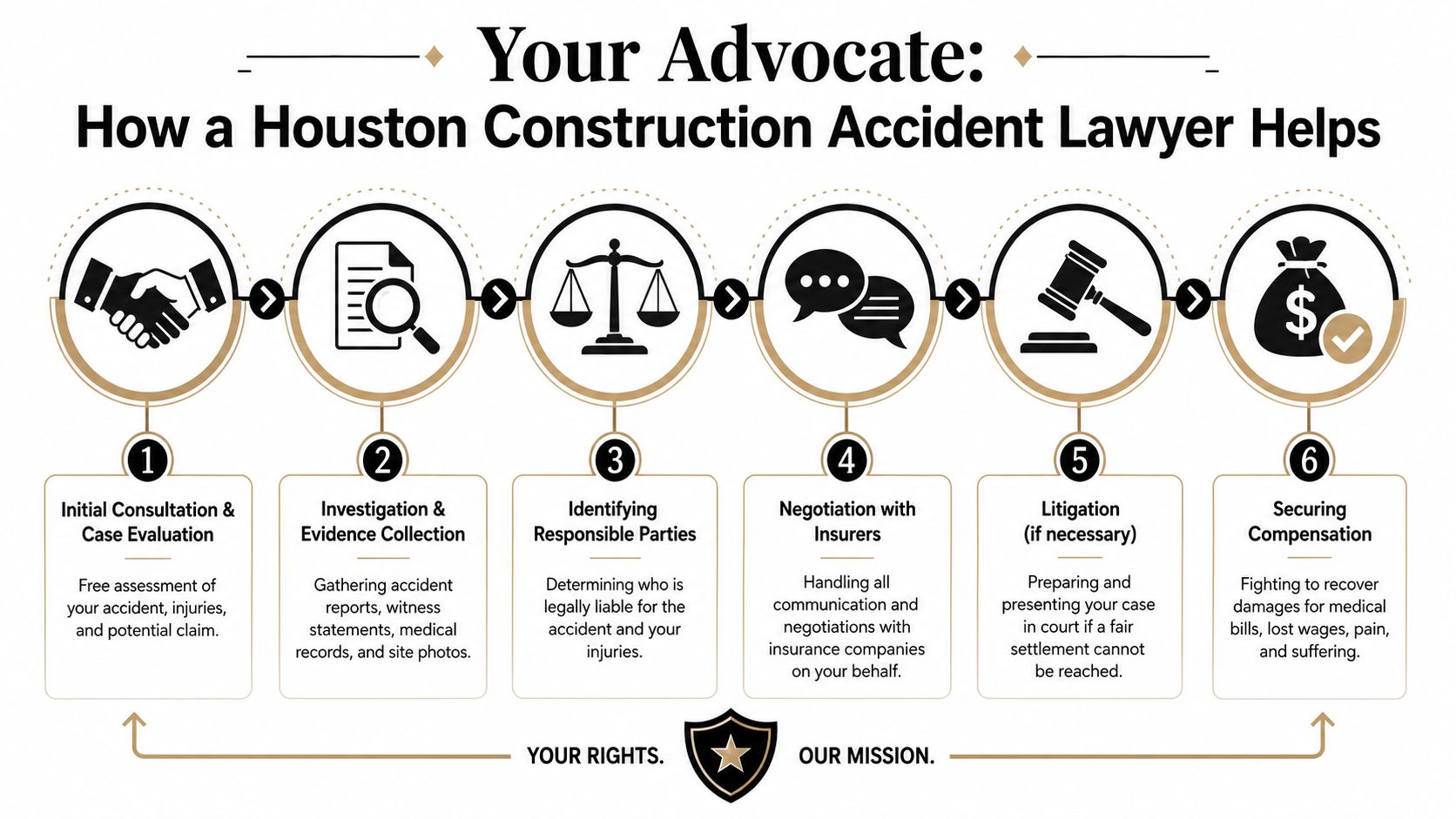
The legal work starts with investigation
After a serious site injury, facts can disappear quickly. Equipment gets moved. Debris gets cleared. Supervisors write reports that may leave out important details. Witnesses return to work or change jobs.
That's why an attorney often starts with:
- Reviewing the accident scene and any photos or videos
- Requesting incident reports and employer records
- Collecting medical records that connect the injury to the event
- Talking to witnesses before memories fade
- Looking at contracts to see who controlled the work area, equipment, and safety rules
A lawyer identifies more than one possible defendant
Construction cases often involve several companies at once. Your employer may be one player, but not the only one. A general contractor, subcontractor, property owner, equipment company, or manufacturer may also matter.
That's one reason workers sometimes benefit from learning how injury representation works in other contexts too, such as Houston Car Accident Lawyer services, which involve representation for car accident victims in Houston and Harris County. Different accident types raise different facts, but the core legal work is similar. Identify fault, gather evidence, calculate damages, and deal with insurers who want to pay less.
Practical rule: The first story you hear after a construction accident is rarely the full story.
Communication and pressure handling
Insurance companies often move fast. They may sound helpful. They may even say they “just need your side.” But their goal is usually to limit what they pay on an auto insurance claim, workplace injury claim, or third-party liability claim.
A lawyer can step in and handle:
- Insurer contact: So you're not answering loaded questions while medicated or under stress.
- Settlement review: So you know whether an offer covers your losses.
- Claim strategy: So workers' comp issues, third-party claims, and possible gross negligence questions don't get mixed up or missed.
The Law Office of Bryan Fagan, PLLC is one Texas personal injury firm that handles accident claims and helps injured people evaluate liability, damages, and insurance disputes. For many clients, the immediate value is simple. You get someone focused on the legal side while you focus on healing.
Identifying Who Is Legally Responsible for Your Injuries
The key legal question in any construction case is liability. In plain English, liability means legal responsibility. If a person or company caused your injury through careless conduct, unsafe conditions, or defective equipment, that party may be liable for your losses.
Negligence is the failure to use reasonable care. On a construction site, that can mean failing to secure materials, ignoring fall protection rules, using damaged equipment, or allowing dangerous electrical conditions to remain in place.
Why construction liability is rarely simple
Construction sites are crowded workplaces. One company pours concrete. Another installs steel. Another runs electrical lines. Another operates a crane. That overlap matters because more than one party may share blame.
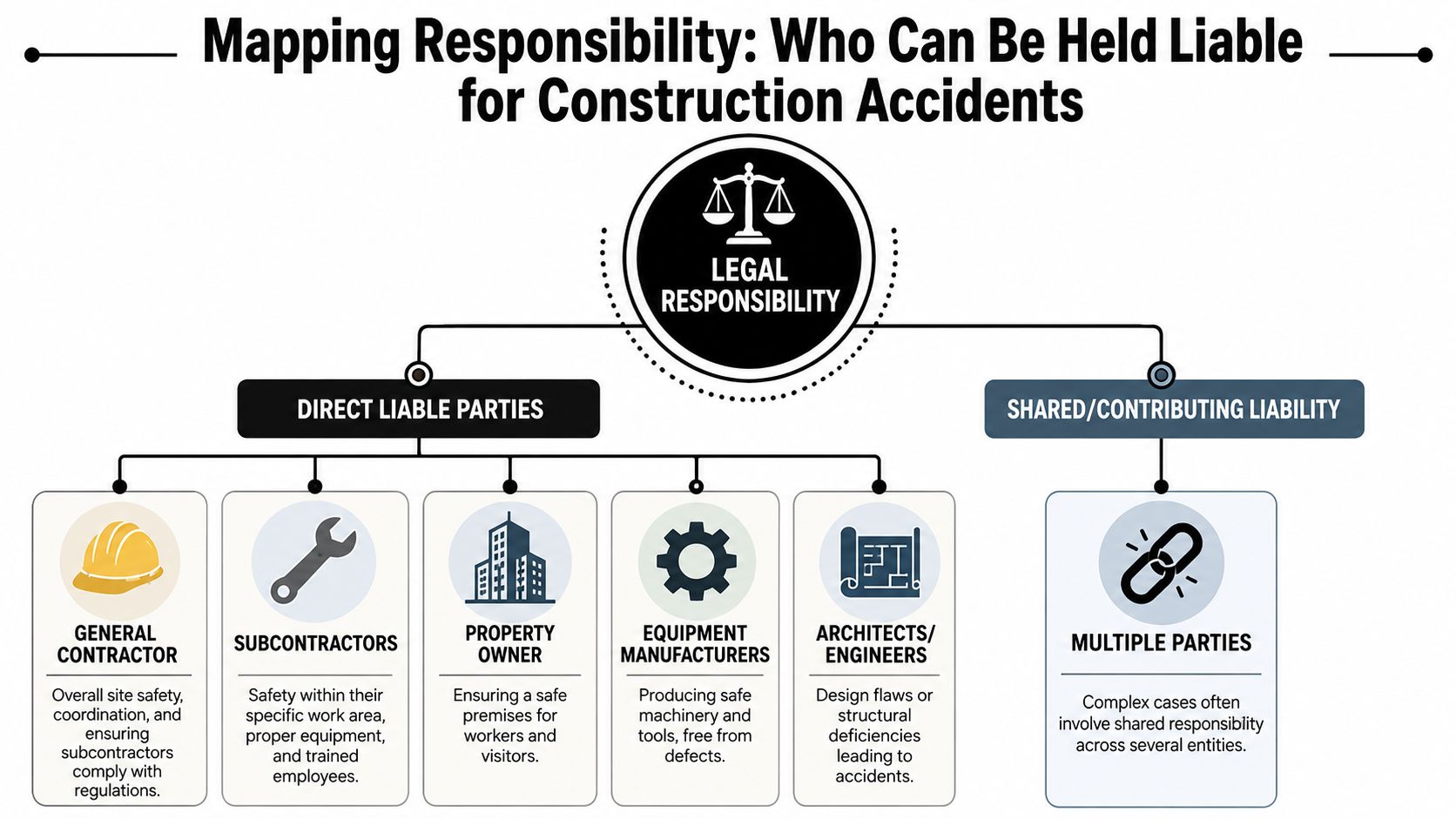
A Houston example makes this easier to see. Suppose a worker near the Galleria is injured when a crane load swings unexpectedly and knocks him from a platform. The general contractor may have failed to coordinate site safety. The crane subcontractor may have used poor rigging practices. The equipment company may have supplied a defective component. An engineer or site planner may have created a dangerous lift path.
For a closer look at crane-related risk, see this article on what commonly causes crane accidents.
The Fatal Four and why they matter
Some hazards show up again and again. The “Fatal Four” of falls, struck-by objects, electrocutions, and caught-in/between incidents were responsible for 59.9% of all construction worker deaths in 2017, as noted in this construction accident overview citing BLS data.
That doesn't just describe safety risk. It also tells lawyers where to look for proof. If your injury involved one of those categories, the case may turn on site supervision, training, safety equipment, inspection records, lockout procedures, or contractor control over the area.
Texas comparative fault in plain language
Texas uses comparative fault under Chapter 33 of the Texas Civil Practice & Remedies Code. That means fault can be divided among multiple people or companies, including the injured person.
Under Texas law, you cannot recover damages if your percentage of responsibility is greater than 50% under Texas Civil Practice and Remedies Code section 33.001. If you are 50% or less responsible, your recovery is reduced by your share of fault.
Here's a simple example:
| Finding | Result |
|---|---|
| You are 20% responsible | Your damages are reduced by 20% |
| You are 51% responsible | You are barred from recovery |
That's why insurers often argue the worker caused the accident. They know comparative fault can reduce or even defeat a claim. A Texas injury attorney builds the case to show who controlled the danger, who ignored safety obligations, and why blame-shifting doesn't match the evidence.
Workers Comp vs Third-Party Claims in Texas
Many workers get bad information. They assume a job-site injury automatically means workers' compensation, and that workers' compensation is the only option. In Texas, that's not always true.
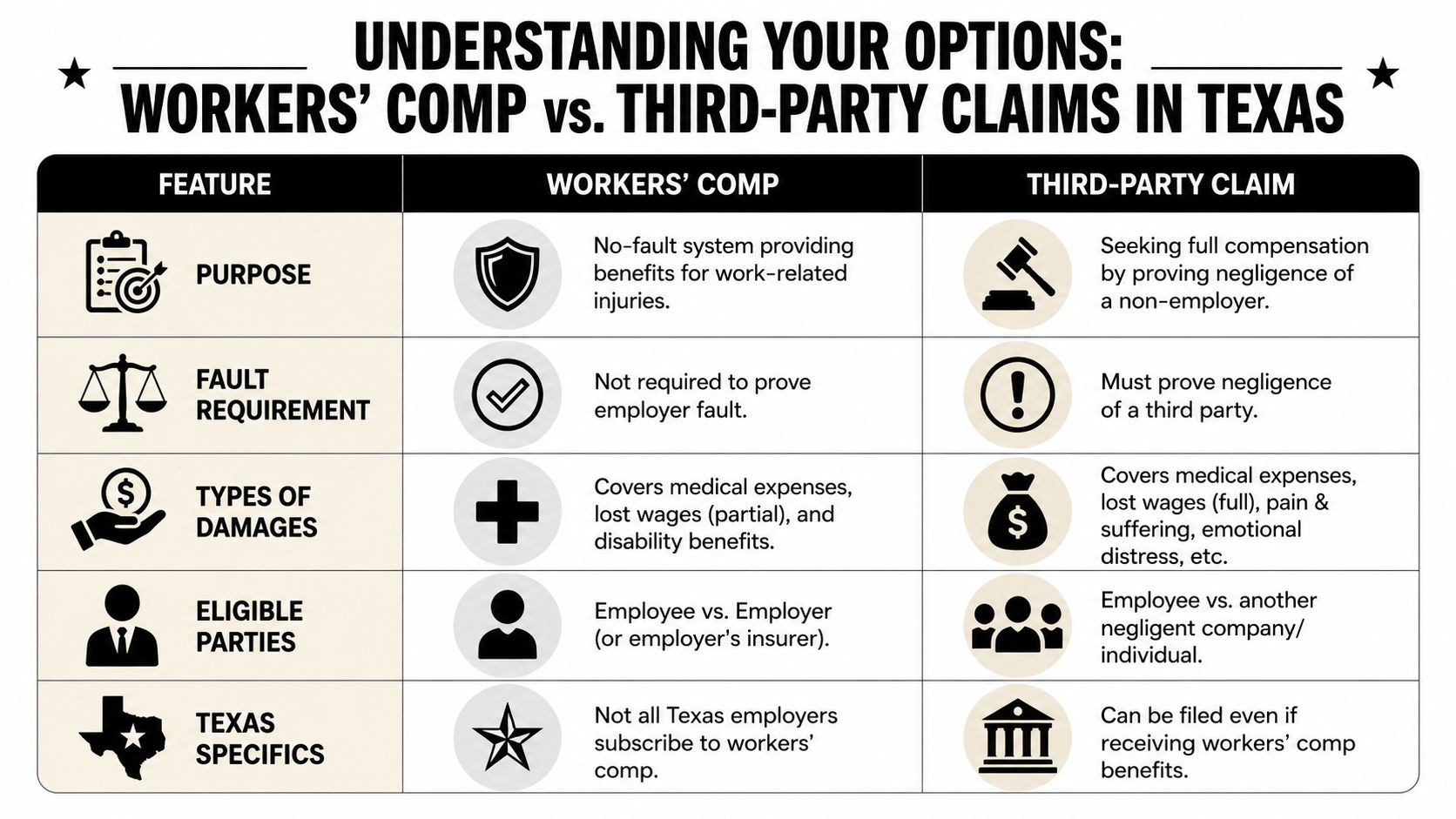
Some employers carry workers' compensation coverage. Some don't. Texas allows certain employers to operate as non-subscribers, meaning they do not subscribe to the workers' compensation system.
What workers' comp usually does
Workers' compensation is generally a no-fault system. That means you usually don't have to prove your employer caused the injury in order to seek benefits. In exchange, the system limits what you can recover.
Workers' comp commonly focuses on medical care and partial wage-related benefits. It usually does not provide damages for pain and suffering.
What a third-party claim does
A third-party claim is a personal injury case against someone other than your employer, such as a negligent subcontractor, general contractor, property owner, or equipment maker. In that kind of claim, you must prove negligence.
But if you prove it, the damages can be broader. That may include full lost earnings and non-economic harm such as pain, mental anguish, and other losses recognized by law.
Later in the process, many injured workers also find it helpful to read more about being hurt at work in Texas, especially when multiple claims may overlap.
A short video can also help explain the difference in a more visual way:
Why non-subscriber status matters so much
Data shows that 32% of Texas construction employers do not carry workers' compensation insurance, which creates an important path for injured workers to pursue direct negligence claims against non-subscriber employers as noted here.
That matters because if your employer is a non-subscriber, you may be able to sue the employer directly for full damages, including losses workers' comp does not cover.
If your employer is a non-subscriber, your case may be much different from what coworkers or supervisors tell you.
Simple comparison
- Workers' comp claim: Usually no need to prove fault, but benefits are limited.
- Third-party claim: You must prove negligence, but damages may be broader.
- Non-subscriber employer claim: If the employer opted out of workers' comp, you may be able to sue the employer directly.
This distinction can affect not just your medical bills, but your future. It can also matter in fatal cases where surviving family members may ask about wrongful death compensation after a loved one dies from a construction injury.
Full Compensation You Can Recover After an Accident
Once liability is clear, the next question is damages. Damages means the losses the law allows you to recover. Some are financial and easy to document. Others involve the human cost of the injury, which is real even if it doesn't arrive in a bill.
Texas law generally separates damages into economic and non-economic categories. In some cases involving extreme misconduct, Chapter 41 of the Texas Civil Practice & Remedies Code may also allow exemplary damages, sometimes called punitive damages, when gross negligence can be proven.
Economic damages
Economic damages are the measurable losses tied to the injury.
These often include:
- Medical expenses: Emergency care, surgery, follow-up visits, medication, therapy, and rehabilitation.
- Lost income: Wages you missed while unable to work.
- Reduced earning ability: If the injury limits the kind of work you can do in the future.
- Out-of-pocket costs: Travel for treatment, medical equipment, and related expenses.
A practical example helps. If a worker suffers a serious leg injury in a scaffold fall, the damages may include the ambulance ride, hospital stay, orthopedic treatment, physical therapy, and months of missed paychecks. If he can't return to the same physical job, future earning capacity may also be part of the case.
Non-economic damages
Non-economic damages cover losses that don't come with a simple receipt.
They may include:
- Pain and suffering
- Mental anguish
- Physical impairment
- Disfigurement
- Loss of enjoyment of daily life
Some of the most serious harm in a construction case never appears on a bill. Chronic pain, anxiety, sleep loss, and permanent limitations affect families every day.
If you want a plain-language overview of the process, this guide on how damages are calculated in injury cases can help you understand what lawyers and insurers examine.
Chapter 41 and gross negligence
Texas Civil Practice & Remedies Code Chapter 41 becomes important when the conduct goes beyond ordinary carelessness. Gross negligence involves an extreme degree of risk and a conscious disregard for the safety of others.
An example could be a company knowingly sending workers into a dangerous area with obviously defective equipment or ignoring a severe hazard after repeated warnings. Not every case qualifies. But when the facts support it, Chapter 41 can become a major part of the claim.
For families after a fatal incident, damages may also connect with a wrongful death case. That process is separate from a typical car collision claim handled by a Houston car accident lawyer, but the core idea is similar. Texas law can provide a path to recover losses caused by another party's negligence.
Critical Deadlines and Evidence to Protect Your Claim
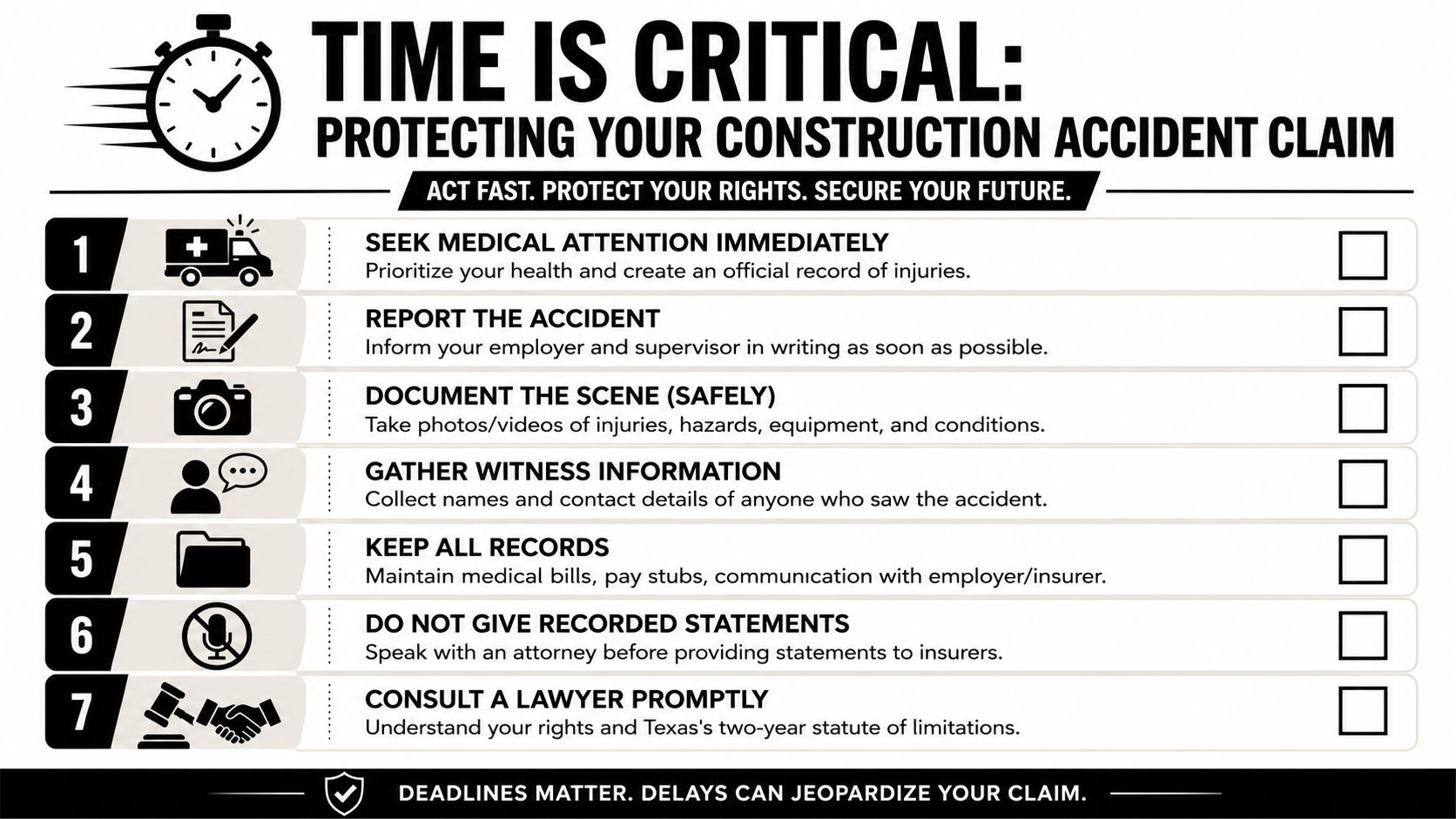
Time matters in every injury case. In Texas, the statute of limitations for filing a personal injury lawsuit arising from a construction accident is generally two years from the date of the incident under Civil Practice and Remedies Code § 16.003, and missing that deadline can permanently bar a third-party liability claim in court as explained here.
A statute of limitations is the legal deadline to file suit. If you miss it, the court can dismiss your case even if the facts are strong. That's why waiting can be dangerous, especially when records, witnesses, and physical evidence may not last.
What to do right away
If you're physically able, protect your claim step by step:
- Get medical care first. Your health comes before paperwork, and treatment creates a record of the injury.
- Report the accident in writing. Tell your employer or supervisor what happened, where it happened, and when.
- Photograph what you can safely capture. Include the hazard, your injuries, tools, equipment, and the surrounding area.
- Collect witness names and contact information. Coworkers may remember things differently weeks later.
- Keep every record. Save bills, discharge papers, prescriptions, work restrictions, pay information, and messages from insurers or supervisors.
What not to do
Some mistakes can weaken a case even when the injury is serious.
- Don't give a recorded statement too early: You may not yet know the full medical picture.
- Don't assume the company report is complete: Internal reports often leave out key details.
- Don't ignore follow-up care: Gaps in treatment can give insurers room to argue that you weren't badly hurt.
- Don't wait for the “right time” to talk to a lawyer: Delay helps the other side.
The strongest claims are often built from ordinary things people save in the first few days. A photo, a text message, a witness name, or a discharge instruction can matter later.
A short example from real life
A worker falls from unsecured framing on a residential build. He tells the supervisor verbally, goes home, and hopes the pain will ease. Days later, his back worsens. The site has already changed, and no one agrees on what caused the fall.
Now compare that with a worker who gets treatment immediately, reports the incident in writing, takes photos of the missing protection, and keeps his paperwork. The second worker hasn't guaranteed a win. But he has protected the evidence needed to prove the case.
How The Law Office of Bryan Fagan Fights for You
After a serious construction accident, victims often need two things at the same time. They need space to heal, and they need someone to deal with the legal pressure. That includes the employer, the insurance company, outside contractors, and anyone else trying to narrow the story before the facts are fully known.
That's where steady legal representation matters. Your lawyer should be asking hard questions about site control, contracts, safety obligations, medical evidence, and damages. Your job is to focus on treatment, follow medical advice, and protect your health.
What representation should feel like
Good representation should feel clear, not confusing. You should know what claim is being investigated, what evidence matters, and what decisions are yours to make.
It should also be honest. Not every case settles quickly. Not every injury follows a straight medical path. But strong legal work can still reduce uncertainty by preserving proof, identifying the right defendants, and putting pressure on the right insurer.
Why Texas-specific knowledge matters
Texas construction cases can turn on issues that don't exist in many other states. Non-subscriber law is one example. Comparative fault under Chapter 33 is another. Chapter 41 can matter when the conduct rises to gross negligence.
A lawyer handling your case should be ready to explain all of that in plain language. You shouldn't have to guess whether you're dealing with workers' comp, a third-party negligence lawsuit, a direct non-subscriber claim, or some combination of claims.
Your next step can be simple
You don't need every answer before making the call. You don't need perfect records. And you don't need to wait until the insurance company “finishes reviewing” the matter.
Bring what you have. That may include:
- Accident details: Date, location, and what you remember
- Medical paperwork: ER records, discharge instructions, work restrictions
- Employer information: Company name, supervisor name, and any written report
- Insurance contacts: Letters, emails, or voicemail messages
- Photos and witness names: Even a few can help
A serious site injury can affect your income, your family, and your future for a long time. Getting legal guidance early can help you understand whether you may pursue compensation for medical costs, lost earnings, pain and suffering, and in the worst cases, wrongful death compensation for surviving loved ones.
If you were hurt on a job site and need answers about your rights, contact The Law Office of Bryan Fagan, PLLC for a free consultation. We help injured Texans understand negligence, liability, insurance issues, and the difference between workers' comp and direct injury claims. If your employer is a non-subscriber or a third party may be responsible, you may have more options than you've been told. We handle cases on a contingency-fee basis, which means you don't pay us unless we win your case.