Skip to content
A car crash can change your life in seconds, but you don't have to face recovery alone.
If you're reading this, there's a good chance your family is living through a confusing stretch right now. Maybe the crash happened on I-45, Beltway 8, or a neighborhood road in Houston. Maybe your loved one walked away from the wreck, seemed shaken but “mostly okay,” and then days or weeks later started having headaches, memory lapses, irritability, trouble sleeping, or changes in focus that don't feel normal.
That's one of the hardest parts of a brain injury. It often doesn't look dramatic from the outside. There may be no cast, no stitches, no obvious sign that something is wrong. But inside the home, everyone feels it. Work gets harder. Conversations change. Routines fall apart. Insurance calls keep coming while your family is still trying to understand what happened.
A Houston brain injury lawyer helps families deal with that gap between what the injury looks like and what the injury does. This area of law isn't just about filing papers. It's about proving the truth of an injury that insurance companies often try to minimize, protecting your rights under Texas law, and making sure the claim reflects the full cost of recovery.
The Unseen Aftermath of a Houston Accident
On Monday, your loved one says they are sore but fine after a Houston crash. By Thursday, they cannot finish a simple conversation, forget why they walked into a room, and snap at the people they love. That kind of change is frightening, especially when the emergency room visit did not give your family a clear answer.
A brain injury often works like a wiring problem inside a house. The lights may still turn on, but certain rooms flicker, switches stop responding, and small tasks suddenly take far more effort. After a wreck, those problems can show up as headaches, slowed thinking, poor sleep, mood changes, sensitivity to noise, or trouble keeping up at work and at home.
Families often doubt themselves at this stage. They ask whether the symptoms are stress, pain medication, lack of sleep, or something more serious. That confusion is common because traumatic brain injuries do not always announce themselves right away, and standard scans do not always capture the full picture.
The timing matters for another reason. Some people wrongly assume the legal clock started running before anyone knew a brain injury was involved. Texas law can be more nuanced than that. In some cases, the discovery rule becomes important when cognitive or neurological symptoms appear later and a person could not reasonably have understood the seriousness or cause of the injury at the start. In plain terms, a delayed diagnosis does not automatically mean you have no case.
That does not mean you should wait. It means you should ask questions early.
Mental and emotional symptoms can also overlap with trauma after a violent crash. If your family is trying to sort through those changes, this plain-language resource on how anxiety and depression affect the brain may help you understand part of what you are seeing while medical providers continue evaluating possible brain injury symptoms.
What should a family do during this uncertain period?
Write down what changed and when. Keep a simple timeline of headaches, missed appointments, confusion, sleep disruption, personality changes, and work problems. Save discharge papers, follow-up instructions, prescriptions, and messages to employers or schools. If a spouse, parent, or adult child notices changes, that observation can matter because relatives often see the pattern before the injured person does.
Early documentation helps in two ways. It improves medical care because doctors get a clearer history. It also protects the legal claim if an insurance company later argues that the symptoms appeared too late, were too minor, or came from something else.
A brain injury case often begins in this gray area. Your family knows something is wrong, but you do not yet have the full medical explanation. That is exactly why careful attention in the first days and weeks can make such a difference.
What a Houston Brain Injury Lawyer Actually Does
People often think every injury case works the same way. A broken wrist claim and a brain injury claim do not. A Houston brain injury lawyer has to build a case that explains both fault for the wreck and the hidden effects of the injury.
First, the lawyer investigates liability
Liability means legal responsibility. In a car crash case, that usually means identifying who caused the collision and why. The lawyer gathers the police report, photos, video if available, witness accounts, vehicle damage evidence, and medical records that tie the mechanism of the crash to the injury.
A simple example helps. If a Houston driver was stopped in traffic and another driver hit them from behind, liability may appear straightforward. But even then, insurers may still argue about the force of impact, prior medical history, or whether the symptoms really came from the crash.
Second, the lawyer builds the medical story
In a TBI case, the lawyer doesn't just collect records. The lawyer helps organize the timeline so neurologists, neuropsychologists, and other treating professionals can explain what changed after the wreck.
That matters because families often describe the injury in everyday terms:
- Memory problems: forgetting names, appointments, or conversations
- Behavior changes: irritability, panic, withdrawal, or mood swings
- Work difficulties: trouble multitasking, following instructions, or staying focused
- Home life disruption: missed bills, confusion, fatigue, and loss of independence
Those details can make the case real in a way billing records alone cannot.
Third, the lawyer measures long-term losses
A strong claim looks past today's bills. It asks harder questions. Can your loved one return to the same job? Will they need future therapy? Are they less able to manage daily tasks, parenting, or independent living?
In severe cases, lawyers may work with planners and specialists to estimate future care needs. If you want a local overview of how personal injury cases proceed, Filing an Injury Claim in Harris County Courts gives a factual explanation of how these cases move through the Harris County civil courts.
Fourth, the lawyer deals with the insurance company
Insurance adjusters handle brain injury claims with caution because these cases can involve substantial future losses. They may focus on gaps in treatment, “normal” early imaging, or social media posts that seem inconsistent with the injury.
Practical rule: Don't assume the insurance company understands what your family is going through just because you've reported the crash.
A lawyer's job includes preparing the claim, responding to pushback, valuing damages, and deciding whether negotiation is productive or whether a lawsuit needs to be filed. That work becomes even more important when an auto insurance claim turns into a dispute over symptoms that don't show up neatly on paper.
How Traumatic Brain Injury Claims Work in Texas
Texas brain injury claims follow the same legal foundation as other personal injury cases, but the facts are often more technical. The law asks two main questions. Who caused the crash, and what harm did it cause?
Key terms in plain English
Negligence means someone failed to act with reasonable care. A driver who texts, speeds, runs a light, or follows too closely may be negligent.
Damages means the losses the law allows you to claim. That can include medical care, lost income, and non-economic harm such as pain, suffering, and reduced quality of life.
Statute of limitations means the legal deadline to file a lawsuit. Missing that deadline can end your right to seek compensation.
Texas also uses comparative fault, which means more than one person can share blame.
How Chapter 33 affects your case
Under Chapter 33 of the Texas Civil Practice and Remedies Code, Texas follows a modified comparative fault rule. A claimant cannot recover damages if their responsibility is greater than 50 percent, and if they are 50 percent or less at fault, their recovery is reduced by their percentage of responsibility, as explained in this Texas comparative fault overview.
Here's a simple example. Suppose a Houston driver is struck during a chain-reaction crash on I-45. The defense argues that the injured driver was speeding and shares fault. If a jury decides the injured driver was partly responsible, any award is reduced by that percentage. If the injured driver is found more responsible than the legal threshold allows, recovery is barred.
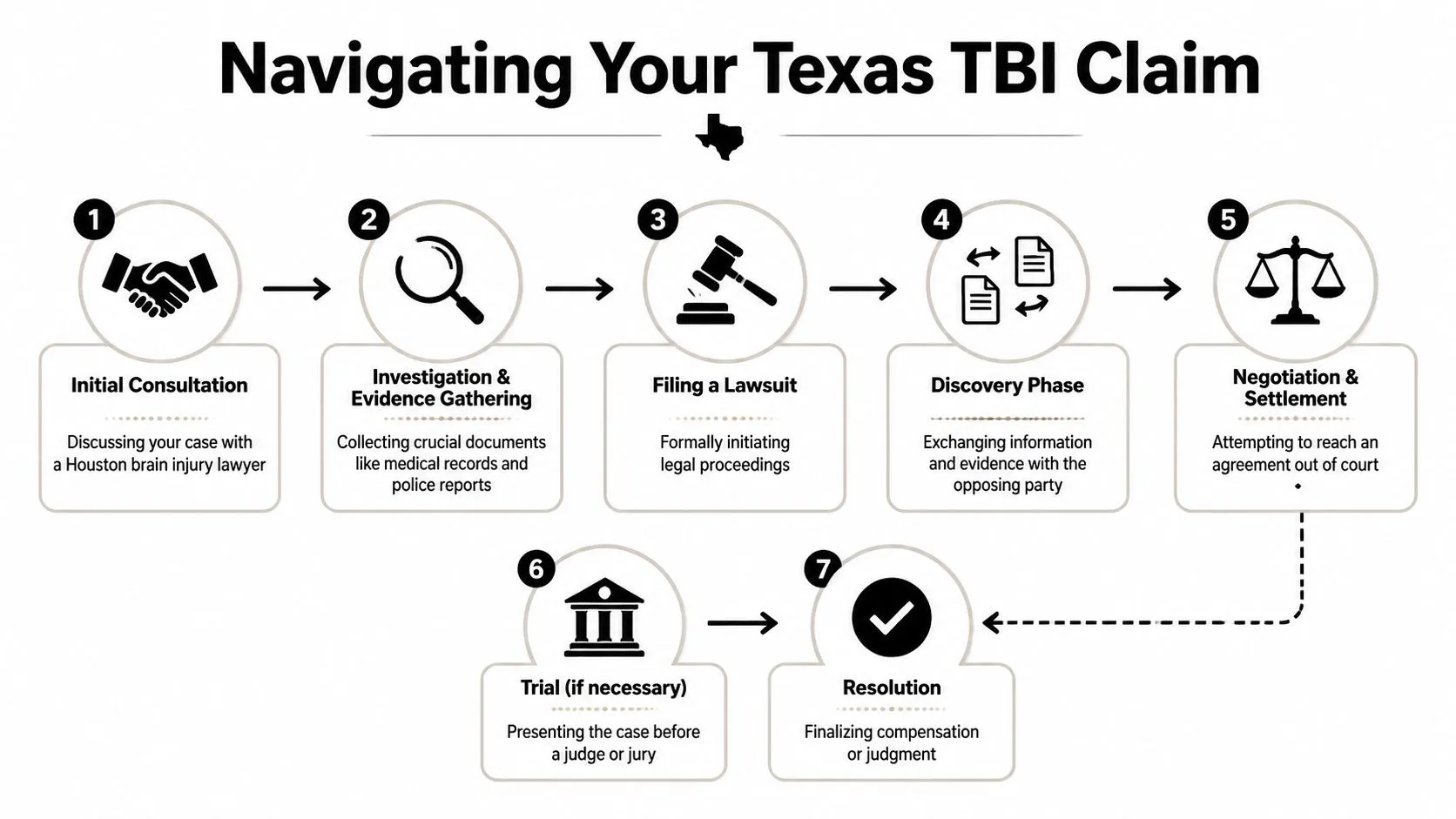
The path from crash to resolution
Most TBI claims move through a sequence that feels slow from the family's perspective:
Consultation and intake
You meet with a lawyer, review the wreck, discuss symptoms, and identify possible claims.Investigation
The legal team gathers records, scene evidence, witness information, and insurance details.Medical development
Treatment continues. The case becomes clearer as doctors document symptoms and functional loss.Demand and negotiation
The insurer reviews the evidence and may dispute fault, causation, or the value of damages.Lawsuit and discovery
If needed, the case enters formal litigation. Each side exchanges information and takes testimony.Settlement or trial
Many cases resolve through negotiation. Some require a judge or jury to decide.
Where confusion usually starts
Families often expect the legal process to move only as fast as the paperwork. In reality, the case often depends on the medical picture becoming clear. A brain injury claim may take time because the symptoms, limitations, and future needs need to be documented carefully.
That's why it helps to think of a Houston brain injury lawyer as both an investigator and a translator. The lawyer turns medical evidence, work disruption, and daily struggles into a legal claim that fits Texas negligence law under Chapters 33 and 41.
Crucial Evidence and Medical Documentation for Your Case
A family often learns the hardest part of a brain injury case weeks after the wreck, not at the scene. The CT scan may look normal. The injured person may even go home the same day. Then the missed appointments start, the headaches keep coming, and a once-patient parent becomes irritable or confused. That gap between the accident and the full picture of the injury is exactly why documentation matters so much in a Houston brain injury claim.
Insurance companies usually do not spend much time arguing that a collision happened. They focus on causation and timing. They ask whether the crash really caused the thinking problems, mood changes, or memory loss, and whether those symptoms appeared soon enough to be connected to the event. With traumatic brain injuries, that question can be more complicated than families expect because some symptoms show themselves slowly.
Why ordinary medical records may leave gaps
Emergency room records are an important starting point, but they are only the first snapshot. They often capture the immediate crisis, not the changes that unfold over days or months. A mild or moderate TBI can work like a hairline crack in a foundation. At first, everything looks mostly intact. As daily stress builds, the weakness becomes harder to ignore.
That is one reason families should not assume a normal scan ends the story. Follow-up care with neurologists, therapists, and neuropsychologists may show deficits that were easy to miss on day one. Consistent treatment also creates a timeline, and timeline matters in these cases.
If symptoms appeared later, that timeline may also matter for a different reason. Texas law can involve the discovery rule in some injury cases, which means the clock may depend on when the injury was discovered or reasonably should have been discovered, rather than only the date of the crash. Families dealing with delayed cognitive symptoms should treat that issue carefully and get legal advice early, because a delayed diagnosis does not always mean the claim is lost.
What to gather now
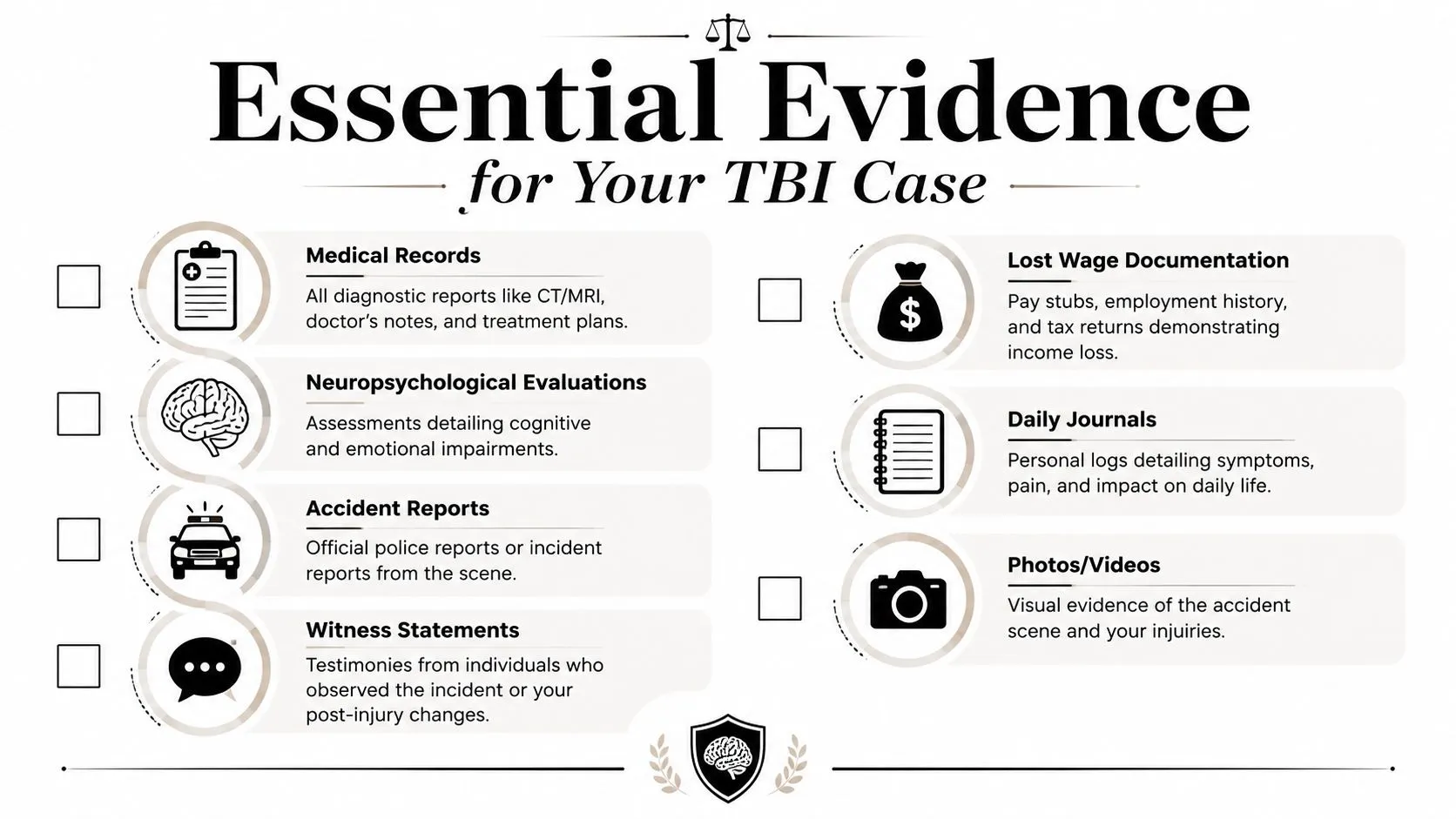
The strongest file usually combines medical proof with day-to-day evidence of change. Start collecting:
- Crash evidence: police report, scene photos, vehicle damage photos, witness names, and available video
- Medical records: ER records, ambulance records, imaging reports, neurologist visits, prescriptions, therapy notes, and follow-up appointments
- Cognitive testing: neuropsychological evaluations measuring memory, attention, processing speed, and executive functioning
- Work and school records: missed time, reduced duties, disciplinary issues, accommodations, or falling performance
- Home-life proof: calendars, symptom journals, text messages, and notes from family members who observe changes firsthand
- Financial records: medical bills, receipts, insurance letters, wage records, and out-of-pocket expenses
Families who are still trying to line up care after a collision often find this guide on medical treatment after a motor vehicle accident useful for organizing the treatment side of the case.
Evidence families often miss
Some of the most persuasive evidence comes from ordinary life. A spouse may notice that medications are skipped, bills go unpaid, or simple conversations have to be repeated. A supervisor may see that a dependable employee now loses track of instructions or cannot manage multi-step tasks. Those observations help connect medical terminology to real-world loss.
Keep a simple journal.
Write down headaches, dizziness, sleep problems, irritability, missed tasks, and moments of confusion. Include dates when possible. If the injured person was improving and then plateaued, note that too. Small entries made close to the event often carry more weight than a broad summary written months later.
For severe, life-changing injuries, some families also review Houston Catastrophic Injury Lawyer for broader information about claims involving long-term impairment.
Why careful documentation changes the case
A brain injury case often turns on whether you can show change over time. Before the wreck, your loved one handled work, errands, parenting, and conversations a certain way. After the wreck, those same tasks may take longer, require reminders, or not happen at all. Medical records explain part of that story. Family observations, work records, and consistent follow-up care fill in the rest.
That full record also protects families from a common mistake. If delayed symptoms lead someone to believe they waited too long, they may give up before learning whether the discovery rule could apply. Good documentation helps a lawyer examine when the injury became reasonably knowable, how it progressed, and how to present that timeline clearly to the insurer or the court.
Calculating Damages and Compensation for a TBI
A family often reaches this stage with a simple question that feels impossible to answer: what is this brain injury claim worth?
The hard part is that a TBI rarely fits into a single bill or one doctor visit. A broken arm usually has a clearer path. A brain injury can change how a person works, sleeps, remembers, drives, parents, and relates to the people around them. Some of those losses show up right away. Others become clear only after weeks or months, which is one reason delayed symptoms matter so much in these cases.
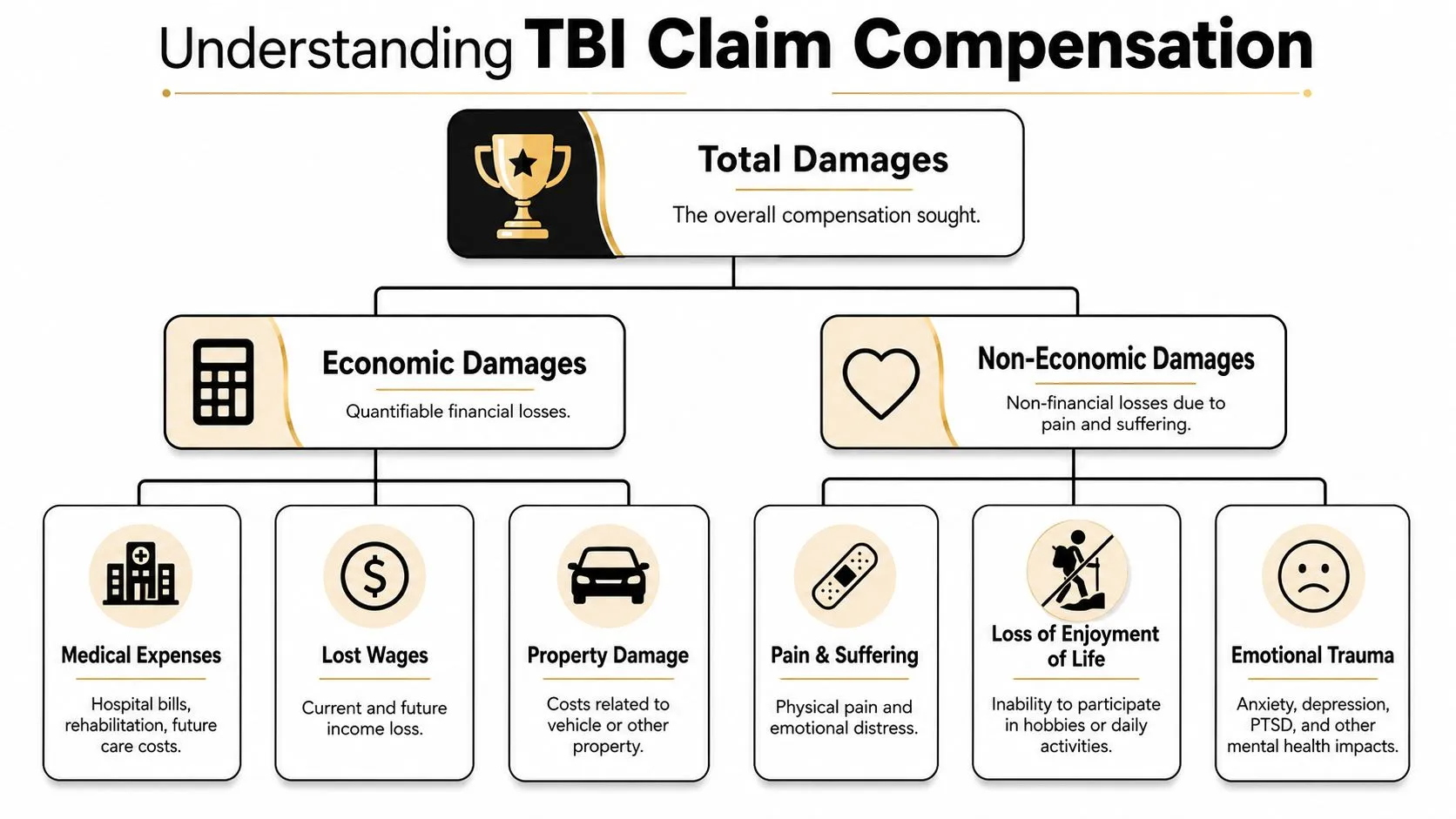
Two categories of damages
Texas injury claims usually divide damages into two broad groups.
Economic damages are the losses you can measure in dollars with records. These often include hospital charges, neurologist visits, therapy, medication, lost income, reduced future earning ability, and out-of-pocket costs tied to the injury.
Non-economic damages cover the human cost. That can include pain, mental anguish, loss of enjoyment of life, changes in personality, strain on a marriage, and the loss of independence that follows cognitive problems.
In a brain injury case, that split matters because insurers often focus on the visible bills and downplay the day-to-day losses. Families know the difference. They see the missed appointments, the repeated questions, the short temper, and the tasks that used to be automatic but now require supervision.
How lawyers place a value on a TBI claim
Valuing a TBI claim works more like building a long ledger than picking a number out of the air. A lawyer looks at what the injury has already cost, what treatment will likely be needed later, and how the symptoms affect work and ordinary life over time.
That timeline matters.
If your loved one seemed "mostly okay" after the accident but later developed memory problems, headaches, fatigue, or trouble concentrating, the value of the case may look very different than it did in the first few weeks. Those delayed symptoms do not just affect medical care. They can also affect how damages are proven, especially when the injury becomes reasonably clear only after time has passed.
A practical way to organize the losses
Start with four buckets and fill them with proof as the case develops:
| Type of loss | What families should document |
|---|---|
| Medical care | Emergency treatment, specialists, imaging, therapy, prescriptions, future treatment recommendations |
| Income loss | Missed work, reduced hours, demotion, job loss, reduced earning capacity |
| Daily function | Driving limits, missed childcare duties, household help, reminders needed for routine tasks |
| Personal impact | Headaches, frustration, depression, sleep disruption, relationship changes, loss of hobbies |
This structure helps families avoid a common mistake. They count the early bills, but they miss the ongoing cost of a person who cannot manage life the way they could before.
Why severe and delayed-symptom cases are often undervalued at first
Early settlement talks can be misleading in TBI claims. An insurer may treat the case like a short-term concussion claim before anyone understands the full picture. Then the months pass, and the injured person still cannot focus at work, still forgets instructions, or still cannot tolerate noise and stress the way they once did.
That is why patience matters. So does medical follow-up.
The discovery rule often enters the conversation later, in the limitations analysis, but it also matters here in a practical sense. If symptoms were delayed, families may not understand the seriousness of the injury at first, which means the claim can be undervalued early if no one connects those later cognitive problems back to the accident.
No chart can tell you the exact value
Two people can have the same diagnosis on paper and very different damage claims. One may return to work quickly with few lasting effects. Another may keep the same job title but need reminders, work slower, make costly mistakes, or come home exhausted and unable to function the rest of the day. The second person may have larger damages even if the medical records look similar at a glance.
That is why a lawyer does more than total up invoices. The job is to show how the injury changed the person's earning power and daily life in a way a jury or insurer can understand.
If you want a plain-language framework for valuing a claim, this guide on how to calculate damages in a Texas injury case gives a helpful starting point.
Texas Timelines and the Statute of Limitations
A Houston family leaves the emergency room after a crash relieved to hear, “The CT scan looks normal.” Weeks later, their loved one cannot remember appointments, loses words mid-sentence, and becomes overwhelmed by noise or routine decisions. By then, a dangerous question often appears: did we wait too long?
That question matters because Texas deadlines can block a case before a jury ever hears what happened. In many personal injury claims, the lawsuit deadline is two years. But brain injury cases can be harder to pin down because the injury may not be obvious on day one.
To visualize the deadline, start here.
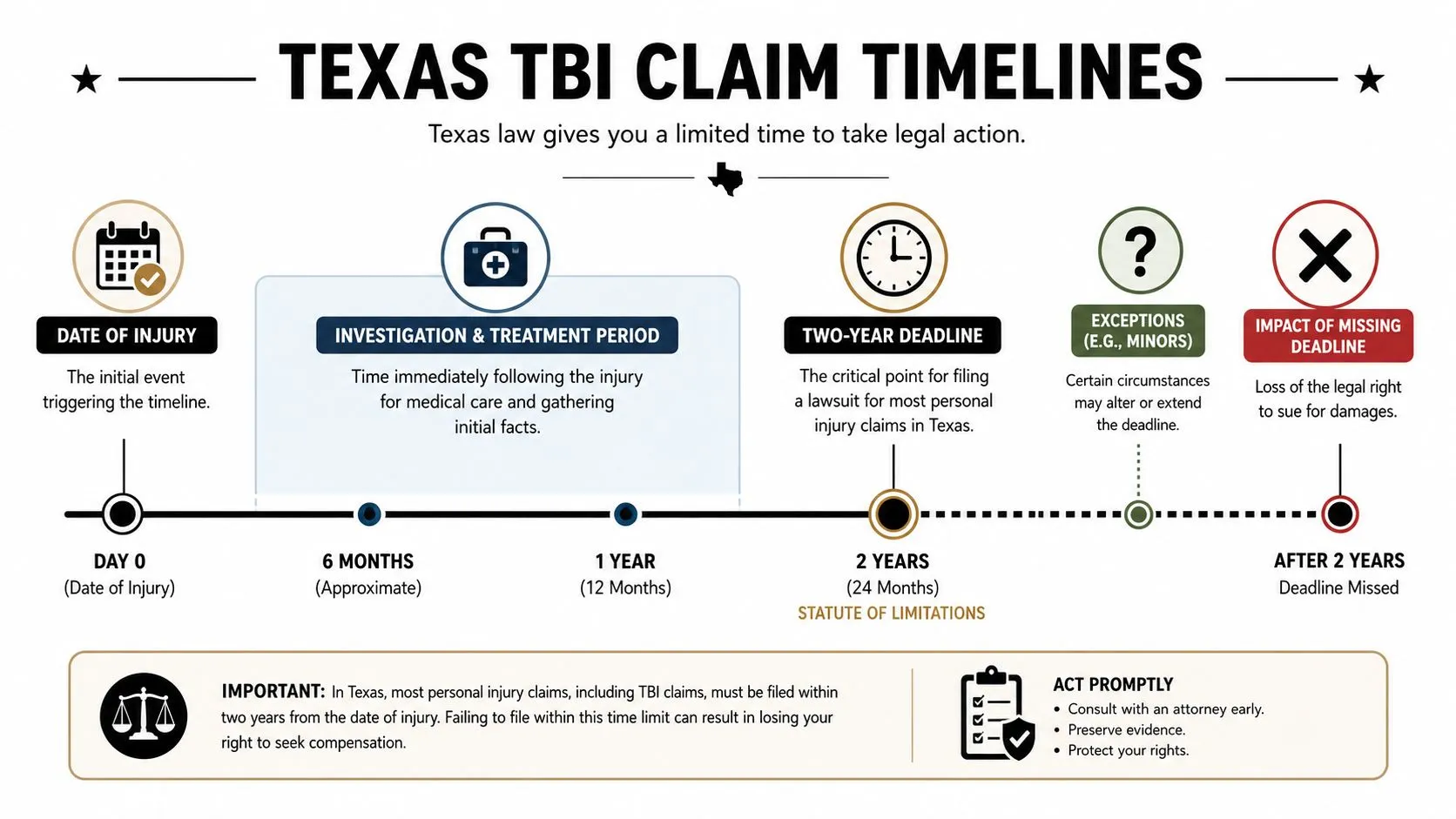
Under Texas Civil Practice and Remedies Code § 16.003, the usual deadline for filing a personal injury lawsuit is two years from the date of injury. The part families often miss is the discovery rule. In plain English, that rule can matter when a person did not know, and reasonably could not have known, that a serious injury existed until later. A delayed diagnosis or delayed cognitive symptoms may raise that issue, as discussed in this discussion of delayed TBI symptoms and the discovery rule.
The discovery rule is not a reset button.
It works more like a narrow exception that may apply in the right facts. Some cases still run from the crash date. Some cases allow an argument that the clock should be measured differently because the injury was not reasonably discoverable earlier. Families should not assume either answer without getting legal advice and reviewing the medical timeline carefully.
A delayed diagnosis does not automatically mean you missed your case. It also does not automatically extend your deadline.
This short video gives a useful overview of why timing matters in injury cases.
Other timeline issues families should know
A few other rules can change the calendar in important ways:
- Claims involving minors: for an injured child, the filing period is often treated differently, and the clock may not begin running in the same way it would for an adult.
- Wrongful death claims: the deadline usually runs from the date of death rather than the date of the accident.
- Government cases: if a city, county, or other government unit may be involved, a formal notice claim can be due much sooner than a standard lawsuit deadline. This can happen in cases involving city vehicles, dangerous public property, or other government-related facts.
The first practical step is to get the timeline on paper. Mark the crash date, every ER or urgent care visit, the first time memory or concentration problems showed up, each referral, and the date a doctor first connected those symptoms to a brain injury. That timeline often becomes the roadmap for analyzing whether the ordinary two-year rule applies or whether the discovery rule needs to be argued.
If you want a plain-language overview of filing deadlines, this guide to statutes of limitations in Texas explains the basics.
The safest move
Do not wait for symptoms to become unmistakable before talking with a lawyer. Waiting can cost more than time. Witness memories fade, crash evidence disappears, and medical records become harder to connect back to the accident. In a brain injury case, early legal review helps a family protect the standard deadline while also preserving any discovery-rule argument if the full scope of the injury came into focus later.
Choosing Your Advocate and The Bryan Fagan Difference
A common Houston brain injury story goes like this. The crash happens, the ER rules out a skull fracture, and everyone hopes the worst has passed. Then, weeks later, the person you love cannot focus, forgets simple tasks, gets irritable, or cannot handle work the way they could before. Families often wonder whether they waited too long to get legal help because the actual problem did not show up right away.
That question matters when you choose a lawyer.
A brain injury case can turn on delayed symptoms and timing. You want an attorney who understands more than crash reports and insurance paperwork. You want someone who can trace the line from the wreck to the later cognitive changes, build the medical proof carefully, and address the discovery rule when symptoms were not reasonably clear at the start.
What to ask before you hire anyone
Ask how the lawyer handles cases where the brain injury became obvious later. Ask what records they use to show the first signs of memory loss, mood change, headaches, or concentration problems. Ask how they work with neurologists, neuropsychologists, therapists, employers, and family witnesses who saw the changes day by day.
Those questions are practical. In a delayed-symptom case, the lawyer often needs to build a timeline like a puzzle. One piece may come from an early ER visit. Another may come from a spouse who noticed personality changes. Another may come from a doctor who later connected those symptoms back to the accident. If a lawyer talks only about settling fast, that is a warning sign. TBI claims often require patience, detailed proof, and a clear plan for answering the insurance company when it argues the symptoms came from stress, age, or something unrelated.
Why this issue is easy to miss
Families usually know to ask whether a lawyer has handled serious injuries. Fewer know to ask whether that lawyer understands delayed discovery.
That point can make a real difference in a brain injury case. Texas deadlines are serious, but the analysis is not always as simple as counting two years from the crash date and stopping there. When symptoms surface later or are only later tied to a traumatic brain injury, the discovery rule may become part of the case strategy. A lawyer who understands that issue can evaluate the ordinary deadline while also preserving the argument that the injury was not reasonably apparent earlier.
The Law Office of Bryan Fagan, PLLC handles Texas personal injury and car accident matters, including claims involving serious crash injuries, disputed symptoms, and long-term rehabilitation issues. For a family dealing with a possible TBI, one useful question is whether the legal team can explain, in plain English, how they would document delayed symptoms and protect any discovery-rule argument from the beginning.
The relationship matters in a brain injury case
You are choosing more than someone to file papers in court. You are choosing the person who will help present your family member's before-and-after story with care and precision while your household is already under strain.
Clear communication matters here because brain injury claims can feel confusing even to careful families. A good Texas injury attorney should be able to explain fault, insurance issues, deadlines, and damages without hiding behind legal jargon. You should know what the next step is, what records still need to be gathered, and what problem the lawyer is trying to solve at each stage.
Families should also feel heard when the injury is hard to see. Broken bones show up on an X-ray. Cognitive injuries often show up in missed appointments, personality changes, slower thinking, forgotten conversations, and work problems. A lawyer who takes those changes seriously is better positioned to present the claim accurately and persuasively.
If the crash led to a fatal injury, that same careful approach matters in a wrongful death case. The legal process cannot fix the loss, but it can help protect the family's financial stability and hold the responsible party accountable.