A car crash can change your life in seconds, but you don't have to face recovery alone.
If you were arrested for DWI in Texas a few hours ago, recovery may not be the word you'd use right now. You may be sitting in a holding cell, waiting for a family member to call back, or staring at paperwork on your kitchen table after release and wondering what just happened. You may also be asking the two questions almost every person asks first. Can I still drive, and what happens next?
The first 48 hours after a dwi arrest in texas matter because two cases start moving at the same time. One is the criminal case in court. The other is the Administrative License Revocation process, often called ALR, which can affect your driver's license even before your criminal case is resolved. If you treat this like just one problem, you can miss the deadline that hurts you fastest.
There's another layer for some families. If the arrest followed a crash, you may also be dealing with an insurance claim, possible injury allegations, or questions about civil liability, which means legal responsibility for harm. In Texas injury cases, comparative fault means more than one person can share blame, and damages means the money sought for losses like medical bills, lost income, pain and suffering, or in fatal cases, wrongful death compensation. Those civil rules come from Texas Civil Practice & Remedies Code Chapters 33 and 41. They matter if your DWI arrest involved an accident, even though they are separate from the criminal charge.
An Arrest Can Change Your Life in Seconds
At 2 a.m., a routine drive home turns into flashing lights, roadside questions, handcuffs, and a tow truck. By sunrise, your phone is full of missed calls, your car is impounded, and your job, license, and reputation all feel at risk.
That spiral is common. It's also manageable when you respond quickly.

You are not the only person facing this
In 2024, Harris County alone reported 40,189 DWI arrests, according to Texas DWI arrest statistics discussed here. That doesn't minimize what you're going through. It does mean the system is busy, fast-moving, and not built to slow down for your confusion.
If your arrest involved alcohol, prescription medication, or another substance, don't guess about what the State may claim impaired you. Some people are arrested after taking medication they believed was safe. If you need plain-language background on sedatives and similar substances, this explanation of what are downer drugs can help you understand the issue.
The worst first move is panic. The better move is to protect your words, your paperwork, and your deadlines.
What usually helps in the first day
A person released after a first arrest often wants to “clear things up” by calling the officer or explaining the situation online. That usually makes things worse. The better approach is narrower and calmer.
- Save every document: Keep the bond sheet, property receipt, towing information, and any suspension notice together.
- Tell one trusted person: You need someone who can help with transportation, bail logistics, and paperwork.
- Read before signing anything else: Bond conditions can create problems right away if you miss a requirement.
- Get a practical overview: If you need a focused next-step checklist, review what to do after a Texas DWI arrest.
For families, this is usually the hard truth. The next 48 hours won't resolve the case, but they can prevent avoidable damage.
Your Immediate Rights During and After the Arrest
Individuals often hurt their own case before they ever see a judge. They do so by talking too much.
Police will ask questions that sound casual. Where were you coming from? How much did you have to drink? When was your last drink? Those questions are designed to build the timeline the State later uses against you. Your safest response is polite and short.
What to say and what not to say
You have the right to remain silent. In plain English, that means you do not have to answer questions that may help the State prove intoxication.
You can say:
“I want to remain silent, and I want a lawyer.”
That is direct, respectful, and useful. Don't argue. Don't try to out-explain the officer. Don't turn silence into a speech.
A few practical points matter here:
- Be polite: Rudeness doesn't help.
- Be clear: “Maybe I should talk to a lawyer” is weaker than “I want a lawyer.”
- Stop volunteering details: Once you invoke your rights, stick with it.
- Don't narrate your evening: Even harmless-seeming facts can be used later.
For a broader plain-language overview, know your legal rights when arrested is a useful starting point.
Common mistakes that don't work
Some people think cooperation means giving a full explanation. It doesn't. Compliance with lawful instructions is one thing. Self-incrimination is another.
These responses usually backfire:
- “I only had two drinks.” That statement still places alcohol in your body and gives the prosecutor a sound bite.
- “I'm fine to drive.” That becomes an argument about your judgment.
- “I was tired, not drunk.” Maybe true, but said at the wrong time it becomes evidence you were impaired in some way.
- Long roadside explanations: Officers rarely treat them as a reason to stop the investigation.
Ask for counsel early
You also have the right to an attorney. Use it early, not after you've spent an hour trying to talk your way out of an arrest. Early legal help matters because your criminal case and your license case begin developing immediately, often from the same police report, body camera footage, and test records.
If there was a crash, keep one more point in mind. Your words can affect more than the DWI case. They may also affect any later auto insurance claim, a dispute over liability, or a civil injury case involving another driver, passenger, or family pursuing wrongful death compensation.
Navigating the Booking and Arraignment Process
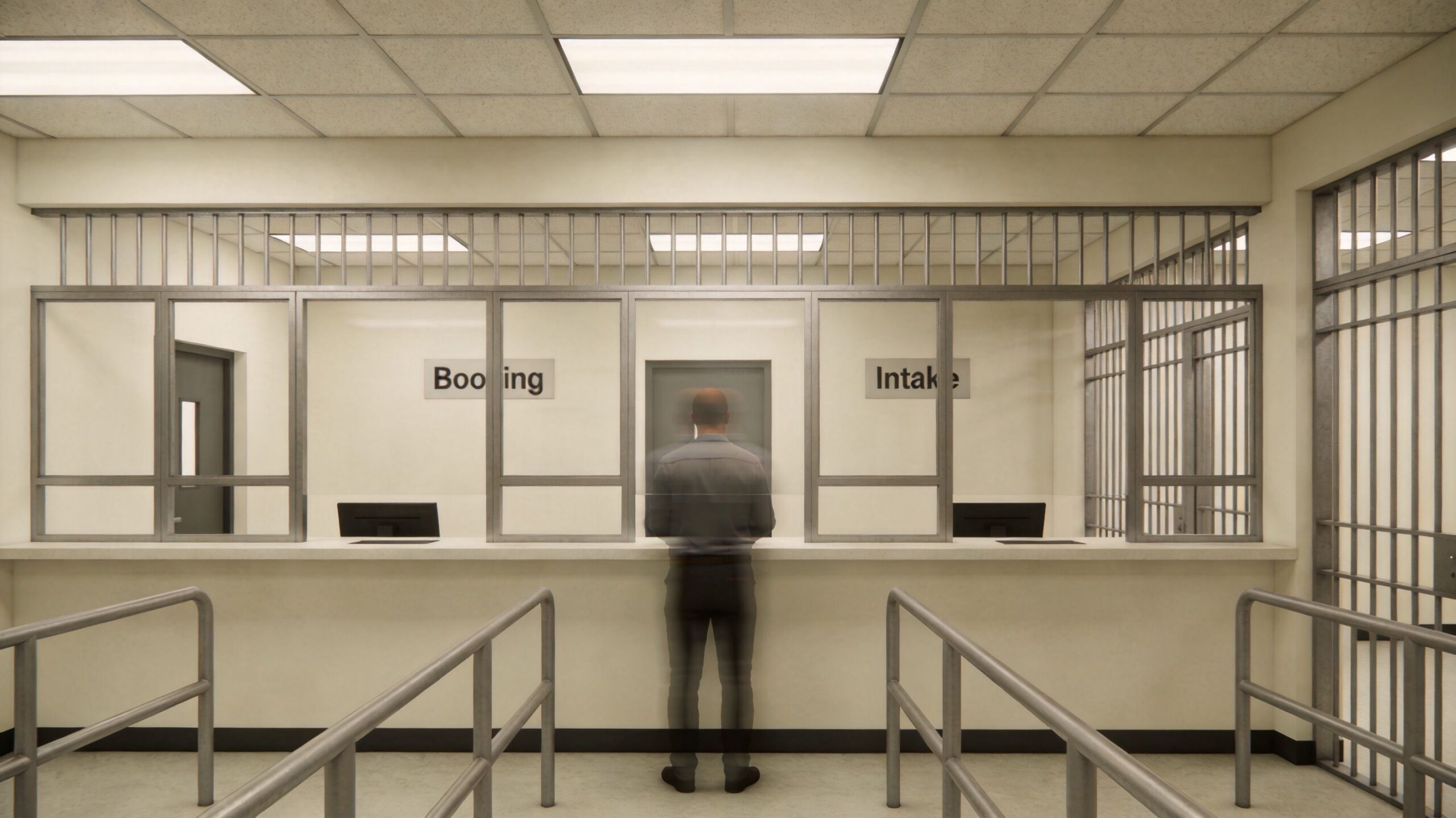
After the arrest, the uncertainty usually shifts from the roadside to the jail. Booking feels mechanical because it is. Officers or jail staff take fingerprints, photographs, inventory your property, and process the charge. That part is not your chance to argue the facts.
The first hearing that matters is magistration, sometimes called your initial appearance before a magistrate.
What the magistrate does
Under Texas Code of Criminal Procedure Art. 15.17, you must be brought before a magistrate within 48 hours of your arrest. During that hearing, the judge sets bail, typically $500 to $5,000 for a first DWI, and may impose conditions such as an Ignition Interlock Device according to this discussion of Texas magistration and first-offense DWI bail.
At that hearing, you are usually told:
- The charge against you
- Your rights
- Whether bail is set
- What conditions apply if you're released
A few terms help:
| Term | Plain-English meaning |
|---|---|
| Bail | The amount set to secure release |
| Bond | The promise or financial arrangement used to get out |
| PR bond | Personal recognizance release, meaning release based on your promise to appear, without posting the usual cash amount up front |
Trade-offs people often miss
People focus on getting out of jail fast. That's understandable. But release terms can shape the weeks that follow.
For example, a lower bond with strict conditions may still be better than sitting in jail. On the other hand, agreeing to conditions you don't fully understand can lead to violations. If the judge orders an ignition interlock, alcohol monitoring, or a no-alcohol condition, treat that order seriously from the first hour after release.
Practical rule: If a judge gives you a condition, assume the court expects immediate compliance, not “when you get around to it.”
How to handle the hearing
Your attitude matters, but not in the way people think. The magistrate is not looking for a dramatic explanation. The court wants orderly processing, honest information, and confidence that you'll return.
Do this instead:
- Listen carefully to every condition
- Get copies of what you're given
- Ask for clarification if you don't understand a release term
- Make transportation plans before release if you may not be able to drive
- Tell your lawyer about anything unusual in the timing, paperwork, or testing
If an arrest followed a crash, there may also be a civil side developing at the same time. In that setting, terms like damages mean financial losses claimed by an injured person, and comparative fault means the parties may dispute who caused the collision and in what share. A Houston car accident lawyer or Texas injury attorney looks at those issues very differently than a criminal prosecutor does, but the facts can overlap from day one.
The Clock Is Ticking on Your Texas Driver's License
Many people think the court date controls everything. It doesn't. Your driver's license is on a separate track, and that track starts almost immediately.
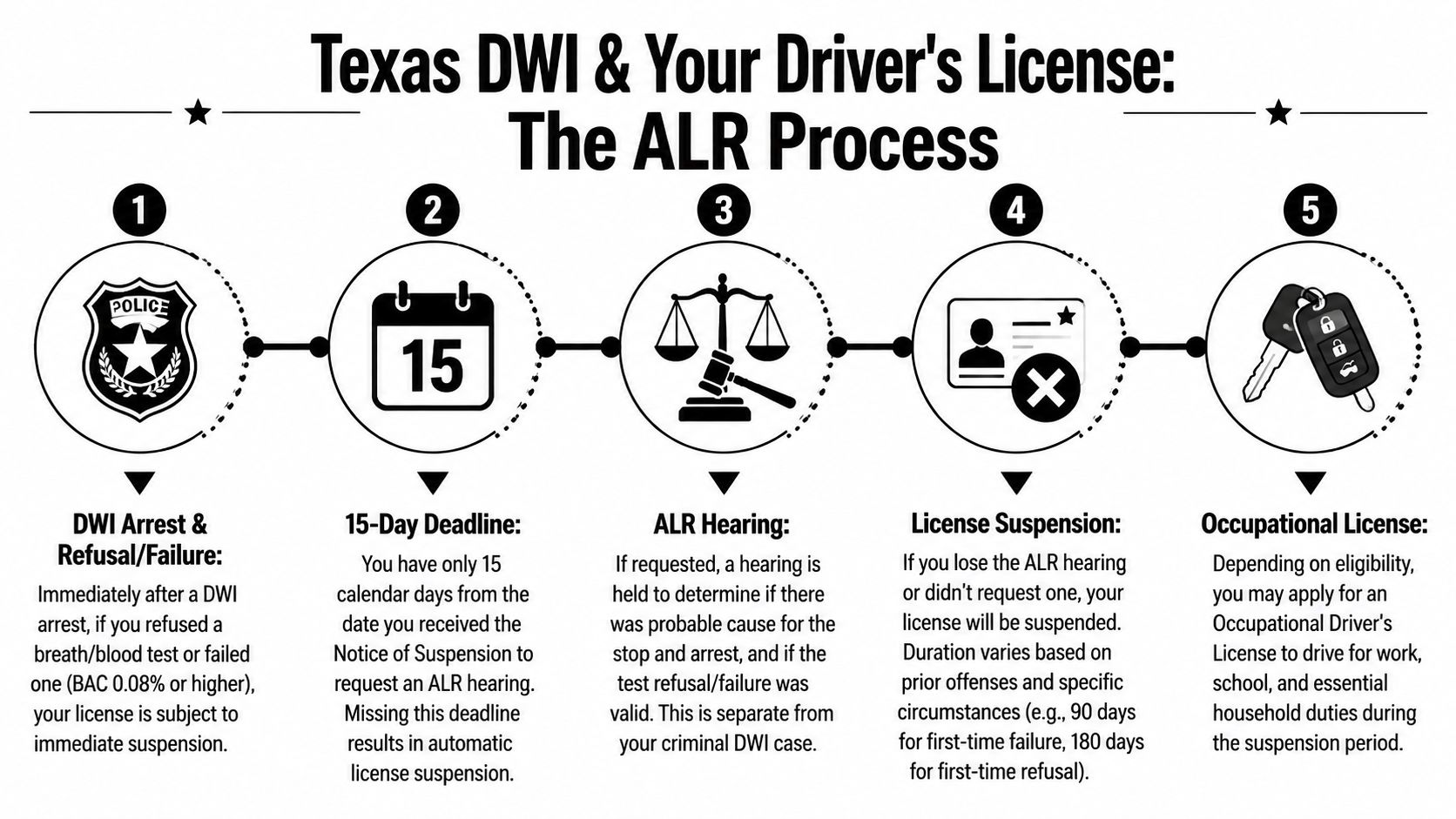
When you are arrested, you may receive a DIC-25 form. That paper carries significant weight because it acts as a temporary permit and a warning that the State is moving to suspend your license.
The ALR case is separate from the criminal case
Upon arrest, you are given a DIC-25 form, which serves as a temporary driving permit and notice that you have 15 days to request an Administrative License Revocation hearing. If you do nothing, your license faces automatic suspension on the 41st day after arrest, as explained in this overview of the Texas ALR deadline and DIC-25 notice.
That means you can be doing fine in the criminal case and still lose your license by missing paperwork.
Here is the practical timeline:
| Action Item | Deadline | Governing Body | Consequence of Inaction |
|---|---|---|---|
| Request ALR hearing after receiving DIC-25 | Within 15 days | Texas Department of Public Safety | Automatic suspension process continues |
| License suspension takes effect if no hearing is requested | 41st day after arrest | Texas Department of Public Safety | Loss of driving privileges |
| Appearance before magistrate | Within 48 hours of arrest | Criminal court under Texas Code of Criminal Procedure Art. 15.17 | Delay concerns may affect early case handling |
| Comply with bond conditions | Immediately upon release | Criminal court | Risk of bond trouble or re-arrest |
Later in the process, the suspension period can differ depending on whether there was a failed test or a refusal. The key point in the first 48 hours is simpler. You must protect the deadline first.
If your job depends on driving, or you hold a commercial license, the consequences can be even harder. Drivers in that position should also review how a DUI affects a CDL in Texas.
Here is a short video that helps explain the license side of a DWI case:
Why the ALR hearing matters beyond the license
The ALR process isn't just about keeping your license. It can also give your lawyer an early look at the officer's reasons for the stop and arrest. That matters because the same facts often appear again in the criminal case.
A fast response in the first 48 hours creates a significant advantage. A delayed response usually creates cleanup work.
If you remember only one deadline from this article, remember the 15-day ALR deadline.
Preserving Evidence and Preparing Your Defense
Once you're out, your job is not to solve the case by yourself. Your job is to preserve facts before they fade.
Memory changes fast after a stressful arrest. So do witness memories. So does physical evidence. If you wait a week, you will forget details that mattered.

Build a clean timeline while it is fresh
Write down the full timeline of the day and evening.
Include:
- What you ate and when
- What you drank, if anything, and roughly when
- Where you were
- Who saw you
- When you started driving
- Why you believe the officer stopped you
- What roadside instructions you remember
- Anything unusual about weather, lighting, shoes, fatigue, injury, or medical issues
Don't polish it. Just get it down accurately.
If a crash occurred, preserve that side too. Save photos, names of passengers, tow records, vehicle location, and any insurance claim number. A police crash report can become important in both a DWI defense and a civil claim. If you need help understanding what information appears in that paperwork, this guide on how to read a police accident report is useful.
What to gather in the first two days
The strongest early defense work often starts with ordinary items people overlook.
- Receipts and timestamps: Restaurant tabs, gas station receipts, parking records, and rideshare records can help anchor timing.
- Witness names: Passengers, friends, bartenders, or anyone who saw your condition before driving may matter.
- Medical information: Diabetes, reflux, injuries, anxiety, or balance problems can become relevant depending on the facts.
- Your paperwork: Take photos of every page you received and store them in one folder.
According to this discussion of Texas DWI dismissals and early defense work, approximately 10 to 15 percent of DWI cases in Texas can result in dismissal when a defendant works with an experienced DWI attorney who can challenge procedures and evidence. That does not mean dismissal is likely in every case. It means details matter, and the first details usually come from you.
Good defense files are built from specifics, not from broad statements like “I wasn't that drunk.”
What does not help
Posting online does not help. Calling witnesses and coaching their memory does not help. Throwing away receipts because they “look bad” does not help.
Preserve first. Explain later.
How a Texas DWI Attorney Can Help You Today
By the time many individuals begin searching for counsel, they are already juggling three pressures at once. The criminal charge is pending. The license deadline is approaching. If there was a wreck, insurance questions or injury claims may also be surfacing.
That combination is why early representation matters. A lawyer's first value is not courtroom drama. It is control.
What counsel can do right away
In the first days, a DWI lawyer may help by:
- Protecting the ALR deadline
- Reviewing bond conditions and release terms
- Identifying what evidence should be preserved
- Screening for issues in the stop, arrest, testing, or paperwork
- Helping you avoid statements that damage either the criminal or civil side
If the arrest involved a collision, you may also need guidance on the injury side. In Texas personal injury law, liability is who is legally responsible. Comparative fault means fault can be divided among people involved in the crash. Damages are the losses claimed, such as medical expenses, lost wages, pain and suffering, and in fatal cases, wrongful death compensation. Those civil issues are governed in part by Texas Civil Practice & Remedies Code Chapters 33 and 41.
That matters because a person can face a criminal DWI case and, separately, an insurance or injury dispute growing out of the same event. A Houston car accident lawyer or Texas injury attorney handling the civil side will focus on negligence, coverage, medical proof, and the value of an auto insurance claim. A DWI defense lawyer focuses on the State's evidence, procedure, and admissibility. The smart move is to recognize both tracks early.
What an initial consultation should cover
A useful first call should be practical. You should leave knowing what deadlines exist, what documents to send, what not to say, and what the next court-related step is.
Ask direct questions:
- Has the ALR request been or can it be handled immediately?
- What bond conditions apply right now?
- What paperwork should I send today?
- Do I need to do anything about an ignition interlock or testing condition?
- If there was a crash, how do I protect myself with insurers?
The Law Office of Bryan Fagan, PLLC can be one option for that kind of early case review if your DWI arrest also overlaps with accident-related injury or insurance issues, including questions about liability, comparative fault, and damages.
A steady response is better than a fast apology
People in crisis often want to apologize, explain, promise, and move on. That instinct is human. It is rarely strategic.
The first 48 hours after a dwi arrest in texas are about keeping your situation from getting worse. Protect your silence. Protect your license deadline. Protect the evidence. Follow bond conditions exactly. Then get focused legal advice before you make decisions that are hard to undo.
If you or a family member is dealing with a DWI arrest that also involves a crash, injuries, or insurance problems, contact The Law Office of Bryan Fagan, PLLC for a free, confidential consultation. You can get clear answers about your rights, the criminal process, your driver's license, and any related civil issues such as an auto insurance claim, liability disputes, or wrongful death compensation. You don't have to sort this out alone.