A car crash can change your life in seconds, but you don't have to face recovery alone.
If you were hit by a drunk driver, you may be dealing with pain, car damage, missed work, and a lot of anger. Then you hear something that makes it worse: the driver's DWI case might be dismissed. For many crash victims, that feels unfair. You may wonder whether that means the driver “got away with it,” or whether your own case just got weaker.
Those are reasonable fears. They're also where a lot of people get confused.
A criminal DWI case and a civil injury claim are not the same case. The criminal court decides whether the State can prove a crime. Your injury claim focuses on who caused your crash, how badly you were hurt, and what compensation you need to move forward. A dismissal in criminal court can matter, but it does not automatically block your right to recover money for medical care, lost income, pain, and other losses.
A Drunk Driving Crash Can Change Your Life But You Are Not Alone
A Houston driver rear-ended at a stoplight might go from a normal workday to an ambulance ride in a matter of minutes. A family driving home from dinner can end up in the ER because another driver chose to drink and get behind the wheel. In the days after a crash like that, people often feel two things at once. They want accountability, and they need help paying the bills.
Then the criminal case starts moving in its own direction.
You might hear that the driver was arrested for DWI, then later learn the charge could be reduced, challenged, or even dismissed. That can feel like the system stopped seeing what happened to you. But your recovery does not depend on the criminal court alone.
A lot of victims are also trying to heal while sorting out treatment. If you're dealing with neck pain, back pain, or mobility problems after a collision, resources like Boston physical therapy for crash victims can help you understand what recovery may look like after an auto accident.
Why the criminal case feels personal
When someone drunk hits you, the DWI charge can feel like proof that what happened was wrong. So if that charge gets dismissed, it's easy to think your own claim disappears too. It doesn't work that way.
Criminal prosecutors represent the State of Texas. Your injury claim is about your losses. Those include your hospital bills, therapy, lost paychecks, vehicle damage, and the daily disruption the crash caused in your life.
A dismissal can be painful to hear, but it is not the same as a finding that the other driver did nothing wrong.
What you can do while the DWI case unfolds
You don't need to wait for the criminal case to finish before protecting your own position. In fact, waiting can make things harder.
Focus on these basics:
- Get medical care: Follow up after the ER, keep appointments, and tell your doctors about every symptom.
- Save records: Keep discharge papers, prescriptions, receipts, and photos of your injuries and vehicle.
- Be careful with insurers: The other driver's insurance company may try to minimize your injuries early.
- Track the criminal case: If you want a plain-English look at the process after an arrest, this guide on the first 48 hours after a DWI arrest in Texas can help you understand what may be happening behind the scenes.
The Real Numbers Behind DWI Dismissals in Texas
If you're searching how often are dwi cases dismissed in texas, the short answer is that dismissals do happen, but the numbers need context.
One widely cited summary of Texas DWI outcomes explains that dismissal rates hover around 10% to 15% among cases that proceed without a guilty plea, and that among about 53,000 defendants who pleaded not guilty in a sample year, prosecutors secured convictions on original DWI charges in about 70%, lesser charges in 30%, and dismissals in 13%, which translated to nearly a 45% chance of reduction or dismissal for those contesting their charges according to Texas DWI dismissal statistics summarized here.
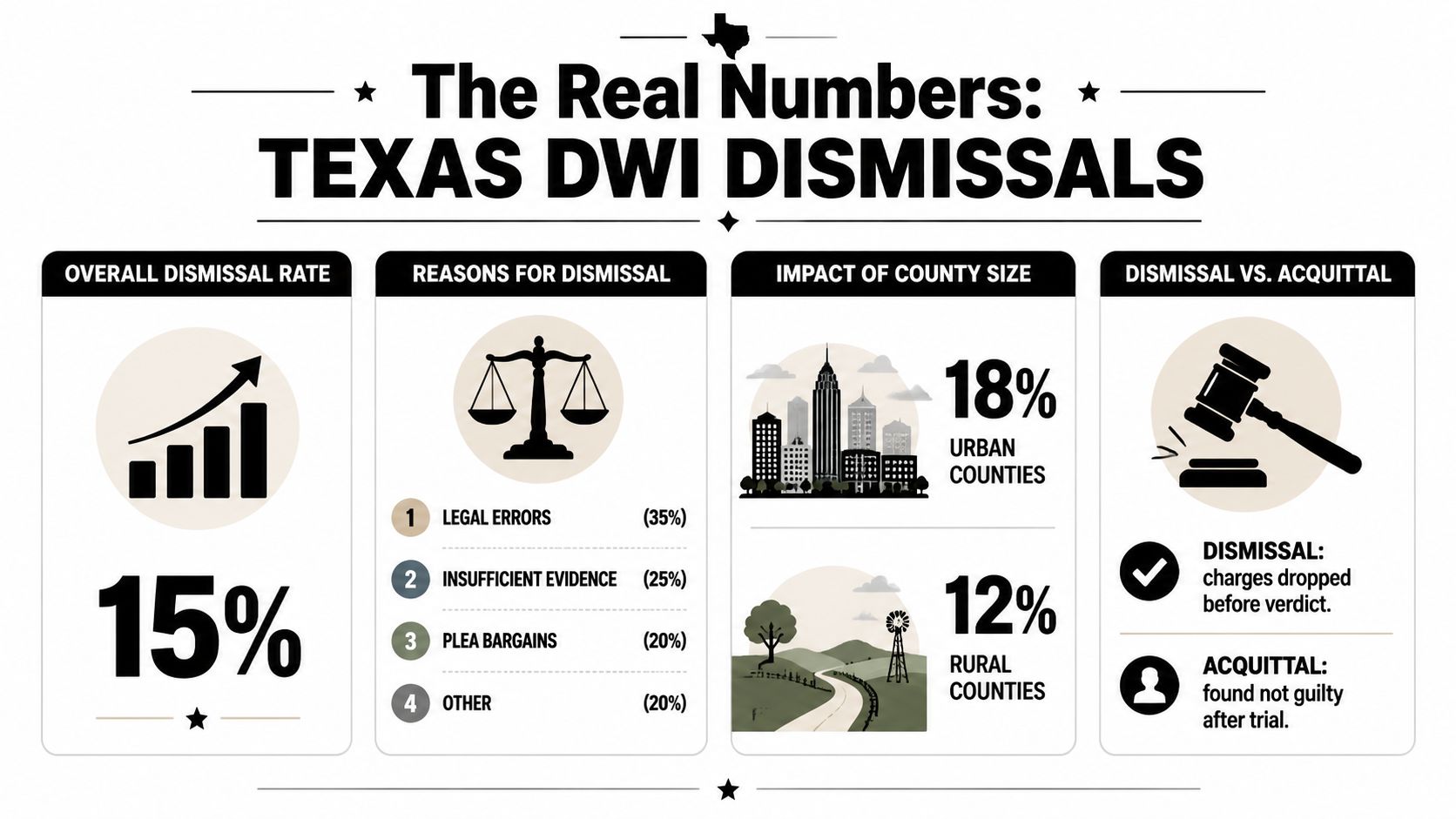
That's the part many people miss. A simple “dismissal rate” can sound low if you compare it to all arrests. But once you look at the subset of people who fight the charge instead of pleading guilty right away, the picture changes.
The key difference is who contests the case
A DWI arrest is not the same thing as a DWI dismissal. Between those two points, many cases end in guilty pleas, some end in convictions, some are reduced, and some are dismissed.
Consider the following breakdown of the situation:
| Outcome type | What it means for the criminal case |
|---|---|
| Guilty plea | The driver accepts responsibility, so there's no chance of dismissal in that path |
| Conviction on original charge | The State proves the DWI charge as filed |
| Conviction on lesser charge | The case resolves, but not on the original DWI count |
| Dismissal | The charge is dropped before a guilty verdict |
For crash victims, this matters because hearing “the case wasn't dismissed often” doesn't tell the whole story. Many people never fight the charge. The dismissal question becomes more meaningful when the defendant contests the case and the court reviews the evidence more closely.
Why the numbers can feel confusing
People often compare different pools of cases without realizing it. One number may describe all arrests. Another may describe only cases that moved forward. Another may focus on people who pleaded not guilty.
That's why two statements can both be true:
- Dismissals may look relatively limited when compared to all DWI arrests.
- Dismissals and reductions become more common when you look only at contested cases.
Practical rule: When you hear a DWI dismissal percentage, ask, “Out of which group?” All arrests, filed cases, or contested cases can produce very different-looking answers.
What this means if you were injured
The criminal system is not built around your medical bills or your missed wages. It is built around whether the State can prove a DWI offense under criminal rules.
Dismissals happen often enough that victims should be prepared for that possibility, especially in contested cases. If you're waiting for the criminal case to “prove everything” for your auto insurance claim or injury case, that can leave you exposed.
Why Some Texas DWI Charges Get Dismissed
A DWI dismissal usually doesn't mean the crash never happened. It usually means there was a problem with the criminal case itself.
Sometimes the officer may have stopped the driver without a legally valid reason. Sometimes a breath test can't be used because the machine, process, or paperwork is challenged. Sometimes the prosecutor decides the available proof won't hold up in court.

Illegal stop problems
Police generally need a lawful reason to pull a driver over. If the stop itself was improper, the defense may ask the court to exclude evidence that came after it.
That can matter a lot in DWI cases. If key observations or test results are tied to a stop the court rejects, the prosecutor may have a weaker case than it first appeared.
Building a house on a weak foundation serves as a useful comparison. Even if the rest of the structure looks solid, the problem underneath can affect everything built on top of it.
Testing and evidence problems
Breath and blood evidence can be powerful, but only if the State can show it was handled correctly. A criminal case may run into trouble if the testing process, machine reliability, or collection procedure is challenged.
Field sobriety tests can also be disputed. They may be affected by lighting, road conditions, physical limitations, anxiety, or how the officer gave the instructions.
If you want to understand why some criminal defendants beat or reduce these charges, this overview of what are the chances of beating a DWI in Texas gives more background on common defense issues.
Here's a quick visual explanation of how these disputes can shape a case:
Weak proof of intoxication
A person can cause a crash and still present a difficult criminal DWI case for the prosecutor. The State has to prove intoxication under criminal standards, not just poor driving.
That's where victims often feel blindsided. You may know the driver smelled like alcohol, slurred words, or admitted drinking. But if a key piece of evidence is excluded or the proof is incomplete, the criminal case can weaken fast.
Common reasons a prosecutor may back away include:
- Questionable stop evidence: The defense argues police lacked a proper basis to stop the vehicle.
- Breath or blood challenges: The State may struggle to rely on the chemical test.
- Video or witness issues: Footage may be unclear, missing, or inconsistent with the report.
- Proof gaps: The prosecutor may not be able to tie all the evidence together strongly enough for criminal court.
A criminal dismissal often reflects a proof problem, not a clean bill of health for the driver who caused the wreck.
How Dismissal Rates Vary Across Texas Counties
Where the criminal case is filed can make a real difference. Texas counties do not all handle DWI cases the same way.
According to a county-level summary, Dallas County sees an 18% to 25% dismissal rate, Harris County is around 10% to 15%, and Travis County is around 15% to 22%, with differences linked to prosecutorial caseloads and pre-trial hearing procedures under Texas law, especially in cases near the legal limit, as discussed in this review of Texas county DWI dismissal patterns.

Why county differences matter
A DWI case in Houston doesn't move through exactly the same local system as one in Austin or Dallas. Prosecutors in busy counties may face heavier dockets. Judges may run pre-trial hearings differently. Local offices may also vary in how they evaluate borderline cases.
For a victim, that can feel frustrating because the seriousness of the crash may look the same from county to county. But the criminal process is local. Court culture, staffing, and scheduling can all affect whether a weak or close case gets pushed forward or dropped.
A simple county comparison
| County | Reported dismissal range |
|---|---|
| Dallas County | 18% to 25% |
| Harris County | 10% to 15% |
| Travis County | 15% to 22% |
Those ranges don't mean any one case will land in a certain outcome. They show that local practice matters.
What victims should take from this
If the drunk driver who hit you is being prosecuted in Harris County, the criminal result may look different than a similar case in Dallas County. That does not change the basic civil question in your case: who caused the crash and what harm did it do to you?
A San Antonio passenger injured in a late-night T-bone collision may care greatly whether the driver is criminally convicted. That reaction is natural. But from a personal injury standpoint, the more urgent work is usually gathering proof early. That includes crash scene photos, medical records, witness information, and insurance details.
County-based dismissal patterns can affect the criminal case. They do not erase your right to pursue a civil claim for the damage the crash caused.
What a DWI Dismissal Means for Your Injury Claim
This is the question most injured people really want answered. If the driver's DWI case is dismissed, can you still recover compensation?
Yes, you can.
A dismissed criminal case can make your civil case more complicated, but it does not shut the door. One legal summary notes that recent trends suggest more DWI dismissals due to technical challenges and prosecutorial overload, and that a dismissal can complicate civil claims, especially UM/UIM claims, because there is no automatic conviction to rely on, which makes strong legal representation more important for proving liability and damages, as explained in this discussion of dismissed DWI cases and victim claims.

Criminal court and civil court use different rules
In criminal court, the State must prove guilt beyond a reasonable doubt. That is a very high standard.
In a civil injury case, you generally need to show that it is more likely than not that the other driver caused your injuries. That lower standard matters. A prosecutor may decide the DWI charge is too risky to take to trial, yet the evidence may still strongly support your injury claim.
Here are the key terms in plain English:
- Liability means legal responsibility. In a crash case, it answers who caused the wreck.
- Damages means the losses you can recover money for, such as medical expenses, lost wages, pain, impairment, and property damage.
- Comparative fault means blame can be shared. Under Texas Civil Practice & Remedies Code Chapter 33, your compensation can be reduced if you were partly at fault.
- Statute of limitations means the deadline to file suit. If you wait too long, you can lose your claim even if the facts are on your side.
Texas negligence law still protects your claim
Texas personal injury law focuses on negligence. That means a driver had a duty to act carefully, broke that duty, and caused harm.
If an impaired driver drifted across lanes and hit you on I-45, your case may rely on many types of proof besides a criminal conviction:
- Police observations from the crash scene
- Witness statements about speeding, swerving, or drinking
- Medical records tying your injuries to the collision
- Photos and video from dashcams, businesses, or phones
- Accident reconstruction when fault is disputed
Under Texas Civil Practice & Remedies Code Chapter 41, some cases may also raise issues involving exemplary damages in serious misconduct situations. Those claims depend on the facts and evidence in the civil case, not just whether the criminal prosecution ended in a conviction.
UM and UIM claims can get harder, but not impossible
If the at-fault driver has little insurance or none at all, you may need to turn to your own uninsured/underinsured motorist coverage. That's where a criminal dismissal can create friction.
Your insurer may say, “There was no conviction, so intoxication isn't proven.” But a conviction is not the only way to prove fault. A Texas injury attorney can build the case through records, testimony, and investigation.
That can also matter in cases involving bars or restaurants that may have over-served a driver. Texas has separate rules in some of those cases, often called dram shop claims in Texas.
A real-world example
A Houston driver is rear-ended by a man leaving a sports bar late at night. The arresting officer files a DWI case, but later the breath-test evidence gets challenged and the prosecutor dismisses the charge. The victim still has a broken wrist, physical therapy bills, and time away from work.
The civil claim can still move forward by showing:
- the other driver caused the crash,
- the victim suffered real injuries,
- those injuries led to financial and personal losses.
That is why a Houston car accident lawyer or Texas injury attorney should evaluate the full civil picture, not just the criminal docket.
For families who lost a loved one, the same principle applies. A dismissal in criminal court does not automatically block a claim for wrongful death compensation.
A DWI Dismissal Is Not the End of Your Fight for Justice
When the criminal case doesn't end the way you hoped, it's easy to feel defeated. But your right to seek compensation doesn't rise or fall with the DWI charge alone.
Your civil case can stand on its own evidence. A lawyer can use crash reports, scene photos, medical records, witness interviews, vehicle damage, phone records when relevant, and expert analysis to show what happened and why the other driver is legally responsible. That work matters whether you're filing a third-party claim, an auto insurance claim, a UM/UIM claim, or a lawsuit.
What to do next after a drunk driving crash
If you're still in the middle of treatment or insurance calls, take these steps:
Keep every medical record
Save bills, imaging results, work notes, and therapy updates.Don't assume the insurer will be fair Insurance adjusters often focus on limiting payouts, not on what your recovery requires.
Avoid guessing about fault
Even a casual apology can be twisted into an argument about shared blame.Ask how Texas comparative fault applies
Under Chapter 33, your compensation may be reduced if the defense argues you were partly responsible. That issue should be handled carefully.Get legal advice before accepting a settlement
Once you settle, you usually can't go back for more money later.
The criminal case asks whether the State can prove a crime. Your injury case asks what you need to rebuild your life.
You deserve answers that make sense, not legal jargon and delay. You also deserve someone who sees the full picture. Not just the arrest report, but the surgery, the missed paychecks, the sleepless nights, and the strain on your family. The Law Office of Bryan Fagan, PLLC handles personal injury matters involving intoxicated drivers, uninsured motorist disputes, and fatal crash cases, including claims where the criminal process does not produce a conviction.
If you're unsure where things stand, talking to a lawyer can give you clarity. It can also protect you from letting the criminal case distract you from the deadlines and evidence that matter most in your own claim.
If a drunk driver hurt you or someone you love, you don't have to sort through the criminal case, insurance process, and Texas injury laws by yourself. The team at The Law Office of Bryan Fagan, PLLC helps crash victims pursue compensation for medical bills, lost income, pain and suffering, and wrongful death losses, even when the driver's DWI case is dismissed. A free consultation can help you understand liability, comparative fault, deadlines, and the next steps for your auto insurance claim or lawsuit. You pay nothing unless your case is won.