
A DWI arrest can leave you sitting at your kitchen table, paperwork spread out, trying to answer one basic question. What happens next?
For many Texans, the first big point of anxiety is court. You may be worried about jail, your job, your license, and what the judge will say when your case is called. That fear is normal. It also helps to know that your first court date is usually not the moment your whole case is decided.
If you're trying to understand what happens at your first DWI court date in Texas, the clearest way to think about it is this. You are dealing with two problems at once. One is the criminal court case. The other is the fight over your driver's license. Those two tracks move on different timelines, and that difference confuses people more than almost anything else after an arrest.
A DWI arrest can also grow out of a crash, which raises separate civil issues. If another driver, passenger, or family is dealing with injuries, questions about liability, damages, comparative fault, and insurance may arise too. In plain English, liability means who is legally responsible. Damages means the losses a person claims, such as medical bills, lost income, or pain and suffering. Comparative fault means more than one person can share blame. In Texas injury law, those concepts often come from Texas Civil Practice & Remedies Code Chapters 33 and 41. If your arrest followed a wreck, you may be facing both a criminal case and an insurance or injury claim at the same time.
Understanding the Arraignment Your First Day in Court
Your first court date in a Texas DWI case is usually an arraignment. That word sounds heavier than it is. An arraignment is the court's formal opening step. It is not a trial.
At that hearing, the judge usually reads the charge, tells you about your rights, asks for a plea, and sets the next court date. For a typical first-offense DWI, the charge is usually a Class B misdemeanor. The baseline penalties on conviction can include up to 180 days in jail, a fine up to $2,000, and a driver's license suspension of up to one year, with a three-day mandatory minimum jail term. Those details come from this Texas DWI court-date guide.
That doesn't mean you're walking into court to be sentenced on day one. It means the court is putting the case on the rails.
What the arraignment actually does
Think of the arraignment as a checkpoint with four jobs:
- Confirm the charge: The court makes sure you know what offense has been filed.
- Advise you of rights: You have the right to remain silent, the right to counsel, and the right to require the State to prove its case.
- Take an initial plea: In many cases, a not-guilty plea is entered so your defenses stay intact.
- Set the next step: The judge or court staff will move the case toward a later setting, often for pretrial work.
If you've been reading everything you can since your arrest, you may also want to review what to do in the first 48 hours after a DWI arrest in Texas. That early window often affects how prepared you feel by the time the first court date arrives.
Practical rule: Your first court date is usually about procedure, not proof.
What people often misunderstand
Many people hear "court date" and assume they need to explain what happened. Usually, that is not the purpose of this setting. You are not there to tell the judge your full side of the story. You are there because the court must formally open the case and protect your rights while it moves forward.
A simple example helps. Suppose you're arrested after a late-night stop in Harris County, and no one was hurt. You might show up expecting witnesses, testimony, and a final decision. Instead, the court may spend only a short time on your case, confirm the charge, address representation, and send the matter to a later setting.
That can feel strange, but it matters. Early court settings often shape bond conditions, scheduling, and how much time your lawyer has to get records, video, and testing information.
Navigating the Courtroom A Step-by-Step Guide
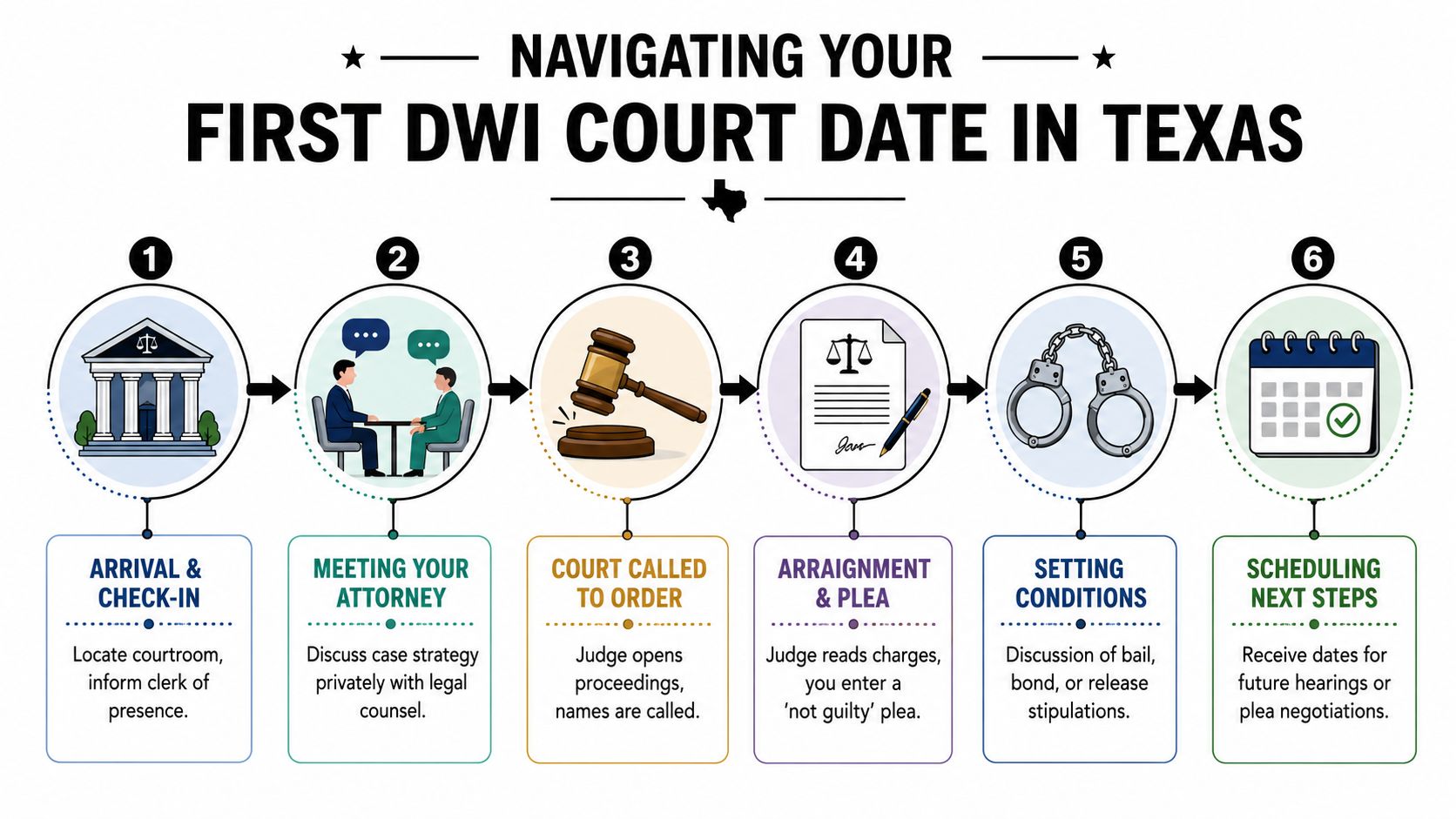
Walking into a Texas courtroom for a DWI case feels easier when you know the sequence. The first appearance is often an administrative checkpoint. The court confirms the charge, reviews bond conditions, and sets the next hearing. It's also common for a defense lawyer to enter a not guilty plea on the client's behalf to preserve rights and defenses as the case moves into pretrial. The court may also impose or change bond conditions, including an ignition interlock requirement, as explained in this discussion of first Texas DWI court appearances.
Who you'll see in the courtroom
A few people usually control the flow:
| Person | What they do |
|---|---|
| Judge | Runs the hearing and makes rulings about the case schedule and conditions |
| Prosecutor | Represents the State |
| Defense attorney | Protects your rights and speaks for you on legal issues |
| Clerk | Tracks the case paperwork and settings |
| Bailiff | Maintains courtroom order |
You may spend more time waiting than speaking. That's normal.
What the day usually looks like
Most first appearances follow a simple rhythm:
Arrival and check-in
Get there early enough to find the courtroom, clear security, and check in if needed.Quick conversation with your lawyer
If you have counsel, this is often when you confirm what will happen when the case is called.Your case is called
The clerk or bailiff may call your name and case.The court handles the formalities
The court verifies the charge and who represents you.Plea and bond discussion
A not-guilty plea may be entered, and the judge may review or modify release conditions.Next date gets set
You leave knowing the next setting, or your lawyer receives it for you.
The first hearing often feels less dramatic than people expect. That's because the system is usually handling administration, not deciding guilt.
Terms worth knowing
A few phrases often trip people up:
- Bond conditions: Rules you must follow while the case is pending. These can affect travel, alcohol use, reporting, or driving.
- Ignition interlock device: A device installed in a vehicle that can become a condition of bond in some cases.
- Continuance: A delay or reset to a later date.
- Pretrial setting: A later court date used to address evidence, negotiations, motions, or readiness.
If the judge changes your conditions, take them seriously. A lot of trouble starts not from the original arrest, but from ignoring release rules after court.
Your Driver's License The Separate Fight You Must Start Now
Many people are blindsided at this stage.
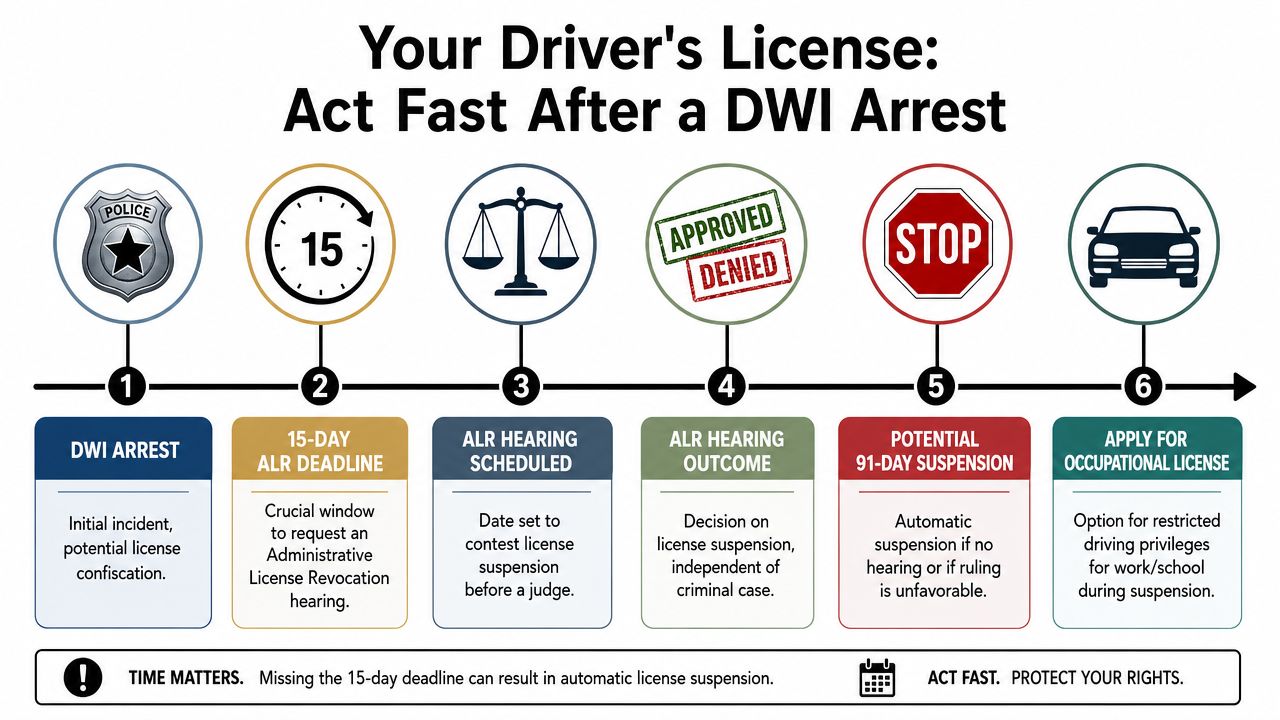
Your DWI case in criminal court is one track. Your driver's license problem is another. They are related, but they are not the same case. A Texas DWI arrest triggers both a criminal case and an administrative case about your license. You have only 15 days from the date of arrest to request an Administrative License Revocation hearing, and that deadline is separate from your criminal court setting. In one county source, the first court appearance may be set 40 to 60 days after arrest. See this explanation of the Texas DWI process and ALR timing.
Why this causes so much confusion
People often focus on the court date printed on the criminal paperwork and assume that's the first deadline that matters. It isn't.
The license deadline can arrive long before you ever stand in front of a judge in the criminal case. So someone may think, "My court date isn't for weeks. I have time." Then the ALR deadline passes, and the license issue gets harder to fight.
A simple way to separate the two tracks
| Track | What it's about | When it hits |
|---|---|---|
| Criminal case | The DWI charge in court | Often later |
| ALR case | Your right to keep driving | Starts immediately after arrest |
If your ability to drive affects work, school, medical care, or family duties, this part deserves fast attention. In some situations, a person may later seek an Occupational Driver's License, which is a restricted license that can allow limited driving for necessary purposes.
If you remember only one thing from this section, remember this. The license clock can run while you're still waiting for the first criminal court date.
A practical example
Suppose a Houston driver is arrested after being stopped on the way home and is released the next day. The first criminal setting may still be weeks away. But the driver doesn't get to wait on the license issue. The administrative deadline starts immediately.
That's one reason many people talk with a lawyer early. If you're weighing timing, this guide on when to hire a DWI lawyer in Texas can help you think through the decision.
And if your bond or licensing terms involve interlock requirements, resources from other states can still help you understand how the process is organized. For example, this overview of finding approved GA ignition interlock vendors gives a practical look at how restricted-license compliance is often structured, even though Texas rules are their own.
Common Mistakes to Avoid at Your First DWI Court Date
Most damage at a first court setting doesn't come from some dramatic courtroom moment. It comes from small, preventable mistakes.
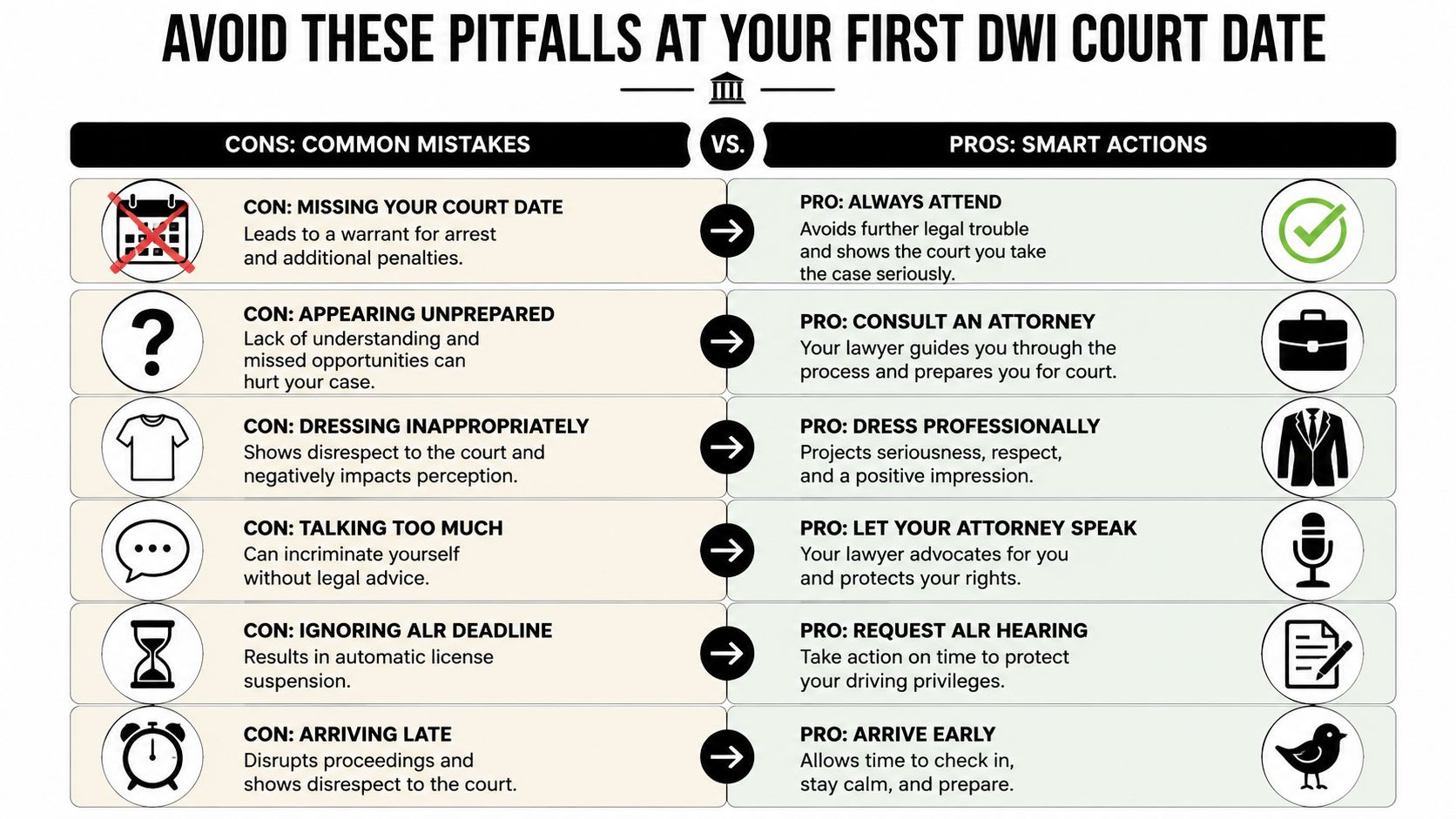
Start with the basics. Show up on time, dress like you take the court seriously, and understand that this isn't the place to argue your case directly to the judge. Your goal is to protect your position, not to relieve stress by talking.
The mistakes that hurt people most
Trying to explain everything to the judge
You may think you're clearing things up. In reality, you may be giving the State useful statements before your lawyer has reviewed the evidence.Pleading guilty too early
A quick plea can close off defenses before you know the strengths and weaknesses of the case.Missing the date or arriving late
Courts expect attendance and respect for the schedule. A missed appearance can create problems that are much worse than a routine first setting.Ignoring bond conditions
If the judge orders conditions, follow them carefully. Confusion is common, but noncompliance can snowball fast.Dressing or acting casually
You don't need to look perfect. You do need to show respect.
What smart preparation looks like
Some people learn best by seeing examples, so this short video may help frame the basics before you go:
A better approach usually looks like this:
- Arrive early: Give yourself time for parking, security, and finding the courtroom.
- Bring your paperwork: Keep your bond papers, notice, and identification organized.
- Listen more than you speak: Let your lawyer handle legal communication when possible.
- Ask questions before court, not during panic: If you don't understand a condition, ask before you leave the courthouse.
- Treat every instruction as important: Small details often become big issues later.
Speaking less is often the safer move. Your lawyer can argue for you. You don't need to volunteer facts in a stressful moment.
If the DWI followed a crash
The situation can become more complicated. A DWI arrest that grew out of a wreck may also lead to injury claims, insurance disputes, or wrongful death allegations. In the civil side of a crash case, comparative fault means responsibility can be divided among the people involved. Under Texas Civil Practice & Remedies Code Chapter 33, a person's own share of fault can affect what they recover in a personal injury case.
If you're also dealing with an auto insurance claim, be careful about recorded statements and broad releases. A rear-ended Houston driver on I-45, for example, may be dealing with a liability investigation, medical treatment, and questions about alcohol allegations all at once. That overlap is one reason people need a coordinated legal plan.
How an Attorney Protects You Before and During Your First Appearance
A lawyer's job starts before the hearing.
Good representation isn't only about standing next to you in court. It's about getting ahead of deadlines, making sure the right plea is entered, reviewing what the court can require of you, and reducing the chance that you hurt your own case. In some misdemeanor situations, counsel may also handle parts of the process in a way that limits what you personally have to do in open court.

What legal help often changes right away
An attorney can help by:
Reviewing the immediate deadlines
The license issue doesn't wait for the criminal case to catch up.Preparing you for the hearing
That includes what to expect, what not to say, and what paperwork matters.Addressing bond conditions
If the court is considering restrictive terms, your lawyer can respond in a focused way.Managing the next court setting
A DWI case doesn't end at arraignment. It moves into pretrial work, where timing and preparation matter.
One practical resource, if you're still evaluating counsel generally, is this article on choosing a Forsyth County defense attorney. It isn't Texas-specific, but it does a good job of showing the kinds of questions people should ask before hiring a defense lawyer anywhere.
Why this matters more if there was a crash
A DWI tied to a collision can create two legal fronts. The criminal side focuses on the charge. The civil side may involve injury claims, insurance disputes, and questions about negligence.
In plain English, negligence means failing to use reasonable care. If someone is hurt in a crash, Texas injury law may also involve damages, which can include medical expenses, lost wages, and pain and suffering. Chapter 41 of the Texas Civil Practice & Remedies Code addresses certain rules related to damages in civil cases. If a fatal crash happened, surviving relatives may also have questions about wrongful death compensation.
That overlap matters because statements made in one context can affect another. A Texas injury attorney or defense lawyer handling crash-related cases will usually watch both tracks carefully.
The Law Office of Bryan Fagan, PLLC handles Texas accident and DWI-related matters, including cases where a criminal charge and crash consequences overlap.
Self-representation usually creates avoidable risk
Some people think the first court date is simple enough to handle alone. That's understandable, but risky. The court process may look brief on the surface while still affecting bond terms, scheduling, driving privileges, and later strategy.
If you're thinking about doing it yourself, read this first on what happens if I represent myself in a DWI case in Texas.
A lawyer doesn't erase the charge. A lawyer helps you avoid making the charge harder to defend.
Protecting Your Future After a DWI Arrest in Texas
The first court date matters, but it is only one part of the process.
By the time that setting arrives, the smartest approach is usually to have three things clear in your mind. First, the arraignment is generally an administrative step, not the trial. Second, your driver's license issue may need attention before the criminal court date ever happens. Third, the choices you make early can shape how manageable the rest of the case feels.
After the first appearance, cases usually move into pretrial work. That may involve obtaining evidence, reviewing video and reports, discussing bond compliance, evaluating defenses, and considering negotiation options. The path can feel long, but it does have structure.
If your DWI arrest happened after a crash, don't ignore the civil side. Insurance companies may start evaluating fault, coverage, and injuries long before the criminal case is finished. That's where terms like liability, comparative fault, and statute of limitations become important. The statute of limitations is the legal deadline to file a claim. In injury cases, missing that deadline can mean losing the right to recover at all. A person handling both a criminal case and a personal injury dispute should be cautious about statements to insurers and should document medical care, lost time from work, and communications about the crash.
Some people also look into education, treatment, or diversion-related support while their case is pending. For a general look at how supportive programming can fit into the bigger picture, this article on Still Water Wellness support for DUI diversion may be useful background reading.
If you're also dealing with a crash claim, practical next steps usually include getting medical care, preserving records, notifying the insurer carefully, and avoiding casual statements about fault. A Houston car accident lawyer can help when a DWI-related arrest overlaps with a wreck, injury allegations, or a disputed auto insurance claim.
If you're facing a DWI charge, worried about your license, or dealing with a crash that has turned into both a criminal and civil problem, The Law Office of Bryan Fagan, PLLC can help you understand your options. The firm offers free consultations, and you can talk through your first court date, license concerns, insurance issues, and possible injury exposure in a confidential setting. You don't have to guess your way through this. You can get clear guidance, protect your rights, and take the next step with a plan.