Skip to content
A car crash can change your life in seconds, but you don't have to face recovery alone.
If you're reading this after a refinery fire, blast, or chemical release in Houston, you may still be in shock. One minute you were working a normal shift. The next, you were running through smoke, calling your family from a hospital bed, or wondering why your chest still burns days later. Some people suffer obvious trauma right away. Others walk away thinking they were lucky, then develop breathing problems or other symptoms much later.
That's where many injured workers get stuck. They know something went wrong, but they don't know whether they have a workers' comp claim, a lawsuit, an auto insurance claim tied to a work vehicle, or some other path entirely. Texas injury law can feel confusing, especially when your employer, contractors, and insurance companies all seem to be telling different stories.
A Houston refinery accident lawyer helps sort out those paths. This is not the same as a simple crash claim, even though some core rules of Texas negligence law still apply. Under the Texas Civil Practice & Remedies Code, Chapters 33 and 41, issues like fault, damages, and limits on certain recovery can matter in personal injury cases. If your case involves a third party instead of only your employer, those rules may become central.
The Aftermath of a Refinery Accident
A refinery accident throws your life off balance fast. You may be worried about burns, breathing trouble, missed paychecks, and whether your employer will blame you. Your spouse may be fielding calls from supervisors while trying to get updates from doctors. That confusion is normal.
A simple example shows how quickly this happens. A worker near a processing unit hears an alarm, sees a flash, and gets knocked down by the force of an explosion. In the hours after, he's treated for visible injuries. A week later, he also starts coughing, can't sleep, and feels dizzy whenever he exerts himself. His family wants answers, but every company involved is already protecting itself.
Why these cases matter in Houston
Refinery accidents are not rare, isolated events. According to the US Bureau of Labor Statistics information discussed here, oil and gas workers in Texas report approximately 3,000 workplace injuries annually. That number helps explain why injured workers in Houston often need legal guidance that goes beyond a routine injury claim.
Practical rule: Get medical care first, then start protecting the paper trail. Your health and your records matter equally.
What you can do right now
If you've been hurt, focus on actions that preserve both your recovery and your rights:
- Get checked again if symptoms change: Some refinery injuries don't show their full impact on day one.
- Report what happened clearly: Keep your own notes about where you were, what you saw, and who was present.
- Save every record: Hold onto discharge papers, prescriptions, test results, pay records, and messages about the incident.
- Be careful with insurer calls: Whether it's a workplace claim or another type of claim, early statements can shape the case.
If your injury happened while driving for work or involved a company vehicle on the way to or from a plant, a Houston car accident lawyer or Texas injury attorney may also need to evaluate that part of the case. Some refinery incidents overlap with transportation issues, insurance disputes, and even wrongful death compensation claims when a family loses a loved one.
Common Causes and Hidden Dangers in Texas Refineries
Refinery accidents often start with mechanical failure, poor maintenance, or unsafe operating conditions. But the legal danger isn't limited to the dramatic event everyone saw. The harder cases sometimes involve the exposure nobody understood at first.
How major refinery accidents happen
The physical causes are often technical, but the basic idea is simple. Systems that handle heat, pressure, and flammable material have to work exactly as intended. When they don't, a small failure can become a disaster.
According to this discussion of refinery explosion causes, Houston refinery accidents, particularly explosions, are frequently caused by the failure of pressure relief systems or corrosion in high-temperature distillation units, where hydrocarbon vapors mix with air to create an explosive atmosphere upon ignition.

That kind of event can cause immediate injuries such as burns, fractures, head trauma, and severe emotional shock. Families usually understand right away that a legal claim may exist.
The hidden danger of toxic exposure
Toxic exposure cases are different. They often begin with a worker saying, “I felt okay at first,” or “I thought it was just irritation.” Later, the person develops deeper breathing problems, chronic symptoms, or a serious illness that may take a long time to diagnose.
A delayed-injury case can be harder because:
- Symptoms may not appear right away: That creates doubt for employers and insurers who want to say the exposure wasn't serious.
- Medical proof takes time: Doctors may need repeated visits, imaging, or specialist evaluations before they connect the condition to the release.
- Legal timing becomes more complicated: In some cases, the question is not just when exposure happened, but when the injury was or should have been discovered.
Toxic inhalation injuries can be especially difficult because a worker may look stable after the event, yet still face a serious long-term medical problem later.
Why delayed injuries change the legal strategy
A common misunderstanding is that every claim starts and ends on the date of the explosion. That's not always true when the harm develops over time. A lawyer may need to analyze when your condition became reasonably discoverable, how doctors documented the progression, and whether federal agency findings help show what was released into the air.
That's one reason refinery cases are different from ordinary traffic claims, even though terms like liability and damages still matter in both. Liability means legal responsibility for the harm. Damages means the losses the law may allow you to recover, such as medical costs, lost income, pain, and other harm.
Your Legal Rights Workers Comp vs Third-Party Lawsuits
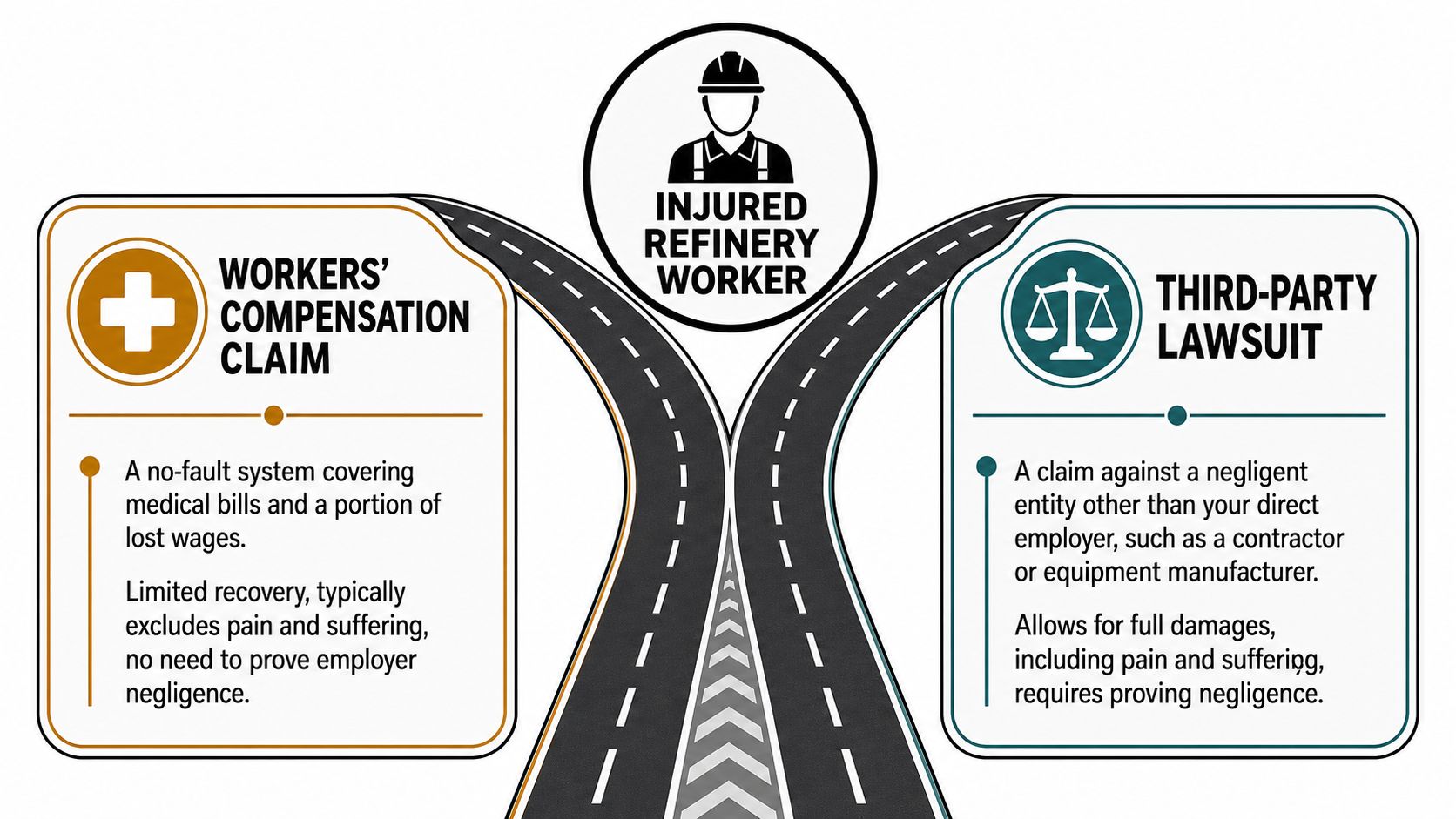
The easiest way to understand this is to think of it as a two-lane highway. Both lanes start with the same event. You were hurt at or around a refinery. But the lane your case follows changes what you must prove and what compensation may be available.
Lane one through workers' compensation
Workers' compensation is usually the more limited path. In plain English, it is a system that can provide defined benefits for work-related injuries without requiring you to prove your employer was careless. That sounds helpful, and in many situations it is.
But workers' comp often does not provide the same range of recovery available in a personal injury case. In many refinery matters, that means no recovery for pain and suffering through the comp claim itself. If your employer carries workers' comp coverage, that system may be your main remedy against the employer.
You can read more about job-related injury issues in this guide on being hurt at work in Texas.
Lane two through a third-party lawsuit
A third-party claim is different. This lawsuit targets someone other than your direct employer. That might be a contractor, subcontractor, equipment maker, maintenance company, or another outside entity connected to the incident.
This lane matters because a third-party case may allow recovery for the full scope of personal injury damages, including pain and suffering. That can be critical in refinery injury cases involving burns, long-term lung damage, disability, or loss of normal daily life.
Here's a simple comparison:
| Legal path | What it usually involves | What often matters most |
|---|---|---|
| Workers' compensation | Work injury benefits system | Whether the injury happened in the course of work |
| Third-party lawsuit | Personal injury claim against a non-employer | Whether that outside party acted negligently and caused the injury |
A short video can make that split easier to visualize.
Key legal words in plain English
Some terms sound technical, but they're manageable once you strip away the jargon.
- Liability means who is legally responsible.
- Negligence means failing to use reasonable care.
- Comparative fault means more than one party may share blame.
- Statute of limitations means the legal deadline to file a claim.
- Damages means the compensation the law allows for your losses.
Texas also follows a modified comparative negligence system. According to this explanation of Texas comparative negligence law, if you are 50% or less at fault, you can still recover damages, but your compensation is reduced by your percentage of fault. If you are 51% or more at fault, you cannot recover compensation.
That rule usually matters in third-party injury litigation, not in the same way it does in a straightforward workers' comp claim.
Where Chapters 33 and 41 fit
Under Texas Civil Practice & Remedies Code Chapter 33, courts address proportionate responsibility, which is closely tied to comparative fault. Under Chapter 41, Texas law addresses exemplary damages, sometimes called punitive damages, and related standards. In a refinery case, those chapters may matter if the evidence supports a civil lawsuit against a third party and raises questions about fault allocation or especially serious misconduct.
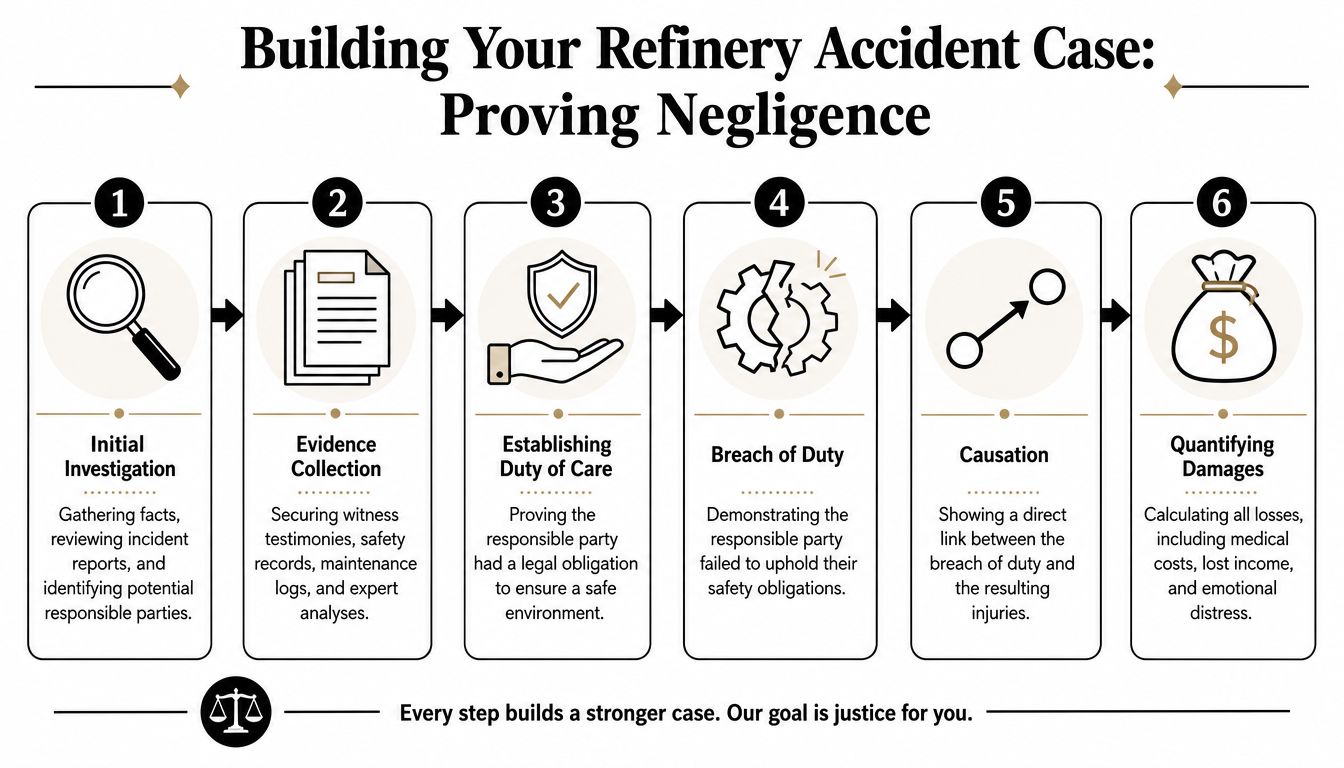
How a Lawyer Proves Negligence in a Refinery Case
A refinery case is built piece by piece. Unlike a typical roadway crash, the evidence may include technical logs, industrial procedures, federal safety standards, contractor records, and expert analysis about what failed and why.
The evidence a lawyer looks for
A lawyer usually starts by identifying every entity connected to the event. Then the investigation turns to the records that show what happened before, during, and after the accident.
Important evidence may include:
- Incident reports: Internal reports can help establish timing, location, and who responded.
- Maintenance logs: These may show skipped inspections, repairs, or known equipment problems.
- Witness accounts: Coworkers often notice warnings or unsafe practices that never make it into formal paperwork.
- Monitoring and emergency records: Air data, shutdown records, and response documents may help prove the nature of the event.
In a refinery case, early evidence preservation can matter as much as the lawsuit itself. Cleanup starts quickly, and companies rarely keep harmful evidence in the easiest possible format for an injured worker.
Why OSHA standards matter
Federal safety rules often become a central part of the case. According to this discussion of refinery litigation standards, plaintiffs must establish liability by proving violations of OSHA Process Safety Management standard 29 CFR 1910.119, which requires rigorous hazard analyses and operating procedures.
That matters because negligence is easier to show when a company or outside contractor failed to follow safety duties that exist to prevent exactly this type of harm. A lawyer may work with engineers, industrial safety experts, and medical experts to connect those violations to your specific injuries.
A real-world example of how proof comes together
Take a worker who was exposed during a release linked to a contractor's valve work. The legal team may compare maintenance records, contractor responsibilities, witness statements, and later medical findings. If the records show the contractor failed to follow required procedures and the failure led to the release, that creates a direct path toward liability.
If the worker later gives sworn testimony, language access may become important. Resources on navigating deposition interpreting challenges can help families understand why clear interpretation can affect the accuracy of a case record.
For comparison, a case involving a road collision on refinery property might also require traffic-related analysis. A Houston Car Accident Lawyer handles representation for car accident victims in Houston and Harris County, while a refinery injury lawyer focuses on industrial evidence and workplace safety failures. The legal tools overlap in some areas, but the proof is very different.
What Compensation Can You Claim for Your Injuries
Once liability is established, the next question is what your case is worth in legal terms. The answer depends on your injuries, your losses, and whether the claim is limited to workers' comp or includes a third-party lawsuit.
Economic damages
Economic damages are the financial losses you can point to on paper. These are often easier to document, though future losses can still require expert support.
Examples include:
- Medical bills: Emergency care, hospital stays, medication, specialist visits, and future treatment
- Lost wages: Income you missed while recovering
- Reduced earning ability: If you can't return to the same type of refinery work
- Rehabilitation costs: Ongoing therapy or long-term support
If you want a broader explanation of how lawyers value these losses, this guide on how damages are calculated in injury cases is a helpful starting point.
Non-economic damages
Non-economic damages cover harms that don't come with a simple invoice. They are still real, and often they are the hardest part of the injury.
A worker with chronic breathing problems may lose sleep, independence, stamina, and the ability to enjoy normal family routines. Someone with severe burns may live with pain, scarring, and emotional distress long after the hospital discharge.
Some of the most serious refinery losses don't show up on a bill. They show up when you can't sleep, can't breathe normally, or can't return to the life you had before.
Punitive or exemplary damages
In rare cases, Texas law may allow punitive damages, also called exemplary damages. These are not meant to repay your losses directly. They are meant to punish especially serious misconduct and discourage similar behavior. Chapter 41 of the Texas Civil Practice & Remedies Code governs this area.
A Houston driver rear-ended on I-45 may pursue damages in a crash case. A refinery worker exposed to toxic chemicals may pursue a different mix of damages in a third-party industrial case. The categories are familiar across Texas personal injury law, but the proof and stakes often look very different. If a death occurred, surviving family members may also need guidance about wrongful death compensation.
Key Questions to Ask a Houston Refinery Accident Lawyer
Not every personal injury lawyer handles refinery litigation well. These cases are technical, document-heavy, and often involve multiple companies with competing stories. You need direct answers before you hire anyone.
Questions that reveal real experience
Bring a list and take notes. Good questions include:
- How do you evaluate delayed toxic exposure claims? You want to know whether the lawyer understands injuries that don't fully appear right away.
- Who do you investigate besides the employer? This helps you learn whether the lawyer looks seriously at contractors, manufacturers, and other third parties.
- How do you preserve refinery evidence early? The answer should include records, witnesses, and technical data.
- How do Texas negligence rules affect my case? The lawyer should explain fault, damages, and deadlines in plain English.
- Who will handle my file? You deserve clarity about communication and day-to-day case work.
A practical checklist can also help you compare attorneys side by side. This guide on questions to ask a personal injury attorney gives you a useful framework.
Ask about deadlines and diagnosis timing
The statute of limitations is the deadline for filing suit. For most Texas personal injury negligence claims, Texas Civil Practice and Remedies Code Section 16.003(a), as discussed here, provides a two-year limitations period that begins when the injury occurred or was reasonably discovered.
That wording matters in toxic exposure cases. Ask the lawyer how they analyze cases where diagnosis came after the initial incident. That issue can shape the whole case.
Look for clarity, not slogans
A good consultation should leave you feeling more grounded, not more pressured. If you're comparing firms or legal service tools, it can help to browse AI Law reviews and similar feedback sources to see how people evaluate communication and client experience. The goal is not hype. The goal is clear, informed help.
Contact The Law Office of Bryan Fagan for a Free Consultation
After a refinery accident, you may feel pulled in too many directions at once. Doctors want follow-up visits. Your employer wants paperwork. An insurance adjuster wants a statement. Your family wants answers you may not have yet. You don't need to solve all of that alone.
The Law Office of Bryan Fagan, PLLC offers free consultations for injury cases and works on a contingency-fee basis, which means you don't pay attorney's fees unless there is a recovery in your case. That structure gives injured people a way to get legal guidance without adding another immediate financial burden.
Why timely legal help matters
A refinery case can involve workers' comp questions, third-party negligence issues, comparative fault arguments under Chapter 33, and damages issues under Chapter 41. It may also involve long-term exposure evidence that becomes harder to prove if records disappear or medical documentation starts too late.
If your case also includes a fatal loss or a commercial vehicle component, related practice areas may matter too, including claims involving truck accidents in Houston. Some families also need help understanding wrongful death compensation when a refinery event takes a loved one's life.
What to bring to a consultation
You don't need a perfect file. Bring what you have:
- Medical papers: discharge records, prescriptions, test results
- Work documents: incident reports, employer communications, pay records
- Photos or videos: injuries, damaged gear, scene images if available
- Your timeline: when the event happened, when symptoms began, and what changed
If you're curious how law firms educate the public and explain complex cases online, Outrank's insights on legal marketing offer one example of how legal information is presented. But when your own health, job, and future are on the line, personalized advice matters more than general content.
The important thing is to act before deadlines become another problem. Even if you aren't sure whether your case belongs in workers' comp, a third-party lawsuit, or both, a consultation can help you understand your rights and next steps.
If you were hurt in a refinery accident, or if your family is dealing with the loss of a loved one, contact The Law Office of Bryan Fagan, PLLC for a free consultation. You can talk through your situation, learn how Texas law may apply, and get clear guidance about workers' comp, third-party claims, auto insurance claim issues, and wrongful death compensation. You deserve answers, respect, and a path forward.