Skip to content
A car crash can change your life in seconds, but you don't have to face recovery alone.
If you're reading this after a wreck in Pearland, you're probably dealing with more than vehicle damage. You may be hurting, missing work, fielding insurance calls, and trying to stay calm for your family. On roads like FM 518, Broadway, or the routes that connect Pearland to Houston, an ordinary drive can turn into a legal and financial mess fast.
That first day often feels blurry. A parent is trying to find the tow yard. A spouse is asking whether the pain will get worse tomorrow. Someone is already wondering how to pay for treatment. That's normal. After a collision, those affected don't need legal jargon. They need a clear plan.
A Pearland car accident lawyer helps turn chaos into steps. The right guidance can protect your health, your evidence, your insurance claim, and your right to seek compensation under Texas law. If your crash involved a distracted driver, a drunk driver, a commercial truck, or an uninsured driver, those details matter early.
This guide walks through the process in plain English. You'll see how liability works, what comparative fault means, what damages may be available, how the filing deadline works, and what to do when an insurer tries to lowball your claim. You'll also see where families often get tripped up, especially when they assume the insurance company will sort everything out fairly on its own.
A Crash Can Change Your Life But You Dont Have to Face It Alone
A Pearland family can be driving home on FM 518 after an ordinary evening and, within seconds, everything changes. One moment you are thinking about homework, dinner, or tomorrow's commute. The next, you are dealing with neck pain, a damaged car, missed work, and an insurance adjuster asking questions before you have even had time to breathe.
That is what makes the first days after a wreck so hard. The crash is over, but the problems keep arriving in waves. Pain may show up later. Bills start coming. A low settlement call can sound tempting when the deductible is due and the car is still in the shop.
Recovery usually happens on three tracks at the same time, and they rarely stay neatly separated:
- Your health. Doctor visits, imaging, medication, physical therapy, and watching for symptoms that get worse after the adrenaline fades.
- Your finances. Lost income, repair costs, rental car issues, deductibles, and the strain of ordinary household expenses.
- Your claim. Gathering proof, identifying who caused the wreck, and protecting your right to recover money under Texas law.
A crash claim works a lot like building a file for a school or work project. If key pages go missing, the full picture gets harder to prove. That is why the early days matter so much. Photos, medical records, receipts, witness names, and even a short note about your pain each day can all become part of the story that shows what this wreck cost you.
Practical rule: Treat the period after a crash as a record-building window. Keep every bill, save every receipt, and write down what you feel and what you miss because of the injury.
Distracted driving remains a serious problem on Texas roads. The Texas Department of Transportation's distracted driving data shows how often a routine trip turns into a life-changing collision. For Pearland victims, that risk feels local, not abstract, especially on busy roads that connect neighborhoods to Houston job routes, school traffic, and packed commercial corridors.
Many injured people make the same understandable mistake. They assume the insurance company will gather the facts, value the claim fairly, and account for future treatment on its own. In reality, insurers often look for reasons to pay less, especially when fault is disputed or injuries are not fully visible right away. That problem gets sharper in Texas because the 51 percent fault rule can reduce or block recovery if blame is pushed onto you.
You do not need to solve every legal and financial issue on day one. You do need a clear plan, a calm approach, and an understanding of how Pearland crash cases really unfold from the scene of the wreck to the point where compensation is on the table.
What a Pearland Car Accident Lawyer Actually Does For You
Many people think a lawyer only files lawsuits or appears at trial. In a car wreck case, the job starts much earlier. A Pearland car accident lawyer often steps in while you're still arranging medical care and trying to get your car looked at.
The first benefit is simple. Your lawyer becomes the point of contact for the claim. That means the insurance company has to direct many communications through your legal team instead of catching you off guard when you're stressed or medicated.
The job starts with protection
A lawyer helps protect you from avoidable damage to your claim by handling:
- Insurance communication so you don't give a recorded statement that gets twisted later.
- Evidence collection such as police reports, photos, medical records, witness information, and crash scene details.
- Claim organization so bills, repair estimates, wage loss documents, and treatment records are tracked in one place.
Texas negligence law depends on proof. To win a claim, the injured person must prove duty, breach, causation, and damages, as discussed by Reyes Law's explanation of Texas comparative negligence. In plain language, that means showing the other driver had a duty to drive safely, failed to do it, caused the crash, and left you with actual harm.
A lawyer also looks for missing pieces
A crash is rarely just about the bumper damage. It may involve future treatment, missed work, or a dispute over who caused what. If the collision involved a delivery van, company vehicle, or commercial truck, there may be more than one liable party.
For example, a Houston driver rear-ended on I-45 may think the case is only against the driver behind them. But if that driver was working at the time, the employer may become part of the investigation. The same kind of careful analysis can matter in Pearland crashes on busy commuter routes.
A lawyer may also help families understand when a different type of traffic injury claim is involved. For instance, Houston Pedestrian Accident Lawyer covers representation for pedestrians struck by vehicles in Houston.
A strong claim isn't built from one dramatic fact. It's built from many small facts preserved early and presented clearly.
Calculating the claim, not just filing it
Lawyers also estimate the full value of a claim. That includes not only current expenses, but also future losses that may not be obvious in the first week after the crash.
Texas Civil Practice & Remedies Code Chapter 41 is part of the broader damages framework lawyers consider when evaluating what losses may be recoverable and how a case should be presented. In everyday terms, damages means the money claimed for losses caused by the wreck. That may include medical expenses, lost income, property damage, pain, and other harm recognized by law.
The Critical Steps to Take Immediately After a Pearland Crash
The first day after a crash matters. Not because you need to become your own lawyer at the roadside, but because a few calm decisions can protect both your health and your claim.
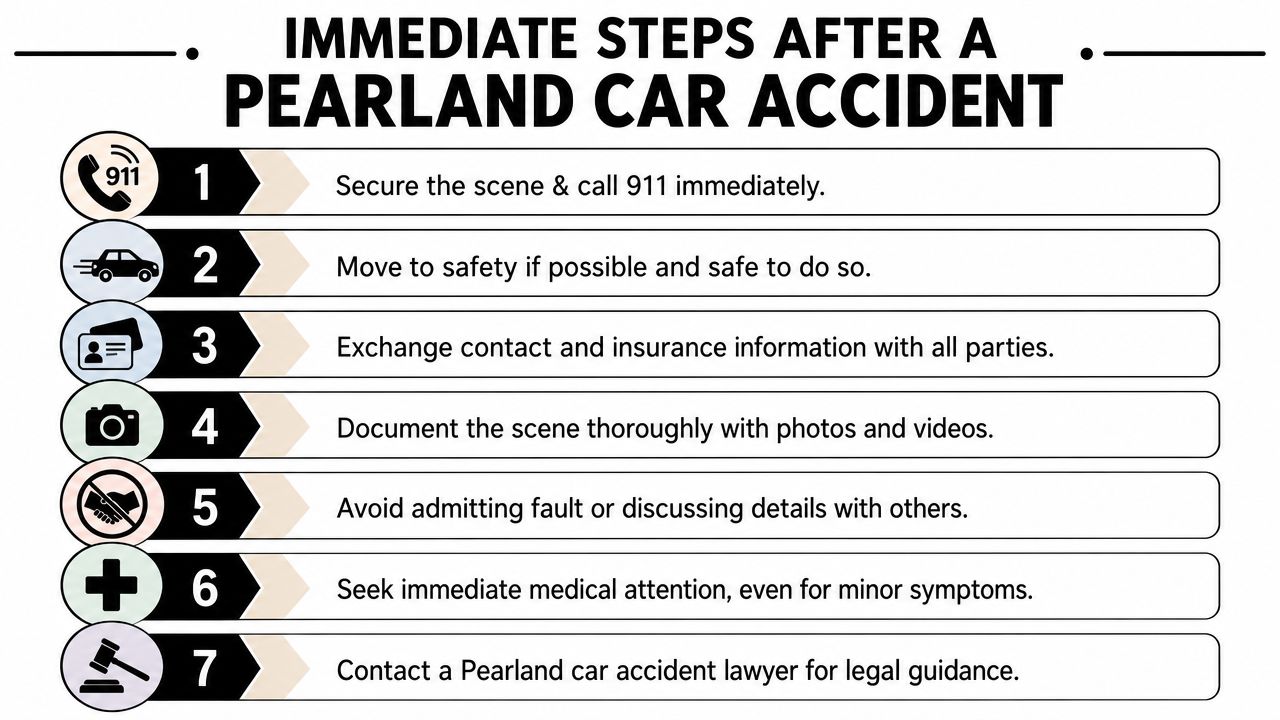
What to do at the scene
Start with safety. If you can move without making things worse, get to a safer location and call 911.
Then focus on gathering the basics:
- Call police and request medical help. Even if the crash seems minor, an official report can become important later.
- Exchange information. Get names, contact details, driver's license information, plate numbers, and insurance details.
- Take photos and video. Capture vehicle positions, damage, skid marks, debris, traffic signs, weather, and visible injuries.
- Get witness names. Neutral witnesses can make a big difference if the facts are disputed.
Don't argue about fault. Don't apologize in a way that sounds like an admission. Just stick to facts.
What to do in the next several hours
Symptoms can show up later. Neck pain, headaches, numbness, and back pain often don't peak at the scene.
Take these steps as soon as you can:
- Get checked by a medical professional. This protects your health and creates a record linking the crash to your injuries.
- Save everything. Keep discharge papers, prescriptions, invoices, and towing or rental paperwork.
- Write down your memory. Note where the crash happened, which direction each vehicle was traveling, what the light was doing, and what was said.
If you want a broader checklist, this guide on what to do after a car accident is a useful next read.
What to avoid in the first few days
The most common mistakes are preventable.
| Situation | Better choice |
|---|---|
| The other insurer asks for a recorded statement | Politely decline until you understand your injuries and legal position |
| You feel "mostly okay" | Keep your medical appointment anyway |
| You want to post about the crash online | Don't. Photos and comments can be used against you |
| You get an early settlement offer | Review it carefully before signing anything |
An auto insurance claim is the request you make for payment under an insurance policy. That sounds simple, but the process gets complicated fast when fault, injuries, and coverage limits are disputed.
Who Is Liable Understanding Fault in Texas Car Accidents
Fault decides who pays. After a wreck in Pearland, that question often becomes a fight within days, especially in crashes on busy roads like FM 518 where each driver may tell a different story about the light, speed, or lane position.
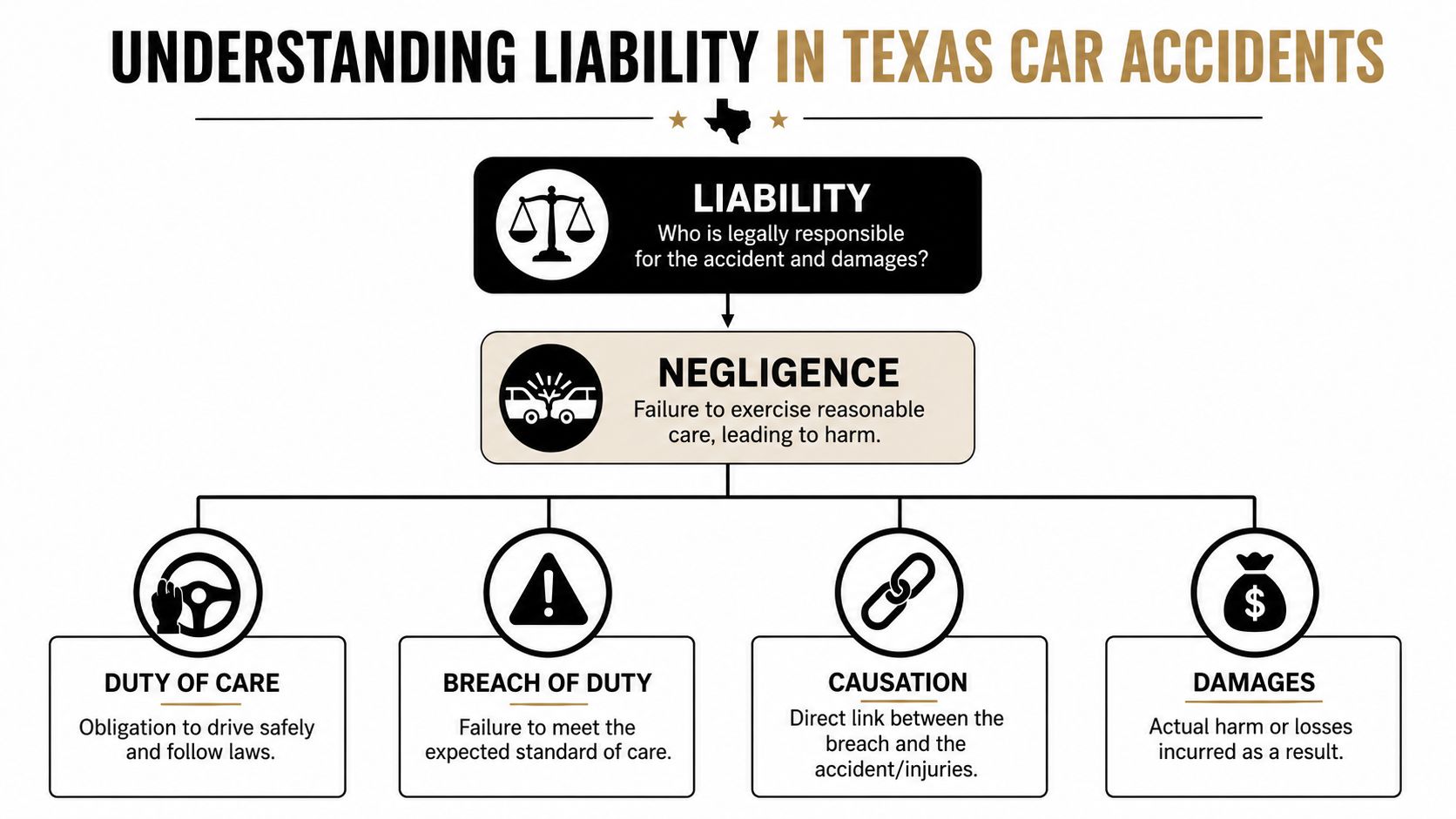
The four parts of negligence
Texas car accident claims usually rise or fall on negligence, which means a driver failed to use reasonable care. Courts and insurers often break that question into four parts:
- Duty. Every driver has a legal duty to operate a vehicle with reasonable care.
- Breach. A breach happens when that driver breaks the rules of safe driving, such as speeding, texting, following too closely, or running a red light.
- Causation. The unsafe act must be what caused the crash.
- Damages. There must be actual losses, such as medical bills, missed work, pain, or vehicle damage.
A simple way to understand it is to picture a chain. If one link is missing, the claim gets weaker. If a driver on Broadway ignores a red light and hits a vehicle that entered legally, the duty, breach, causation, and damages are easier to see. In a disputed merge, sudden-stop, or multi-car pileup, those links take more work to prove.
Texas uses a 51% fault rule
Texas follows proportionate responsibility under Texas Civil Practice and Remedies Code Chapter 33. As the Texas Constitution and Statutes website explains in Chapter 33, an injured person cannot recover damages if that person is more than 50% responsible for the harm. If the injured person is 50% or less at fault, the recovery is reduced by that percentage.
That rule matters more than many families realize.
If your case is worth $100,000 and you are found 20% at fault, your recovery drops to $80,000. If you are found 51% at fault, you recover nothing from the other side. That is why fault arguments are not just paperwork. They directly affect whether a claim has value and how much money is available for medical care, lost income, and repairs.
| Fault finding | What it means |
|---|---|
| You are 20% at fault | You can still recover, but your damages are reduced by 20% |
| You are 50% at fault | You can still recover, but half the damages are reduced |
| You are 51% at fault | You recover nothing from the other negligent party |
Why fault is often contested in Pearland claims
Insurance companies study the facts for one reason. Shifting even a small share of blame onto you can shrink the payout.
That happens often in Pearland-area crashes involving intersections, rear-end collisions, left turns, lane changes, and chain-reaction wrecks. A rear-end crash may look simple until the insurer argues the lead driver stopped suddenly. An intersection crash may seem clear until both sides claim they had the green light. On roads with heavy local traffic, a few seconds of confusion can become the center of the whole case.
The evidence usually decides which version holds up. Police reports matter, but they are only one piece. Photos, witness statements, vehicle damage, skid marks, black-box data, medical records, and nearby camera footage can all affect the final fault decision.
Common ways insurers try to increase your share of blame
Adjusters rarely say, "We are trying to cut the claim." They usually frame it in softer language. They may argue that you were distracted, following too closely, driving too fast for conditions, or failed to avoid the impact.
That is why early statements matter. A casual comment like "I never even saw him" can be recast as inattention. A guess about speed can be treated like a firm admission. In property-damage disputes, even the value of a totaled vehicle can become part of the pressure campaign, which is one reason some drivers benefit from understanding the appraisal clause before accepting the insurer's position.
What liability really means for your case
Liability is about proof, not assumptions. The side with the clearer evidence usually has the stronger position.
A Pearland car accident lawyer helps build that proof in a way that fits Texas law. That can include identifying every potentially responsible party, answering blame-shifting arguments, and showing why the other driver's conduct caused the losses that followed. For injured victims dealing with the 51% rule, that work can make the difference between a reduced recovery and no recovery at all.
Maximizing Your Compensation What Your Claim Is Really Worth
Most injured drivers don't know what their claim is worth in the first week, and they shouldn't be expected to. Insurers often make early offers before the full picture is clear. That's one reason low settlements happen.
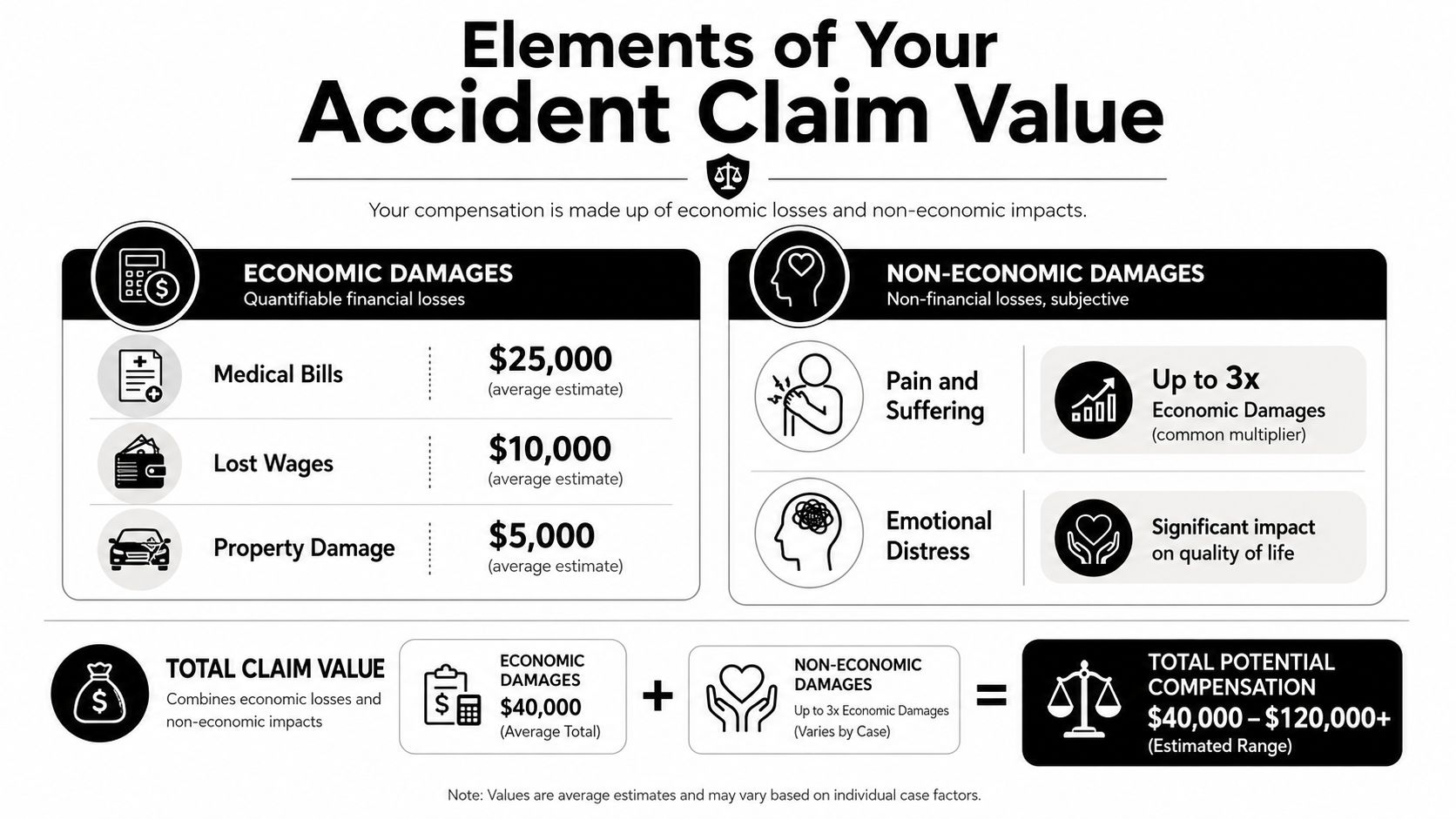
The two broad categories of damages
A car wreck claim usually includes economic damages and non-economic damages.
Economic damages are losses you can point to on paper, such as:
- Medical bills
- Lost wages
- Property damage
- Out-of-pocket expenses tied to the crash
Non-economic damages are human losses that don't come with a fixed bill, such as pain, emotional distress, and the effect the injury has on daily life.
A Texas injury attorney looks at both categories together. If you settle too soon, you may leave future care, future missed work, or ongoing pain out of the claim entirely.
Why policy limits matter so much
Texas requires minimum liability coverage of $30,000 for bodily injury or death to one person and $60,000 for two or more people in one collision under Texas minimum auto liability rules discussed by Gustin Law. That may sound substantial until you see what a serious injury costs.
A major problem in Pearland and across Texas is underinsurance. 60% of Texas drivers carry only minimum $30K/$60K liability coverage, while average medical costs for moderate-to-severe crashes exceed $150,000, according to Newman Injury Law's Pearland car accident page. That's a large gap between available coverage and actual loss.
That same source points to a practical solution many drivers forget about. Your own UM/UIM coverage may help when the at-fault driver has no insurance or not enough insurance. UM/UIM stands for uninsured or underinsured motorist coverage.
Other sources of recovery can matter
A claim may involve more than one payment source. Depending on the facts, there may be a claim against a company policy, your own UM/UIM policy, or in some cases the at-fault driver's assets.
Property damage disputes can also drag on, especially when a vehicle is declared a total loss. If you're fighting over vehicle value, it helps to read about understanding the appraisal clause so you know one common way these disagreements are handled.
The first offer often reflects what the insurer hopes you'll accept before your damages are fully documented.
If you're comparing options for legal help, one resource is Houston Car Accident Lawyer, which provides representation for car accident victims in Houston and Harris County.
The Clock Is Ticking Texas Car Accident Deadlines You Cannot Miss
A Pearland crash claim can go stale faster than families expect. You may still be getting treatment, waiting on repair estimates, or trying to get an adjuster to return your calls. Meanwhile, the legal clock keeps running.
For most Texas car accident injury cases, the deadline to file a lawsuit is two years from the date of the crash under Texas Civil Practice & Remedies Code § 16.003. If that date passes, the court can dismiss the case, even if your injuries are real and the insurer has been discussing settlement. If you want a plain-English explanation, this guide to the Texas car accident statute of limitations breaks down how the rule works.
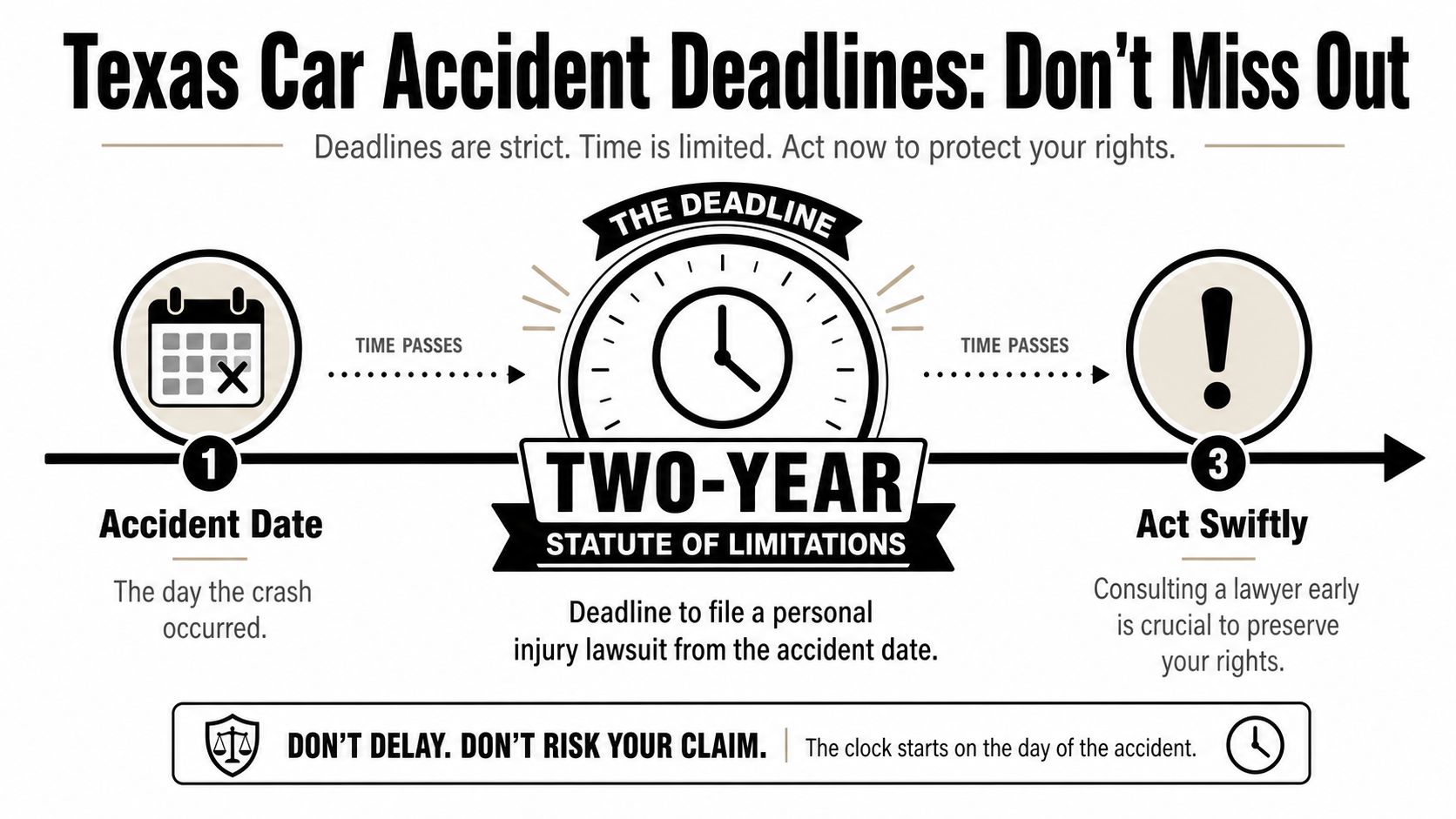
What "statute of limitations" actually means
The statute of limitations is the filing deadline for a lawsuit. It is separate from an insurance claim.
That distinction trips people up. An adjuster can keep asking for records, reviewing treatment, or discussing fault for months. None of that extends the court deadline by itself. A settlement conversation is not a substitute for filing on time.
Wrongful death cases follow a similar timing rule, but the two-year period generally runs from the date of death, not always the date of the crash. That difference matters for families who are still dealing with funeral costs, probate issues, and unanswered questions about what happened.
Why waiting hurts a case long before the deadline
The two-year mark is the final stop, not the point when delay starts causing damage.
A car accident case works like a trail of footprints after rain. Right after a wreck on FM 518 or another busy Pearland road, the evidence is sharp and visible. With time, it fades.
- Witnesses forget small but important details
- Nearby video footage may be overwritten
- Damaged vehicles get repaired, sold, or totaled out
- Skid marks, debris patterns, and scene conditions disappear
- Gaps in medical care give insurers room to argue that you were not badly hurt
This short video helps explain why legal timing matters so much after a crash.
Delay also makes fault disputes harder. In Pearland cases, insurers often look for a way to shift part of the blame onto the injured driver. Under Texas's 51% fault rule, that argument can change the value of a claim or wipe it out if they convince a jury you were mostly responsible. Acting early gives your lawyer a better chance to secure the records, photos, phone data, and witness statements needed to push back before the story gets rewritten by the insurance company.
Choosing the Right Advocate for Your Pearland Case
Not every lawyer handles car wreck cases the same way. If your collision happened in Pearland, you want someone who understands how a Texas injury claim is built, how insurers defend these cases, and what local evidence tends to matter.
The right advocate doesn't just sound confident. The right advocate listens, explains, and acts quickly.
What to look for
Use this checklist when comparing firms:
- Focus on injury law so the lawyer regularly handles negligence, insurance, and damages issues.
- Experience with Texas fault disputes because comparative fault arguments can decide whether a case survives.
- A clear process for communication so you know who will answer questions and update you.
- Trial readiness because insurers negotiate differently when they know a lawyer can take a case forward if necessary.
If you're sorting through your options, this article on how to choose a car accident lawyer can help you ask better questions during consultations.
Ask how fees work
Many individuals worry about cost right away. That's understandable. After a crash, cash flow is often tighter than usual.
Many injury cases are handled on a contingency fee. That means the lawyer is paid from a recovery if the case succeeds, rather than charging upfront hourly fees. Before hiring anyone, ask for the fee agreement in writing and make sure you understand costs, case expenses, and how settlement funds are distributed.
Local understanding matters
A Pearland case may involve suburban intersections, commuter traffic toward Houston, and adjusters who treat "minor" crashes as if they can't cause serious injuries. But local victims know better. A rear-end crash near a busy retail corridor can disrupt childcare, work schedules, and treatment for months.
One option families may consider is The Law Office of Bryan Fagan, PLLC, a Texas personal injury firm that handles car accident claims, insurance disputes, and wrongful death matters for injured Texans. The key is to choose an advocate who explains your rights clearly and takes your case seriously from day one.
Frequently Asked Questions About Pearland Car Accident Claims
After a crash in Pearland, families usually have the same concern. What happens now, and how do we avoid a mistake that hurts the claim? These answers focus on the issues local victims run into most often, from collisions on busy roads like FM 518 to insurance adjusters who try to treat a real injury like a small inconvenience.
How is fault determined in a Texas car accident?
Fault is built from evidence, piece by piece. Police reports, vehicle damage, photos from the scene, witness statements, medical records, and sometimes crash reconstruction all help show what happened.
In Texas, more than one driver can share blame. That matters because insurers often try to shift extra fault onto the injured person to reduce what they pay. If a wreck happened in heavy Pearland traffic or during a confusing turn at a crowded intersection, the details matter even more.
Do I have to go to court to get a settlement?
Many car accident claims settle without a trial. A case often resolves after the facts are gathered, treatment is understood, and the insurance company sees the full value of the harm.
Court becomes more likely if the insurer disputes fault, questions your injuries, or offers far less than the claim is worth. In practice, the stronger your preparation, the more seriously the insurer tends to treat the case.
What does comparative fault mean in plain English?
Comparative fault means both drivers can be assigned a share of responsibility. Your compensation can be reduced by your percentage of fault.
Texas also uses the 51% rule. If you are 51% or more responsible, you usually cannot recover damages from the other driver. A simple way to view it is this. Partial fault may reduce a claim. Too much assigned fault can block it altogether.
What are damages?
Damages are the losses the crash caused. Some are financial, such as medical bills, lost income, rehabilitation costs, and vehicle-related expenses. Others reflect how the injury changed your daily life, such as pain, physical limits, missed family responsibilities, and the loss of normal routines.
That second category is where families often feel confused. A claim is not limited to receipts. It can also include the human cost of the injury.
What if the other driver had little or no insurance?
This is a common problem. A driver may carry only minimal coverage, or none at all, leaving your losses larger than the available policy.
Your own uninsured motorist or underinsured motorist coverage may help in that situation. A lawyer can also check for other possible sources of recovery, such as an employer policy, a commercial policy, or another party who contributed to the crash.
Should I talk to the other driver's insurer?
You can usually give basic facts, such as the date and location of the crash. Be careful beyond that. Do not guess about speed, fault, or the extent of your injuries. Do not downplay pain just because adrenaline is still high.
Recorded statements deserve special caution. What sounds like a casual question can later be used to challenge your claim.
Can a Houston car accident lawyer handle a Pearland case?
Yes. Pearland cases often connect to the larger Houston area because of commuting routes, medical providers, and the insurance companies handling the claim. A Houston car accident lawyer may regularly represent people injured in Pearland.
Local familiarity still matters. A lawyer who understands Pearland traffic patterns, local crash locations, and how insurers respond to suburban collision claims may be better prepared to present the facts clearly.
What if a crash caused a death in my family?
A fatal crash changes the legal case and the family's immediate needs. Texas law may allow a wrongful death claim or a survival claim, depending on the facts. These cases can involve funeral expenses, lost financial support, and the loss of care, guidance, and companionship.
Time matters here. So does careful handling. Families should try to preserve records, avoid detailed insurer conversations before getting advice, and get legal guidance as soon as they are able.
If you were hurt in a wreck and need answers about your next step, contact The Law Office of Bryan Fagan, PLLC for a free consultation. You can get clear guidance about your rights, your auto insurance claim, possible compensation, and what to do now to protect your case.