Skip to content
A car crash can change your life in seconds, but you don't have to face recovery alone.
The same is true after an oilfield injury. One normal shift can turn into a helicopter ride, an ER visit, surgery, missed paychecks, and hard questions about how your family is supposed to get through the next few months. When considering a Houston oilfield accident lawyer, individuals are probably not looking for legal theory. They want clear answers, honest guidance, and a plan.
At the same time, many injured workers already know how confusing Texas injury claims can get. You may hear one story from a supervisor, another from an insurance adjuster, and something completely different from a contractor on site. Terms like liability, damages, comparative fault, and statute of limitations start showing up fast. In plain English, liability means legal responsibility. Damages are the losses the law may let you recover, such as medical bills, lost income, and pain and suffering. Comparative fault means your compensation can change if you share part of the blame. The statute of limitations is the filing deadline.
Texas negligence law also matters here. To win a negligence claim in Texas, you generally must prove duty, breach, causation, and damages, and the proof standard is a preponderance of the evidence, meaning the claim is more likely true than not, as explained in this discussion of Texas negligence elements. In oilfield cases, those rules often overlap with Texas Civil Practice & Remedies Code Chapter 33 on responsibility and fault allocation, and Chapter 41, which can become important in cases involving especially serious misconduct.
A practical example helps. A Houston driver rear-ended on I-45 may bring a straightforward auto insurance claim against the at-fault driver. An oilfield worker hurt when one company's valve fails on another company's rig, while a third company controls site safety, faces a much more complex investigation. That's why identifying every responsible party matters from day one.
An Injury on the Oilfield Can Change Your Life in an Instant
You clock in expecting another long day. Then a pressure event happens. A hose whips loose. A piece of equipment jams. Someone yells. A few minutes later, your phone is gone, your hard hat is somewhere on the ground, and your spouse is getting a call no family ever wants.
That kind of shock is hard to describe unless you've lived it. Most injured workers don't just deal with pain. They deal with uncertainty. Can you return to work? Who pays for treatment? What if your employer says another company caused it? What if the contractor says you were never really their worker?
Texas oilfields create those problems because they are busy, layered workplaces with multiple companies operating side by side. Texas leads the nation in oil and gas output, and the Bureau of Labor Statistics reported about 161,300 workers in the industry as of September 2019, exposing a massive workforce to hazards like explosions and equipment failures, according to this overview of Houston oilfield accident risks.
Practical rule: The first story told about an oilfield accident often leaves out key facts. Early investigation matters because jobsite narratives can harden quickly.
A serious oilfield case doesn't move like a simple slip-and-fall claim. Equipment may disappear. Contractors may point fingers. Insurance companies may try to narrow the case before you even understand what happened. That's why a Houston oilfield accident lawyer should know how these sites operate, not just how to file paperwork.
You still have options. You may have a workers' compensation issue, a third-party injury claim, or both. You may also have a claim involving unsafe equipment, poor supervision, or failures in site coordination.
The path forward starts by protecting your health and preserving the facts.
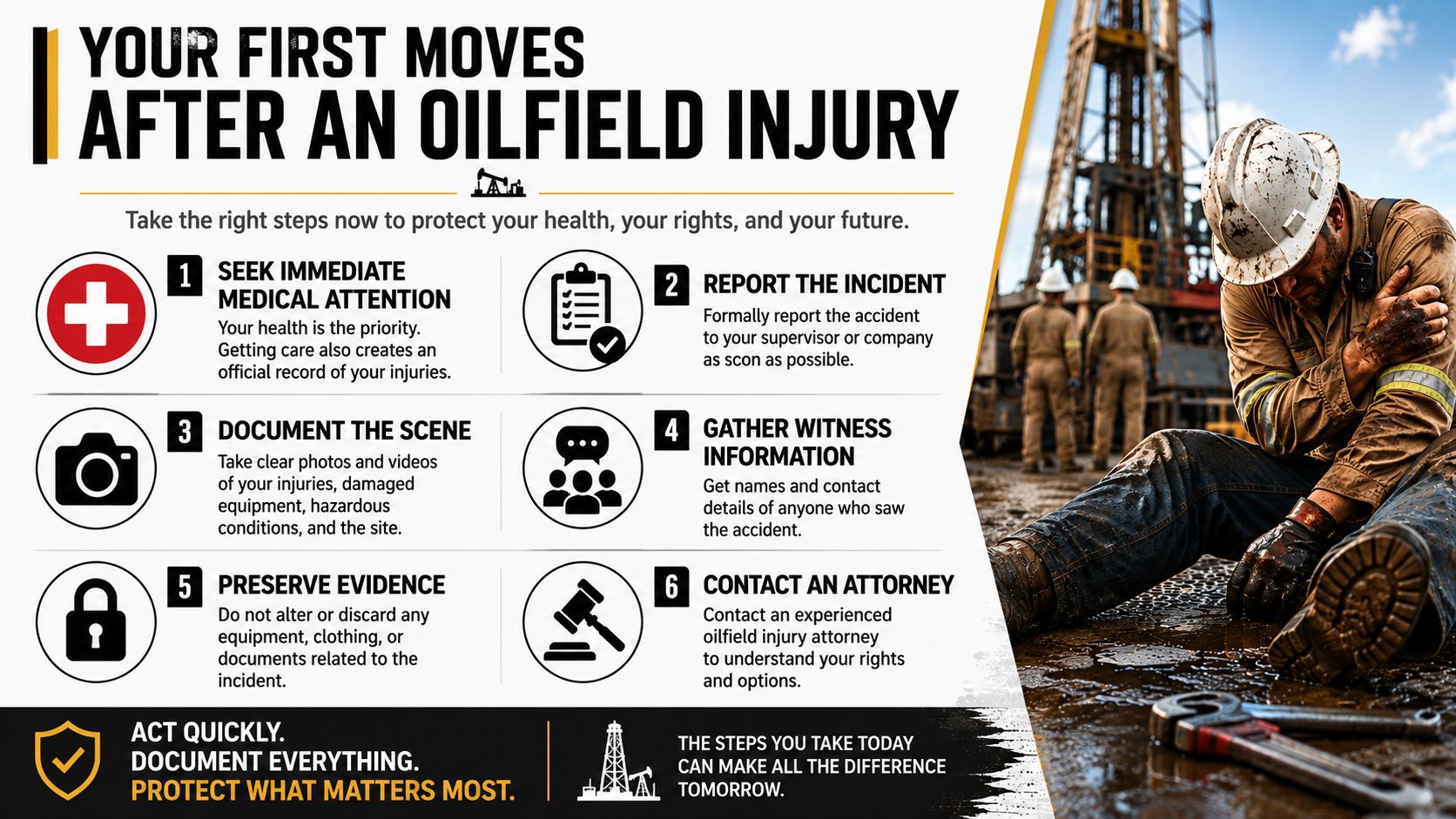
Your First Moves After an Oilfield Injury
The first hours and days after an accident can shape the rest of your case. Small choices matter. So does what you say, what gets documented, and what gets lost.
Get medical care before you worry about the claim
Your health comes first. If you're seriously hurt, get emergency treatment. If the injury seems minor, still get checked. Burns, head injuries, crush injuries, toxic exposure, and back injuries often worsen after adrenaline wears off.
Medical records also matter legally. They create a timeline between the incident and your symptoms. If you wait too long, the insurance company may argue something else caused the problem.
Report the incident carefully
Tell your supervisor or the company contact that you were hurt and that the injury happened on the job. Keep it factual. Don't guess about speed, blame, or what you “should have done.” Don't say you're fine if you're not.
A short report is better than a rushed explanation that turns into a problem later.
- State the basics: when it happened, where it happened, and what equipment or task was involved.
- Name witnesses: if anyone saw the event or the unsafe condition, include that.
- Ask for a copy: if the company creates a report, try to keep a copy or photo of it.
For broader workplace guidance, this resource on what to do if you were hurt at work can help you avoid common mistakes in the first few days.
Preserve what the site won't preserve for you
Oilfield scenes change fast. Trucks move. tools get reassigned. damaged parts get removed. If you can do it safely, start documenting.
- Photograph the scene: include your injuries, the equipment involved, warning signs, ground conditions, and anything that looks broken or out of place.
- Save your gear: don't wash bloody clothing, throw away gloves, or replace damaged PPE until you speak with counsel.
- Write down details: record names of contractors, logos on trucks, serial numbers, shift times, and what work each crew was doing.
The clean-up crew's job is to restore operations. Your job is to preserve proof.
Be careful with insurers and company representatives
Soon after an accident, someone may ask for a recorded statement. You don't have to treat every call like it's friendly. Insurance companies and company investigators often look for ways to narrow liability, reduce damages, or shift fault.
If the injury also involved a roadway crash, such as a company pickup, tanker, or service truck, legal issues may overlap with motor vehicle claims. In that setting, a Houston Car Accident Lawyer handles representation for car accident victims in Houston and Harris County.
Talk to a lawyer before evidence goes cold
You don't need to know every legal answer before making the call. You only need enough to know this is too important to handle casually. Oilfield cases are rarely just about one employer and one injury report.
Who Is Held Accountable for Your Injuries
The biggest mistake in many oilfield claims is assuming the direct employer is the only party that matters. On a modern Texas site, that often isn't true.
Liability starts with negligence
Liability means legal responsibility for the harm done to you. In most injury cases, that responsibility is built around negligence. A company or person may be negligent if they owed you a duty of care, failed to meet it, and caused real harm.
On an oilfield, that can look different depending on who had control over the work, the equipment, or the site. One company may run drilling operations. Another may supply pressure-control equipment. Another may handle transport. Another may supervise safety compliance.

The overlooked problem with multi-contractor sites
One of the hardest issues today is the “silent employer” problem. A worker may be hired through one layer, paid through another, supervised by someone else, and injured by equipment supplied by a fourth company. When the injury happens, each business may try to say someone else was responsible.
That problem has become harder, not easier. Data from the Texas Department of Insurance shows a 22% increase in oilfield accidents involving independent contractors in 2024, which has created more complex liability disputes where injured workers need help identifying all responsible parties, according to this discussion of Houston oilfield contractor liability.
Here are some of the parties that may be involved:
- Direct employers: They may have failed to train workers, provide safety gear, or enforce safe procedures.
- Contractors and subcontractors: A third-party crew may have created the hazard that injured you.
- Equipment manufacturers: If a valve, hose, truck component, or machine failed because it was defective, a product liability claim may exist.
- Property owners or operators: The company controlling the site may have ignored a dangerous condition.
A real-world example
A Houston driver rear-ended on I-45 usually knows who hit them. An oilfield worker hurt in a rig blowout or equipment failure may face a completely different puzzle.
Say a transport crew delivers equipment. A subcontractor installs it. Another contractor performs pressure testing. The site operator wants production moving. Then a component fails and a worker suffers burns. The direct employer may not be the party with the deepest responsibility. The right claim may depend on contracts, maintenance records, communications, and which company had actual control at the moment of failure.
Some of the strongest oilfield cases aren't built by asking who signed the paycheck. They're built by asking who controlled the risk.
What works and what doesn't
What works is a site-specific investigation. That means identifying every company present, collecting contracts, preserving equipment, and tracking who made each operational decision.
What doesn't work is accepting the first explanation from the company or assuming workers' comp is the full answer. In many cases, it isn't.
Navigating Your Claim Workers Comp vs a Lawsuit
After an oilfield injury, many workers ask the same question. Do I file workers' comp, sue someone, or both? The answer depends on who employed you, who caused the injury, and whether a third party played a role.
The basic difference
Workers' compensation is usually a no-fault system. It can provide medical and income-related benefits without requiring you to prove negligence. But it can also limit what you recover, especially for pain and suffering.
A third-party lawsuit is different. It targets a person or company other than your direct employer when that party's negligence caused the injury. In a lawsuit, you may seek a broader range of damages, including pain and suffering and other losses recognized under Texas personal injury law.
For workers dealing with that choice, guidance from a Houston work injury lawyer can help clarify whether the claim should stay in the workers' comp system, move into civil litigation, or involve both paths.
Workers' Compensation vs. Third-Party Lawsuit at a Glance
| Feature | Workers' Compensation Claim | Third-Party Lawsuit |
|---|---|---|
| Fault | Usually does not require proof of fault | Requires proof that another party was negligent |
| Who you claim against | Typically your employer's workers' comp system | A negligent contractor, manufacturer, property owner, or other third party |
| Damages | More limited benefits | Broader personal injury damages may be available |
| Pain and suffering | Generally not part of a basic workers' comp claim | May be recoverable in a lawsuit |
| Investigation | Often focused on reporting and medical records | Often requires deeper evidence on fault, control, equipment, and safety failures |
Comparative fault under Texas law
Texas follows a modified comparative fault rule under Texas Civil Practice & Remedies Code Chapter 33. That means your own conduct can affect your recovery. Under Section 33.001, you can't recover compensation if you're found to be more than 50% responsible for the accident. If you're 50% or less at fault, your damages are reduced by your percentage of responsibility, as explained in this overview of Texas comparative negligence law.
This matters in oilfield cases because defendants often argue the worker knew the risk, ignored a warning, or made a bad call under pressure. Those arguments don't automatically win. They have to be supported by facts.
What Chapter 41 can mean
Texas Civil Practice & Remedies Code Chapter 41 can become important in cases involving gross negligence or willful misconduct. Not every case reaches that level, but when a company knowingly ignores a serious risk, the legal analysis changes. These are fact-heavy issues that usually require a careful review of safety records, prior warnings, and decision-making on the jobsite.
If a company tries to pin the whole accident on you, don't assume that's the final word. Fault in Texas is argued, investigated, and proven.
Understanding the Legal Timeline and Process in Texas
The legal clock starts early, often before you're physically ready to deal with it. That's why deadlines matter.
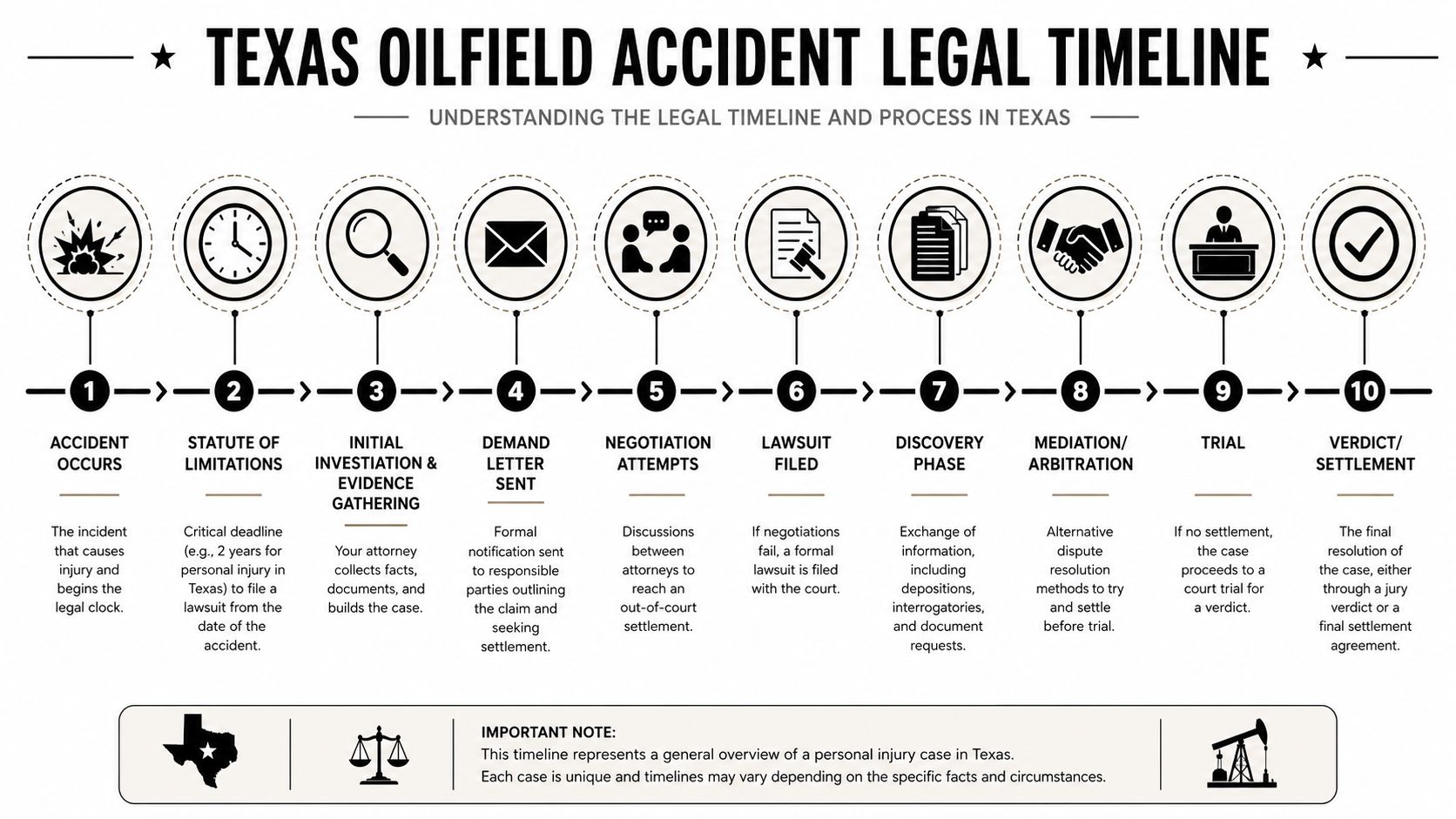
To help make the process easier to follow, this timeline gives a simple overview.
The deadline you can't afford to miss
In Texas, the statute of limitations for an oilfield injury lawsuit is typically two years from the accident date under Texas Civil Practice and Remedies Code Section 16.003. A workers' compensation claim must be filed within one year, making speed critical, as discussed in this guide to Texas oilfield accident filing deadlines.
If you want a plain-language explanation of filing windows, this article on statutes of limitations in Texas is a useful place to start.
What the process usually looks like
Most injury claims don't jump straight into trial. They move through stages.
Investigation begins
Your lawyer gathers reports, medical records, photographs, witness information, and company documents.Liability gets mapped out
In an oilfield case, this may include employers, contractors, subcontractors, equipment suppliers, and insurers.A claim is presented
That may involve an auto insurance claim, a workers' comp filing, a third-party demand, or a lawsuit.Negotiations follow
Insurance companies often test whether you understand the full value of the case.Litigation may be necessary
If the other side won't offer fair compensation, the case may move into discovery, mediation, and trial preparation.
This video gives a general overview of how legal claims can progress:
Trade-offs during the timeline
A fast settlement isn't always a good settlement. Early offers can come before the full medical picture is clear. On the other hand, waiting too long to investigate can weaken evidence and reduce bargaining power.
That balance matters in every Texas injury case, whether it's an oilfield blast, a service-truck collision, or a wrongful death compensation claim brought by a family after a fatal incident.
Preparing for Your Free Consultation
You do not need a perfect file before you speak with a lawyer. On a Houston oilfield case, the first meeting is often where we identify the missing pieces, figure out which company controlled the work, and spot whether a contractor, tool provider, trucking company, or site operator may share responsibility.
That matters more than injured workers are often told. On many well sites, several companies are working side by side, and the paperwork does not always match what happened in the field. A free consultation should help sort out who was directing the job, who owned the equipment, who set the safety rules, and who may be trying to shift blame.
What to bring if you have it
Bring what you have today.
- Medical records and bills: discharge papers, prescriptions, work restrictions, and follow-up instructions
- Incident documents: employer reports, emails, text messages, safety write-ups, and any statements you were asked to give
- Photos and videos: your injuries, the work area, damaged equipment, vehicles, PPE, or failed parts
- Witness information: names, job titles, phone numbers, and the company each person worked for
- Insurance papers: letters from workers' comp carriers, liability insurers, or adjusters
If the injury involved a service truck, company pickup, or other vehicle, bring the crash report and any claim correspondence tied to that wreck.
Do not worry if some records are missing. A good lawyer can request records, preserve evidence, and ask early questions about contracts and site control before those details get harder to prove.
Questions worth asking
Use the consultation to test whether the lawyer understands how Texas oilfield cases work.
- Have you handled cases with several contractors or subcontractors involved?
- How will you determine who controlled the job site, equipment, or safety procedures?
- Who will deal with adjusters and company representatives for me?
- What evidence should be preserved right away, including contracts, inspection records, and training documents?
- If my employer has workers' comp, can I still have a claim against another company?
- What happens if settlement talks fail and the case needs to be filed in court?
Those answers tell you a lot. A lawyer who only looks at the direct employer can miss a large part of the case.
How contingency fees work
Oilfield injury cases are commonly handled on a contingency fee. That means you do not pay attorney's fees up front. The lawyer is paid only if there is a recovery through settlement or verdict.
Ask for the fee agreement in writing. Read how fees, case expenses, and medical liens are handled. That is a practical step, especially if you are out of work and trying to protect every dollar.
The Law Office of Bryan Fagan, PLLC handles personal injury matters in Texas, including accident cases involving liability disputes, damages, and insurance issues.
Bring your questions, your documents, and an honest timeline of what happened. You do not need to show up with a finished legal theory.
Why Choose The Law Office of Bryan Fagan for Your Fight
Oilfield injury cases are hard because the facts are layered and the consequences are serious. You may be dealing with medical treatment, time away from work, insurance pressure, and several companies all trying to narrow their role. You need a legal team that can keep the case organized and keep the focus on your rights.
The Law Office of Bryan Fagan approaches injury cases with a client-centered focus and practical Texas experience. That matters when the case involves overlapping issues such as workplace negligence, a company vehicle collision, insurance disputes, or a fatal accident that may support a wrongful death compensation claim. In some situations, the same kind of detailed liability work seen in commercial vehicle cases also matters in oilfield litigation, especially when contractors, transport crews, or site operators all played a part.
Trial-tested experience also matters. Firms with decades of trial-tested litigation experience are more likely to achieve maximum compensation for long-term rehabilitation and pain and suffering, especially when they secure results before key deadlines expire, as noted in this discussion of trial-tested oilfield injury representation.
If you're looking for a Houston oilfield accident lawyer, the most important next step is simple. Get your case reviewed before evidence disappears, deadlines tighten, and the other side defines the story for you.
If you or someone you love was hurt in an oilfield accident, contact The Law Office of Bryan Fagan, PLLC for a free consultation. You can get clear answers about your rights, your options, and the path forward under Texas law. There is no obligation, and if your case is handled on contingency, you won't pay unless there is a recovery.