You should hire a DWI lawyer in Texas immediately after your arrest, not weeks later and not right before court. You have only 15 days to request an Administrative License Revocation hearing to fight an automatic driver's license suspension, and waiting can cost you that chance.
If you're reading this after a late-night traffic stop, a ride home from jail, or a call from a family member asking what happened, you're probably overwhelmed. That's normal. A DWI arrest can make you feel like everything is moving at once. Your license, your job, your schedule, your family responsibilities, and your court date all suddenly feel uncertain.
The first goal is simple. Slow down, stop guessing, and get legal help now.
A lot of people think the important date is the first court appearance. In Texas, that's often not the first date that matters. In many cases, significant damage starts earlier, especially if you miss the deadline tied to your license. A good lawyer starts protecting you before the prosecution's version of events hardens into the file.
If you need a broader checklist for the immediate aftermath, this guide on the first 48 hours after a DWI arrest in Texas is a useful place to start.

A DWI Arrest Can Change Your Life But You Must Act Quickly
You get home after a late-night stop, set the papers on the kitchen table, and assume the problem is your court date. In Texas, that assumption costs people options. The first damage often happens before the first court setting, especially if no one acts on the driver's license side of the case within the short window the law gives you.
That is why the answer to when should i hire a dwi lawyer in texas is usually immediate. Hire one as soon as you learn you are being accused, whether that is after an arrest, after a citation, or when you find out charges are being filed. A DWI case starts taking shape fast. Officers finish reports, video gets requested or overlooked, and you may be tempted to explain the stop to police, prosecutors, family, or your employer in ways that create avoidable problems.
The early hours matter for another reason. A DWI arrest often creates two separate problems at once. One is the criminal charge. The other is the threat to your license, and the license deadline can expire long before the criminal case is resolved. If you need a practical checklist for those first decisions, review these first 48 hours after a DWI arrest in Texas.
What to do in the first day
Focus on the steps that protect you.
- Do not discuss the facts of the stop: Do not try to fix the case by calling the officer, sending detailed texts, or posting your version online.
- Keep every document: Bond papers, any notice related to suspension, towing paperwork, and release records may all matter later.
- Write down what happened while it is fresh: Note where you were, what the officer said, whether field sobriety tests were given, whether a breath or blood sample was requested, and whether there were witnesses, passengers, or a crash.
- Get legal advice before making decisions: Early choices about statements, deadlines, and paperwork can affect both your defense and your ability to keep driving.
A first offense still deserves immediate attention. Texas law allows jail time, fines, annual surcharges in some cases, license consequences, and conditions that interfere with work and family life. Low BAC arguments also do not make a case harmless. Prosecutors can still rely on driving facts, officer observations, field sobriety testing, and chemical evidence disputes.
The practical rule is simple. Get counsel involved before deadlines pass, before records get harder to obtain, and before you start explaining the case to anyone who can use those statements against you.
The 15-Day Deadline to Save Your Driver's License
It's often overlooked that a Texas DWI arrest can trigger two separate fights. One is the criminal case. The other is the driver's license case.
The license side moves fast, and it doesn't wait for the criminal case to be resolved. That's why this deadline deserves immediate attention.
The deadline that catches people off guard
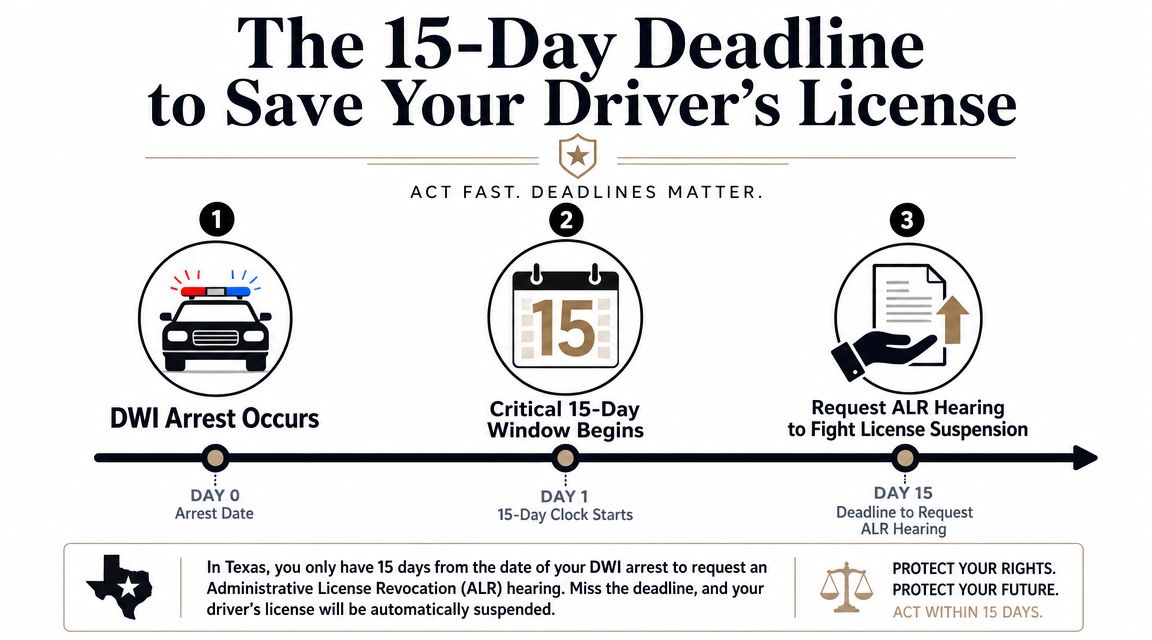
Texas drivers have only 15 days from the date of a DWI arrest to request an Administrative License Revocation hearing, and missing that deadline often means losing the right to challenge the suspension permanently, as explained in this discussion of the Texas ALR hearing deadline after a DWI arrest.
That deadline matters whether you drive to work, take children to school, care for a parent, or live in an area where getting around without a vehicle is difficult. A missed ALR request can create a transportation problem long before the criminal charge is resolved.
Criminal court and license suspension are not the same thing
Here is the simplest way to understand it:
| Process | What it affects | Why timing matters |
|---|---|---|
| Criminal DWI case | Charge, defense, plea, trial, record | It develops over time, but early work helps shape the defense |
| ALR license case | Your ability to contest license suspension | It has a short deadline and can be lost quickly |
A lot of people assume, “My lawyer can deal with the license issue later.” Sometimes later is too late.
What a lawyer does with that window
A lawyer can request the ALR hearing on time and begin using that process strategically. The hearing is about your license, but it can also be an early chance to examine parts of the state's case, lock in testimony, and spot weaknesses before the criminal side moves deeper into court.
That's one reason the first days matter so much. Early counsel can work on both fronts at once. Texas guidance aimed at DWI defendants also advises hiring a DUI attorney as soon as possible after arrest and notes that drivers should act before the administrative license deadline expires in order to preserve defenses tied to those first 15 days, as discussed by Texas DUI and DWI attorneys on early post-arrest action.
If your arrest was recent, don't spend the next week deciding whether the case feels “serious enough.” Use that time to protect your license.
Protecting Your Rights Before Evidence Disappears
The hours after a DWI arrest often decide what defense options are still available later. While you are dealing with bond, towing, work, and the shock of the arrest, evidence is already aging. Patrol car video may be deleted under routine retention policies. A witness who clearly remembers the stop tonight may be far less certain in two weeks. Details the officer wrote from memory can harden into the version the prosecution relies on.
One of the first places I look is the stop itself. If the officer did not have a lawful basis to pull you over, that problem can affect everything that came after it, including field sobriety testing, statements, and chemical evidence.
The stop can shape the entire case
People often focus on the breath or blood result first. Sometimes the better starting point is earlier than that. Why were you stopped? Was it a traffic violation, a welfare check, drifting within a lane, or something less clear on video than it sounds in the report?
Those questions matter because the stop is not just background. It may determine whether key evidence comes in at all.
Delay costs you proof
Early defense work usually focuses on preserving and collecting records before they become harder to get or harder to use:
- Dash-cam and body-cam footage: Video can confirm or contradict the officer's description of your driving, balance, speech, and compliance.
- Scene conditions: Lighting, road surface, weather, traffic flow, and noise can affect how field sobriety tests looked and how reliable they were.
- Witness accounts: Passengers, restaurant staff, friends, or bystanders tend to remember the timeline better right away.
- Testing records: Maintenance logs, blood draw procedures, chain of custody records, and lab paperwork are easier to examine early, before the case has drifted forward without scrutiny.
If you want a practical overview of the building blocks prosecutors rely on, this guide on how prosecutors prove DWI in Texas shows why the first observations and records deserve immediate attention.
What early action looks like
A lawyer who gets involved quickly can send preservation requests, obtain video, identify witnesses, compare reports to footage, and test whether the stated reason for the stop holds up. That work is separate from the 15-day ALR deadline, but the same lesson applies. Waiting can close doors you cannot reopen.
I have seen cases where the video told a calmer, cleaner story than the report. I have also seen cases where the missing piece was never recovered because nobody asked for it soon enough.
Some of the strongest DWI defenses begin before any breath test or blood result. They begin with the reason for the stop and whether the evidence was preserved while it still existed.
What a Texas DWI Lawyer Actually Does For You
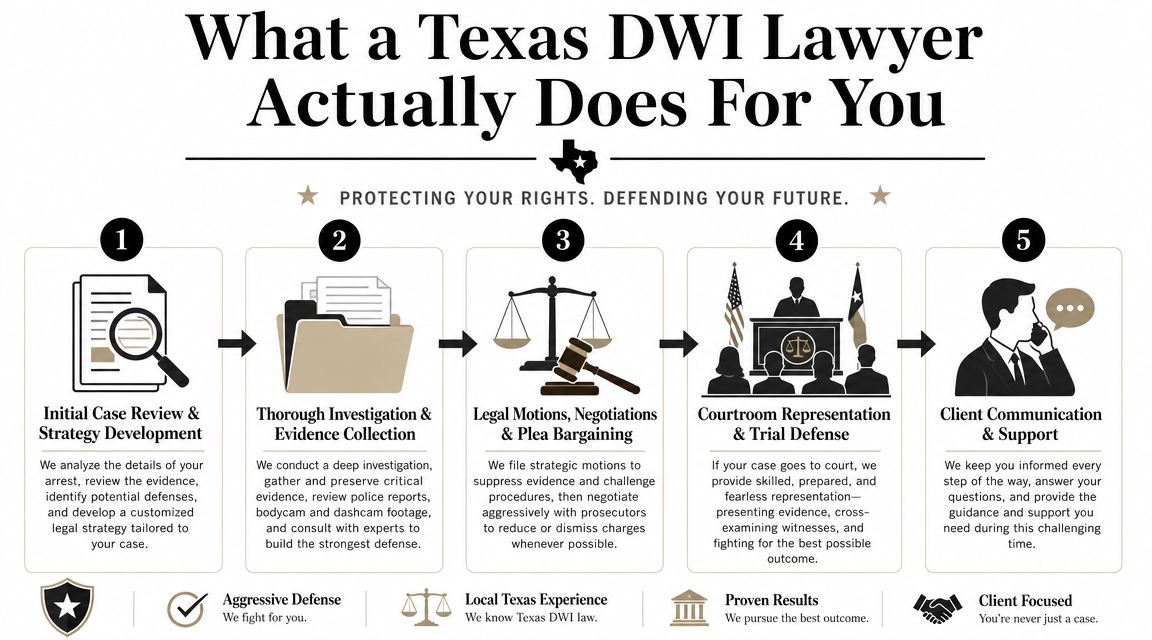
The lawyer's work starts the day of the arrest, not the day of court.
In Texas, a DWI case usually splits into two fights right away. One is the criminal charge. The other is the effort to keep your driver's license by requesting the ALR hearing within 15 days. Miss that deadline, and the license suspension process can move ahead without you having that early chance to contest it. A good DWI lawyer treats that deadline as immediate business, then builds the criminal defense on a separate track.
Texas DWI cases also turn on details that are easy to miss if nobody is looking for them early. Defense lawyers examine whether the stop was lawful, whether the officer followed training on field sobriety testing, whether the testing records hold up, and whether the state can prove impairment rather than just suspicion. That is why people often look for counsel who regularly handle DWI cases in Texas, including guidance like Houston DWI defense guidance discussing specialized early intervention.
The job is bigger than going to court
A Texas DWI lawyer typically helps by:
- Addressing the license issue immediately: Filing the ALR hearing request on time, checking the suspension paperwork, and preparing for a hearing that can matter both for your ability to drive and for early testimony from the arresting officer.
- Reviewing the file closely: Police reports, video, breath or blood records, notices, and dispatch information are compared for inconsistencies, omissions, and procedural mistakes.
- Handling communication and filings: Counsel deals with court settings, deadlines, prosecutors, and required paperwork so you do not make avoidable mistakes while the case is pending.
- Challenging weak points in the state's case: That can include the traffic stop, roadside test instructions, arrest decision, chemical testing process, or the way evidence was stored and documented.
- Evaluating options: Some cases call for negotiation. Some call for motions to suppress. Some should be prepared for trial early because that changes how the prosecution values the case.
- Helping protect your routine and your record: A lawyer explains bond conditions, occupational license options if needed, court expectations, and the practical choices that can affect work, family obligations, and long-term consequences, including concerns many clients have about whether a first Texas DWI can mean jail time.
This short video gives a helpful overview of what legal representation can look like in practice:
A real-world example
A driver in Houston gets stopped late at night for drifting within a lane. The report says slurred speech and poor performance on field sobriety tests. The driver assumes the case is over.
That is often the moment when legal help becomes practical, not theoretical. I want to know whether the officer had a valid reason to extend the stop, whether the video matches the report, whether the test instructions were given correctly, and whether fatigue, stress, footwear, injury, or road conditions played a role in what the officer labeled impairment. I also want to know whether the ALR hearing was requested in time, because missing that deadline can cost a significant advantage you do not get back.
Those are the mechanics of a DWI defense. They are also the difference between reacting to the accusation and testing whether the state can prove it.
Some Texans also review DWI-focused material from The Law Office of Bryan Fagan, PLLC while comparing local defense options and deciding whom to call after an arrest.
Is a Lawyer Necessary for a First Offense or Low BAC?
Yes, in many cases a lawyer is still necessary even if this is your first arrest or your BAC seems low. The danger in a “minor” DWI is that people underestimate it and make decisions too early.
Texas law does not limit DWI accusations to cases where a person is over the standard BAC line. The state can pursue a case based on impairment, and that changes how you should think about risk.
First offense does not mean low stakes
A first-offense DWI in Texas is typically a Class B misdemeanor carrying up to 180 days in jail and a $2,000 fine, and Texas law allows a DWI charge based on impairment even if the driver's BAC is below 0.08%, as explained by Austin DWI defense guidance on first-offense and low-BAC cases.
That's why “I was under the limit” is not a full defense by itself. It may be an important fact, but it is not the end of the analysis.
Common assumptions that hurt people
- “It's my first offense, so I should just handle it myself.” First-time charges still carry real criminal exposure and long-term consequences.
- “My BAC was low, so the case will probably be dismissed.” The state may still focus on driving behavior, officer observations, field tests, or other signs it claims show impairment.
- “There wasn't a big crash, so this is minor.” Even without a major collision, the criminal case can affect your record, your license, and your work.
If you're asking whether jail is possible in a first case, this article on whether you will go to jail for a first DWI in Texas can help you understand the issue in plain terms.
If the DWI involved a crash
When a DWI arrest grows out of a car wreck, your legal exposure may extend beyond the criminal case. That's where personal injury law becomes relevant.
In civil cases, liability means legal responsibility for causing harm. Comparative fault means responsibility can be shared. Under Texas Civil Practice and Remedies Code Chapter 33, fault can be allocated among the people involved, which can affect whether and how much compensation is available. Damages are the losses claimed in a case, such as medical bills, lost income, pain and suffering, or in a fatal case, potential wrongful death compensation. Chapter 41 addresses certain rules tied to damages in Texas civil litigation.
A Houston driver rear-ended on I-45 by someone later arrested for DWI may face one legal process as a defendant in criminal court and a separate insurance or injury claim arising from the crash. That claim may involve an auto insurance claim, disputes over fault, and settlement pressure from carriers. If you were injured rather than arrested, a Houston car accident lawyer or Texas injury attorney would look at negligence, comparative fault, and available damages very differently than a criminal defense lawyer would.
How to Choose the Right DWI Attorney for Your Case
Not every criminal lawyer is the right lawyer for a DWI case. These cases can become highly technical very quickly, especially when breath testing, blood draws, medication issues, or an accident are involved.
Because DWI cases often depend on scientific evidence, an important factor in hiring counsel is whether the lawyer can use expert witnesses to challenge breathalyzer accuracy, blood draw protocols, or accident reconstruction evidence, as discussed in this overview of expert witnesses in Texas DWI cases.

What to look for in the consultation
Ask practical questions. You're not hiring a slogan. You're hiring judgment.
- Specific DWI experience: Ask how much of the lawyer's work involves DWI defense rather than general criminal practice.
- Local familiarity: A lawyer who regularly appears in your county may better understand local procedures, prosecutors, and court expectations.
- Comfort with technical evidence: Breath and blood evidence often require more than surface-level review.
- Clear communication: You should leave the consultation understanding the immediate deadlines and likely next steps.
- Fee clarity: You need to know what the fee covers, what happens if the case becomes more complex, and how the billing is structured.
Good signs and bad signs
| Sign | Why it matters |
|---|---|
| The lawyer talks about deadlines first | That usually means they understand the urgency of the case |
| They ask detailed questions about the stop | Strong defense starts with facts, not canned answers |
| They explain strengths and weaknesses | Honest advice is more useful than reassurance without analysis |
| They promise a specific outcome | That's a warning sign |
| They brush off the science | DWI cases often hinge on technical details |
If your case also involves injuries from a collision, this resource for accident victims can help you think through how to evaluate counsel on the civil side as well.
A good consultation should leave you calmer, clearer, and better informed. It shouldn't leave you confused but “impressed.”
Take the First Step to Protect Your Future Today
After a DWI arrest, the worst approach is drifting. You don't need to know today how the entire case will end. You do need to protect your options while they still exist.
That starts with one clear move. Get a lawyer involved immediately.
The reason isn't panic. It's preservation. Your ability to fight for your license has a short deadline. Your ability to challenge the stop, secure records, examine testing, and prepare a strong case is strongest at the beginning. Once those opportunities narrow, they're hard to reopen.
If the arrest followed a collision, there may also be separate civil issues involving liability, comparative fault, damages, insurance adjusters, and in the most serious cases, wrongful death compensation. In that setting, timing matters on both the criminal and injury sides. Texas also has a statute of limitations, which is the legal deadline to file certain civil claims. Missing any deadline can weaken or end a claim.
You may feel embarrassed, angry, or scared. That doesn't mean your case is over. It means you need a plan.
If you need answers right now, contact The Law Office of Bryan Fagan, PLLC for a free, confidential consultation. You can talk through what happened, learn your immediate options, and get clear guidance on protecting your license, your rights, and your future without pressure or guesswork.