
The flashing lights are behind you. Your car is on the shoulder. You've been arrested, booked, and released, and now the paperwork is sitting on your kitchen table. One thought keeps coming up: maybe I should just handle this myself.
That reaction is understandable. Legal fees feel heavy when you're already worried about work, your license, your family, and what happens next. Many people ask whether they can save money and represent themselves.
They can. But a Texas DWI case is not a simple ticket, and it doesn't move on common sense alone. It moves on procedure, evidence, deadlines, and strategy.
A DWI Charge in Texas Can Be Overwhelming
A lot of people who search what happens if I represent myself in a DWI case in Texas are in the same place. They're anxious, embarrassed, and trying to make a fast decision under pressure. They may think, “I know what happened. I can explain it to the judge.”
That instinct makes sense. The problem is that court doesn't work like a conversation where everyone gets heard and the fairest story wins. In Texas, representing yourself in a DWI case is legally allowed, but the court will hold you to the same procedural standards as a licensed attorney. You still have to follow filing deadlines, evidence rules, and courtroom procedure, with no special leniency, and the consequences can include fines, mandatory education, license suspension, and even jail time, as discussed in this Texas DWI overview.
A self-represented person also has to start gathering the building blocks of the case alone. That may include the police report, breath or blood testing records, witness information, and video evidence. If you don't know what to ask for, or when to ask for it, important defense issues can stay buried.
Practical rule: If you represent yourself, the court expects you to act like a lawyer, not like a concerned person trying their best.
That's why it helps to read practical material on protecting your rights in DUI cases and to review immediate next steps after arrest, such as this guide on what to do immediately after a DWI arrest in Texas.
Why self-representation feels easier than it is
The first trap is emotional. Right after an arrest, people often focus on the event itself: why they were stopped, what the officer said, whether they felt impaired, whether the test was fair.
A DWI defense can involve those facts, but it also depends on whether those facts are presented correctly under the rules. If you miss that difference, you can walk into court with a story and walk out with a conviction.
What works and what doesn't
What works is getting organized early, preserving paperwork, and learning that your case has moving parts you may not see yet.
What doesn't work is assuming honesty alone will carry the day. In a DWI case, sincerity is not a substitute for legal procedure.
The Two Legal Battles You Immediately Face
A Texas DWI arrest usually creates two separate fights at the same time. Many self-represented defendants realize that too late.
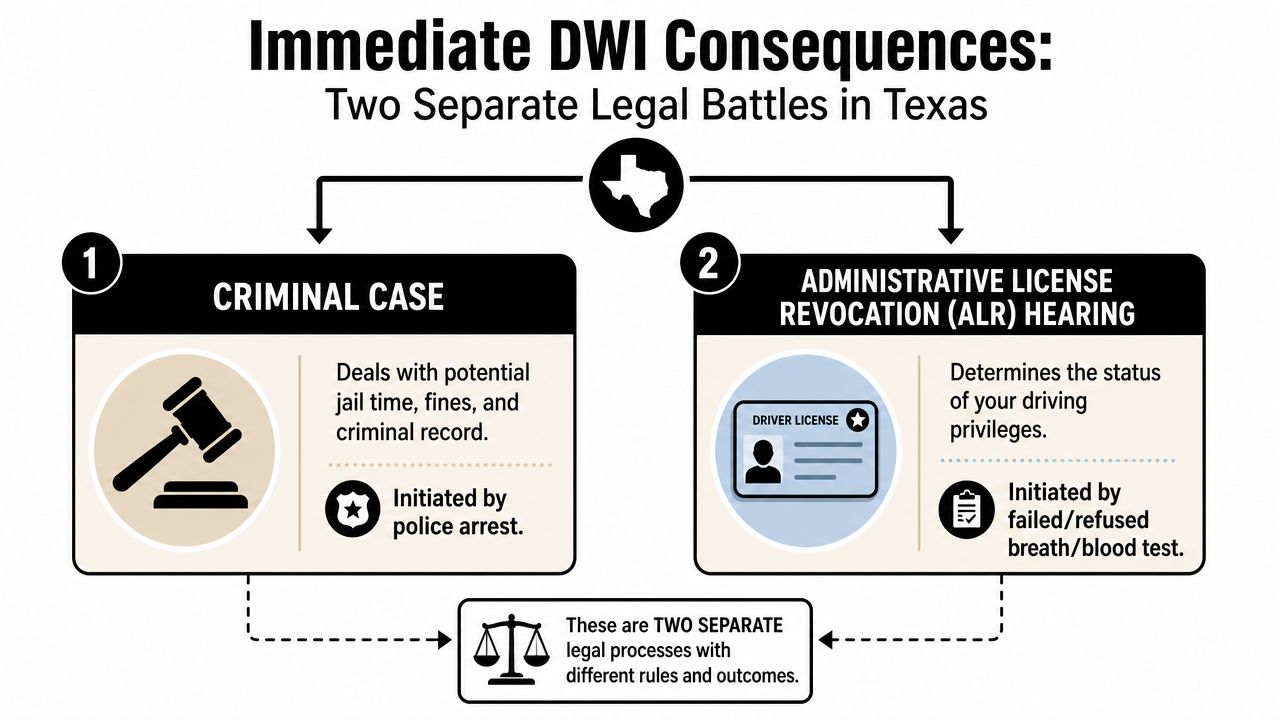
The criminal case
This is often the first thing that comes to mind. The State accuses you of driving while intoxicated and tries to prove it in court. That case can affect your criminal record, penalties, and your future.
You'll deal with court dates, pleas, prosecutor negotiations, possible motions, and maybe trial. If you represent yourself, you're responsible for managing every one of those steps.
The license case
Separate from the criminal prosecution, there may also be an Administrative License Revocation hearing, often called an ALR hearing. That proceeding focuses on your driving privileges.
It's easy to make a dangerous mistake here. Some people assume that if the criminal case is still pending, their license issue will wait too. It won't. These are separate tracks. If you're trying to decide whether to get help early, this article on when to hire a DWI lawyer in Texas can help you think through timing.
You're not dealing with one legal problem after a DWI arrest. You may be dealing with two, each with its own procedures and consequences.
Why this matters if you go pro se
When lawyers talk about DWI defense, they're often thinking in parallel. One track is the criminal accusation. The other is the threat to your license. A self-represented defendant often thinks in a straight line and handles only the next court date that appears on the paper.
That approach diminishes your advantage.
- Missed deadlines hurt fast: If a required request or response doesn't happen on time, your options can narrow before you've even reviewed the evidence.
- The cases inform each other: Testimony and records developed in one setting can shape strategy in the other.
- Early choices matter: What you say, what you request, and what you fail to challenge can affect the entire path of the case.
The hidden problem
The biggest problem isn't just lack of knowledge. It's false confidence. DWI procedure can look simple from the outside because the paperwork is short and the hearings can move quickly.
But quick hearings can create permanent damage. A person representing themselves may not realize that the case is being built long before trial.
Navigating the Criminal Court Process Alone
If you represent yourself, the criminal case becomes your job. Not emotionally, but practically. You become responsible for the work a defense lawyer would normally handle.
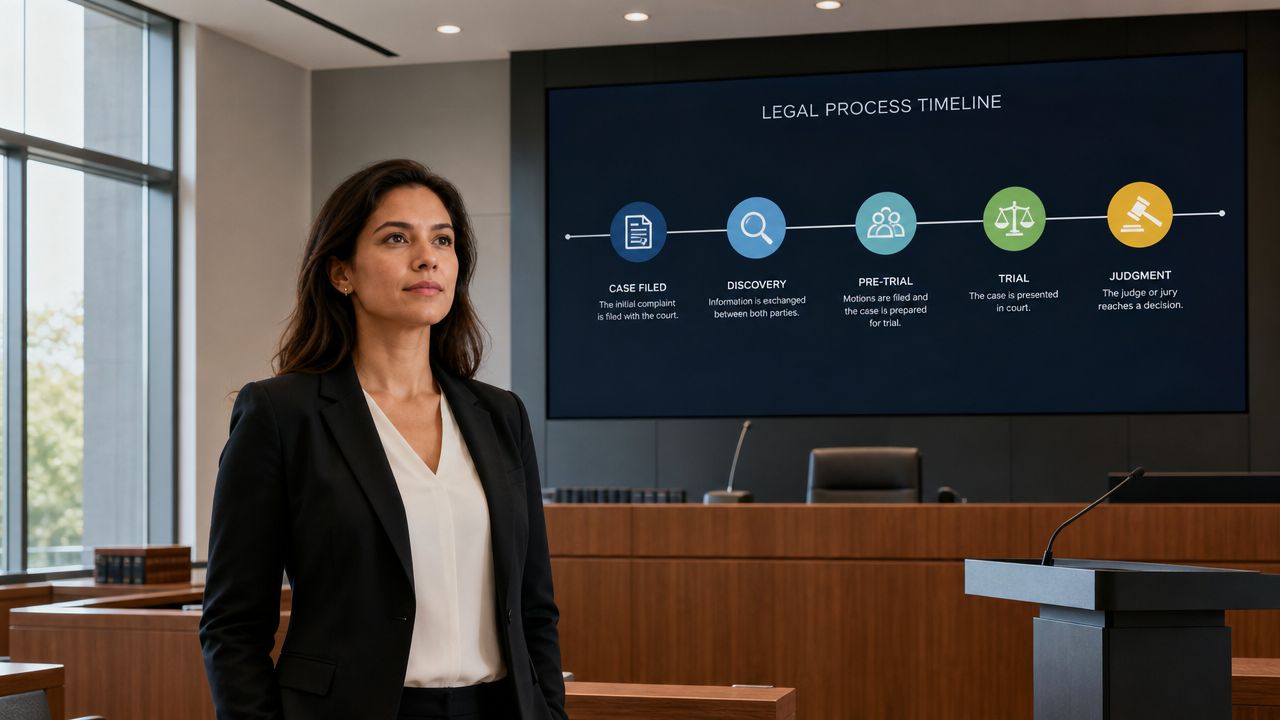
Texas court-help guidance warns that pro se litigants must build their own case with evidence the judge allows, and that missing procedural rules can harm their interests long term. In a DWI case, that matters because the defense often turns on technical suppression issues such as the legality of the stop, field sobriety administration, and breath-test records. If those issues are not raised correctly and on time, the prosecution's evidence may come in unchallenged, as noted in Texas court-help guidance on self-representation.
Arraignment and the first appearances
At the opening stage, you'll usually need to appear, understand the accusation, and enter a plea. That sounds straightforward, but even early hearings shape momentum.
The court won't coach you on strategy. The prosecutor won't tell you what defenses you may be giving up. If paperwork needs to be filed, requested, or challenged, that burden is yours.
Discovery and evidence gathering
It is during discovery that many self-represented defendants fall behind. Discovery is how you pursue and review the evidence tied to your case.
In a DWI file, that can include:
- Police narratives: What the officer says justified the stop and arrest.
- Video evidence: Dash-cam and body-cam footage that may support or undercut the officer's account.
- Testing material: Breath-test documents, blood records, and related paperwork.
- Witness information: Anyone who observed the stop, arrest, or your condition.
A lot of people assume the truth will “come out” naturally. It usually doesn't. You have to identify what matters, request it properly, and know what to do with it once you have it. To understand what the State is often trying to prove, it helps to review how prosecutors prove DWI in Texas.
Motions, objections, and pretrial strategy
This is where legal training often makes the biggest difference. In many DWI cases, the defense depends on challenging whether evidence should come in at all.
That can involve asking questions like these:
- Was the stop lawful?
- Were field sobriety tests administered correctly?
- Were test records complete and properly documented?
- Was the evidence preserved in a form the court can accept?
If you don't know when and how to raise those issues, you may lose them.
A strong DWI defense often starts before trial. If the issue isn't preserved early, it may not be available later.
Trial is only part of the case
People who represent themselves often focus on what they'll say in front of the judge or jury. But much of the essential work happens before that moment.
That includes drafting requests, reviewing records, preparing witness questions, deciding whether to negotiate, and recognizing which issue gives you actual advantage. If you're learning all of that while facing a criminal charge, you're already at a disadvantage.
Common Mistakes That Can Cost You Your Case
The right to self-representation is real. The protection it offers is limited. Texas courts have long recognized that right, but legal practitioners repeatedly warn that it doesn't improve the odds of success. One Texas defense source states that representing yourself in a DWI trial can “all but guarantee” conviction because one missed objection, deadline, or evidentiary challenge can damage the defense, according to this discussion of pro se DWI risks in Texas.
That warning is blunt, but the reason matters. Self-represented defendants don't usually lose because they don't care. They lose because DWI cases reward technical precision.
Failing to challenge the stop
Every DWI case starts with police contact. If the stop itself was flawed, that may matter a great deal. But that issue doesn't raise itself.
A self-represented defendant may tell the court, “The officer had no good reason to stop me.” That's not the same as properly developing and litigating the issue. If the challenge isn't framed correctly, the court may never reach the point.
Treating field sobriety tests like common-sense evidence
Many people walk into court thinking field sobriety tests are just visual proof of intoxication. They don't realize the defense may involve how the tests were instructed, demonstrated, scored, observed, and described.
A self-represented defendant often argues the conclusion. A trained lawyer usually attacks the foundation first.
The mistake isn't only losing the argument. It's arguing the wrong argument.
Overlooking records behind breath or blood evidence
Testing evidence can look unbeatable on paper. But the strength of that evidence often depends on documentation, procedure, and whether weak points are identified and used strategically.
If you don't know what supporting records matter, you may accept the State's summary at face value. That can turn a contestable issue into an uncontested one.
Cross-examining the officer without a plan
Many pro se cases often falter at this point. The defendant wants to challenge the arresting officer, but cross-examination isn't a chance to vent. It's a controlled method for limiting, exposing, or testing testimony.
Common failures include:
- Asking open-ended questions: That lets the officer repeat and strengthen the State's version.
- Arguing instead of questioning: Judges usually stop that quickly.
- Missing the report details: If you don't know the report cold, you won't spot contradictions.
- Chasing small points: You can spend valuable time on details that don't move the case.
Misunderstanding what “telling your side” can accomplish
A courtroom is not designed to reward the most heartfelt explanation. It's designed to apply rules to admissible evidence.
If you represent yourself, one of the hardest lessons is this: being sure you're right and being able to prove your defense are two different things.
The Pros and Cons of DWI Self-Representation
People usually consider self-representation for one reason. They want to avoid legal fees. That reason is real, and it shouldn't be mocked.
But the trade-off is severe. Defense sources warn that self-representation is a “very bad idea” in DWI cases because unrepresented defendants face a substantial risk of jail time, license loss, or unfavorable plea outcomes. The reason is practical. Bargaining power often depends on finding weaknesses in the State's proof, such as calibration issues or officer procedure errors, and pro se defendants often lack the technical ability to do that, as explained in this DWI self-representation discussion.
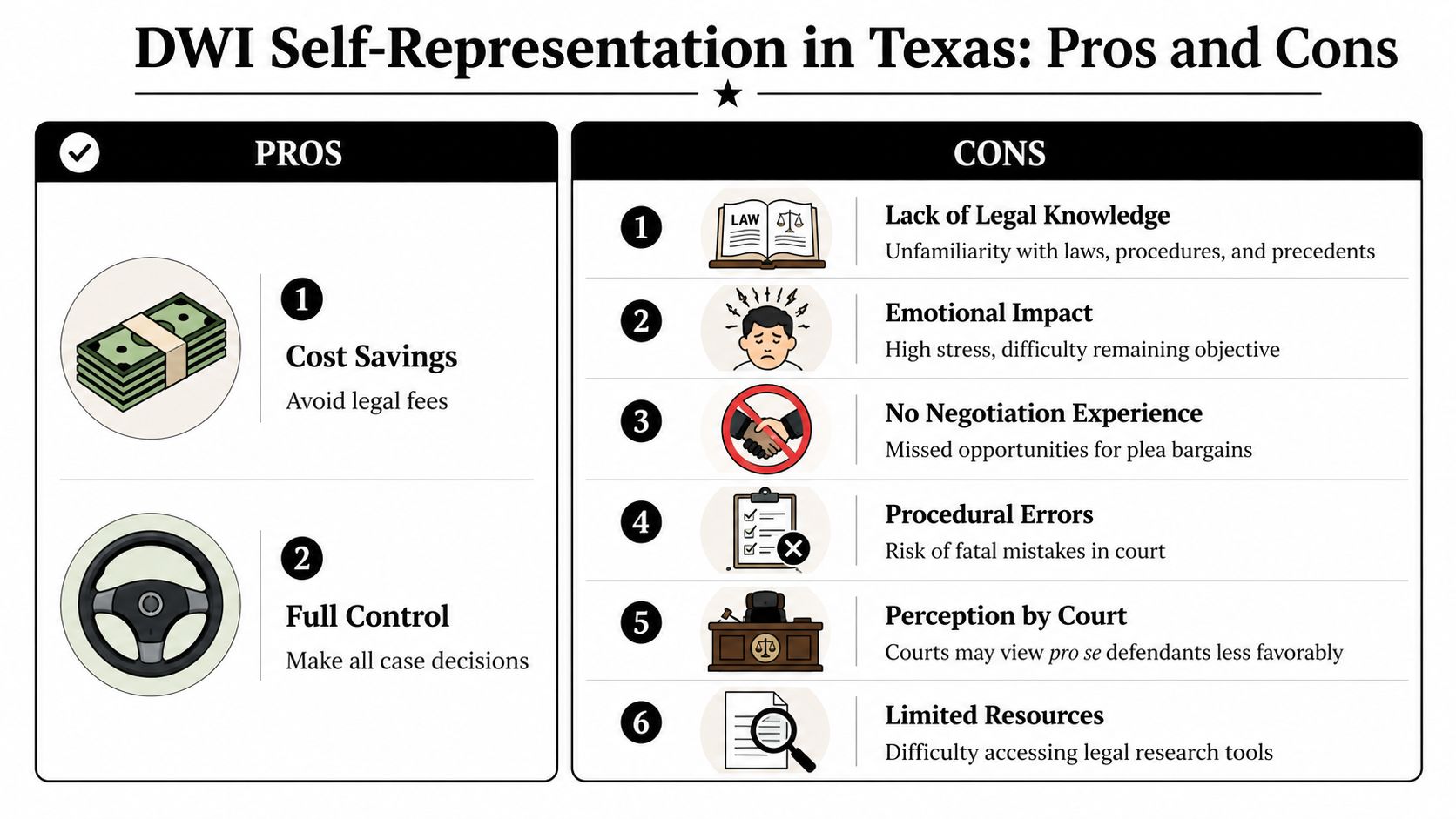
The short version
The upside is narrow. The downside reaches almost every part of the case.
| Factor | Representing Yourself (Pro Se) | Hiring an Experienced DWI Attorney |
|---|---|---|
| Cost | You may avoid attorney fees upfront | You pay for legal representation |
| Court rules | You must learn and apply procedure yourself | Counsel handles filings, motions, and deadlines |
| Evidence review | You must identify what matters on your own | Counsel can analyze records and pressure points |
| Negotiation | You speak for yourself with the prosecutor | Counsel can negotiate from a legal and factual position |
| Suppression issues | You must spot and preserve them yourself | Counsel can raise challenges in the proper form |
| Trial presentation | You question witnesses while defending yourself | Counsel handles courtroom strategy and examination |
| Stress | You carry the legal and emotional burden at once | You still face stress, but not alone |
The real pros
There are only a few practical advantages, and they're limited.
- Lower immediate spending: You don't pay a lawyer at the start.
- Direct control: You make every decision yourself.
- No communication gap: You don't have to relay facts through counsel.
For some people, that control feels important. But control without the ability to use it effectively can become expensive in a different way.
The cons most people underestimate
The biggest problems aren't dramatic. They're quiet.
- You can weaken your position before trial: A missed motion or weak request can close off better outcomes.
- You may misread plea offers: A proposal can look reasonable if you don't understand the weaknesses in the State's case.
- You carry your emotions into strategy: That makes objective decisions harder.
- You may create a record that hurts you: Statements made in frustration can do real damage.
A DWI case is rarely won by passion. It's usually shaped by preparation, timing, and whether the right issue is raised the right way.
A Practical Checklist Before You Decide
Before you decide to represent yourself, stop and ask harder questions than “Can I do this?” The better question is whether you can do it well enough to protect your future.
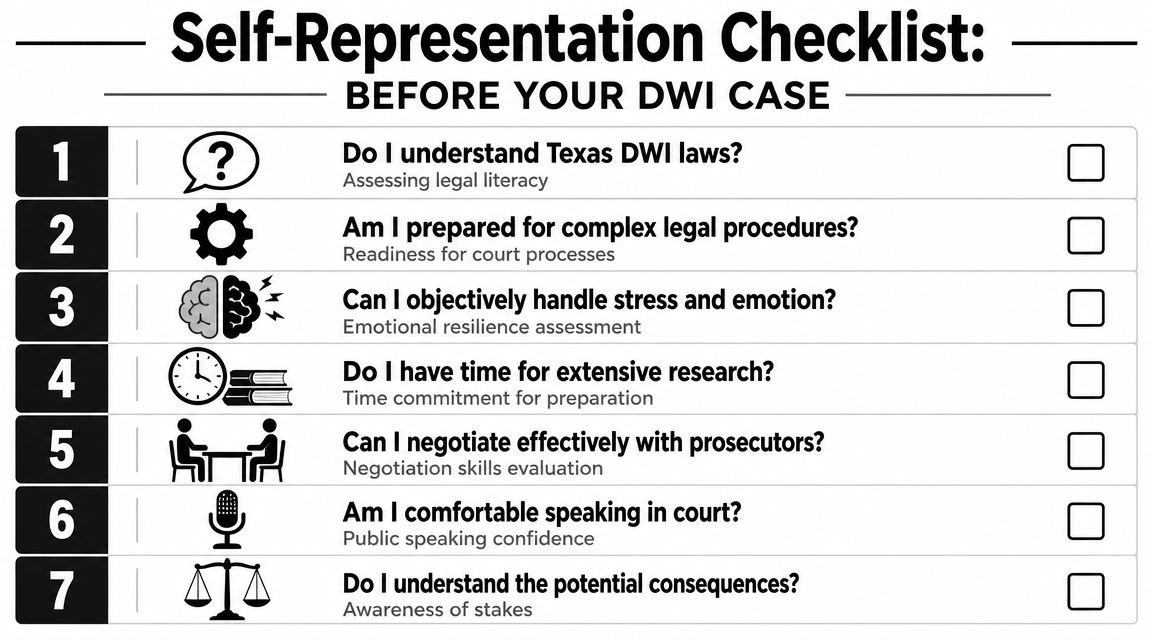
One Texas defense source puts the issue the right way: the practical question isn't just whether you can represent yourself, but what defenses, bargains, and record-protection options you might permanently lose by doing so. Self-represented defendants may unintentionally waive defenses by missing deadlines or failing to file the right motions, as explained in this Texas DWI warning about self-representation.
Ask yourself these questions
- Do I understand Texas DWI procedure well enough to protect legal issues early? If you don't know when an objection, request, or motion must happen, you may lose the point before you ever argue it.
- Can I obtain and evaluate technical evidence? That includes reports, video, testing paperwork, and related records.
- Am I comfortable speaking in open court? Not casually. Clearly, under pressure, while the judge expects precision.
- Can I cross-examine a police officer without arguing? That takes discipline and planning.
- Do I know how to evaluate a plea offer? You need to understand both risk and negotiating strength.
- Do I have the time to build this case? Self-representation competes with your work, family, and stress.
- Can I stay objective about my own arrest? That's harder than one might expect.
This short video may also help frame what's at stake before you decide:
A simple self-test
If your plan is “I'll tell the judge what really happened,” you're probably not ready to represent yourself in a DWI case.
If your plan includes learning procedure, preserving issues, obtaining evidence, analyzing weaknesses, negotiating carefully, and presenting admissible proof, then you at least understand the size of the task.
What an honest answer sounds like
Individuals aren't looking for a legal hobby. They're looking for the safest path through a stressful event.
That's why the smartest decision is often not about toughness or intelligence. It's about recognizing when the cost of doing it alone could be much higher than it first appears.
Protect Your Future and Know Your Options
If you're asking what happens if I represent myself in a DWI case in Texas, the honest answer is this: you keep the right to speak for yourself, but you also take on the full burden of protecting yourself in a system that won't slow down to help you.
That means managing deadlines, evidence, negotiations, and courtroom procedure while also dealing with the personal fallout of the arrest. In DWI cases, the difference between a better outcome and a damaging one often comes down to details that don't look important until it's too late.
Choosing not to represent yourself doesn't mean you're weak or uninformed. It usually means you understand what's at stake. A DWI accusation can affect your record, your license, your work, and your peace of mind.
The good news is that asking questions now is the right first step. Getting clear advice early can help you understand what options still exist, what risks need attention, and what defenses may still be available.
If you're dealing with a DWI arrest and need clear guidance, contact The Law Office of Bryan Fagan, PLLC for a free consultation. You can talk through your situation confidentially, understand your options, and get a practical view of what comes next. You don't have to make this decision alone, and you don't have to guess about the risks to your future.