Skip to content
A car crash can change your life in seconds, but you don’t have to face recovery alone.
If you’re reading this after a Texas DWI arrest, you may still be replaying the stop in your head. The flashing lights. The questions. The tow truck. The booking desk. Maybe there was a crash involved, and now you’re worried about more than the criminal case. You’re worried about your license, your job, your insurance, and whether an injured person may bring a civil claim against you.
That fear is real. So is the confusion. What helps now is a short, disciplined plan for the first few days. In Texas, a DWI arrest creates two problems at once. One is the criminal case. The other is the driver’s license problem that starts moving almost immediately. If the arrest involved a collision, there may also be a third track: civil liability for injuries and property damage.
For accident victims and families, this same timeline matters for another reason. If the other driver was arrested for DWI, the early days after the crash often shape the evidence in your injury claim, your auto insurance claim, and in severe cases, a wrongful death compensation case.
Your Guide Through the First 24 Hours
The first day after a DWI arrest rarely feels orderly. Individuals are exhausted, embarrassed, and trying to figure out who to call first. A parent may be arranging a bond. A spouse may be trying to find the impounded vehicle. Someone who was injured in the crash may already be talking to an insurance adjuster.
What works in those first hours is not trying to solve everything. What works is protecting the few things that can still be protected immediately.
A common pattern looks like this: a driver is stopped, arrested, booked, and released later with paperwork they barely remember receiving. Then the panic starts. They focus on the court date and ignore the separate license issue. That’s often the first major mistake.
If you want a quick comparison of how early post-arrest priorities are handled in another state, Ticket Shield’s overview of the first steps after a Florida DUI is useful because it shows the same basic truth. The first administrative deadlines matter just as much as the criminal charge.
The right move after a DWI arrest isn’t to explain yourself better. It’s to get organized faster.
In practical terms, your first day should focus on four things:
- Stay quiet about the facts: Don’t text detailed explanations to friends, family, or coworkers.
- Keep every document: Don’t throw away booking papers, bond paperwork, towing receipts, or the notice tied to your license.
- Write down what happened: Memory fades quickly after a stressful arrest.
- Get legal help early: The license deadline starts before individuals feel ready to deal with it.
If there was an accident, the stakes widen. A Houston car accident lawyer or Texas injury attorney will look at fault, insurance coverage, injuries, and whether the conduct may affect a civil claim. That doesn’t replace criminal defense advice. It addresses the separate damage the crash may have caused.
Protecting Your Rights from the Moment of Arrest

The most useful sentence in the first hours is simple:
“Officer, I am choosing to remain silent and I would like to speak with an attorney.”
That sentence does two jobs. It tells law enforcement you are invoking your right to remain silent, and it tells them you want counsel. You don’t need to argue. You don’t need to sound clever. You need to be clear, polite, and consistent.
What to say and what not to say
You must provide basic identifying information. Beyond that, casual conversation can become evidence. Officers often ask where you were coming from, whether you had anything to drink, or when you last ate. People answer because they think cooperation will fix the situation. Usually, it doesn’t.
Use this approach instead:
- Be respectful: Don’t escalate the stop with hostility or sarcasm.
- Decline factual discussion: Don’t explain how tired you were, how little you drank, or why you were driving.
- Repeat your request if needed: If more questions come, calmly say you’re remaining silent and want an attorney.
- Don’t narrate by phone: Jail calls and emotional calls to friends can create new problems.
What the booking period looks like
For a first-time DWI, the initial custody period after arrest and booking can last between 24 and 48 hours before you see a judge for bail, according to Peek Law Group’s discussion of what happens after a DWI arrest in Texas. During that window, the safest practice is to give only basic identifying information and request an attorney.
That matters because fatigue changes judgment. People start talking because they want out, want sympathy, or want to “clear something up.” In most cases, those statements help the prosecution more than the defense.
If a crash happened during the arrest event
If your DWI arrest followed a collision, there’s another layer to protect. Texas civil claims turn on liability, meaning legal responsibility for causing harm. If you were hurt by an intoxicated driver, your injury case may involve both the driver and insurance carriers. If you were the arrested driver, your statements can affect both the criminal case and any injury claim brought against you.
A rear-end crash on I-45 is a simple example. If one driver is arrested for DWI after the collision, the criminal case moves forward in one lane, while the injury claim for medical bills, lost income, and vehicle damage moves in another. The facts overlap, but the processes do not.
The 15-Day Countdown to Save Your Driver's License
Your court date is not the first deadline that matters.
The urgent deadline is the one tied to your driver’s license. In Texas, you have exactly 15 days from the date of a DWI arrest to request an Administrative License Revocation hearing, often called an ALR hearing. If you miss that window, the license suspension process moves forward automatically. According to BRCK Criminal Defense’s explanation of what you need to do after a DWI arrest in Texas, about 70% of unrepresented individuals miss this deadline, while properly contested hearings with an attorney can lead to license retention in about 40% to 50% of cases.
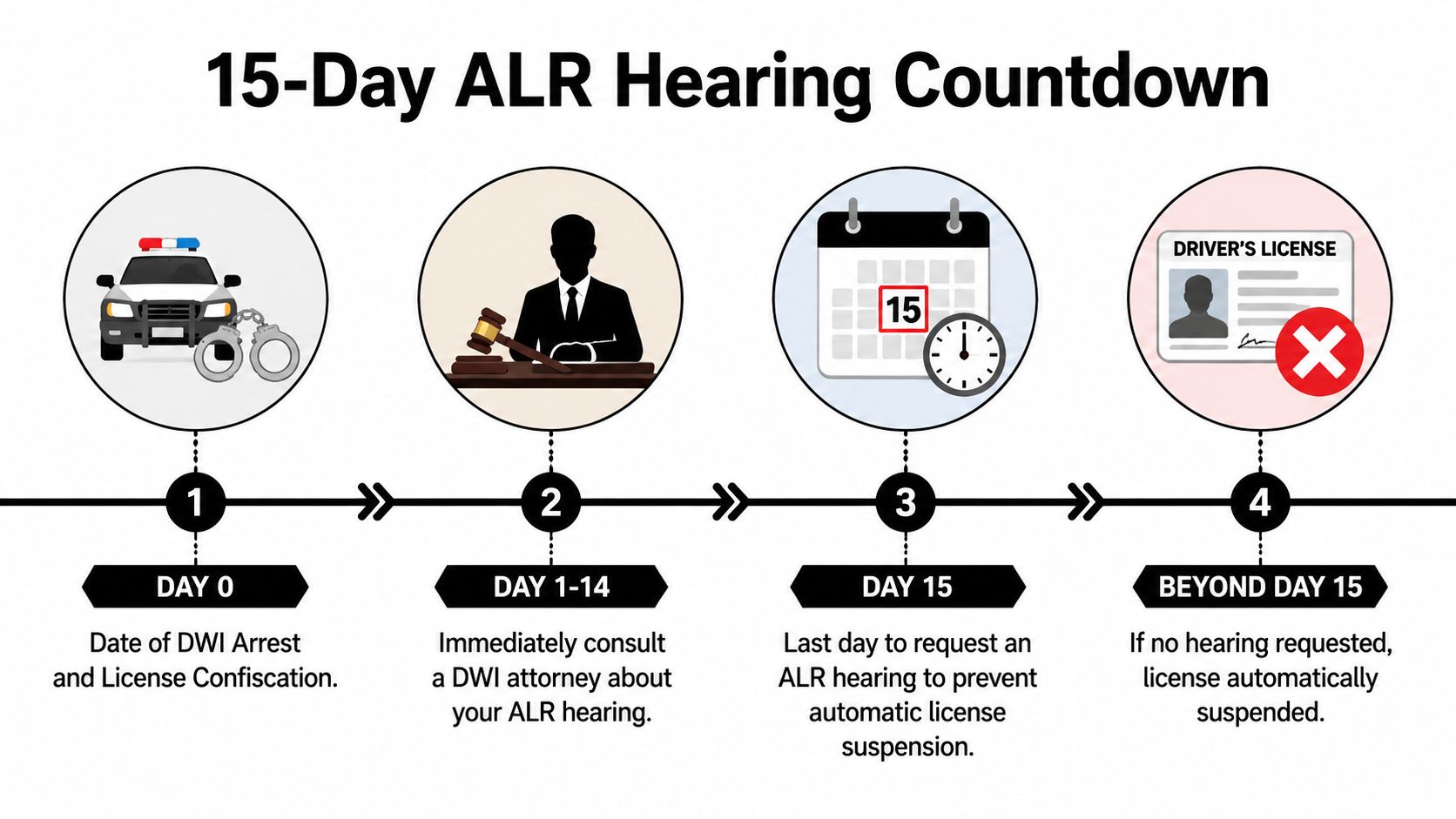
Why this hearing matters
The ALR case is separate from the criminal DWI charge. That’s the part many people miss. They think, “I’ll deal with my lawyer when the criminal case gets moving.” By then, the license problem may already be in motion.
This hearing can matter for everyday life more than almost anything else in the early phase. If you drive to work, take a child to school, attend medical appointments, or care for an older parent, losing your license changes your life quickly.
Practical rule: Treat the ALR deadline as if it were your first court date. It isn’t optional, and waiting to “see what happens” is usually what causes the damage.
What to gather right away
The ALR request starts with paperwork, not arguments. Find and preserve the notice you received after arrest. Many drivers know they were handed documents but don’t know which one matters most.
Focus on these items:
- Your notice of suspension paperwork: Keep it flat, legible, and photographed on your phone.
- Any temporary driving document: Don’t assume it lasts as long as your criminal case.
- Booking and bond records: These help reconstruct the timeline.
- Tow and impound papers: They often help confirm dates and sequence.
A short explainer can help if you’re trying to understand education and treatment programs that sometimes arise in DUI-related settings outside Texas. For general context, Georgia DUI Schools' SAP program details show how administrative and educational requirements can develop alongside a case, even though Texas uses its own procedures.
What an attorney looks for at the hearing
The hearing is not just a box to check. It can create an early opportunity to challenge whether the stop, arrest, or testing process was handled properly. Lawyers often examine the basis for the stop, the officer’s observations, and the handling of tests and reports.
This overview may help you visualize how fast that deadline arrives:
A disciplined first move is usually better than a rushed self-filed one. If your request is late or defective, you may lose your advantage before the criminal case really begins.
What works and what doesn’t
Here is the trade-off:
| Approach | Likely result |
|---|---|
| Ignoring the ALR paperwork | You lose the chance to contest the suspension in time |
| Trying to “wait for court” | The license track keeps moving without you |
| Calling a lawyer quickly | You give yourself a chance to preserve driving privileges |
| Keeping documents organized | Your lawyer can act faster and with fewer avoidable errors |
This is the center of what to do immediately after a DWI arrest in Texas. If you do nothing else in the first days, do not miss that hearing deadline.
Getting Out of Jail and Hiring the Right Legal Help
Release from jail feels like the end of the emergency. It isn’t. It’s the point where mistakes become more subtle.
People often rush to hire the first lawyer who answers the phone. That’s understandable. You want relief. You want someone to “take over.” But a DWI case is not a generic traffic problem, and it shouldn’t be handled like one.

Bail gets you out. Counsel helps protect what comes next
Bail or bond addresses custody. It does not protect your license, evaluate the stop, preserve records, or assess civil exposure from a crash. Those jobs belong to your lawyer.
If a collision happened, your legal needs may split. One lawyer may focus on criminal defense. Another may be needed if there’s an injury case, an insurance dispute, or a wrongful death compensation claim. That dual-track reality matters because the criminal file and civil claim can affect each other without being the same case.
Questions worth asking before you hire anyone
Don’t interview a lawyer like you’re buying a commodity. Ask practical questions that reveal whether they know this field.
Consider asking:
- How do you handle ALR hearings? You want someone who deals with the license issue immediately, not later.
- What records do you request first? A strong answer should include police reports, video, testing records, and timeline documents.
- How do you evaluate stop and arrest issues? The lawyer should be able to explain probable cause and procedure in plain English.
- What if there was a crash with injuries? This tells you whether they recognize the civil side of the problem.
- Who communicates with me and how often? Clear communication matters when deadlines are short.
A lawyer who can’t explain the first week of your case in plain English may struggle to explain your position in court.
Watch for process, not promises
A careful lawyer won’t promise a result. What they should promise is a process. That includes collecting your papers, requesting records, handling the ALR deadline, and helping you avoid unforced errors.
If you want a plain-language example of an early case-management tool, this overview of a lawyer letter of representation shows how formal notice from counsel can help organize communication and reduce confusion once legal representation begins.
The best hiring choice is usually the lawyer who asks precise questions, identifies immediate deadlines, and speaks candidly about both risk and strategy.
How to Preserve Evidence for Your DWI Defense
Memory is evidence. It just fades faster than people expect.
Within the first day or two, sit down somewhere quiet and write your own timeline. Don’t polish it. Don’t turn it into a speech. Just record what happened in order, while the details still feel fresh.
Your personal timeline matters
Start with the traffic stop itself. Why did the officer say you were stopped? What did the officer ask first? What did you say? What instructions were given outside the vehicle?
Then move through the arrest and booking process. Include anything that seemed confusing, rushed, or unusual. Small details often become important later.
Write down:
- The location of the stop: Street names, landmarks, weather, and traffic conditions.
- The sequence of events: When you were asked to exit, where you stood, and what happened next.
- What tests were discussed or performed: Don’t guess about legal terms. Describe what you remember seeing and doing.
- Your physical condition: Fatigue, injury, anxiety, footwear, lighting, and road surface can all matter.
- Witnesses and passengers: Include names, phone numbers, and what they may have seen.
Keep every paper and every digital trace
Create one folder, physical or digital, and put everything in it. Most defense files get stronger when the client is organized early.
Your folder should include:
- Bond paperwork and receipts
- Tow, storage, and impound documents
- Any citation or notice you received
- Photos of injuries, vehicle damage, or the scene
- Names of officers, jail staff, and tow companies if known
If the arrest followed a crash, documents may overlap with your insurance file. Learning how details are captured in official records can help, especially when facts from the stop and collision intersect. This guide on how to read a police accident report is helpful for understanding what officers usually record and what may be missing.
Write for accuracy, not drama. A short, factual timeline is more useful to your lawyer than a long emotional narrative.
If you were the injured party in the crash
For accident victims, evidence preservation serves a different goal. It supports an auto insurance claim and, if necessary, a personal injury lawsuit. Under Texas law, damages means the money a court may award for losses such as medical bills, lost income, pain and suffering, and property damage. Liability means who is legally responsible.
Texas also follows a modified comparative fault system under Texas Civil Practice & Remedies Code Chapter 33. In plain English, comparative fault means more than one person can share blame. If you were partly at fault, that can affect what you recover. Chapter 41 addresses certain rules related to damages in civil cases.
That’s why early evidence matters so much. The criminal case may focus on intoxication. The civil case often turns on proof, fault allocation, and documented losses.
Managing a DWI's Impact on Your Job and Finances
A DWI arrest doesn’t stay in the courthouse. It follows you into payroll, scheduling, insurance, licensing, and family budgets.

According to Sarabia Law’s discussion of steps to take after being charged with a DWI, a DWI arrest can trigger immediate collateral consequences beyond fines and jail time. Some people must report the arrest to an employer or professional board within days, and a person with a CDL can face permanent disqualification, which can threaten income long before the criminal case is resolved.
Work problems often start before court does
If you drive for work, supervise a fleet, hold a professional license, or work under a reporting policy, the arrest can become an employment issue fast. Don’t guess about what your employer requires. Check your handbook, contract, union rules, or licensing obligations before making broad disclosures.
That’s especially true for commercial drivers. If your work depends on a clean driving status, the problem is bigger than inconvenience. It may affect whether you can keep your role at all. For a closer look at that issue, this article on DUI with a CDL explains why commercial license holders face different pressure than most drivers.
The financial side is immediate
A DWI arrest can trigger costs all at once. Towing, storage fees, missed work, transportation problems, and legal expenses often arrive before the case is even scheduled in a meaningful way.
If a crash was involved, the financial picture may become much more serious. Civil claims can seek compensation for injuries and losses. In a Texas injury case, a person may pursue medical expenses, lost earnings, and other damages tied to the wreck. If someone died, surviving family members may have a wrongful death compensation claim.
Here’s a simple breakdown:
| Problem | Why it matters now |
|---|---|
| Vehicle impound and transport issues | You may need the car, paperwork, and personal property quickly |
| Job reporting duties | Delay can create separate employment trouble |
| Insurance communication | Early statements can shape a later auto insurance claim |
| Civil exposure after a crash | Injury claims can outlast the criminal case by a wide margin |
Protect your future reputation carefully
People often focus only on court and forget the digital footprint. Arrest information can surface online and create separate stress around hiring, housing, and privacy. If you’re trying to understand that side of the problem, this arrest record removal guide offers general background on digital privacy concerns.
Don’t let panic drive your employment decisions. Read the policy, understand the reporting rule, and talk to counsel before making broad statements that can’t be taken back.
For accident victims, these same employment and financial pressures matter in a different way. If an intoxicated driver injured you, your claim may need to account for wage loss, treatment costs, fault disputes, and insurance resistance. A Houston car accident lawyer or Texas injury attorney can help evaluate negligence, damages, and insurance strategy under Texas law.
The statute of limitations is also important in civil cases. In plain English, that term means the legal deadline to file a lawsuit. Missing that deadline can bar a claim entirely, so don’t assume the criminal case timeline protects your civil rights.
You Are Not Alone, We Can Help You Find Your Footing
The first days after a DWI arrest can feel like your life split into pieces overnight. One part is criminal. Another is your license. If there was a wreck, a third part may be civil liability, injury claims, or insurance disputes.
The most useful first moves are straightforward. Stay silent about the facts of the arrest. Keep your paperwork. Write down your timeline. Get legal guidance quickly. If a crash injured you or your family, preserve medical records, repair documents, and insurance correspondence just as carefully.
Texas civil law adds another layer that people often overlook. Under Texas Civil Practice & Remedies Code Chapters 33 and 41, questions about negligence, comparative fault, and damages can shape what an injured person recovers after a crash. That’s true whether the case involves a routine collision, a serious injury, or a wrongful death compensation claim.
If you’re trying to figure out what to do immediately after a DWI arrest in Texas, the most important thing to know is that you still have meaningful choices. Early action won’t erase the arrest, but it can protect your rights and keep avoidable mistakes from making the situation worse.
If you or your family are dealing with the aftermath of a DWI arrest or a crash involving an intoxicated driver, The Law Office of Bryan Fagan, PLLC can help you understand your options. Our team helps Texans evaluate injury claims, liability disputes, insurance issues, and the civil consequences that often follow a drunk driving arrest. Whether you need guidance from a Houston car accident lawyer, help with an auto insurance claim, or answers about wrongful death compensation, reach out for a free, confidential consultation.