A car crash can change your life in seconds, but you don't have to face recovery alone.
If you're asking Should I fight my DWI or plead guilty in Texas, you're probably dealing with more than one problem at once. You may be worried about jail, your license, your job, and what your family will think. If there was a wreck, you may also be worried about injuries, an auto insurance claim, and whether a guilty plea will hurt you in a later lawsuit.
My direct advice is this. Don't plead guilty just to make the stress stop. In many Texas DWI cases, that's the fastest way to create a permanent problem.
The right decision depends on the evidence, the stop, the testing, whether anyone was hurt, and what a conviction would do to your future. It also depends on something many people miss. A DWI case can spill into a civil case after a crash, and that can affect liability, damages, and negotiations with insurance companies. That's why this decision needs strategy, not panic.
A DWI Arrest Is Overwhelming but You Have Options
The first night after a DWI arrest usually feels the same for a lot of people. You replay the traffic stop. You wonder if you said too much. You look at the paperwork and feel like you're already losing.
You're not.
A charge is not a conviction. A prosecutor still has to prove the case. Your lawyer's job is to test every part of the state's evidence, protect your license, and keep one bad night from becoming a permanent mark on your record if that outcome can be avoided.
What most people get wrong
People often think the choice is simple. Fight the case and risk everything, or plead guilty and get it over with. That's not how good DWI defense works.
A smart defense usually starts with questions like these:
- Was the stop legal. If the officer didn't have a valid reason to pull you over, that matters.
- Were the field sobriety tests given correctly. Officers don't always administer or interpret them properly.
- Are the breath or blood results reliable. Scientific evidence can be challenged.
- Was there a crash. If so, the criminal case may affect later injury claims and insurance disputes.
Practical rule: If you haven't seen the evidence, you're not ready to decide whether a plea deal is good.
Why this decision matters beyond criminal court
For many readers, the DWI arrest happened during or after a collision. That changes the stakes. In a Texas car accident case, liability means legal responsibility for causing the crash. Damages means the losses someone claims, like medical bills, lost income, pain and suffering, or property damage.
Texas also uses comparative fault under Chapter 33 of the Texas Civil Practice & Remedies Code. In plain English, that means fault can be divided between people involved in a crash. If multiple drivers share blame, the percentages matter in a personal injury case.
If someone was injured, your DWI decision can affect how the civil side develops. A guilty plea may make the other side more aggressive. It may also shape how insurers handle settlement discussions. That's one reason a Texas injury attorney or Houston car accident lawyer often looks at both tracks together instead of pretending the criminal case exists in a vacuum.
The Two Paths After a Texas DWI Charge
You really have two broad paths. Fight the charge or resolve it through a guilty plea as part of a plea bargain. Those paths sound simple, but they play out very differently.
A Texas DWI outcomes analysis discussing Texas DPS-related 2020 data reported 33,476 guilty pleas in DWI cases and 10,046 dismissals or releases with no charge. That's the practical reality. Pleading guilty is common, but fighting the case is not some fantasy. A meaningful number of cases still end without a conviction-like result.
What fighting a DWI really means
Fighting doesn't always mean marching into a jury trial. Think of it more like checking every bolt on a bridge before you agree to cross it. Your lawyer looks for weak points in the state's case and uses them to push for a better outcome.
That can include:
- Challenging the stop
- Reviewing video
- Examining breath or blood testing issues
- Questioning field sobriety testing
- Negotiating for dismissal or reduction after exposing weaknesses
Sometimes fighting leads to trial. Often it creates an advantage long before trial.
What pleading guilty really means
A guilty plea is usually part of a negotiated resolution. You give up the right to force the state to prove the charge at trial, and in return you may get a more predictable sentence or a reduced charge.
That can sound attractive when you're exhausted. Sometimes it is the right move. But it only makes sense after your lawyer has done the work to figure out whether the state's case is strong or shaky.
A rushed guilty plea solves the court's scheduling problem before it solves your legal problem.
Why the system pushes plea deals
The criminal system runs on plea bargaining. That matters because you're making this decision inside a negotiation-driven process, not a trial-driven one. Prosecutors expect many cases to settle. Defense lawyers know that, and they use preparation to improve bargaining power.
If your case also involved a wreck, the strategy gets even more important. A plea may affect later discussions with injured passengers, other drivers, or insurers. That's why someone searching for should I fight my DWI or plead guilty Texas shouldn't think only about fines or probation. You have to think about the whole picture.
Comparing Your Options A Side-by-Side Analysis
The chart below gives the blunt version.
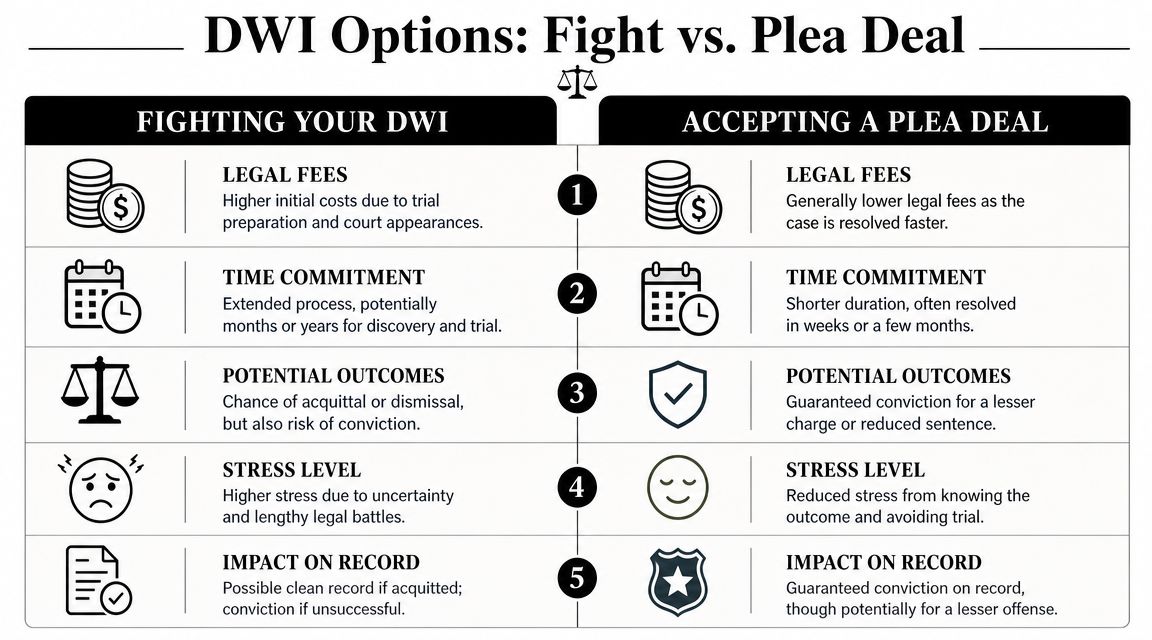
Fighting a DWI vs. pleading guilty in Texas
| Consideration | Fighting the DWI Charge | Pleading Guilty (Plea Bargain) |
|---|---|---|
| Primary goal | Dismissal, suppression of evidence, reduction, or acquittal | Faster resolution with a known negotiated outcome |
| Case timeline | Usually longer because your lawyer investigates, files motions, and may prepare for trial | Usually shorter because the case resolves without extended litigation |
| Legal cost pattern | Often higher upfront because more work is required | Often lower upfront because the case ends sooner |
| Stress level | More uncertainty, more court settings, more waiting | Less uncertainty because you know the deal |
| Chance to attack evidence | Strong. Your lawyer can challenge the stop, tests, procedures, and scientific proof | Limited once you accept the plea |
| Record impact | Better chance to avoid a conviction if the case is dismissed or won | A guilty plea creates a conviction |
| Civil case impact after a crash | May preserve stronger defenses in later injury litigation | May complicate liability and insurance disputes |
| Who should consider it | People with factual, legal, or scientific weaknesses in the state's case, or people who have a lot to lose from a conviction | People whose cases are strong for the state and who receive a carefully reviewed deal that limits damage |
Here's a useful video overview before you decide how aggressive your strategy should be.
The biggest difference is your record
The hardest truth in this decision is the record issue. According to this Texas legal answer on DWI guilty pleas and record clearing, pleading guilty to a Texas DWI creates a permanent criminal conviction that is generally not eligible for expunction or nondisclosure, except in extraordinary circumstances like a pardon.
That should stop you cold before you plead guilty for convenience.
How the criminal case can affect a crash claim
If your DWI involved a wreck, the choice also affects civil exposure. Texas personal injury law uses liability to decide who caused the harm and damages to measure losses. Under Chapter 41 of the Texas Civil Practice & Remedies Code, some cases may also involve claims for heightened damages depending on the facts alleged. I'm not saying every DWI crash becomes that kind of case. I'm saying the plea decision can change how the civil side is argued.
A simple example helps. A Houston driver rear-ended on I-45 by someone later charged with DWI may file an injury claim for medical treatment, missed work, and pain. If the accused driver pleads guilty quickly, the insurer and civil lawyer on the other side may treat that plea as a major pressure point.
If you're the injured person instead of the accused driver, this same overlap matters in the opposite direction. A Houston car accident lawyer may evaluate both fault and insurance coverage while tracking what happens in the criminal case.
Key Factors That Influence Your Decision
No two DWI cases deserve the same answer. The right call depends on the specific circumstances. Some facts push hard toward fighting. Others make a negotiated plea more sensible.
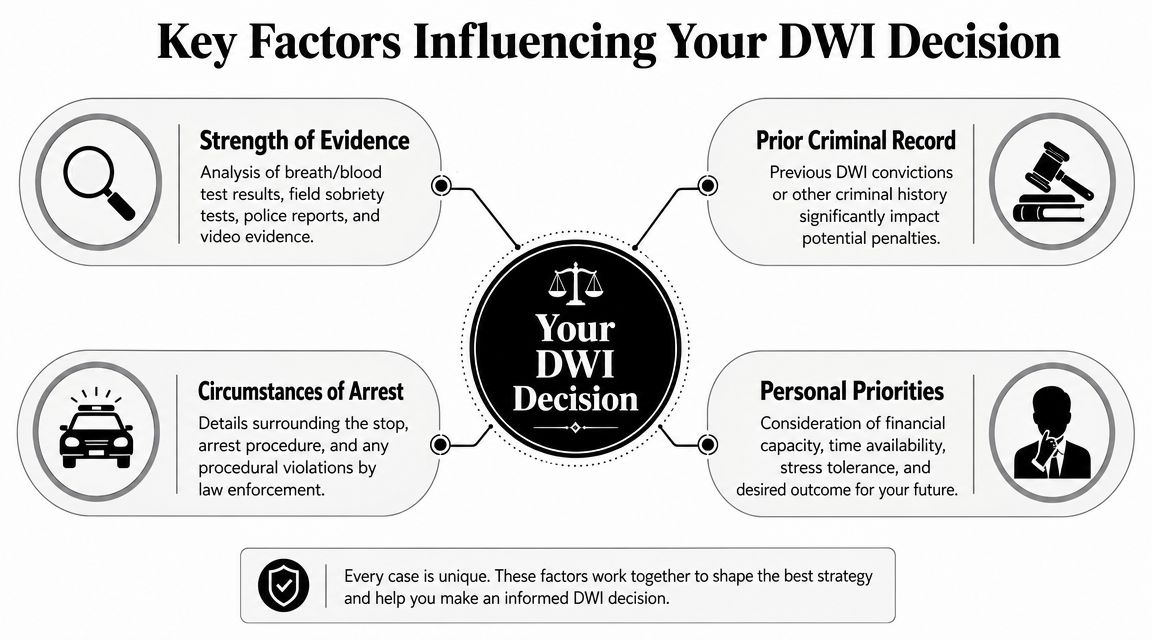
Strength of the evidence
This is the first question I'd ask in any consultation. Was there bad driving on video. Was the stop clear. Did the officer explain observations well. Are the testing procedures clean or messy.
Weak evidence changes everything. Strong evidence doesn't end the case, but it changes what a good resolution looks like.
If you want a practical look at one common issue, this article on whether a DWI can be reduced to reckless driving in Texas helps explain why charge reduction is very fact-specific.
Prior history and the crash facts
Prior criminal history matters. So does whether there was a collision, property damage, or injury. A simple stop with contestable testing issues is not the same as a crash case with multiple witnesses and visible injuries.
If there was a crash, think about both courtrooms:
- Criminal court decides whether the state can prove the DWI charge.
- Civil court or insurance negotiations deal with fault, injuries, and compensation.
That second track matters for victims too. If an intoxicated driver hurt you, your civil claim may seek payment for hospital bills, wage loss, pain and suffering, and in fatal cases, wrongful death compensation. The criminal case may influence those negotiations even though it does not replace a civil claim.
When a DWI charge grows out of a wreck, the smartest strategy looks at the prosecutor, the insurance carrier, and the injury lawyer on the other side all at once.
Your personal priorities
Some people can tolerate a longer case because avoiding a conviction matters most. Others need fast certainty because of work, childcare, or professional licensing concerns. Neither reaction is irrational. But your priorities should guide strategy, not override reality.
A few examples:
- Commercial drivers often consider license-related fallout a critical issue.
- Professionals may worry about background checks and licensing boards.
- Non-citizens need immigration-safe advice from the right lawyer.
- Parents in custody disputes should think carefully before creating a conviction record.
Don't forget the civil side after a wreck
Texas personal injury law centers on negligence, which means failing to use reasonable care. If a DWI arrest followed a crash, insurers and injury lawyers will look closely at whether impaired driving contributed to the collision. That affects liability, comparative fault under Chapter 33, and the value of an auto insurance claim.
A Dallas family struck by an allegedly intoxicated driver at an intersection, for example, may pursue bodily injury claims while the criminal case is still pending. The person charged with DWI shouldn't make plea decisions without understanding that overlap.
What It Means to Fight a Texas DWI Charge
You are charged with DWI after a crash. The prosecutor wants a conviction. The insurance company wants a statement. If someone was hurt, a civil lawyer is already building a negligence case around the same facts. Fighting the criminal case means controlling that overlap early, before one bad move strengthens all three fronts against you.
Your lawyer's job is to test every part of the state's case and to protect you from making the criminal file a gift to the civil side. That starts with gathering the evidence. Police reports, bodycam and dashcam video, blood or breath records, witness accounts, 911 calls, scene photos, and the timeline all matter. In wreck cases, the defense also looks at crash causation, vehicle damage, road conditions, and whether the state is blaming intoxication for facts that may have another explanation.
Common defense targets
A serious DWI defense challenges whether the evidence is admissible, reliable, and persuasive. According to this discussion of expert witnesses in DWI cases, defense teams may use toxicologists, breath test experts, field sobriety experts, and accident reconstruction experts to examine breath testing, blood analysis, field sobriety administration, and crash mechanics.
That matters because the arrest report is only the state's version of events.
Common pressure points include:
- The traffic stop or initial contact. The officer needs a lawful reason to stop you or investigate you.
- Field sobriety testing. Instructions, lighting, footwear, medical conditions, fatigue, and surface conditions can affect performance.
- Breath or blood evidence. Collection procedures, maintenance records, chain of custody, lab work, and interpretation all deserve close review.
- Officer observations. Claims about slurred speech, balance, odor, and demeanor are often less clear on video than they sound in a report.
- Crash causation. In an accident case, the state still has to prove more than alcohol in your system. It has to connect impairment to what happened, and that same issue can shape civil liability.
Strategy matters most. A weak point in the criminal case can change plea negotiations. It can also limit what an insurer or injury lawyer can use to frame you as plainly at fault. That does not make the civil problem disappear, but it can stop you from handing the other side an easy story.
Fighting also does not mean you are promising yourself a trial. It means your lawyer investigates first, files the right challenges, uses experts when needed, and makes the prosecutor deal with the weaknesses in the case. Many favorable resolutions come after the defense shows it is prepared. Pleading guilty before that work gets done is usually a mistake.
If you are still deciding how quickly to retain counsel, this guide on when to hire a DWI lawyer in Texas explains the timing.
You can hire private counsel, use appointed counsel if you qualify, or speak with The Law Office of Bryan Fagan, PLLC. Choose a lawyer who understands that a DWI tied to a wreck is never just a criminal file. It is one set of facts with consequences in more than one courtroom.
A strong defense starts with proof, procedure, and disciplined decisions that do not strengthen the case against you.
Your First Steps After a Texas DWI Arrest
What you do in the next few days matters. If you freeze, deadlines keep moving anyway.
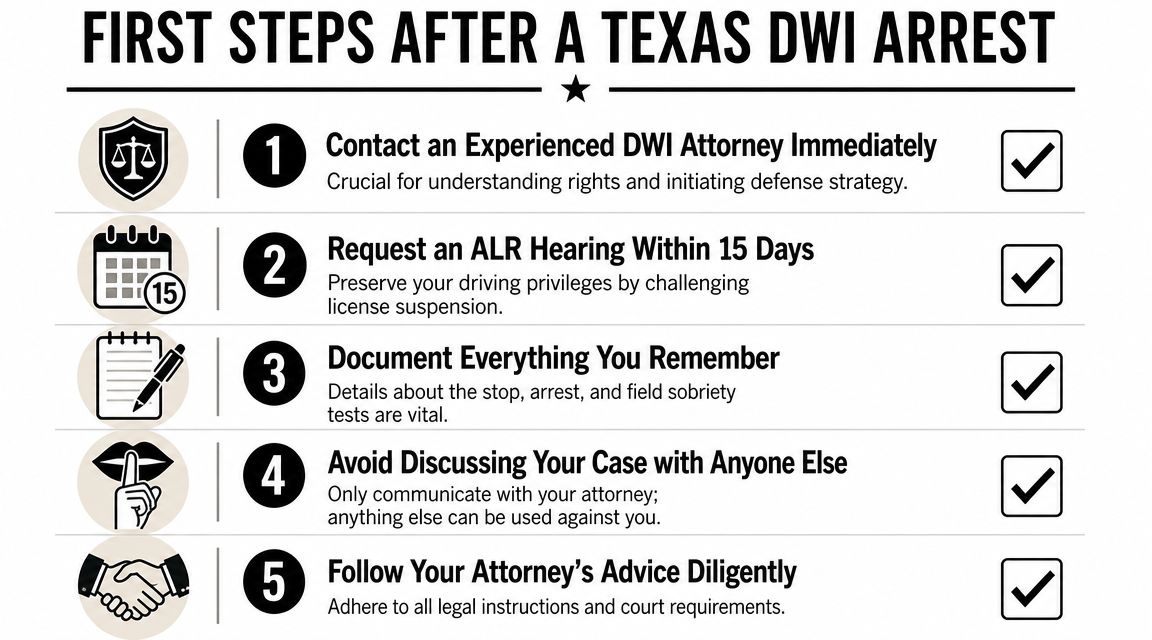
Do these five things now
Call a DWI lawyer quickly
You need advice before you talk yourself into a bad decision. If you're weighing timing, this guide on when you should hire a DWI lawyer in Texas is worth reading.Request the ALR hearing within 15 days
This deadline is critical if you want to challenge the driver's license suspension process. Miss it, and you may lose your advantage early.Write down everything you remember
Note where you were, what you drank if anything, what the officer said, whether tests were explained, weather conditions, and whether there was a crash.Preserve evidence
Save bond paperwork, towing records, videos, receipts, names of witnesses, and anything tied to the stop or collision.Stop talking about the case
Don't post online. Don't explain your case to friends. Don't try to talk your way out of it with police or insurance adjusters.
If there was a crash
Take the civil side seriously too. Texas has a statute of limitations, which is the legal deadline to file a lawsuit. In plain English, if you wait too long, you can lose the right to bring the claim at all. If you were injured by another driver, or if someone claims you caused injuries, early case review matters.
A San Antonio passenger hurt in a crash involving a suspected drunk driver may need medical records, photos, witness information, and insurance details organized immediately. Those same facts can matter in both the criminal and civil tracks.
Why This Is Not a Decision to Make Alone
The plea system is built to move cases. A Texas DUI defense article summarizing national plea-bargain data notes that about 95% of state convictions come from pleas, not trials. That tells you something important. If you don't have a lawyer pushing back, the system has a natural tendency to funnel you toward a deal.
That doesn't mean every plea is bad. It means every plea must be earned.
If your case involved a wreck, this gets even more serious. A guilty or no-contest resolution can affect later civil litigation involving negligence, insurance coverage, and injury damages. For crash victims, that overlap may influence settlement advantage. For defendants, it may increase exposure. Either way, you shouldn't make a criminal decision while ignoring the civil fallout.
Language access matters too. If English isn't your first language, understanding the exact consequences of a plea is essential. Families dealing with court settings and legal paperwork often benefit from learning how court certified interpreters help people understand legal language accurately.
If you're also deciding what kind of representation makes sense, this article on whether a public defender is good for DWI in Texas can help you think through that choice realistically.
The bottom line is simple. If the evidence is weak, fight. If the evidence is strong, negotiate from a position of knowledge, not fear. If there was an accident, make sure your strategy accounts for both the criminal case and any injury claim.
If you're facing a DWI charge after a crash, or you're an injured victim trying to protect your rights, contact The Law Office of Bryan Fagan, PLLC for a free consultation. Our team helps Texans evaluate liability, comparative fault, damages, insurance issues, and the collision between criminal allegations and civil exposure. Whether you need a Houston car accident lawyer, guidance from a Texas injury attorney, help with an auto insurance claim, or support pursuing wrongful death compensation, you deserve clear answers and a plan built around your future.