A motorcycle crash can change your life in seconds—but you don’t have to face recovery alone. The feel of the open road can be shattered in a single, devastating instant, leaving you with physical pain, emotional shock, and a flood of questions about what to do next.
A Motorcycle Crash Changes Everything, But You Aren’t Alone
It's a disorienting and overwhelming experience, but you don't have to figure it all out by yourself. Understanding your rights is the first and most powerful step you can take to get back in control.
This guide is here to give you straight answers about the Texas motorcycle helmet law and how it could impact your ability to get the justice and compensation you and your family deserve. We'll break down the legal complexities in plain English so you have the knowledge you need to protect yourself.
The flowchart below outlines the basic steps to take right after an accident.
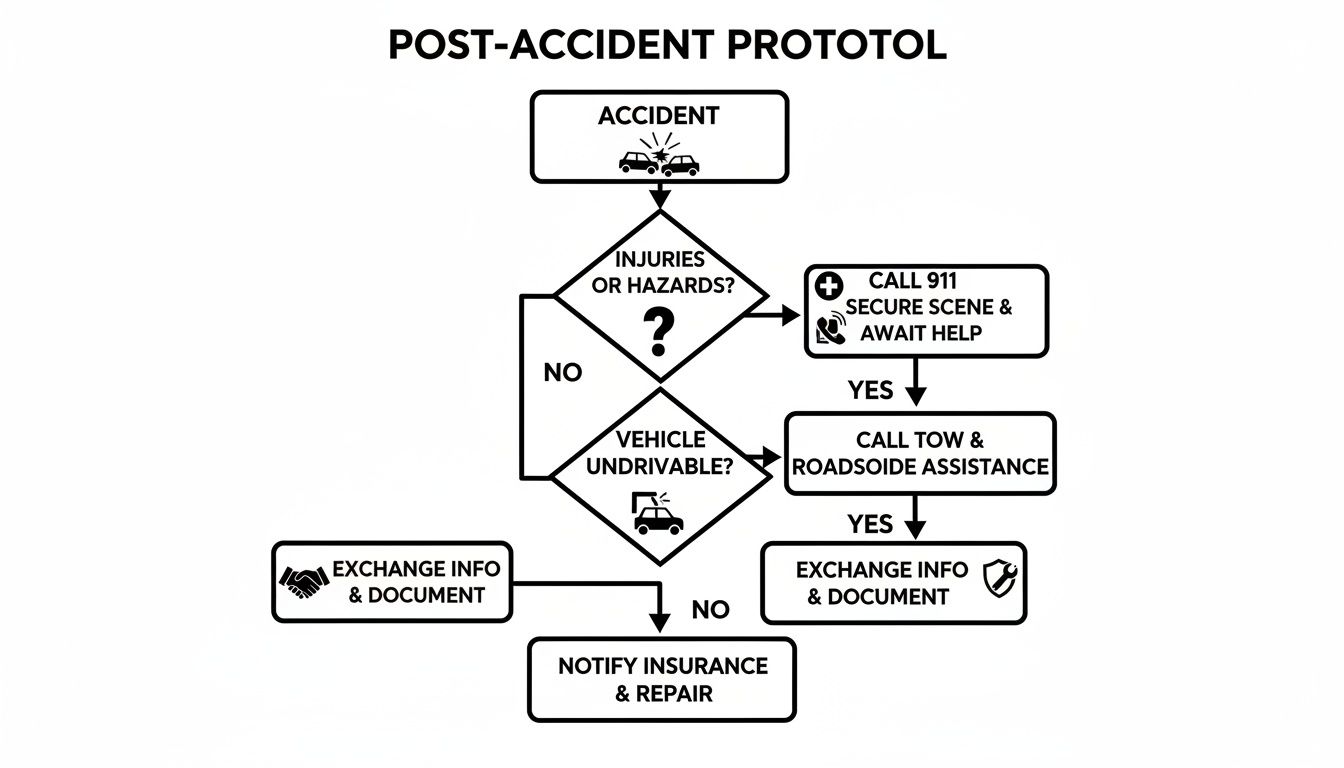
It’s a roadmap for the moments when you’re most vulnerable, and it underscores why asking the right questions and getting professional guidance is so critical. The Law Office of Bryan Fagan is here to be that guide, offering the compassionate, expert support you need.
Breaking Down the Texas Motorcycle Helmet Law
Let's cut through the confusion and get straight to what Texas law actually says about motorcycle helmets. The rules are laid out in Texas Transportation Code § 661.003, but you don't need to be a legal expert to understand them.
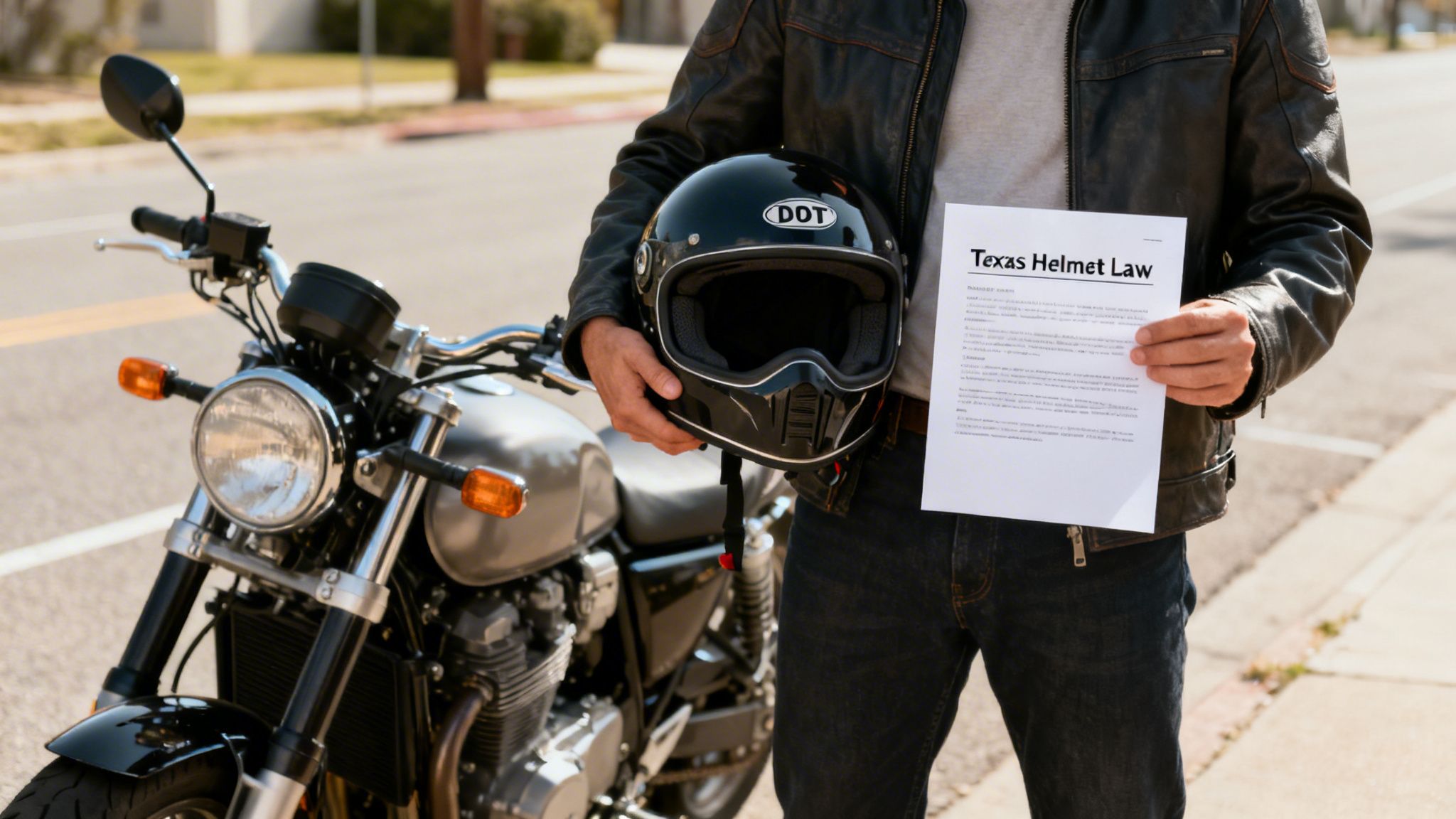
The law is built around a single, critical age: 21 years old.
For anyone—rider or passenger—under the age of 21, the rule is absolute: you must wear a helmet. There are no exceptions to this.
But what about riders 21 and over? This is where Texas's famous "helmet law exception" comes into play. You can legally ride without a helmet, but only if you've met two specific conditions:
- You must successfully complete a state-approved Motorcycle Operator Training Course.
- You must carry proof of at least $10,000 in medical insurance coverage.
This isn't a new concept. The original mandatory helmet law had a profound impact on rider safety. In fact, it was estimated to have saved 650 lives in its first nine years alone, a finding backed by public safety data from the CDC.
Who Needs to Wear a Motorcycle Helmet in Texas?
To make it even simpler, here's a quick breakdown of who needs to buckle up their helmet before hitting the road in Texas.
| Rider/Passenger Age | Helmet Required? | Exemption Requirements |
|---|---|---|
| Under 21 | Yes, Always | None. The requirement is mandatory with no exceptions. |
| 21 and Older | No, if exempt | Must complete a safety course and carry $10,000 in medical insurance. |
So, while Texas law offers a path for experienced, insured adult riders to go without a helmet, the default rule is always "helmet on." If you're over 21 but haven't met both exemption requirements, you are still legally required to wear one.
How Not Wearing A Helmet Can Impact Your Injury Claim
It’s the first question on almost every rider’s mind after a crash: “I wasn’t wearing a helmet—can I still get compensation for my injuries?”
The short answer is yes, you often can. But you can be sure the at-fault driver's insurance company will try to use this against you.

Insurance adjusters often use a legal concept called comparative fault, which is known as "proportionate responsibility" in the Texas Civil Practice & Remedies Code.
Here’s a real-world example of how it plays out. Imagine a distracted driver ran a red light and T-boned your motorcycle on a street in Houston. The insurance adjuster won't deny their driver caused the crash. Instead, they’ll argue that your decision not to wear a helmet is what really caused the severity of your head injury.
Their goal is to shift as much blame as possible onto your shoulders to reduce their liability—their legal responsibility—and the amount of money they have to pay you.
Under Texas's comparative fault rule, you can still recover financial compensation, or damages, as long as you are found to be 50% or less responsible for your own injuries. This is where having an experienced Houston car accident lawyer becomes absolutely critical. We know how to fight back against these blame-shifting tactics and keep the focus where it belongs—on the negligent driver who caused the accident. You can learn more about how comparative negligence works in Texas here.
Who Is Liable and What Damages Can You Claim?
After a motorcycle crash, getting the compensation you deserve boils down to two key ideas: liability and damages.
First, your Texas injury attorney must establish liability. This is a legal term for proving that another person's negligence—their carelessness—caused your accident. For example, a Houston driver rear-ended on I-45 because they were texting, or a truck swerved into your lane without looking. Once we prove they were at fault, we can pursue damages—the money meant to cover all your losses.
Those losses are broken down into two main categories in a Texas personal injury claim.
- Economic damages are the straightforward, calculable costs. This includes your hospital bills, lost wages from being out of work, and the estimated cost of any future medical care you’ll need.
- Non-economic damages cover the harms that don't come with a price tag. This refers to the physical pain and suffering you've endured, the emotional trauma of the crash, and the loss of your ability to enjoy life the way you used to.
As you begin this process, it's crucial to understand the ins and outs of navigating insurance claims and the strict legal deadlines involved. Texas has a statute of limitations, which is a legal time limit. This law generally gives you only two years from the date of the crash to file a lawsuit. If you miss that window, you could lose your right to seek compensation forever.
You can learn more about the specific steps involved in a motorcycle crash claim in our detailed guide.
The Real-World Dangers Of Riding Without A Helmet
Forget the legal requirements for a moment. The most compelling reason to wear a helmet has nothing to do with avoiding a ticket—it's about protecting your life and well-being.

When Texas relaxed its helmet law back in 1997, the results were as immediate as they were tragic. Motorcycle fatalities shot up by a staggering 30%. You can read more about these findings and see for yourself how a change in the law led to devastating consequences.
That isn't just a number on a report. It represents hundreds of lives cut short and families shattered by what was often a preventable injury. If a family loses a loved one, they may be able to seek wrongful death compensation.
A DOT-approved helmet is specifically designed to absorb the violent force of an impact, drastically reducing the odds of a traumatic brain injury. Without one, the physical fallout can be catastrophic, leading to a lifetime of medical care and a need for ongoing muscle pain relief.
Choosing to wear a helmet is one of the most important decisions you can make every time you ride. If you or a loved one has been hurt, it’s critical to understand your rights after motorcycle accidents in Texas.
Steps to Take After a Motorcycle Accident in Texas
The moments after a motorcycle crash are a blur of adrenaline, shock, and confusion. The practical steps you take next can have a massive impact on both your physical recovery and your ability to get fair compensation.
Here’s a clear, step-by-step guide to protect yourself and your rights.
1. Prioritize Your Health and Safety
Your first priority is always your health. Move to a safe spot away from traffic if you can, and call 911 immediately to request police and medical assistance.
Even if you think you’re okay, get checked out by a doctor. Adrenaline can mask serious injuries, and delaying treatment can make them worse. A medical visit also creates an official record that links your injuries directly to the crash—evidence that is vital for your auto insurance claim.
2. Get an Official Police Report
No matter how minor the accident seems, insist on a police report. This creates an official, unbiased record of the incident, which is crucial for proving what happened.
When the officer arrives, state the facts clearly and calmly. Do not guess about details or admit any fault, even to be polite.
3. Document Everything at the Scene
If you are physically able, use your phone to start gathering evidence.
- Take photos and videos of everything: the position of the vehicles, damage to your bike, your injuries, skid marks, and any relevant road signs or conditions.
- Get contact and insurance information from the other driver.
- Talk to witnesses. Ask anyone who saw the crash for their name and phone number. Their independent testimony can be invaluable.
4. Be Careful What You Say
In the aftermath of a wreck, it's natural to want to be polite, but never apologize or say anything that could be interpreted as admitting fault. A simple "I'm sorry" can be twisted by an insurance company and used against you.
The same rule applies when you speak with the other driver's insurance company. Remember, the adjuster works for them, not for you. Their job is to protect their company's bottom line by paying out as little as possible.
Before you give a recorded statement or accept any settlement offer, you need to speak with an experienced Texas injury attorney. Taking that one step is the single best way to protect your right to fair compensation.
We Are Here to Help You Move Forward
Dealing with the aftermath of a motorcycle accident is tough, but you don't have to carry the burden alone. At The Law Office of Bryan Fagan, PLLC, we are dedicated to helping accident victims and their families find a path to recovery. We understand Texas personal injury law, and we know how to stand up to insurance companies to protect your rights.
You deserve a team that will listen with compassion and fight for you with determination. Contact us today for a free, no-obligation consultation. Let us handle the legal complexities so you can focus on what matters most: healing.