A motorcycle crash can change your life in seconds—but you don’t have to face recovery alone. When you've been in a motorcycle accident, a motorcycle crash claim is the legal path toward getting financial compensation for your injuries and damages. If you've been hurt, it's not just a process—it's your right. It's the first step toward reclaiming your life.
A Motorcycle Crash Can Change Everything in an Instant
The raw shock of a motorcycle accident is something few people can understand. One minute, you’re out on the open road; the next, you're dealing with the aftermath of a collision that has completely upended your world. If this has happened to you, what you're feeling is real, and you're not facing it alone.
The moments after a crash are a blur of confusion, pain, and fear. You’re likely facing serious injuries, a wrecked bike, and the terrifying reality of incoming medical bills and lost paychecks. It’s an immense weight to carry, made even heavier when you have to deal with an insurance company that's looking out for its bottom line, not you.
The Unfortunate Truth for Texas Riders
On Texas roads, motorcyclists are dangerously exposed. With no steel cage, airbags, or seatbelts for protection, riders absorb the full, brutal force of an impact.
The national statistics are grim. In 2023, a staggering 6,335 motorcyclists died in crashes across the U.S.—the highest number ever recorded and a 26% jump since 2019. This means riders account for 15% of all traffic fatalities, despite motorcycles making up just 3% of registered vehicles.
That same year, over 82,000 motorcyclists were injured, and the fatality rate per mile traveled was nearly 25 times higher than for people in cars. You can discover more insights about these motorcycle crash trends and what they mean for rider safety.
These numbers aren't just statistics to us. We see the real-world impact every day, whether it's a rider in Houston hit by a car making a blind left turn or a high-speed collision on a rural highway outside San Antonio.
You Don't Have to Fight This Alone
This guide is designed to cut through the noise and give you clear, practical steps for handling a Texas motorcycle crash claim. We'll walk you through everything, from what to do in the first critical moments after a wreck to understanding the true value of your case.
At The Law Office of Bryan Fagan, our mission is to arm you with the knowledge you need to fight for the compensation you deserve. We know the biases riders face, and we're ready to counter them with hard facts and solid evidence.
Whether you were rear-ended on I-45 in Houston or sideswiped on a side street in Austin, the road ahead can feel overwhelming. We're here to bring clarity. This guide will help you understand:
- The critical actions you must take immediately after an accident.
- How to prove the other driver was at fault under Texas law.
- The different types of damages you can claim.
- How to deal with insurance companies and protect your rights.
A serious motorcycle accident is a life-altering event, but it doesn't have to ruin your future. With the right information and a dedicated Houston car accident lawyer fighting for you, you can focus on what truly matters: your recovery.
Steps to Take Immediately After a Motorcycle Crash
The moments after a motorcycle crash are pure chaos. You're disoriented, adrenaline is pumping, and your first instinct is simply survival. But what you do in these critical first few minutes can dramatically affect both your physical recovery and your ability to file a successful claim for fair compensation later on.
Even if you think you can walk it off, your first priority is safety. Get yourself out of the path of traffic if you can move. Adrenaline is a powerful chemical that can easily mask serious injuries like internal bleeding or fractures. That's why you must call 911—no exceptions. Let the paramedics check you out on-site and always follow up with a full medical evaluation.
This isn't just about your health; it creates an official medical record that directly ties your injuries to the accident. That paper trail is a critical piece of evidence for your auto insurance claim.
Secure the Scene and Gather Evidence
Once you're in a safe spot and medical help is on its way, shift your focus to gathering evidence, if you are physically able to. The other driver’s story might change by the time they talk to their insurance company, but photos and videos don’t lie.
Use your phone to document everything you possibly can.
- Capture the final resting positions of all vehicles.
- Take pictures of the damage to your bike and the other car from every angle.
- Document any skid marks, broken glass, or other debris on the road.
- Photograph any visible injuries you have, like road rash, cuts, or bruises.
This isn't just busywork. A clear visual record can be the one thing that saves your case. Imagine you're sideswiped on a busy Houston freeway like I-45. Photos showing the other car’s front bumper buried in your side—while you're still in your lane—can make it almost impossible for them to deny fault.
This is the typical journey we see clients go through, from the shock of the crash to the overwhelming confusion that follows, and finally, to finding the right guidance.
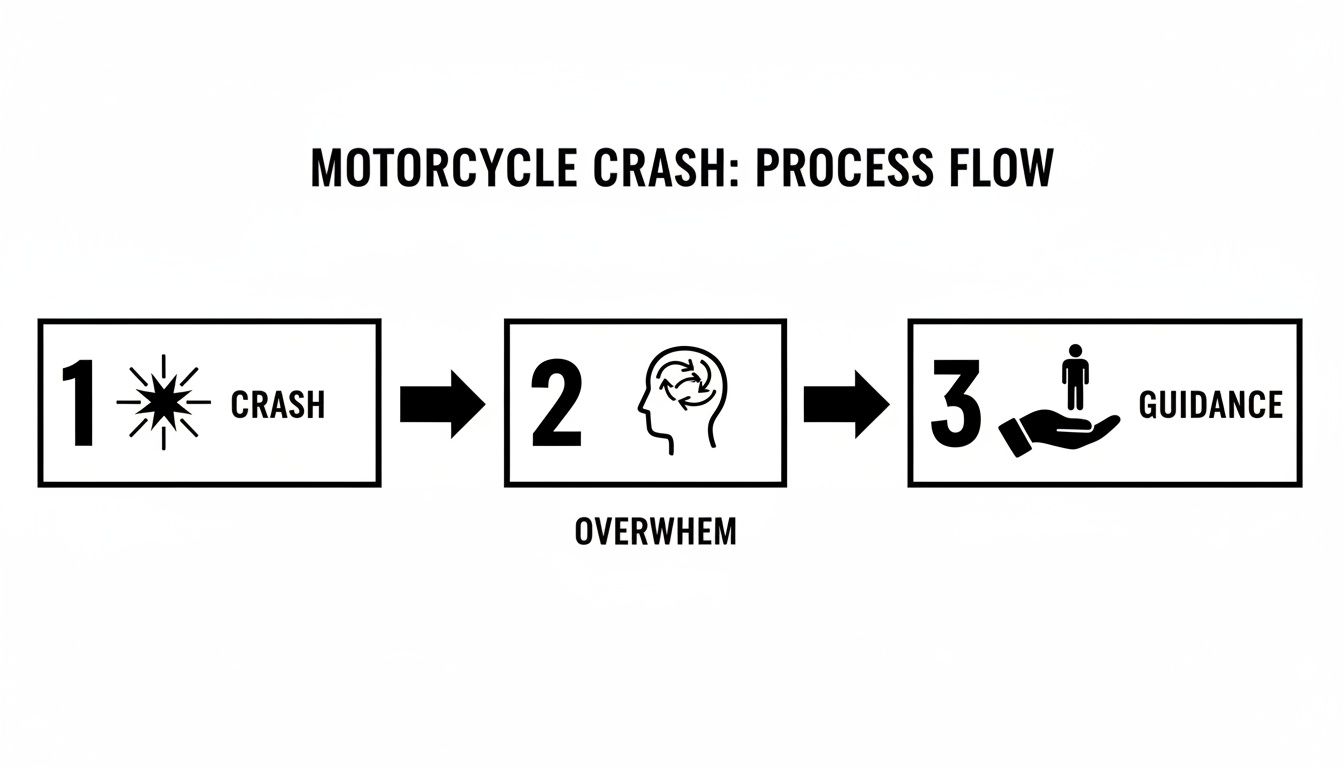
The path starts with the crash itself, leads to a feeling of being completely overwhelmed by the aftermath, and highlights where professional legal guidance becomes essential.
How to Interact With Others at the Scene
How you communicate at the scene is just as crucial as the evidence you collect. When you talk to the other driver, be calm and stick to the facts. Exchange your names, contact info, and insurance details. That’s it.
Never, ever apologize or admit fault. A simple, "I'm so sorry, I didn't see you," can be twisted by an insurance adjuster and used to argue that you accepted responsibility for the accident, even if you were just being polite.
Stick to the facts and don't volunteer any extra information. If there are people who stopped to help or saw what happened, get their names and phone numbers. An independent witness can be your most powerful ally, especially if the other driver tries to pin the blame on you.
When the police arrive, give them a clear and concise statement. Only state what you know for a fact—don't guess about speed or distance. Before they leave, make sure you get the police report number. That report will become a cornerstone of your case.
Protecting your legal rights begins the second the crash happens. By taking these deliberate steps, you’re not just looking after your health—you're laying the groundwork for a strong claim to get the compensation you need to recover and get back on your feet.
Who is Liable in a Texas Motorcycle Accident?

Winning a motorcycle crash claim isn't just about proving you were injured—it’s about proving someone else was legally responsible for the crash. In Texas, we call this establishing liability, and it all comes down to a concept known as negligence.
In plain English, negligence is when another person fails to act with reasonable care, and that failure directly causes your accident. Think of a Houston driver on I-45 who is texting instead of watching the road. If they blow through a red light and hit you, their negligence makes them liable for your injuries and damages.
The Challenge of Unfair Bias Against Riders
Unfortunately, motorcyclists often face an uphill battle from the start. We see it all the time: insurance adjusters, and even juries, can carry an unfair bias that assumes riders are naturally reckless, speeding, or weaving through traffic. The classic excuse, “I just didn’t see the motorcycle,” is often just an attempt to shift blame onto you.
This is where a skilled Houston car accident lawyer becomes your most important asset. We don't accept the other driver's convenient version of events. Instead, we build a powerful, evidence-based case to tear down those stereotypes and expose the truth.
This involves a hands-on approach:
- Accident reconstruction to analyze skid marks, debris fields, and vehicle damage.
- Tracking down and interviewing witnesses who saw what really happened.
- Securing traffic camera or dash-cam footage for undeniable proof of the other driver’s actions.
- Bringing in expert testimony to explain precisely how a driver's mistake led to the collision.
We fight to ensure your story is not just heard but backed by cold, hard facts.
At The Law Office of Bryan Fagan, we know that most riders are safe and responsible. Our job is to prove it by showing that the other driver’s failure to pay attention—not your riding style—was the true cause of the accident.
Understanding Texas’s Proportionate Responsibility Rule
Texas operates under a legal rule called proportionate responsibility, which you might also hear called comparative fault. This rule, laid out in Chapter 33 of the Texas Civil Practice & Remedies Code, can dramatically affect your ability to recover money. It means a jury or judge will assign a percentage of fault to everyone involved in the accident.
That percentage directly reduces your compensation. For instance, imagine a driver runs a stop sign and hits you, but you happened to be going slightly over the speed limit. A jury might decide the other driver was 80% at fault while you were 20% at fault. If your total damages were $100,000, your final award would be cut by your 20% share of fault, leaving you with $80,000.
But this system has a critical—and harsh—cutoff point.
Under Texas law, if you are found to be 51% or more at fault for the accident, you are completely barred from recovering any money. This is known as the 51% Bar Rule.
Insurance companies are masters at exploiting this rule. An adjuster will dig for any shred of evidence—your speed, your lane position, even your reaction time—to push more than half the blame onto you so they can deny your claim entirely.
Below is a table that breaks down how this rule can play out in real-world scenarios.
How Fault Impacts Your Motorcycle Claim in Texas
This table illustrates how Texas's proportionate responsibility rule can affect your compensation based on the percentage of fault assigned to you.
| Your Percentage of Fault | Impact on Your Compensation | Example Scenario |
|---|---|---|
| 0% – 50% | Your total damages are reduced by your percentage of fault. | If you are 20% at fault for a $100,000 claim, you can recover 80%, or $80,000. |
| 51% or More | You are completely barred from receiving any compensation. | If you are found 51% at fault for that same $100,000 claim, you receive $0. This is Texas's 51% Bar Rule. |
| Shared Fault | The insurance company will argue to maximize your fault percentage. | An adjuster may claim your "late" reaction time made you 60% at fault, even if the other driver made the primary error, to avoid paying anything. |
This is precisely why having a powerful advocate in your corner is non-negotiable. We anticipate these exact tactics from day one and build a strong, proactive case to protect your right to fair compensation. Our goal is to prove the other party bears the overwhelming majority of fault, ensuring your financial recovery isn't unfairly slashed or denied altogether.
Calculating the True Value of Your Claim

After a serious motorcycle wreck, one of the first calls you'll get is from the other driver's insurance company. They'll probably make a settlement offer, and it might even sound like a lot of money at first. Don't be fooled. That first offer rarely, if ever, covers the true cost of a motorcycle accident.
Their goal is simple: close your motorcycle crash claim as quickly and cheaply as possible. Our goal is to make sure you get compensation that covers every single loss you’ve suffered—and every loss you will face in the future. In Texas, these losses are called damages, and they fall into two key categories.
Economic Damages: The Tangible Costs of Your Crash
Economic damages are the most concrete part of your claim. Think of them as anything with a price tag or a bill attached. We dig deep to document every one of these costs, because they form the undeniable foundation of your claim.
This goes far beyond the initial E.R. visit. We’re talking about:
- All Medical Expenses: From the ambulance ride and hospital stay to surgeries, physical therapy, prescriptions, and any future medical care you’ll need down the road.
- Lost Wages and Income: If your injuries forced you to miss work, you are entitled to compensation for every dollar of income you lost while recovering.
- Diminished Earning Capacity: What if your injuries mean you can't go back to your old job, or you can't earn what you used to? You can claim the difference in your future earning potential.
- Property Damage: This covers the repair or full replacement value of your bike if it's totaled. It also includes the cost of your helmet, leathers, phone, and any other gear that was damaged.
Take a rider in Dallas who gets T-boned by a distracted driver. He suffers a shattered leg, needs multiple surgeries, and faces months of physical therapy. His economic damages aren't just the $150,000+ in medical bills. They also include six months of lost income from his construction job and the money to replace his specialized touring bike.
Non-Economic Damages: The Human Cost of Your Injuries
While economic damages add up the financial losses, non-economic damages are meant to compensate you for the immense human toll of the accident. These are the losses that don't come with a receipt, but they are just as real—and often more devastating.
Under Chapter 41 of the Texas Civil Practice & Remedies Code, you have the right to demand compensation for:
- Pain and Suffering: This is for the physical pain and discomfort you've already endured and will continue to live with because of your injuries.
- Mental Anguish: This compensates for the emotional trauma of the crash—the anxiety, depression, fear, and PTSD that often follow.
- Physical Impairment: If you can no longer ride, play with your kids, or enjoy the hobbies you once loved, you deserve to be compensated for this profound loss of quality of life.
- Disfigurement: For permanent scarring, amputation, or other visible changes to your body caused by the accident.
Putting a number on these losses is complex. Your attorney will analyze the severity of your injuries, the impact on your daily life, and the long-term prognosis to build a strong case for fair compensation.
Your claim is not just about medical bills. It’s about recognizing the profound impact this event has had on your life, from chronic pain to the emotional scars that don’t show on an x-ray.
Damages in a Wrongful Death Claim
Tragically, some motorcycle accidents are fatal. The statistics are a grim reminder of the risks riders face on the road. In 2023, there were 6,335 motorcyclist deaths nationwide, with a fatality rate of 31.39 per 100 million vehicle miles traveled. This marked a staggering 19% increase from 2022. You can read the full research about these motorcycle accident findings.
When a family loses a loved one, Texas law allows certain surviving family members to file a wrongful death claim. This isn't just about the victim; it seeks compensation for the family's own losses, such as lost financial support, emotional anguish, and loss of companionship. It can also include a "survival" claim for the pain and suffering the rider endured before passing away. Seeking wrongful death compensation is a way to hold the at-fault party accountable and secure your family's financial future.
How to Deal with Insurance Companies
While you’re trying to recover, the insurance company is already building a case against you. Dealing with them is often the most frustrating part of a motorcycle crash claim, because the at-fault driver’s insurance adjuster is not your friend. Their one and only job is to protect their company's bottom line by paying you as little as possible—or nothing at all.
Your phone will start ringing, probably sooner than you expect. The adjuster on the other end will sound friendly and concerned, but make no mistake: every question is a strategic move to find information they can twist and use against you. They are masters at getting you to say something that downplays your injuries or suggests you were somehow at fault.
That First Call from the Adjuster
When the insurance adjuster calls, you are only obligated to give them the basics: your name, address, and the date and location of the crash. That’s it. You do not have to give a detailed story, and you should never agree to a recorded statement without your lawyer on the line.
Adjusters are trained in the art of the leading question. Even a simple, "How are you doing today?" is a potential trap. If you reflexively answer, "I'm fine, thanks," they will document it in their file to argue that your injuries aren't serious, even if you're in excruciating pain. Your best bet is to politely decline to discuss your health and tell them your attorney will be in touch.
One of their favorite tactics is dangling a quick, lowball settlement offer. With medical bills piling up, it can be incredibly tempting to take the cash and run. But accepting that first offer is almost always a huge mistake. These offers come before anyone knows the true extent of your injuries or what long-term care you might need. Once you sign that check, you lose all rights to seek more money for that accident, even if you need major surgery down the road.
Why Every Rider Needs Uninsured Motorist Coverage
What if the driver who hit you has no insurance? Or carries the bare minimum policy that won't even cover your first hospital bill? This happens all the time in Texas, and it's a terrifying thought.
This is exactly why Uninsured/Underinsured Motorist (UM/UIM) coverage is your most important safety net. It’s coverage you buy on your own policy, and frankly, it’s a non-negotiable for every single rider.
If an uninsured driver hits you, your UM coverage kicks in to cover your damages. If the at-fault driver has a cheap policy, your UIM coverage makes up the difference. Taking the time to understand your personal motorcycle insurance policy is one of the most critical things you can do after a crash.
Don't Forfeit Your Rights: The Two-Year Deadline
In Texas, the clock starts ticking the moment your accident happens. You have a strict window of time to take legal action, and this is known as the statute of limitations. For all personal injury claims, including motorcycle accidents, you have exactly two years from the date of the crash to either settle your claim or file a lawsuit.
If you miss that two-year deadline, you lose your right to sue forever. It doesn't matter how badly you were hurt or how clear the other driver's fault was. Your claim becomes worthless.
Two years might sound like a long time, but it disappears quickly when you're building a solid case.
The unfortunate reality is that motorcycle fatalities are on the rise, making insurers even more aggressive. US motorcyclist deaths reached 6,335 in 2023, a 1.3% increase from 2022. Since 1997, these tragic numbers have tripled, now making up 15% of all traffic fatalities. You can read more about these concerning road death statistics. Insurance companies watch these trends closely and use them as leverage to push for low settlements before the true costs of an injury are known.
Waiting to act puts you at a serious disadvantage. Evidence gets lost, witnesses' memories fade, and the insurance company digs in its heels. Contacting a Texas injury attorney right away ensures every deadline is met and your rights are protected from the very beginning.
Common Questions After a Motorcycle Crash
After a motorcycle wreck, your mind is probably racing with questions and uncertainty. The road ahead can feel overwhelming, but getting clear, direct answers is the first step toward taking back control. We’ve gathered some of the most common questions we hear from injured riders in Texas to help cut through the confusion of the motorcycle crash claim process.
This is the practical, straightforward information you need right now, based on our years of experience fighting for riders just like you.
How Long Will My Motorcycle Claim Take?
This is usually the first thing our clients ask, and the honest answer is: it depends. A simple claim where the other driver is clearly at fault and your injuries are minor might wrap up in just a few months.
However, a case with serious injuries, long-term medical needs, a dispute over who caused the wreck, or a stubborn insurance company can easily take a year or more. The most critical factor is your health. We never rush a settlement until you’ve reached what’s called “maximum medical improvement” (MMI). Settling too soon could leave you paying for future treatments out of your own pocket, and that’s a risk we won’t take.
Can I Still File a Claim if I Wasn't Wearing a Helmet?
Yes, absolutely. In Texas, riders over 21 are not legally required to wear a helmet if they meet specific insurance or training requirements. More importantly, Texas law is clear: your decision not to wear a helmet cannot be used to argue you were somehow at fault for the crash itself.
Now, that won’t stop the insurance company from trying. They will likely argue that not wearing a helmet made your head injuries worse, a common tactic to try and pay you less. A skilled Texas injury attorney knows how to shut this down and keep the focus where it belongs—on the negligent driver whose actions caused all of your injuries.
Your legal rights don't vanish just because you weren't wearing a helmet. The core of your claim is about the driver who hit you, not the gear you chose to wear.
Understanding this distinction is crucial for protecting the full value of what you’re owed.
What if the Police Report Puts Me at Fault?
First, don't panic. While a police report is an important document, it is not the final say on who is legally responsible. Officers often arrive after the crash is over and have to piece together what happened from limited evidence. If you were rushed to the hospital, the officer likely only heard the other driver’s version of events.
We see one-sided or flat-out wrong police reports all the time. Our firm has a clear process for challenging them. We launch our own investigation, which often involves:
- Returning to the scene to document physical evidence.
- Hiring accident reconstruction experts to show what really happened.
- Locating and interviewing witnesses the police might have missed.
An inaccurate police report is a hurdle, not a roadblock.
Should I Talk to the Other Driver's Insurance Company?
Be extremely careful. The at-fault driver’s insurance adjuster might sound friendly and concerned, but their job is to find reasons to deny your claim or pay you as little as possible. You are not obligated to give them a recorded statement, and we strongly advise against it without your lawyer on the line.
The best response is to be polite but firm. Decline to discuss the accident or your injuries. Simply give them your basic contact information and tell them your attorney will be in touch. This prevents you from accidentally saying something they can twist and use against you.
It's also a good time to get familiar with your own motorcycle insurance policy. Knowing your own coverage, especially for things like uninsured/underinsured motorists, can be a game-changer.
Why Do I Need a Lawyer if the Other Driver Was Clearly at Fault?
Even when fault seems obvious, insurance companies will fight to minimize what they pay. They might admit their driver made an error but then try to pin some of the blame on you—maybe you were going a few miles over the speed limit. Under Texas's 51% bar rule, if they can convince a jury you were 51% or more at fault, they owe you nothing. Zero.
A Houston car accident lawyer sees these tactics coming from a mile away and builds a case designed to dismantle them. We take over all communications with the insurer, handle the legal deadlines and paperwork, and gather the powerful evidence needed to prove what your claim is truly worth. This lets you step away from the fight and focus on what matters most: healing.
The aftermath of a motorcycle crash can leave you feeling powerless, but you don’t have to go through this alone. The dedicated team at The Law Office of Bryan Fagan, PLLC is here to be your guide and your fighter. We handle every detail so you can focus on your recovery. For a free, no-obligation consultation to discuss your case and learn how we can help, visit us at https://houstonaccidentlawyers.net. We are ready to listen to your story and explain your rights.