
You do not legally have to hire a lawyer for a DWI in Texas, but going without one is a serious mistake. A first DWI can bring up to 180 days in jail, a fine of up to $2,000, and a driver's license suspension of up to one year, and a separate license process can start moving almost immediately after arrest.
If you were arrested last night, you're probably asking the wrong question. The question isn't just whether you need a lawyer. It's how fast you can get one involved.
A DWI arrest often throws individuals into the same spiral. You're replaying the stop, trying to remember what you said, wondering whether the breath test matters, worrying about your job, your license, your family, and what happens next. That fear is normal. It doesn't mean you're finished. It means you need a plan.
Texas DWI cases move on two tracks at once. One is the criminal charge. The other is the fight over your license. If you wait too long, you can lose ground before you even get to court. That's why my advice is direct: yes, if you're asking do i need a lawyer for a dwi in texas, you should hire one right away.
The Question on Your Mind After a DWI Arrest
You get home after a night in jail, drop the bond paperwork on the kitchen table, and start reading words that do not look like plain English. Court dates. Warnings. Deadlines. License consequences. Your first instinct is simple: Do I really need a lawyer for this?
Yes.
Texas does not force you to hire a lawyer for a DWI. Texas does make it dangerous to go without one. A DWI arrest can threaten your freedom, your ability to drive, your job, and your record at the same time. You are not dealing with one inconvenience. You are dealing with a legal problem that starts working against you immediately.
That fear you feel is useful if it pushes you to act fast.
People get in trouble when they treat a DWI like a traffic ticket with extra paperwork. It is a criminal accusation tied to a separate license problem, and delay gives both tracks time to move without you. A lawyer gets involved early, protects your position, and starts checking the basics right away: why you were stopped, what the officer claimed to see, what you said, what testing was done, and what deadlines are already running.
What your fear is telling you
You are not overreacting. You are recognizing that this case can spread into every part of your life if you leave it alone.
The first days matter most. Video can disappear. Witness memories fade. You can miss a deadline before you understand why it mattered. Early legal advice is not about comfort. It is about protecting options while they still exist.
Practical rule: After a Texas DWI arrest, stop polling friends and start talking to a defense lawyer.
A common first mistake
A lot of arrested drivers focus only on the court date listed on the paperwork. That is a mistake. The court case is only part of what you are facing, and one of the most damaging consequences can start before the criminal case gets going.
Other states deal with the same pattern. If you want a comparison, this guide on DUI legal representation in Michigan makes the same point from a different angle.
You have options. The way to keep them is to get a lawyer involved now, not after you have already lost ground.
The Two Cases You Are Fighting After a Texas DWI
A Texas DWI arrest puts you into two legal fights at once. One is the criminal case. The other is the separate driver's license case.
Miss that second track and you can lose your ability to drive before the criminal charge is even sorted out. That is why waiting to “see what happens” is a bad plan.
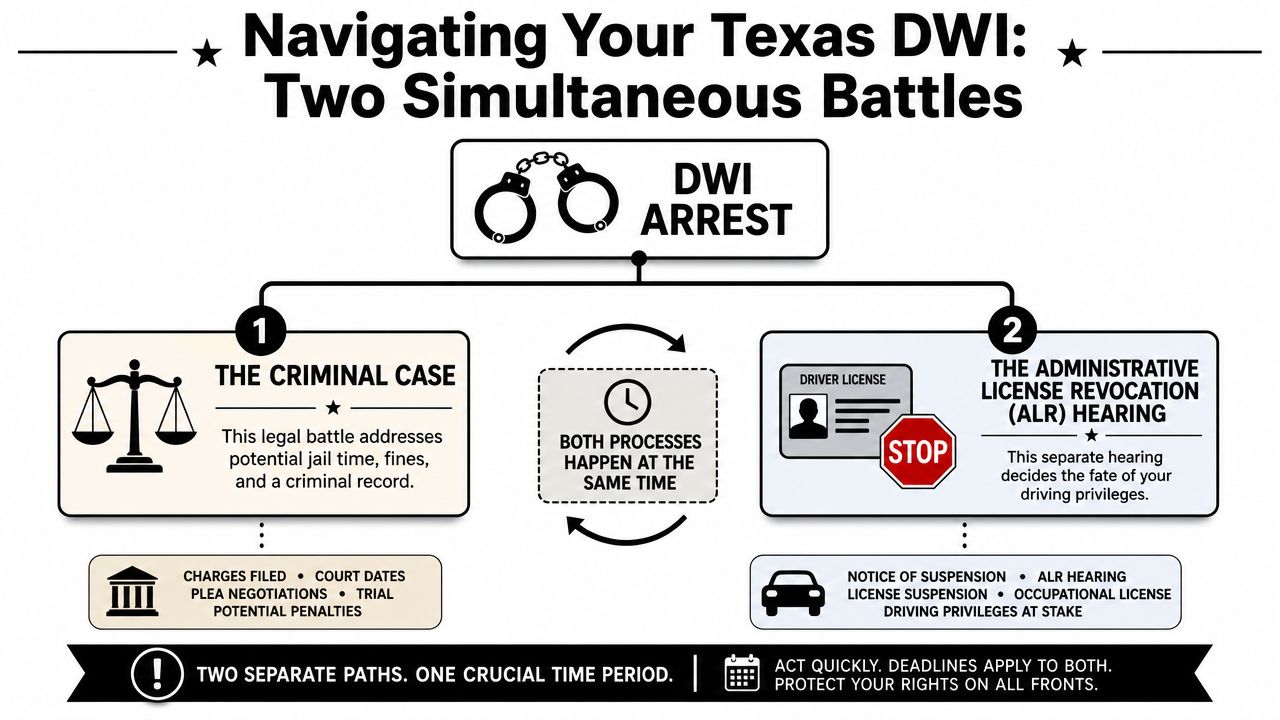
The criminal case
This is the prosecution in court. The State accuses you of driving while intoxicated and tries to prove it with the stop, the officer's observations, field sobriety tests, breath or blood results, video, and your own statements.
A good defense lawyer does not accept that evidence at face value. The lawyer examines whether the stop was legal, whether the officer had grounds to arrest you, whether testing was handled correctly, and whether the State can get its evidence in front of a judge or jury. That work starts early, not on the eve of court.
The ALR license case
The second track is the Administrative License Revocation process, or ALR. It is separate from the criminal case and it moves on its own schedule.
After a DWI arrest, the State can try to suspend your license through ALR. You have a short window to respond. If you do not request an ALR hearing on time, you can lose the chance to fight the suspension early.
That hearing has a different purpose than criminal court. It focuses on your driving privileges, not whether you will be convicted of DWI.
The court case affects your record. The ALR case affects whether you can legally drive to work, school, court, treatment, or home.
Why this two-track problem changes everything
This is why hiring a lawyer right away matters. You are not just defending against one accusation. You are protecting yourself on two fronts, under two different timelines, with two different kinds of consequences.
The criminal case can threaten your record, money, and freedom. The ALR case can hit your daily life first. If driving is tied to your job, your children, or basic family responsibilities, that license fight is immediate, not secondary. As noted in this explanation of time-sensitive rights at stake after a Texas DWI arrest, early action can affect what options remain available.
Here is the practical difference:
| Track | Main issue | What you risk |
|---|---|---|
| Criminal case | Whether the State can prove DWI | Jail, fines, a criminal record, court-ordered penalties |
| ALR case | Whether the State can suspend your license | Loss of driving privileges, work problems, family disruption |
Handle both tracks early. That is how you keep options instead of losing them by default.
Understanding the Full Consequences of a DWI Conviction
A lot of people calm themselves down with the same thought: it is a first arrest, nobody got hurt, so this can probably be handled with a plea and a fine. That is a bad assumption in Texas.
A DWI conviction can hit your freedom, your finances, your ability to drive, and your reputation at the same time. The criminal case decides whether you are convicted. The license fight can still shape how you get to work, take care of your family, and keep your life together while the case is pending.
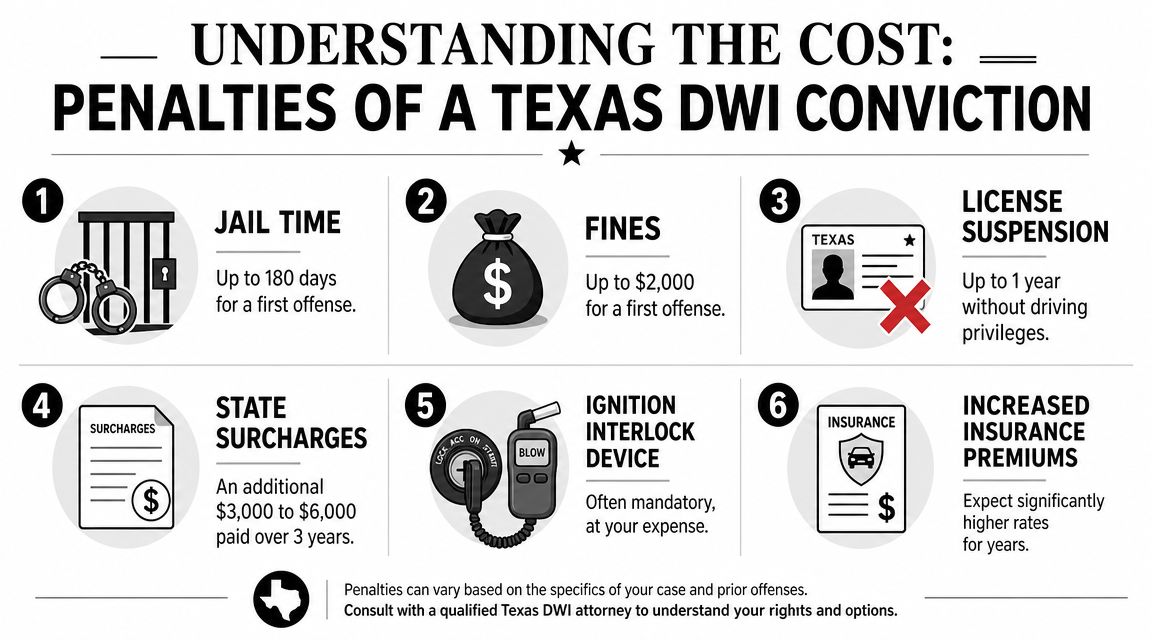
What the court can do to you
Texas treats DWI as a serious criminal offense, even on a first case. A conviction can mean jail, fines, court costs, probation conditions, alcohol education classes, and restrictions that follow you long after the arrest date.
The punishment usually gets worse with prior cases or aggravating facts. If a child was in the vehicle, the case can become far more serious. If you want a clearer sense of how defense strategy can affect the outcome, read this guide on how to fight a Texas DWI case effectively.
The conviction is only part of the problem
The sentence from the judge is not the end of the damage.
A DWI conviction can raise your insurance costs, complicate professional licensing, create trouble with background checks, and put pressure on your job. If driving is part of your work, the fallout can start fast. Even people with clean records get blindsided by the practical consequences.
Some courts also impose ignition interlock requirements or other conditions that change your daily routine. Those conditions cost money and time. They also make a private mistake feel public.
A DWI conviction can affect where you work, how you drive, what employers see, and how much control you keep over your day-to-day life.
What is actually at stake for you
If you are tempted to “just get it over with,” stop and look at the full picture:
- Your record: A criminal conviction can follow you into future job applications, housing screenings, and licensing reviews.
- Your transportation: A suspended or restricted license can turn ordinary responsibilities into daily problems.
- Your income: Missed work, job limitations, and added costs can pile up fast.
- Your family routine: Childcare, school pickup, medical appointments, and errands become harder when your driving status is uncertain.
- Your freedom: Jail exposure is real, and probation can still place strict limits on your life.
This is why hiring a lawyer is not about appearances. It is about reducing damage on both tracks before the consequences harden into something much harder to fix.
How a Skilled DWI Lawyer Fights for You
After a Texas DWI arrest, you are not waiting around for one court date. You are defending two tracks at once. The criminal case is building, and the license case can start moving on a much shorter clock. A skilled lawyer gets to work on both immediately.

First, the lawyer protects your position early
Good DWI defense starts before the State settles into its theory of the case. Your lawyer requests records, preserves video, tracks deadlines, and looks for problems the prosecutor would rather present as settled facts.
That early work matters because DWI cases are built in sequence. The stop has to be lawful. The detention has to be justified. The officer's observations have to hold up. The field sobriety testing has to be administered and interpreted correctly. The arrest, warnings, and chemical testing all have to follow the rules. If one part is weak, the State can lose its advantage fast.
A lawyer should be reviewing:
- Why you were stopped in the first place
- Whether the officer had a valid reason to extend the encounter
- How field sobriety tests were explained, demonstrated, and scored
- What you said, when you said it, and whether those statements are admissible
- Whether the reports match the body cam, dash cam, dispatch log, and paperwork
Then the lawyer challenges the evidence, not just the accusation
A DWI case is often won or lost on details. Officers write reports in a way that sounds clean and confident. Video, timing, and test records often tell a messier story.
Breath and blood evidence also deserve hard scrutiny. Machines require proper maintenance. Samples require proper handling. The State still has to connect a test result to impairment at the time of driving. A defense lawyer with DWI experience knows how to examine those weak points and force the prosecution to prove them instead of assuming them.
If you want a closer look at common defense angles, this guide on how to win a DWI case in Texas explains where these cases often break down.
A skilled DWI lawyer does not show up to apologize for you. The job is to test every claim, challenge weak evidence, and protect you on both the criminal track and the ALR track.
The ALR hearing is part of the fight
Many people focus only on the criminal court setting and miss the separate driver's license case. That is a mistake.
A strong lawyer treats the ALR case as more than paperwork. The hearing can create a chance to question the arresting officer early, lock in testimony, and gather facts that may help the criminal defense later. It is also your chance to fight for your ability to drive or prepare for an occupational license if needed. Delay on this front costs you options.
Choosing counsel with the right focus
You want a lawyer who handles Texas DWI cases with attention to both trial issues and license consequences. General criminal defense experience is not enough by itself. DWI cases turn on police procedure, forensic evidence, and fast administrative deadlines.
One available option for Texas readers is The Law Office of Bryan Fagan, PLLC, which offers legal consultation for Texas criminal law matters, including DWI-related cases.
If you are comparing approaches outside Texas, an Illinois DUI lawyer may frame the same basic point from another state's perspective. Early legal work changes outcomes.
A short explainer can help if you want to hear these issues discussed in plain language.
Is a Lawyer Worth the Investment for a First DWI?
Yes. In most first-offense cases, hiring a lawyer is worth it.
That's my opinion, and it's a strong one. Not because every first DWI gets dismissed. Not because every case has a dramatic flaw. But because the downside of handling it alone is too large, and the value of counsel often shows up in places people overlook.
People usually ask the wrong cost question
The first question many people ask is, “How much does a lawyer cost?” The better question is, “What will this case cost me if I handle it badly?”
Current legal commentary around this issue makes an important point. Many consumers want to know whether counsel can improve outcomes enough to justify the expense, but the value is not only about dismissals or reductions. It can also be about minimizing collateral damage such as employment loss, insurance increases, and interlock requirements, as noted in this discussion of whether hiring a lawyer for a Texas DWI is worth it.
Where the value often shows up
A lawyer may add value in different ways depending on the facts.
- Evidence-driven cases: If the stop, testing, or arrest procedure has weaknesses, a lawyer may be able to challenge key parts of the State's proof.
- High-risk life situations: If you drive for work, hold a professional license, or have family obligations that depend on your mobility, legal help may matter even more.
- Damage-control cases: Sometimes the strongest benefit is limiting fallout, not winning a dramatic dismissal.
If you're comparing how other states frame the same decision, this article from Fiscella Law LLC on hiring an Illinois DUI lawyer gives another useful consumer-focused perspective.
My recommendation for first-time cases
If this is your first DWI, don't let that phrase trick you into passivity. “First time” does not mean “small problem.”
Many people asking whether they'll really face harsh consequences on a first arrest also want to know about jail risk. This guide on whether you will go to jail for a first DWI in Texas is a helpful next read.
The smart view is simple. Hiring a lawyer is an investment in protecting your license, your record, your income, and your options.
Your Immediate Action Plan After a DWI Arrest
You get out of jail, look at the paperwork, and realize you are already behind. That is how Texas DWI cases start. While you are worrying about court, the license case is already on its own clock.
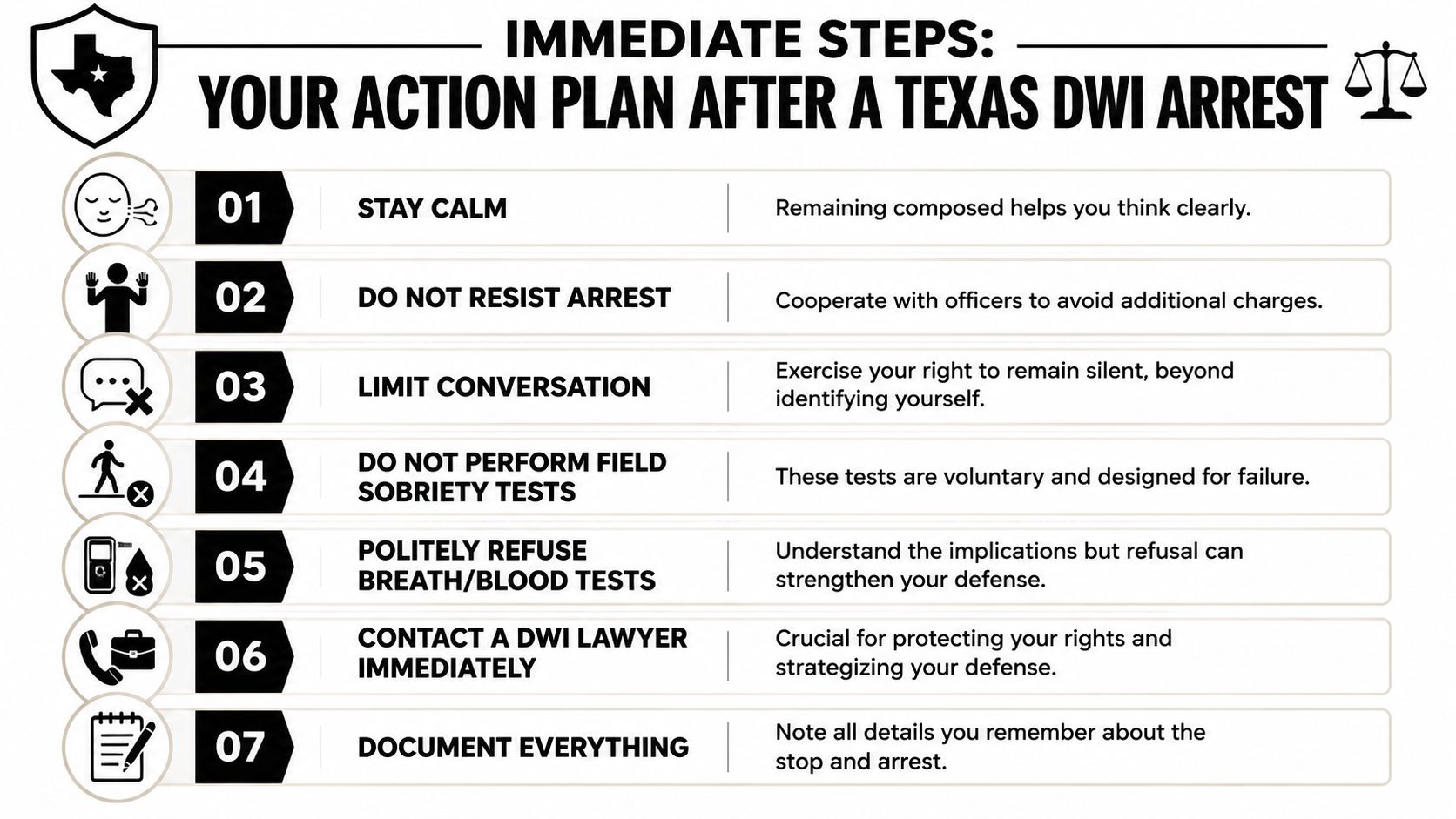
Treat the next few days like a response window, not a waiting period. You are dealing with two tracks at once. The criminal case will move through the court system. The separate ALR license case can move fast if you do nothing.
Do these things first
Write down the stop and arrest in detail.
Do it now, while your memory is still clean. Note where you were, why the officer said you were stopped, what questions were asked, what field tests happened, whether you gave a breath or blood sample, and anything unusual about the arrest.Put every paper in one folder.
Keep your bond papers, citation, notice of suspension, towing or impound documents, and any court setting information together. A missing page can create real problems later.Act on the ALR deadline immediately.
The license suspension issue does not wait for your criminal court date. If you were served with notice after the arrest, there is a short deadline to request an ALR hearing. Miss it, and you can lose an early chance to fight the suspension and question the officer under oath.
Your first priority is control. Get the facts organized, protect your license deadline, and stop making decisions that help the State.
Avoid the mistakes that make a bad case harder
People often hurt themselves after release by talking too much and waiting too long.
- Do not call police or investigators to “clear things up.”
- Do not post about the arrest, the stop, or your drinking on social media.
- Do not assume the court date is your first real deadline.
- Do not rely on online shortcuts or stories from friends who “beat” their case.
If you are unsure what to ask when hiring counsel, this guide on choosing the right criminal defense attorney is a useful starting point.
One conversation can do real damage
Officers and investigators do not need your help building the case. They already wrote their version. Your job is to stop giving them more statements to use against you.
For guidance on answering follow-up questions, read should you talk to police after a DWI arrest in Texas.
Silence is often the smartest move. Then call a DWI lawyer and get a plan in place fast.
Take the First Step Contact Us for a Free Consultation
A DWI arrest can make you feel like your life just split in two. Before the stop, everything felt normal. After the stop, every decision feels loaded.
You do not have to sort this out alone.
A good consultation should give you three things right away. First, clarity about what happened and what deadlines matter. Second, an honest assessment of where the risks are. Third, a concrete plan for what to do next.
What a consultation should do for you
It should not shame you. It should not pressure you. It should help you understand the criminal case, the license problem, and the immediate decisions that can protect your future.
That means talking through questions like these:
- Was the stop challengeable
- What license deadline applies
- What documents should be reviewed first
- What evidence needs to be preserved
- What should you avoid saying or doing now
Why acting now matters
Waiting rarely improves a DWI case. Evidence can get harder to gather. License issues can move forward. Your own memory becomes less useful with time.
You don't need to have every answer before you call. You just need to take the first step.
Asking for legal help after a DWI is not an admission of defeat. It's the first smart move in taking back control.
If you're scared, that's understandable. If you're embarrassed, that's common. If you're worried about how this could affect your work, your family, or your future, you're thinking about the right things.
The direct answer remains the same. If you're asking do i need a lawyer for a dwi in texas, the answer is yes. And the right time to get help is now.
If you need clear answers after a Texas DWI arrest, contact The Law Office of Bryan Fagan, PLLC for a free consultation. You can speak with someone about your arrest, your license concerns, and your next steps in a confidential, no-pressure conversation. The sooner you act, the more options you may be able to protect.