A DWI charge can change your life in a single night. You may be worried about jail, your license, your job, your family, and what people will think. That fear is real, but one fact matters right away. An arrest is not the same thing as a conviction.
In real practice, finding the best defense for a what is the best defense for a DWI in Texas means understanding that there usually isn't one magic phrase or one trick that makes the case disappear. The best defense is the one that attacks the weakest part of the State's proof, fast enough to protect both your criminal case and your driver's license.
A DWI Charge Is Not a Conviction
A lot of people wake up after a DWI arrest and assume the case is already over. It isn't. Texas case outcomes show that many DWI cases are resolved before trial, and some end favorably for the accused. Texas data from 2020 showed 83,088 DWI charges, while 6,771 were dismissed and 3,275 resulted in release with no charge, according to Texas DWI outcome data discussed by Doug Murphy Law.
That matters because DWI cases are often won or lost on procedure, evidence, and timing. A bad stop, weak roadside investigation, sloppy testing process, or missing proof can change the entire case.
A common pattern looks like this. A person is stopped late at night, says too much because they're nervous, tries the field tests on uneven pavement, then gives a breath or blood sample later. From the outside, that may sound like an open-and-shut case. Inside the file, though, there may be serious problems with the stop, the arrest decision, the test timing, or the paperwork.
Practical rule: The sooner a lawyer reviews the stop, video, reports, testing records, and deadlines, the more defense options you usually have.
Some people also benefit from reading broader educational material while they wait to speak with counsel. If you want a plain-language overview of the process, this DUI defense guide from Brian Hansford Law gives a useful general primer.
What actually helps early
The first helpful move is mental. Stop treating the arrest as proof that the State can convict you.
The second is practical. Preserve facts while they're still fresh.
- Write down the timeline: When you last ate, when you drank, where you were, and when the officer stopped you.
- Save receipts and messages: Bar tabs, restaurant receipts, rideshare records, and texts can help reconstruct timing.
- Do not explain the case to friends or coworkers: Loose talk creates problems that can't be taken back.
A strong defense starts with details. Small details often become the reason a case gets challenged, reduced, or dismissed.
The Foundation of Your Defense The Traffic Stop

The traffic stop is often the most important moment in the whole case. If the officer did not have a lawful reason to pull you over, the defense may be able to attack everything that came after it.
What reasonable suspicion means
In plain English, reasonable suspicion means the officer needed a specific, explainable reason for the stop. Not a guess. Not a vibe. Not “it was late and the driver left a bar area.”
The officer must be able to point to facts that support the stop, such as a traffic violation or observable driving behavior that suggests criminal activity. That is why the first question in many DWI cases is simple: Why did the officer stop the car in the first place?
Many Texas defense attorneys emphasize that an unconstitutional stop, one made without a valid traffic violation or articulable suspicion, can taint the entire case and may force a prosecutor to dismiss because key evidence becomes inadmissible, as discussed in Attorney at Law Magazine's overview of Texas DWI laws and defenses.
Why this defense is so powerful
If the stop was illegal, the defense can ask the court to suppress evidence obtained after that stop. That can include:
- Roadside observations: Odor of alcohol, red eyes, slurred speech, and balance claims.
- Statements you made: Admissions about drinking or where you were coming from.
- Field test evidence: The officer's claimed clues from roadside tests.
- Later test results: In some cases, the breath or blood evidence is tied closely enough to the stop that it also becomes vulnerable.
That's why lawyers often say the stop is a strategic issue. It attacks the case at the front end.
If the stop falls apart, the prosecution may lose the evidence chain it planned to build the case on.
What to examine right away
A defense lawyer will usually compare the report to the video and look for mismatch. Officers sometimes write one thing and the video shows something less convincing.
Key questions include:
- Did the video show an actual traffic violation?
- Did the officer describe specific facts, or broad conclusions?
- Did the driving look normal before the stop?
- Did the reason for the stop shift over time?
If you want to understand how much you should say during a roadside investigation, this guide on answering questions during a Texas DWI stop is a useful companion.
Challenging Field Sobriety Tests and the Arrest

Field sobriety tests sound scientific. In practice, they are often subjective, awkward, and heavily dependent on the officer's instructions and interpretation. Many sober people perform poorly on them.
The three tests drivers typically hear about are the eye test, the walk-and-turn, and the one-leg stand. Officers present them as neutral tools, but the roadside setting is rarely neutral. It may be dark, noisy, sloped, wet, or full of passing traffic. You may be tired, frightened, injured, older, or wearing the wrong shoes.
Why field tests are often less reliable than people think
These tests are not measuring whether you are a safe person or a careful driver. They are trying to create clues that support arrest.
A defense lawyer will usually ask:
- Were the instructions clear?
- Was the test demonstrated correctly?
- Was the surface level and safe?
- Did the officer account for medical issues or physical limitations?
- Does the body camera video match the report?
Common Challenges to Field Sobriety Tests
| Factor | How It Affects the Test | Applicable Test(s) |
|---|---|---|
| Uneven ground | Throws off balance and foot placement | Walk-and-Turn, One-Leg Stand |
| Poor lighting | Makes it harder to follow instructions and see lines or foot position | All tests |
| Nervousness | Causes shaking, stiffness, and trouble concentrating | All tests |
| Fatigue | Slows reaction time and affects balance | All tests |
| Age or mobility limits | Reduces balance, flexibility, and coordination | Walk-and-Turn, One-Leg Stand |
| Medical conditions | Can affect eye movement, balance, or speech | All tests |
| Improper instructions | Makes a person appear noncompliant or confused | All tests |
| Footwear or clothing | Interferes with turning, stepping, and balance | Walk-and-Turn, One-Leg Stand |
The arrest still needs legal support
Even if the stop was lawful, the arrest itself must still be supported by probable cause. That is a higher standard than reasonable suspicion. The officer must have enough facts to justify taking you into custody for DWI.
Field tests carry importance. If they were poorly administered or wrongly interpreted, the arrest decision may also be open to attack. The officer's opinion is not untouchable just because it appears in a report.
A roadside test is only as good as the conditions, the instructions, and the officer's honesty about what the video shows.
Some mistakes after arrest make defense harder. This article on what not to do after a DWI arrest in Texas covers avoidable problems, including talking too much and trying to explain things without counsel.
Real trade-offs here
Not every shaky field test issue wins a dismissal by itself. Sometimes it's strongest when combined with a weak stop, a poor video, or questionable chemical evidence. Sometimes it helps in negotiation more than in trial. That's still valuable.
A realistic defense lawyer doesn't just ask, “Can I argue this?” The better question is, “Does this create enough doubt to suppress evidence, reduce the charge, or improve the plea options?”
Attacking Chemical Evidence Breath and Blood Tests
A lot of people call my office after they see a breath number or learn their blood was drawn and assume the case is over. It is not. Chemical evidence can be powerful, but only if the State can prove the sample was lawfully obtained, properly handled, and reliably interpreted.
That timing matters for another reason. In a Texas DWI case, the criminal charge is only one track. The license suspension case starts quickly, and the same records that matter in the criminal case often matter in the ALR process too. Waiting to deal with the test result can cost you evidence and put your driver's license at risk.
Breath tests depend on strict procedure
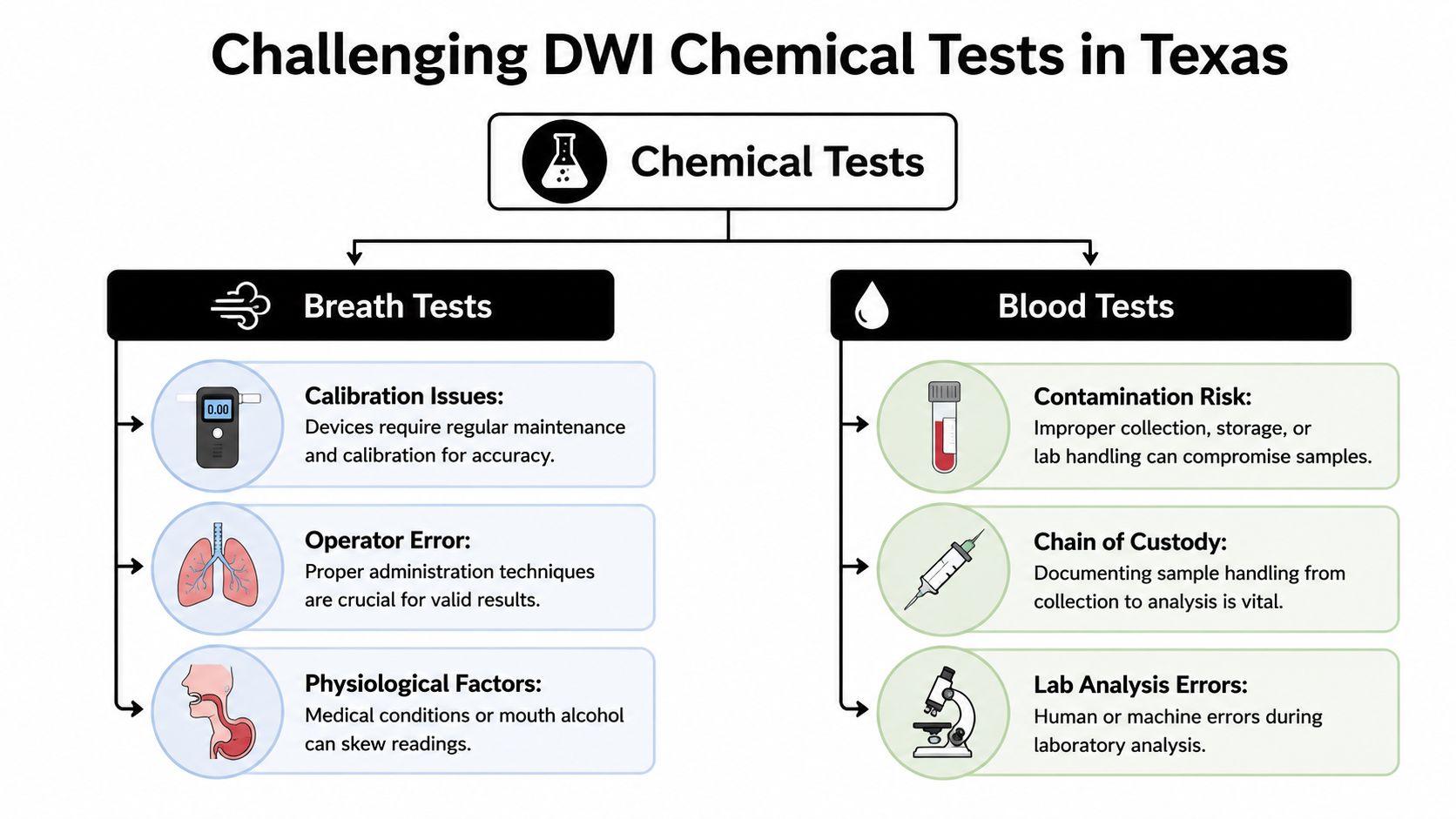
Breath machines do not convict people by themselves. The result only carries weight if the device was maintained, the operator followed protocol, and the test conditions were clean enough to trust the reading.
One recurring issue is the observation period. If the officer did not watch the subject closely for the required period, the test may be vulnerable to challenge. Burping, regurgitation, mouth alcohol, certain dental work, and some medical conditions can affect a sample in ways a jury never hears about unless the defense raises it.
A serious review usually includes the maintenance and inspection history, operator records, video, the printout itself, and whether the reported number fits the rest of the evidence.
Blood tests raise different problems
Blood evidence often looks more scientific to a prosecutor and a jury. It also creates more places where mistakes can happen.
A proper defense review asks questions such as:
- Was the blood draw legal? If police used a warrant, the warrant and affidavit need close review.
- Was the draw done correctly? The location, person drawing the blood, preservatives, tubes, and storage conditions can matter.
- Can the State prove chain of custody? The State must account for who handled the sample and when.
- Did the lab testing hold up? Reporting errors, contamination issues, and poor documentation can weaken the result.
Those are not technical side issues. In the right case, they are the center of the defense.
Timing can change the meaning of the number
Texas law focuses on intoxication at the time of driving. That is why a later test result does not always answer the actual question.
If the stop, arrest, and test happened well after driving, the defense may examine whether alcohol was still being absorbed. That is the rising BAC issue. A person can test higher later than they were when they were behind the wheel. That argument is fact-specific, and it needs a careful timeline, but it can matter in close cases and in cases where the State is relying heavily on the test number. This Texas discussion of DWI defenses including rising BAC explains the concept in plain terms.
The test is a later measurement. The legal issue is earlier.
Records that often matter more than clients expect
Timing defenses and chemical-test challenges are built from documents, video, and small details that people often overlook in the first few days.
Useful evidence can include:
- Receipts or transaction records showing when alcohol was bought
- Witness statements about when drinking started or stopped
- Body cam, dash cam, and dispatch logs showing the actual timeline
- Jail, nurse, or lab records documenting the draw and transfer of the sample
- Food and medication history if absorption or contamination is in dispute
A breath or blood number can look decisive on paper. Its value depends on legality, timing, procedure, and whether the State's paperwork holds together under scrutiny.
Practical trade-offs
Some chemical-test challenges lead to suppression. Some do not. Sometimes the better result is exposing enough weakness to improve negotiations, reduce the charge, or create trial doubt the prosecutor cannot ignore.
What usually fails is a generic claim that the machine was wrong or the lab made a mistake. Courts hear that every day. What helps is a targeted attack backed by maintenance records, lab documents, timeline evidence, and testimony that fits the science and the facts.
If you're looking for practical help evaluating test records and stop evidence, The Law Office of Bryan Fagan, PLLC handles Texas DWI defense matters and related case review as one available option for people trying to assess the strength of the State's proof.
Additional Powerful DWI Defense Strategies
A strong DWI defense is not always about whether you were over the legal limit. In some cases, the better strategy is to force the State to prove a point it cannot prove cleanly, or to cut down the charge and the punishment risk while your lawyer also protects your license on the separate timeline discussed in this first 48 hours after a DWI arrest in Texas guide.
When the real fight is who was driving
Officers do not always see the vehicle in motion. I see this issue come up after wrecks, stalled-car calls, and situations where police arrive after the fact. If nobody clearly saw you operate the vehicle, the prosecution has to piece that element together from statements, witness accounts, video, location evidence, and the condition of the scene.
That can create real room for defense work. A passenger's statement may shift. Body camera footage may show uncertainty. The vehicle's position may not match the officer's assumption. If the State cannot prove operation beyond a reasonable doubt, the case has a serious weakness even if intoxication is heavily argued.
Medical explanations can change how the evidence looks
Officers often describe slurred speech, balance problems, red eyes, confusion, or poor coordination as signs of intoxication. Those same signs can also come from legitimate medical conditions, fatigue, injury, neurological issues, inner-ear problems, reflux, or prescription medication side effects.
This defense only works when it is grounded in records, history, and facts that fit the scene. A vague claim usually goes nowhere. A documented condition that explains what the officer saw can change how a prosecutor evaluates the case and how a jury hears it.
Emergency or necessity defenses exist, but courts examine them closely
A person may have been driving because of an immediate threat, a medical emergency, or another urgent situation with no safe alternative. Texas law can recognize that kind of defense in the right case.
These are difficult cases to win because the facts have to be strong. The timing, the reason for driving, the distance traveled, and the availability of other options all matter. If you raise necessity, expect the prosecutor to test every detail.
Prior convictions and felony enhancements deserve their own review
In felony DWI cases, one of the most important questions is whether the State can properly use the prior convictions it listed. I do not treat that as a paperwork formality. Prior judgments, offense dates, county records, identity matching, and the legal validity of the prior case all need careful review.
Sometimes the challenge does not defeat the whole prosecution. It can still matter a great deal. If an enhancement fails, the punishment range can change dramatically, which affects plea strategy, trial risk, and even bond decisions. People comparing release procedures in different states sometimes look at resources like Colorado DUI release information, but Texas cases turn on Texas charging rules, local court practice, and the specific proof the prosecutor has.
In some DWI cases, the best defense is narrowing the case to what the State can truly prove, then attacking the parts it assumed would go unchallenged.
Your First 48 Hours The Most Critical Steps

The first two days matter more than individuals typically realize. During this critical window, the practical answer to what is the best defense for a DWI in Texas becomes clear. The best defense is often a two-track strategy that starts immediately.
One track is the criminal case. The other is your driver's license.
A critical but often-missed part of Texas DWI defense is the separate administrative license revocation process. A driver has only 15 days from the date of arrest to request a hearing to fight the automatic suspension, and that is why the best defense often means fighting the license case right away while building the criminal defense at the same time, as explained in this Texas ALR strategy overview.
What to do right now
Do these things as soon as possible:
- Request legal help quickly: The ALR deadline does not wait for you to feel settled.
- Write your timeline: Include where you were, what you drank, what you ate, and what happened during the stop.
- Preserve documents: Keep receipts, screenshots, medications, and names of witnesses.
- Stop talking about the case: Do not post online. Do not text details. Do not try to “clear things up” with police.
- Track bond and release terms carefully: Missing a condition creates new problems fast.
People who are dealing with release questions sometimes look for examples from other states just to understand the process flow. This Colorado DUI release information can be a general orientation resource, but Texas deadlines and procedures are different, so local legal advice matters.
Why the ALR hearing matters
The ALR hearing is about your license, but it can also help the defense gather information early. It may lock in officer testimony, reveal timeline issues, and expose weaknesses before the criminal case gets deeper into court.
That early pressure can matter. Good defense work is often about sequence, not just argument.
For a more detailed breakdown of immediate priorities, review this guide to the first 48 hours after a DWI arrest in Texas.
Here's a short video that can help you think through those first urgent decisions.
What people often get wrong
The biggest mistake is waiting. The second biggest is assuming the breath or blood result means there is nothing to fight.
The third is focusing only on the criminal court date while ignoring the license deadline. That is exactly why so many people miss the most time-sensitive part of their defense.
Let an Experienced Attorney Find Your Best Defense
The best outcome in a DWI case is not always a dramatic trial win. Sometimes it is suppression of key evidence. Sometimes it is dismissal. Sometimes it is a negotiated reduction that avoids the full impact of a DWI conviction.
A seasoned attorney looks at the entire chain. The stop. The roadside investigation. The arrest decision. The breath or blood evidence. The timing. The paperwork. The enhancement allegations. Then the lawyer gives you a realistic plan based on what is provable, not what the arrest report claims.
If you've been charged, don't guess your way through it. A focused review done early can protect your license, your record, and your options.
If you're facing a Texas DWI charge, you don't have to sort through the fear and deadlines alone. The Law Office of Bryan Fagan, PLLC offers free consultations so you can get clear, practical guidance about your case, your license, and your next steps. The right defense starts early, and confidential legal advice can help you make smart decisions before small mistakes become bigger problems.