A DWI arrest can turn an ordinary night into a very long morning. You may be worried about jail, your job, your license, your family, and what happens next. That reaction is normal.
The first thing to understand is simple. An arrest is not a conviction. If you're trying to understand how to win a dwi case in texas, the answer usually isn't one trick or one argument. It's a disciplined defense that starts early, preserves your rights, and forces the state to prove every part of its case.
A Texas DWI is often two separate fights at the same time. One happens in criminal court. The other involves your driver's license through the Administrative License Revocation process, often called ALR. Many people focus only on the court date and miss the license deadline, which can damage their position before the criminal case really gets moving.
Your Guide to Navigating a Texas DWI Charge
Texas law treats intoxication as a crime if a driver has a BAC of 0.08% or higher, or if the driver lacks the normal use of mental or physical faculties. The state still has to prove that beyond a reasonable doubt, and a good defense often targets each step of that proof, from the stop to the final test result, as explained in this Texas DWI defense overview.
That matters because many individuals exiting jail believe the breath or blood result decides everything. It doesn't. A DWI case is built from many moving parts, including why the officer stopped you, what the officer saw, how field sobriety tests were given, whether any statements were lawfully obtained, and whether chemical evidence can be used in court.
Two battles start right away
The criminal case asks whether the state can convict you.
The ALR case asks whether the state can suspend your license through a separate process.
Those are different hearings, different rules, and different risks. If you treat them like one issue, you can lose ground fast.
A practical first step is getting clear on the immediate consequences, including release conditions and cost concerns. If you're trying to understand DWI bail costs in Texas, that can help you plan the next few days without guessing.
For a broader immediate checklist, review what to do immediately after a DWI arrest in Texas. The biggest mistakes usually happen before the first court appearance, not during it.
Practical rule: Winning starts with preserving issues early. Cases are often damaged by delay, loose talk, and missed deadlines.
What usually works and what usually doesn't
Some defense moves provide an advantage. Others mostly make people feel better for a week.
What tends to help:
- Early evidence review: Dash-cam, body-cam, dispatch logs, and reports often tell a more complete story than the arrest affidavit.
- Fast license action: Protecting the ALR hearing can create an early opportunity to challenge the stop and arrest.
- Focused case theory: Strong defenses usually center on proof problems, not excuses.
What usually doesn't help:
- Arguing with officers after the arrest
- Posting your version of events online
- Assuming the case is hopeless because of a test result
- Waiting until the first court date to hire counsel
If you're calm, organized, and strategic from the start, you give yourself a real chance to improve the outcome.
The First 15 Days Your Most Critical Window
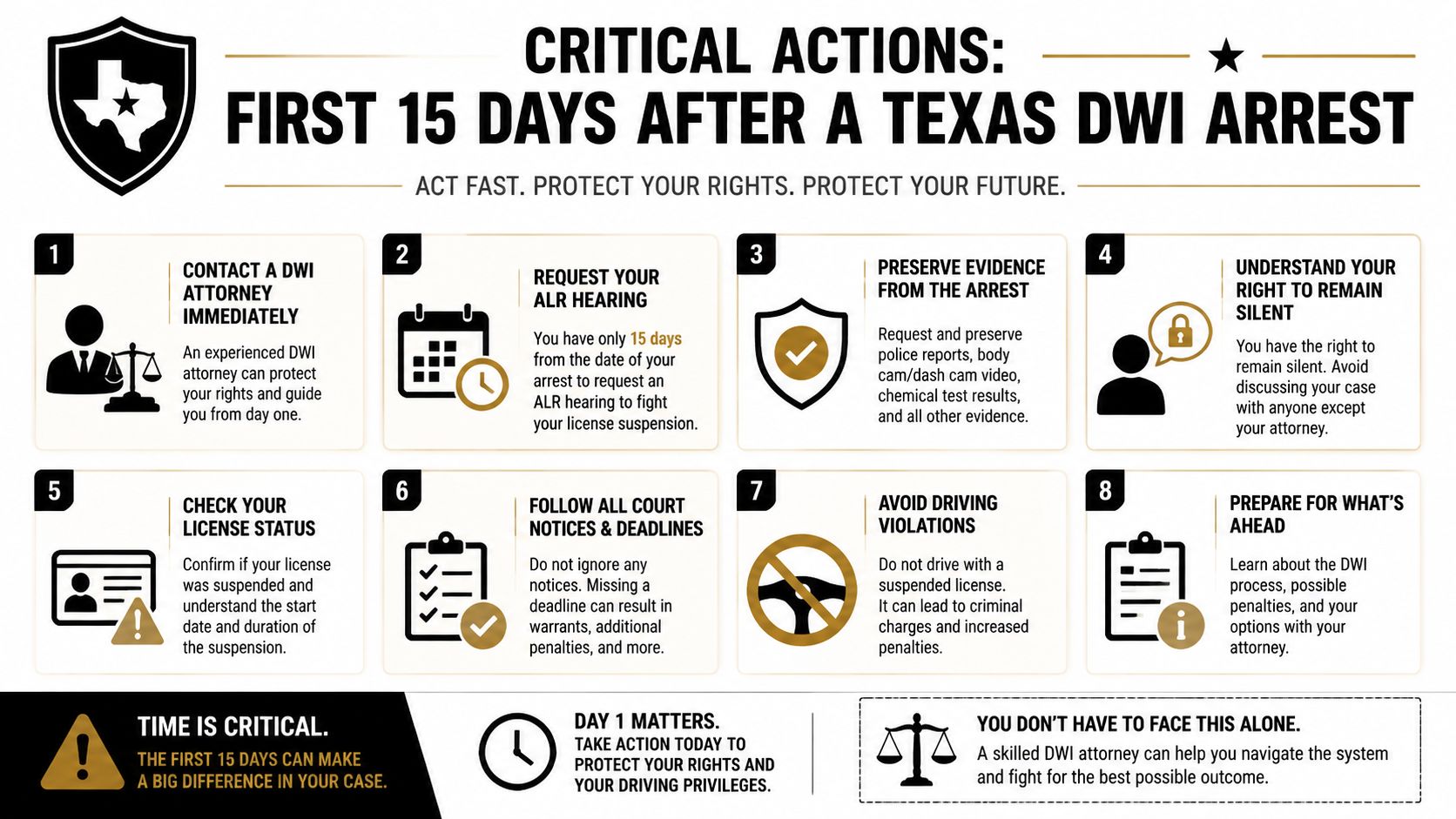
The first two weeks after a DWI arrest are usually the most important part of the case. Not the trial. Not the plea setting. Not the final hearing. The first 15 days.
Texas defense guidance stresses that missing the ALR request deadline can cost you the chance to challenge the license suspension early, while requesting it creates an opening to examine the stop, arrest, and testing procedure before the criminal case moves forward, as discussed in these Texas DWI defense resources on the ALR process.
What to do right now
Start with actions you can control today.
- Request legal help quickly. Time matters because video can disappear, officers' memories harden into reports, and deadlines don't move for confusion.
- Protect the ALR deadline. This is one of the few urgent dates in the case.
- Write your own timeline. Do it while details are fresh. Include where you were, what you drank if anything, when you were stopped, what the officer said, whether there were passengers, and whether any test instructions seemed unclear.
- Save documents and digital records. Receipts, rideshare records, GPS history, texts arranging the evening, and parking records can all matter depending on the facts.
- Stay off social media. Even innocent posts can be misunderstood.
What not to do
The wrong move after arrest is often self-inflicted.
- Don't explain the case to friends in group texts. Those messages can be screenshotted, forwarded, and taken out of context.
- Don't assume politeness requires answering every question. Your right to remain silent still matters after the stop.
- Don't clean up facts. If you spoke to police, took tests, or refused tests, your lawyer needs the truth, not the polished version.
- Don't miss paperwork. Read every sheet you were given.
If you're unsure how much you have to say during police questioning, this guide on whether you have to answer questions during a DWI stop in Texas is worth reading carefully.
Write down the facts while they're still uncomfortable and fresh. Waiting a week can erase details that later matter in court.
Build your case file before the state builds theirs
It's often overlooked how quickly a prosecutor's file starts taking shape. The officer's report, video, test records, and charging paperwork create the state's first draft of the case. Your job is to make sure that draft doesn't become the only story.
A simple personal file should include:
| Item | Why it matters |
|---|---|
| Release papers | They often contain dates, conditions, and license-related notices |
| Your written timeline | It preserves facts before memory fades |
| Names of witnesses | Passengers, bartenders, servers, or family members may help clarify timing and condition |
| Digital records | Location history and receipts can support or challenge parts of the report |
The first 15 days are about control. Not panic. Not internet myths. Control.
Saving Your License The ALR Hearing Explained
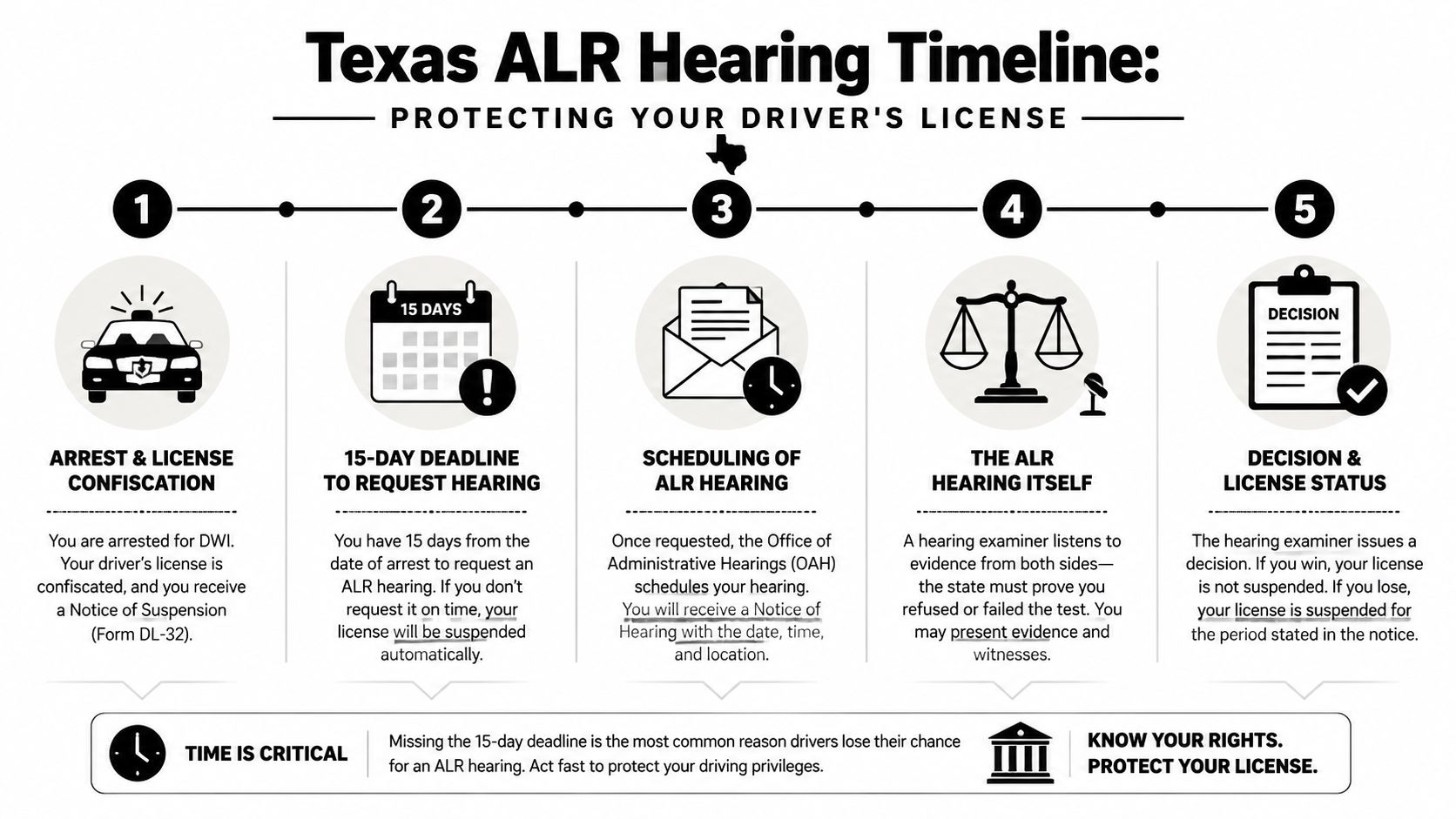
You can be out of jail and still be in two fights at once. One is the criminal DWI case. The other is the effort to keep your license through the Administrative License Revocation process, usually called ALR.
That second fight starts fast. If you do not request the hearing in time, the suspension process can move ahead without giving you the early chance to question the state's case. I tell clients to treat the ALR deadline as one of the first dates that matters after an arrest, because it can affect how you get to work, take your kids to school, and manage daily life while the criminal case is still pending.
What the ALR hearing actually decides
An ALR hearing does not determine guilt or innocence. It focuses on your driving privileges and whether the state can support the suspension based on what happened during the stop, arrest, and testing request.
That narrower focus is exactly why it matters.
The hearing often gives the defense an early, practical look at the evidence before the criminal case is far along. In many cases, the officer has to explain key decisions under oath. That testimony can matter later if the criminal case turns on the same facts. If you want to understand how those facts are later used in court, review how prosecutors prove DWI in Texas.
Why lawyers fight hard on the license case
A police report can read cleanly and still fall apart under questions.
At the ALR hearing, the issues are usually specific. Why did the officer stop you? What signs of intoxication were observed? When were warnings given? Was a breath or blood test requested properly? Did the timeline make sense?
Those details matter because the hearing can do two things at once. It can help you keep your license, and it can preserve testimony that helps the defense later in the criminal case.
Legal advice becomes more important than internet advice at this stage.
What to expect in practical terms
The hearing is usually more focused and technical than people expect. It is not the place for broad explanations about your character or why the arrest has been hard on your family. The useful work is narrower than that.
Your lawyer is usually looking at questions like these:
| ALR issue | Why it matters |
|---|---|
| Basis for the stop | A weak or inconsistent reason for the stop can affect the suspension case and later suppression issues |
| Probable cause for arrest | The officer must justify the shift from detention to arrest with specific facts |
| Statutory warnings and test request | Mistakes in the warning or request process can create problems for the state |
| Test refusal or specimen procedure | The timeline and paperwork need to match what the officer says happened |
Sometimes the license hearing ends well. Sometimes it does not. Even when the suspension is not avoided, the hearing can still produce useful testimony, expose missing details, or pin the officer to a version of events that cannot easily change later.
That is a real trade-off clients need to understand. Winning the ALR hearing is helpful, but the bigger value is often strategic. It gives the defense an early chance to test the case before the criminal side gains momentum.
If your license does get suspended, the next question is often whether you qualify for an occupational license so you can keep driving for necessary tasks. Separate from that, some drivers later look for options to clear up unrelated traffic matters, including A-1 Driving School ticket dismissal, but that does not replace a defense plan for a DWI arrest.
The main point is simple. The ALR case is not paperwork on the side. It is one of the first places a smart defense can start doing real work.
Building a Strong Defense Common DWI Challenges
A DWI defense is rarely built on one dramatic moment. It is usually built by taking apart the state's proof piece by piece.
Texas defense practice commonly starts with the legality of the stop. If the officer lacked a specific, articulable reason for pulling you over, evidence gathered later, including field sobriety tests and chemical tests, may be suppressed and ruled inadmissible, as explained in this Texas DWI stop and suppression guide.
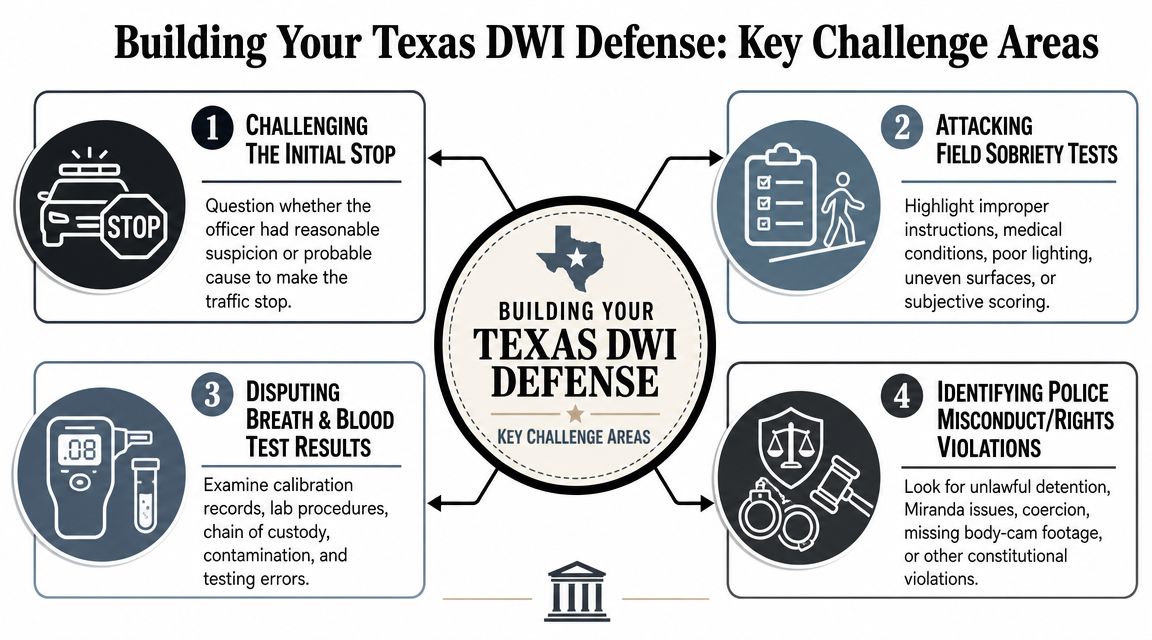
The stop comes first
If the stop fails, the rest of the case may wobble with it.
An officer needs a real reason to pull you over. That reason should match the video, the report, and the timeline. If the report says one thing and the dash-cam shows another, that discrepancy matters. A stop based on vague claims can create a suppression issue that changes the whole case.
A lot of people fixate on the test result. Good defense lawyers usually look backward first.
Field sobriety tests are not magic
Field sobriety tests can look persuasive on paper. They are often less persuasive when you slow them down and examine how they were given.
These tests depend on instructions, conditions, lighting, surface, footwear, medical issues, nerves, and whether the officer followed standardized procedures. If any of that was off, the meaning of the test gets weaker.
Here is one useful reality check. Looking awkward on the roadside is not the same thing as proving intoxication beyond a reasonable doubt.
This short video gives a practical look at common defense themes in Texas DWI cases.
Breath and blood evidence can be challenged
Chemical evidence often sounds more final than it is. Breath testing can raise questions about procedure and machine-related issues. Blood testing can raise questions about collection, handling, storage, and chain of custody.
That does not mean every test result is wrong. It means every step must be checked.
A defense file in this area often looks at:
- Collection records
- Lab paperwork
- Timing
- Officer observations compared with the number
- Any break in chain of custody
Procedure still matters
Some cases are damaged by police shortcuts, incomplete reports, or contradictions between reports and video. Others are not. The point is to verify, not assume.
If you want a plain-English explanation of how the state tries to put these pieces together, read how prosecutors prove DWI in Texas. Knowing what the prosecutor needs helps you see where the weak points may be.
Defense insight: The best question is often not "Did I take a test?" It's "Can the state prove every link in the chain and get that evidence admitted?"
Some readers also confuse DWI defense with routine traffic-ticket handling. They are not the same thing. If you're dealing with a separate citation issue, information about A-1 Driving School ticket dismissal may be useful, but a DWI case requires a much more technical review of constitutional issues, testing, and admissibility.
From Arraignment to Trial The DWI Court Process
After the arrest phase settles down, the criminal case starts moving through court. This part can feel slow, but it is where many cases are won or lost.
Statewide Texas data from 2020 showed 33,476 guilty pleas, 6,771 dismissals, and 1,826 not guilty pleas, which is one reason early strategy matters so much in DWI cases, according to this Texas DWI outcomes analysis. Those numbers don't promise any result in your case. They do show that outcomes vary, and the path matters.
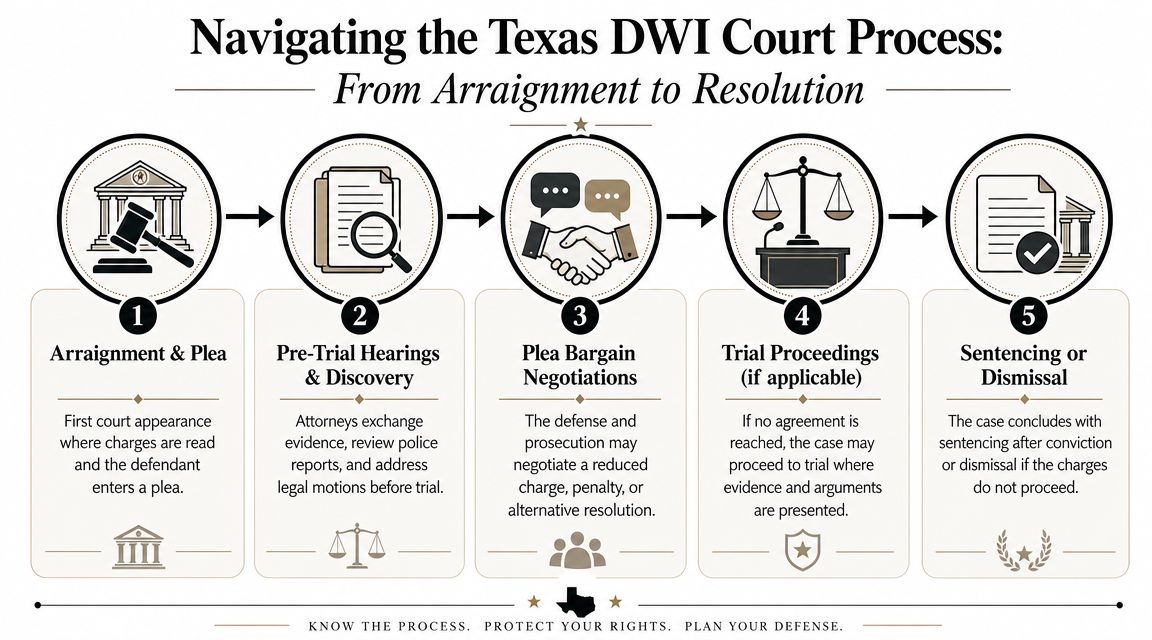
Arraignment and the early court settings
Arraignment is usually the formal start of the court case. The charge is addressed, and the defense enters a plea. In many DWI cases, the practical starting point is a not guilty plea so the defense can investigate, request evidence, and evaluate the case before making permanent decisions.
After that come the early settings. These are often not dramatic hearings. They are work sessions where the lawyers address discovery, scheduling, motions, and possible negotiation.
Pretrial work often decides the case
A lot of good DWI defense happens outside the spotlight.
That may include reviewing body-cam footage frame by frame, comparing reports to video, challenging the stop, challenging the arrest, and identifying whether a motion to suppress makes sense. In large Texas counties such as Harris, Dallas, Tarrant, Bexar, and Travis, local practice and docket speed can affect how quickly these issues get heard, but the core strategy is the same. Attack the proof before you debate punishment.
A simple view of the stages helps:
| Stage | What happens |
|---|---|
| Arraignment | Plea entered and the case is formally underway |
| Pretrial hearings | Evidence is reviewed, motions are argued, negotiations may begin |
| Suppression issues | The defense asks the court to exclude unlawfully obtained evidence |
| Trial or resolution | The case ends through dismissal, plea, or verdict |
Plea offer or trial
Not every case should go to trial. Not every case should plead early either.
The right decision depends on the evidence, the legal issues, the risks of trial, your history, the available defenses, and what the state is offering. A weak stop may justify hard litigation. A strong lab result with clean police work may lead to a different discussion. The answer is case-specific.
This is also where legal advice matters more than internet advice. General information can prepare you. It can't weigh the actual file sitting on the prosecutor's desk.
You Don't Have to Fight This Alone
The night of the arrest is chaotic. The weeks after are where mistakes get expensive.
By this point, you have seen how a Texas DWI splits into two fights at once. One is the criminal case. The other is the effort to protect your driver's license through the ALR process. Both move on their own track, and both can affect your job, your finances, and your options in court. Trying to manage that alone, while also sorting out bond conditions, work, and family pressure, puts you behind early.
Good legal help should bring order to that mess. A lawyer should tell you what deadline comes first, what evidence needs to be requested and reviewed, whether the license hearing deadline is still open, and where the key pressure points are in your case. That includes candid advice about risk. A lawyer who promises a dismissal before reviewing the stop, the video, the test records, and your history is selling certainty no one can credibly offer.
A useful consultation should answer practical questions such as:
- What has to happen in the next few days
- Whether the ALR hearing was requested in time
- What evidence needs immediate review
- Which problems in the state's case are worth pressing
- Whether the goal should be trial preparation, negotiation, or both
The Law Office of Bryan Fagan, PLLC is known as a personal injury firm focused on car accident cases. That matters here in a different way. DWI arrests and alcohol-related crashes often overlap, and understanding how these cases are built, challenged, and documented can help people dealing with the fallout from a drunk-driving incident, especially where injuries are involved.
There is also the personal side of this arrest.
For some people, a DWI charge follows one bad decision. For others, it raises a harder question about alcohol use. If stopping suddenly could be physically dangerous, get medical help and review reliable information on managing alcohol withdrawal. Getting treatment does not decide the criminal case, but it can protect your health and show that you are taking the situation seriously.
Start with facts. Protect your deadlines. Get advice that matches your actual case, not someone else's story.
If you were injured by a drunk driver, or your DWI-related situation involves a car wreck and injury damages, contact The Law Office of Bryan Fagan, PLLC for a free, confidential consultation about your rights and next steps.