A motorcycle crash can change your life in seconds—but you don’t have to face recovery alone. Understanding your rights and the unique dangers Texas riders face is the first step toward getting the justice and financial support you and your family deserve.
The Dangers Texas Motorcyclists Face

There’s nothing like the freedom of an open Texas road on two wheels. It’s a feeling drivers in enclosed vehicles will never fully grasp. But with that freedom comes a serious risk. Unlike someone in a passenger car, a motorcyclist has virtually no protection in a collision. What might be a minor fender-bender for a car is often a life-altering event for a rider.
The numbers tell a grim story. In recent years, motorcycle fatalities in Texas have reached record highs. According to the Texas Department of Transportation (TxDOT), nearly 600 motorcyclists were killed in a single recent year—a tragic spike. These aren't just statistics; they are families and communities torn apart by preventable accidents.
Let's take a closer look at the data.
Texas Motorcycle Accident Key Statistics Overview
The table below breaks down the key figures from a recent year, highlighting just how vulnerable riders are on our roads.
| Statistic Type | Number Reported |
|---|---|
| Total Motorcycle Crashes | 8,912 |
| Motorcyclist Fatalities | 562 |
| Serious Injuries to Riders/Passengers | 2,422 |
| Suspected Minor Injuries | 3,176 |
These figures underscore a harsh reality: thousands of lives are impacted by these crashes every single year in Texas.
Common Hazards on Texas Roads
Most of these accidents aren't caused by bikers taking unnecessary risks. More often, they happen because other drivers fail to pay attention or share the road safely. Motorcyclists frequently become victims of drivers who are distracted, fail to yield the right-of-way, or simply don't see them.
Some of the most common causes we see in motorcycle accident cases include:
- Unsafe Lane Changes: A driver glances in their mirror but doesn't check their blind spot before merging, striking a rider who was there the whole time.
- Left-Turn Accidents: In this classic and devastating scenario, a car turning left at an intersection cuts directly into the path of an oncoming motorcycle.
- Distracted Driving: Texting, talking on the phone, or adjusting a GPS are lethal threats to everyone, but especially to riders.
- Following Too Closely: When a car tailgates a motorcycle, it robs the rider of safe stopping distance. A sudden stop can easily lead to a serious rear-end collision.
When another driver’s carelessness causes your injuries, you have the right to hold them accountable. Understanding the accident wasn't your fault is a crucial first step—both for your recovery and for pursuing a personal injury claim.
Imagine this real-world example: A Houston driver on I-45 looks down at their phone for just a few seconds. In that brief moment, they drift into the next lane and slam into a motorcyclist they never even saw. That single act of negligence can cause everything from severe road rash and broken bones to a traumatic brain injury or permanent spinal cord damage.
If you’ve been injured or have tragically lost a loved one in a crash, you need a compassionate Houston motorcycle accident lawyer in your corner. We understand the biases riders often face and can dig into the details of your accident, gather evidence to prove the other driver's fault, and fight for the compensation you need to rebuild your life. You don’t have to carry this weight alone.
Who Is Liable in a Texas Motorcycle Accident?
Determining who is legally at fault is the most critical part of any injury claim. So, how does the law decide who pays? In Texas, it all comes down to a legal concept called negligence.
In plain English, negligence occurs when someone fails to act with reasonable care, and that failure causes harm to another person. For motorcycle riders, this isn't just a legal term—it’s a daily reality.
When you start your bike, you trust other drivers to follow the rules of the road. When they break that trust, they have breached their duty to keep you safe. This "breach of duty" is the foundation for establishing liability, which is simply the legal term for responsibility.
For example, a driver on a busy Houston street has a duty to look for oncoming traffic before making a left turn. If they become impatient, fail to look, and turn directly into your path, they have acted negligently. Their carelessness is the direct cause of the crash and your injuries, making them liable for the resulting damages.
Proving Negligence in a Motorcycle Accident
To successfully pursue a claim, you and your attorney must prove four specific elements to show the other driver was negligent.
- Duty of Care: First, you must establish that the other driver had a legal obligation to operate their vehicle safely. This is a given for anyone with a driver's license.
- Breach of Duty: Next, you show how the driver violated that duty. Perhaps they were texting, speeding, or made an illegal turn. This is their specific wrongful act.
- Causation: Then, you must connect their breach of duty directly to the crash and your injuries. For example, the fact that they ran a red light was the direct cause of the T-bone collision.
- Damages: Finally, you must demonstrate the actual harm you suffered from the crash. This includes your medical bills, lost wages, property damage, and your physical and emotional pain.
A dedicated Texas injury attorney will investigate your case thoroughly, using police reports, witness statements, traffic camera footage, and accident reconstruction experts to build a strong case proving the other driver’s liability.
Common Causes That Point to Clear Liability
While every crash is unique, some scenarios almost always point to the other driver's negligence. Insurance companies know these patterns but may still try to shift the blame to you. It’s critical to recognize these common causes of motorcycle accidents in Texas.
- Failure to Yield: This often happens at intersections when a car turns left in front of an oncoming motorcycle, violating the rider's right-of-way.
- Unsafe Lane Changes: A driver who fails to check their blind spot before merging poses a massive threat. The classic excuse is, "I never even saw the motorcycle."
- Distracted Driving: A driver looking at a phone is not watching the road. This negligence leaves riders with no time to react.
- Following Too Closely: When a car tailgates a motorcycle, it creates a recipe for a devastating rear-end collision that is almost always the car driver's fault.
Even if you worry you might share some of the blame, it’s important to understand Texas law. You may still be able to recover compensation as long as your share of the fault is not more than 50%.
Unfortunately, an unfair bias against motorcyclists exists. Insurance adjusters often try to argue the rider was speeding or weaving through traffic without proof. This is why having an experienced motorcycle accident lawyer is so critical. We fight back against these stereotypes with hard facts to prove who was truly at fault and ensure you are treated fairly.
Understanding Your Rights Under Texas Law
When you’re recovering from a motorcycle crash, the last thing you want is a legal textbook. But you don’t need a law degree to understand your basic rights. Let’s break down some of the most critical Texas personal injury laws in plain English so you can protect yourself and your family.
Understanding Comparative Fault in Texas
One of the first things an insurance adjuster will try to do is pin some of the blame on you. They might claim you were speeding or weaving between lanes, even without evidence. This tactic is based on a Texas law called comparative fault (also known as proportionate responsibility), found in Chapter 33 of the Texas Civil Practice & Remedies Code.
Here’s how it works: a judge or jury assesses all the evidence and assigns a percentage of fault to everyone involved. Your percentage of fault directly impacts how much compensation you can recover.
Here’s the part you absolutely need to remember:
In Texas, as long as you are 50% or less at fault for the crash, you can still recover damages. If your share of the blame is 51% or more, you are barred from recovering anything.
For example, imagine a driver in Houston runs a stop sign and T-bones you, but there’s evidence you were going a few miles over the speed limit. A jury might find the other driver 90% at fault and you 10% at fault. If your total damages—medical bills, lost income, and pain and suffering—are $100,000, your final award would be reduced by your 10% of fault, meaning you could recover $90,000.
This is why you must fight back against any attempt to shift blame. A knowledgeable Houston car accident lawyer understands these tactics and will work to gather evidence that minimizes your percentage of fault, protecting your right to a full recovery.
What Are "Damages" in a Personal Injury Claim?
In legal terms, damages refers to the money awarded to compensate you for your losses after an injury. The goal is to make you "whole" again, at least financially. After one of the more severe motorcycle accidents in Texas, these damages can be substantial.
Compensation is generally divided into two main categories:
- Economic Damages: These are the straightforward, calculable costs, such as past and future medical bills, lost wages from being unable to work, and the cost to repair or replace your motorcycle.
- Non-Economic Damages: These compensate you for the human suffering caused by the crash, which doesn't come with a price tag. This includes physical pain, mental anguish, permanent scarring or disfigurement, and the loss of your ability to enjoy life.
If the accident tragically results in a fatality, the rider's family may be able to file a wrongful death claim. This type of claim seeks wrongful death compensation for losses like funeral expenses, the deceased’s lost future income, and the loss of their love, companionship, and support.
The Statute of Limitations: A Critical Deadline
There is one rule in personal injury law that cannot be bent: the statute of limitations. This is a strict deadline set by the state for filing a lawsuit.
In Texas, you generally have only two years from the date of the motorcycle crash to file your lawsuit. If you miss that deadline, you lose your right to seek compensation forever, no matter how strong your case is.
Two years might seem like a long time, but it passes quickly when you are focused on medical treatments, rehabilitation, and trying to get your life back on track. Evidence can disappear and witnesses' memories can fade, so it is crucial to speak with a Texas injury attorney as soon as possible to protect your rights.
Practical Steps to Take After a Motorcycle Crash
The moments after a motorcycle crash are chaotic and stressful. Your adrenaline is high, you’re likely in pain, and it’s difficult to think clearly. However, the actions you take can significantly impact your physical recovery and your ability to secure fair compensation for your auto insurance claim.
Here is a practical, step-by-step guide to help you protect yourself, both physically and legally.
Your Health and Safety Come First
Before anything else, your priority is to check for injuries and get to a safe location. If you are able to move, get out of the flow of traffic to avoid a secondary collision.
- Call 911 Immediately. Request police and paramedics. A formal police report is vital for any insurance claim or lawsuit.
- Get Medical Attention, Even If You Feel Fine. Adrenaline can mask serious injuries like internal bleeding or a concussion. Let paramedics evaluate you, and if they recommend going to the hospital, do so. Symptoms can appear hours or even days later.
- Follow Your Doctor's Orders. Adhere strictly to your prescribed treatment plan. Skipping appointments gives the insurance company an excuse to argue your injuries aren't as severe as you claim.
This infographic breaks down the core legal concepts that will be important as you move forward with your claim.
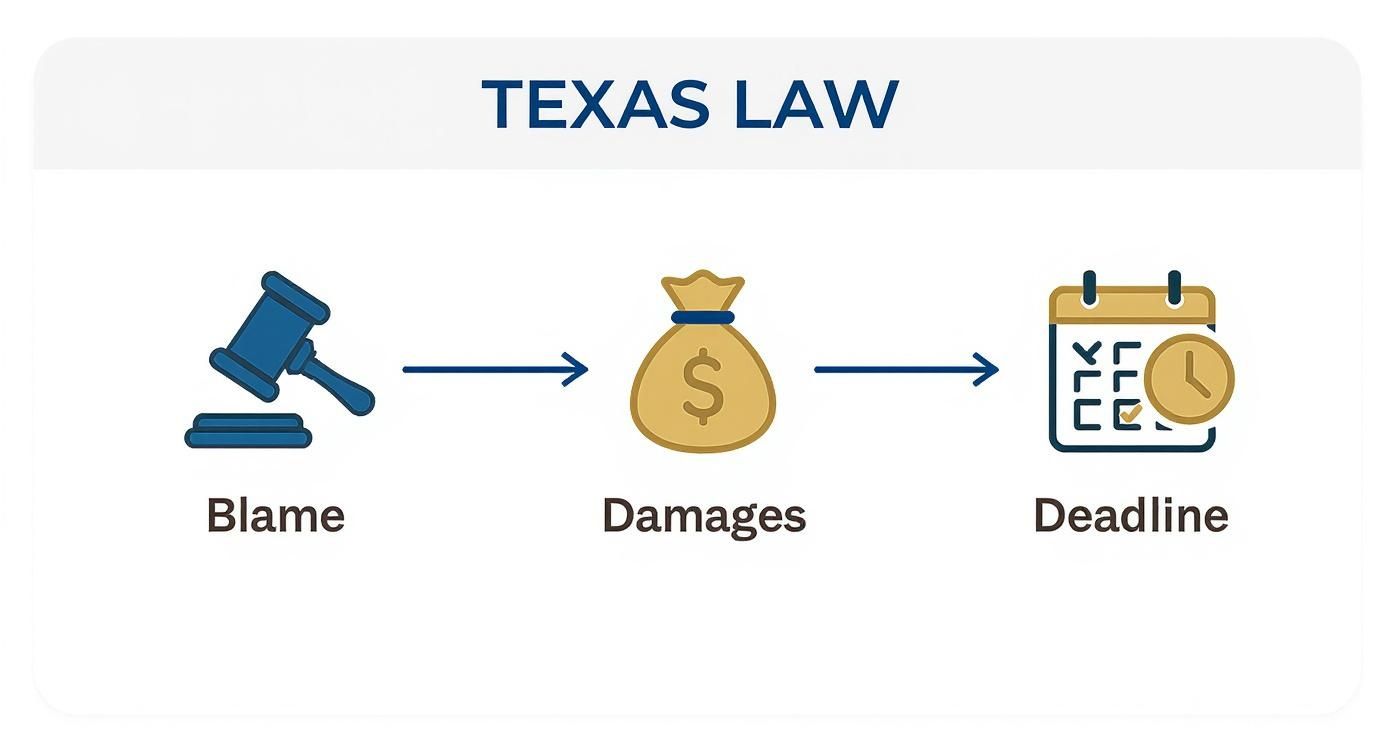
As you can see, the process involves determining fault, calculating your damages, and filing your claim before the legal deadline expires.
Gather Evidence to Protect Your Claim
If you are physically able, the information you collect at the scene can become the foundation of your case.
- Take Photos and Videos: Use your phone to document everything. Get shots of the damage to your bike and the other vehicle, skid marks, road conditions, traffic signals, and your injuries.
- Speak to Witnesses: If anyone saw the crash, get their name and phone number. An unbiased third-party account can be incredibly powerful.
- Exchange Information Carefully: Get the other driver’s name, contact information, and insurance details. However, do not discuss fault. Never apologize or say anything that could be interpreted as an admission of blame.
After a crash, you are not just a victim; you are the most important witness. The evidence you collect in those first few minutes can be invaluable.
The trauma from a crash is not just physical; the emotional toll can be just as debilitating. Resources are available to help, such as this guide on ICBC counselling for emotional recovery after an accident. Your mental well-being is a critical part of your recovery. Speaking with a compassionate Houston injury attorney can also provide reassurance and clarity during this difficult time.
How to Deal with Insurance Companies

After a motorcycle crash, dealing with an insurance company can feel like a second fight. Their primary goal is to protect their profits by paying out as little as possible. You must be prepared to protect your own interests, because the insurance adjuster is not on your side.
Adjusters are trained negotiators. They may sound friendly, but their job is to minimize their company's liability. They often offer a quick, lowball settlement before you know the full extent of your injuries. Accepting that offer is almost always a mistake, as it closes the door on any future compensation, even if your medical condition worsens. They will also try to get you to make a recorded statement to twist your words and assign fault to you.
Understanding the Compensation You Deserve
As mentioned, the money you can recover is legally called damages, which are intended to compensate you for all your losses.
Economic Damages
These are the tangible financial losses you have suffered.
- Medical Expenses: This covers everything from the ambulance ride and hospital stay to surgeries, physical therapy, medications, and future medical care.
- Lost Wages: You can be compensated for the income you lost while out of work.
- Loss of Earning Capacity: If your injuries are permanent and prevent you from returning to your job or earning the same income, you can seek damages for this future loss.
- Property Damage: This covers the cost to repair or replace your motorcycle and any damaged gear.
Non-Economic Damages
These damages are for the intangible harm you have experienced.
- Pain and Suffering: This compensates you for the physical pain and emotional distress caused by your injuries.
- Mental Anguish: This includes compensation for anxiety, depression, PTSD, or other psychological trauma.
- Disfigurement: If the accident left you with permanent scars, you can be compensated for that.
- Loss of Consortium: In some cases, a spouse can file a claim for the loss of companionship and support.
Documenting every loss is crucial. Keep a detailed file of all medical bills, receipts, and pay stubs. It is also wise to keep a daily journal detailing your pain levels, emotional state, and how your injuries impact your daily life.
The Role of a Texas Injury Attorney
Trying to battle an insurance company while recovering from your injuries is an overwhelming task. A skilled Houston motorcycle accident lawyer can level the playing field. Understanding the basics of general automotive insurance and how claims work is also helpful.
Your attorney will handle all communication with the insurance company, protecting you from their tactics. They will conduct a thorough investigation, gather evidence, and accurately calculate the full value of your claim, including future needs. An experienced lawyer knows what your case is worth and will not let you be bullied into accepting an unfair settlement. If the insurance company refuses to negotiate in good faith, your lawyer will be prepared to take your case to court to protect your rights.
Common Questions About Texas Motorcycle Accident Claims
After a serious motorcycle crash, it’s normal to have questions. Getting clear, honest answers is the first step toward regaining control. Here are some of the most common questions we hear from injured riders.
Should I Talk to the Other Driver’s Insurance Company?
It is best to avoid giving a recorded statement to the other driver's insurance adjuster until you have spoken with an attorney. Adjusters are trained to ask questions designed to trip you up or shift blame onto you. Anything you say can be used to reduce your auto insurance claim or deny it completely. The safest approach is to let an experienced Houston injury lawyer handle all communications on your behalf.
What If I Wasn't Wearing a Helmet?
You can still file a claim and recover compensation even if you were not wearing a helmet. The other driver’s negligence caused the crash, and that is the central issue. However, the insurance company will likely argue that your injuries would have been less severe with a helmet in an attempt to reduce their payout under Texas’s comparative fault law. A skilled lawyer knows how to counter this argument, often using medical experts to demonstrate the true cause of your injuries.
How Much Is My Motorcycle Accident Case Worth?
There is no simple formula, as every case is unique. The value of your case depends on several factors:
- The severity of your injuries: More serious injuries that require long-term care result in higher compensation.
- Your total medical bills: This includes all past, present, and future medical expenses.
- Lost income and earning potential: This accounts for the work you have missed and any impact on your future ability to earn a living.
- Pain and suffering: This compensates for the physical pain, emotional trauma, and disruption to your life.
- The clarity of fault: The stronger the evidence against the other driver, the better your position for a full settlement.
An experienced Texas motorcycle accident lawyer can provide a realistic estimate after reviewing the specifics of your case.
What If the Other Driver Was Uninsured?
If the at-fault driver has no insurance, you are not out of options. Your own insurance policy may provide coverage if you have Uninsured/Underinsured Motorist (UM/UIM) coverage. This allows you to file a claim with your own insurance company. However, your insurer may still try to minimize their payout, which is why having an attorney is just as important in these cases.
How Long Will My Case Take to Settle?
The timeline depends on the complexity of your case. A straightforward case with minor injuries might settle in a few months. A serious case involving life-altering injuries or a dispute over fault could take a year or more, especially if a lawsuit is necessary. The goal is not to settle quickly but to secure the full compensation you deserve.
Can I Still Sue If a Loved One Died in the Crash?
Yes. In the tragic event that you have lost a family member, Texas law allows certain surviving relatives (typically a spouse, children, or parents) to file a wrongful death claim. This lawsuit seeks wrongful death compensation for your family’s immense losses, including funeral expenses, lost future income, and the loss of companionship and support. These are emotionally difficult and legally complex cases that require the guidance of a compassionate and skilled attorney.
The aftermath of a motorcycle accident is overwhelming, but you don’t have to face it alone. The dedicated team at The Law Office of Bryan Fagan, PLLC is here to answer your questions, protect your rights, and fight for the full compensation you need to heal and move forward. Contact us today for a free, no-obligation consultation to discuss your case. We are here to help.
Contact The Law Office of Bryan Fagan, PLLC for a Free Consultation