Skip to content
In Texas, a first-time DWI lawyer in 2026 often falls somewhere between about $2,000 and $10,000, with some straightforward cases reported lower and more contested cases climbing much higher. For a simple first offense, some Texas pricing guides place the range at about $1,500 to $4,000, but once a case involves motions, repeated court settings, trial preparation, an accident, injury, or other aggravating facts, quotes can move into $10,000+ territory.
If you're reading this right after an arrest, you're probably not asking the question as a shopper. You're trying to figure out what this will do to your budget, your license, your work, and your family routine. That's the right way to think about it, because the lawyer's fee is only one part of the financial hit.
A calm, realistic budget starts with two truths. First, DWI pricing in Texas isn't a single number. Second, the cheapest quote doesn't always mean the lowest overall cost when the case is finished.
The 2026 Texas DWI Lawyer Cost Spectrum
At 2:00 a.m., the question usually sounds simple: What will a DWI lawyer cost me? By the next morning, the question is wider. How much cash will this case require over the next few months, and what kind of budget keeps one bad night from turning into a much more expensive outcome?
Texas DWI fees sit on a broad spectrum because lawyers are pricing expected work, case risk, and how much of the case can be predicted at the start. A first-offense case with no crash, no unusual facts, and a realistic chance of resolving without heavy litigation will usually be priced very differently from a case involving a refusal, a blood draw, an accident, or trial preparation.
You will also pay for your first conversation with some firms, while others offer that meeting at no charge. If you are comparing firms early, it helps to know how much legal consultations cost before you start calling around.

What the lower end usually buys
The lower end of the market usually reflects a narrower scope of work. That often means a first arrest, fewer factual disputes, fewer hearings, and no signs at intake that the case will require extensive motion practice or a jury trial.
That price point does not mean the charge is minor. It means the lawyer believes the case can be handled with a more predictable amount of time and court work.
Why fees rise quickly
Fees rise when the defense gets labor-intensive. A stop that needs to be challenged, a breath or blood issue that needs expert review, a crash, a child passenger allegation, or prior alcohol-related history can all change the amount of work required. So can county-specific practice, repeated court settings, and the need to prepare as if the case may be tried.
From a client's perspective, the trade-off is straightforward. A lower quote may make sense if the scope is limited and clearly defined. A higher quote may be reasonable if it includes license-related work, contested hearings, detailed evidence review, or trial readiness that could reduce the larger financial fallout later.
Budget for the whole case, not just the retainer
This is the part many people miss.
The legal fee is only one line item. A Texas DWI case can also bring court costs, fines, supervision fees, ignition interlock expenses, bond conditions, alcohol classes, testing, transportation problems while your license is at risk, and insurance increases afterward. For many families, that full stack of costs matters more than the attorney's fee by itself.
A practical budget asks two questions at the same time: what does representation cost, and what does a weak result cost? That is the framework to use if you want a realistic answer to how much does a DWI lawyer cost in Texas 2026.
Understanding DWI Attorney Fee Structures
Two lawyers can quote very different fees for the same arrest, and both quotes can be reasonable. The difference often comes down to billing structure, not just price.
In Texas DWI cases, the fee usually falls into one of three models: a flat fee, hourly billing, or a retainer that is billed down by the hour. Before you focus on the number, get clear on what the lawyer is agreeing to do for that number. That is what determines whether the quote is predictable or whether the bill can keep growing as the case gets harder.

Flat fee versus hourly billing
Here is the practical difference:
| Fee model | How it usually works | Best fit | Main risk |
|---|---|---|---|
| Flat fee | One agreed amount for a defined scope of work | Cases with a fairly predictable path | Trial, extra hearings, or license work may cost more if excluded |
| Hourly | You pay for time spent on the case | Cases with disputed facts or uncertain demands | The total can be difficult to budget in advance |
| Retainer plus hourly | Upfront deposit, then time billed against it | Cases where the workload is hard to estimate early | You need to watch invoices and replenishment requests closely |
A flat fee gives many clients peace of mind because they can budget early. It also creates a common point of confusion. Some flat-fee agreements cover standard court settings, plea discussions, and routine motion practice, but stop short of trial, expert witnesses, contested hearings, or the ALR license hearing. If those items are outside the quoted fee, the "good deal" can become expensive fast.
Hourly billing works better in some cases, especially when the amount of work is hard to predict at the start. If there is a blood draw, accident investigation, body camera footage to review, or a legal issue that may require briefing, hourly billing can be a fairer way to price the work. The trade-off is uncertainty. A lower initial retainer does not always mean a lower final bill.
Questions worth asking in the consult
Ask for the fee agreement in writing and read the scope line by line. Clients who do this early usually make better budgeting decisions.
Useful questions include:
- What is included in the quoted fee: Criminal case only, or also the ALR hearing and license-related work?
- What events create added charges: Trial preparation, expert review, contested motions, or extra court settings?
- Who will handle the case: The lawyer you meet, another associate, or a mix of attorneys and staff?
- How will you be billed for communication and case updates: Especially if the fee is hourly.
- What costs are separate from attorney time: Filing fees, investigators, experts, and records requests often sit outside the legal fee.
If you want a baseline on how much legal consultations cost, review that before you start calling firms. It helps separate the price of the initial meeting from the cost of defending the case itself.
A clear fee agreement should spell out what is included, what is excluded, and what will trigger a new charge. That clarity matters because the legal bill is only one part of the full DWI budget.
Key Factors That Determine Your Final Legal Bill
Two people can be arrested for DWI in the same county and receive very different fee quotes. That usually isn't arbitrary. It's a reflection of how much work the lawyer expects the case to demand.
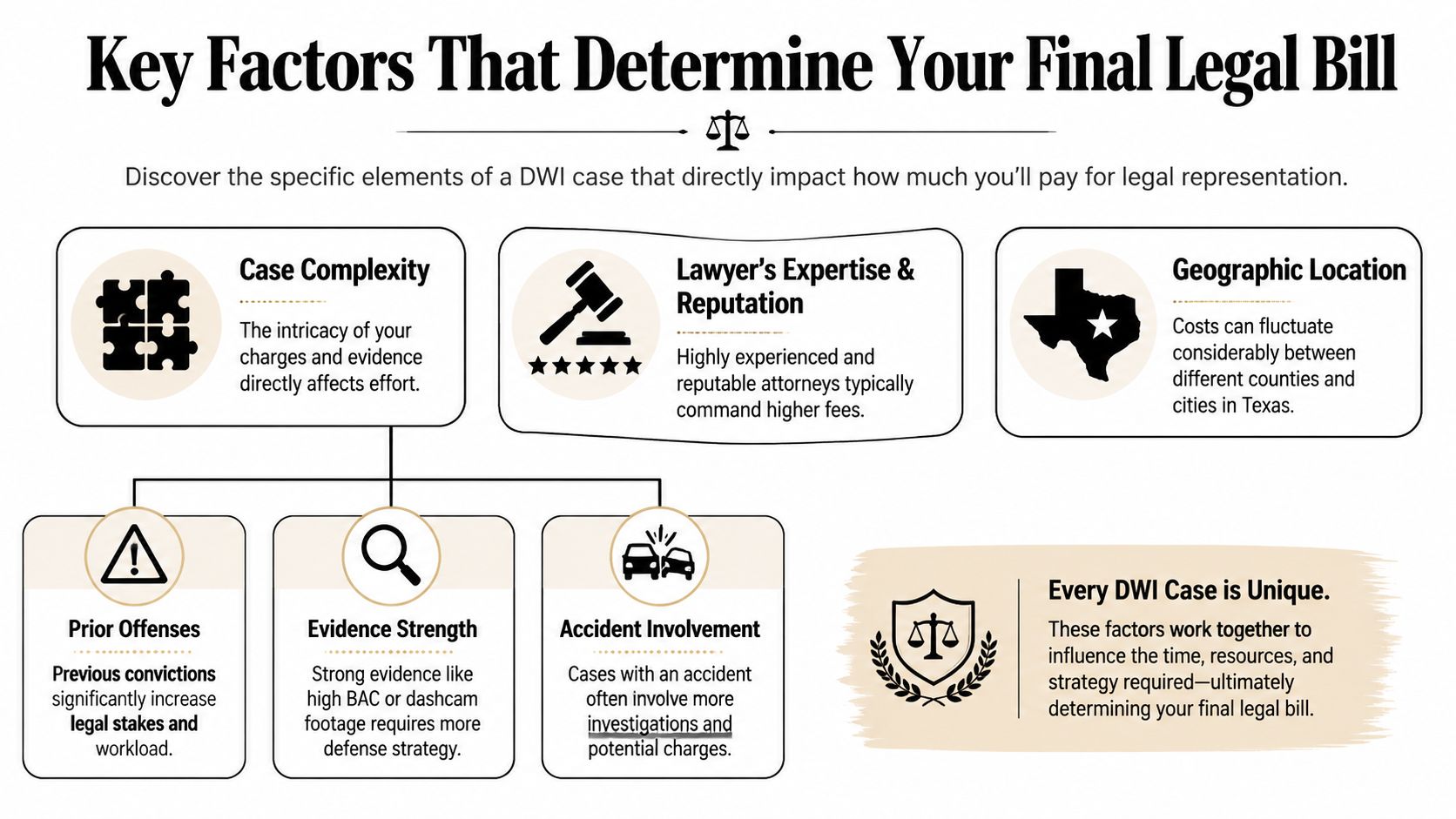
The first major driver is case complexity. A basic first-offense file is one thing. A file that includes prior history, disputed testing, an accident scene, witness issues, or unusually strong prosecution evidence is another. Each added layer creates more time spent on records, video, officer reports, legal research, strategy, and court appearances.
Facts that tend to raise defense costs
Some issues regularly push fees upward:
- Prior offenses: Repeat allegations increase the legal stakes and usually require a more intensive defense approach.
- Accident involvement: A crash often means more evidence, more witnesses, and more scrutiny.
- Injury allegations: Cases tied to physical harm can become much more serious very quickly.
- Child passenger concerns: These facts tend to increase the pressure and complexity of the case.
- Strong evidence disputes: Breath or blood evidence, officer observations, and video all take time to evaluate and challenge.
A lawyer also prices based on how much active litigation seems likely. If the defense may involve suppression issues, evidentiary disputes, or trial preparation, the projected workload changes.
Experience and location matter too
The second and third drivers are the lawyer's background and the court system involved. Some attorneys charge more because they bring deeper trial experience, local court familiarity, or a narrower DWI-focused practice. Geographic location matters because some counties move cases differently, set hearings differently, and create different defense demands.
This overview is helpful if you want a visual explanation of how DWI case variables affect strategy and cost:
A simple way to think about the bill is this. Lawyers don't charge more because the accusation sounds worse. They charge more when the case will require more skilled time, more appearances, and more contested work.
The Total Cost of a DWI Goes Beyond Legal Fees
The legal fee gets the most attention because it's the first invoice often the initial thought. In practice, the bigger financial shock often comes from everything else attached to the case.
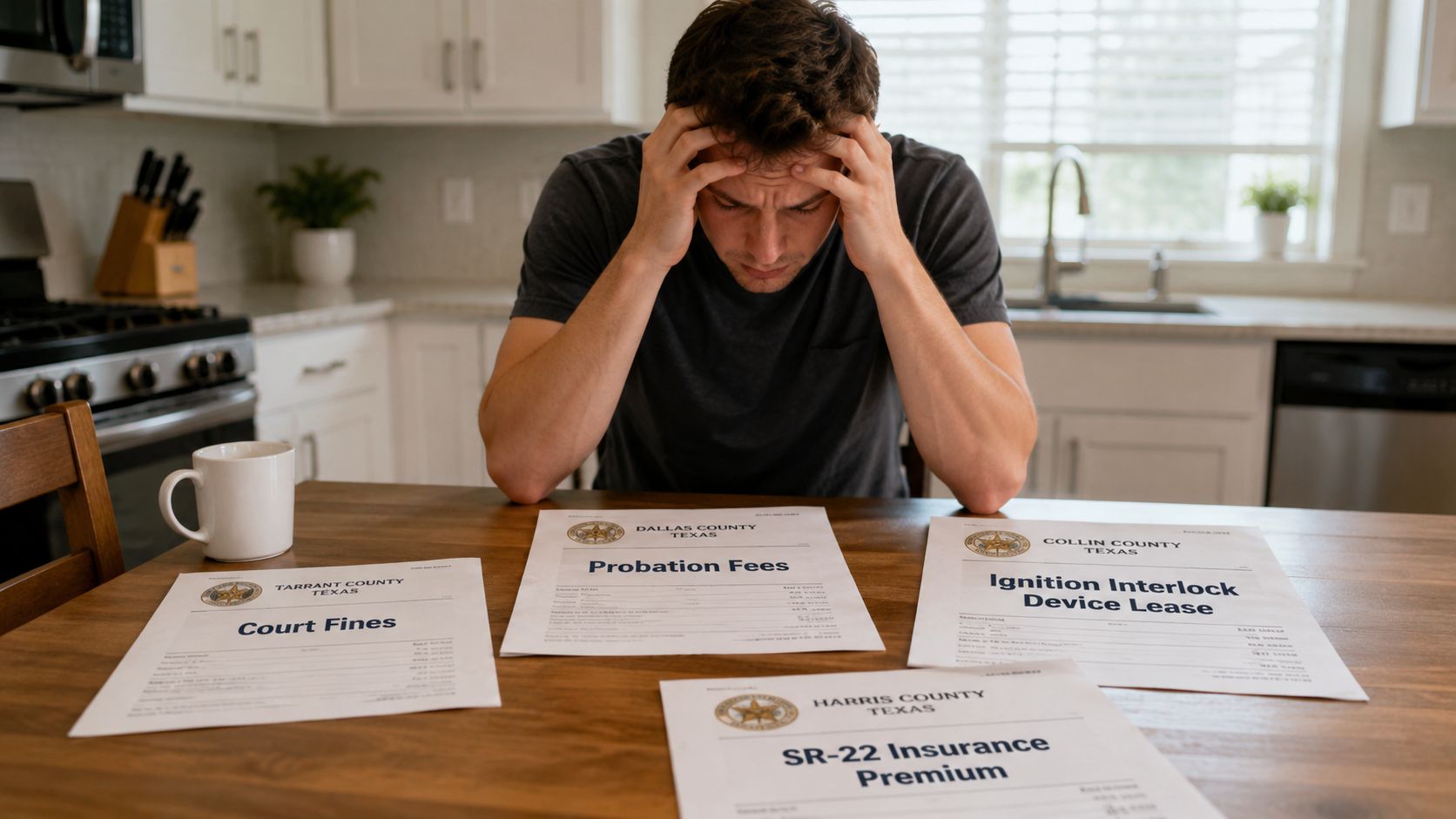
Texas DWI cost breakdowns show that the non-lawyer cost stack can add thousands of dollars, including maximum criminal fines up to $2,000 for a first offense and driver-license surcharges that may run for three years at about $1,000 to $2,000 per year (Texas DWI cost breakdown). That's why a realistic budget has to include more than the attorney contract.
Expenses people often miss
Many people focus on fines and overlook the ongoing or administrative costs that can continue after court. Your checklist should include:
- Court-imposed financial penalties: Fines and court costs are separate from what you pay defense counsel.
- License-related expenses: Suspension issues, reinstatement steps, and compliance costs can keep adding up.
- Probation or supervision charges: If supervision is part of the resolution, recurring monthly obligations may follow.
- Insurance consequences: A conviction can affect premiums and filing requirements.
- Vehicle-related expenses: Towing, storage, and related charges can hit early.
If you're dealing with the immediate release process after arrest, this guide to understanding DUI bail can help you think through that early-stage expense as part of the bigger budget.
Build your budget in categories
A practical way to budget is to separate the case into three buckets:
Upfront legal spend
This is the attorney fee and any early case-related costs.Court and agency obligations
These are the amounts that can come from the court process and driver's license side of the case.Longer-tail fallout
Think insurance, work disruption, transportation problems, and other effects that may last beyond the court date.
Commercial drivers need to be especially cautious because collateral consequences can affect income and licensing issues in ways a non-CDL driver may not expect. This article on DUI with a CDL in Texas is a useful starting point for that specific concern.
Budgeting note: The right defense decision isn't always the one with the smallest upfront invoice. It's the one that makes sense against the full cost of the case.
How DWI Defense Costs Vary Across Texas
A DWI in Houston doesn't always move the same way as a DWI in a smaller county. The law is statewide, but local practice shapes how much work a case takes and how firms price that work.
In larger metro areas such as Houston, Dallas-Fort Worth, Austin, and San Antonio, lawyers often deal with busy dockets, more formal scheduling practices, and prosecutors who may handle DWI files through office-specific policies rather than purely ad hoc negotiation. That can affect preparation time, hearing frequency, and how quickly a case reaches a meaningful resolution.
Metro counties versus smaller counties
In major counties, defense work often feels more procedural. There may be more waiting, more settings, and more paper moving through the system. That doesn't always mean a worse case. It does mean the defense may need more sustained attention over time.
In some smaller counties, the pace can be different and the personalities involved may matter more from the start. Local familiarity can become especially important there because judges, clerks, and prosecutors may have consistent expectations that an out-of-area lawyer doesn't know as well.
Why local knowledge affects the quote
A lawyer who regularly appears in a particular county often prices from experience. They know whether the court tends to require repeated appearances, whether prosecutors demand extensive pretrial exchange, and how often contested matters get reset before being heard.
For readers dealing with an alcohol-related crash rather than only a criminal charge, this page on a drunk driving accident lawyer in Houston can help you sort out the civil side of the problem. That's a different track from the DWI prosecution, but the two can overlap in stressful ways.
The broad lesson is simple. Statewide averages are helpful, but local court culture often explains why one quote looks very different from another.
Evaluating a Lawyer's Value Not Just Their Price
A DWI quote only answers one part of the money question.
The better question is what that fee buys you, what it leaves out, and how the lawyer's approach may affect the rest of the costs that follow, including court requirements, time away from work, license problems, and insurance consequences. A lower fee can make sense in a straightforward case. It can also cost more overall if the lawyer misses issues early, fails to explain what is not included, or pushes a quick result without testing the evidence first.
Value in a DWI case usually shows up in plain, practical ways.
A lawyer who reads the reports closely, gets the video, examines the stop, checks the testing records, and gives you a clear plan is doing work that can change the outcome and your total expense. Good communication matters for the same reason. You need to know whether the quote covers the ALR hearing, pretrial motions, trial settings, expert review, and follow-up court dates, because those details affect your budget just as much as the headline number.
What to look for when comparing lawyers
Use these questions during a consultation:
- What is included in the fee? Ask whether the quote covers the ALR case, contested hearings, motions, trial preparation, and trial itself.
- What usually creates extra charges? Get a direct answer about experts, investigators, blood testing review, and added court appearances.
- How will the evidence be reviewed? A real defense starts with video, reports, testing procedure, and timeline.
- Who will handle the case day to day? In some firms, the lawyer you meet is not the lawyer doing most of the court work.
- How often will I get updates? Silence creates stress and bad decisions.
- What is the likely path of this case? You want a candid assessment, not promises.
The right hire is often the lawyer who can explain risk and cost in the same conversation. That is usually a better sign than the lowest quote or the most confident sales pitch.
Warning signs that affect value
Some fee quotes sound attractive until the details come out later. Watch for vague flat-fee agreements, unclear answers about trial, and pressure to hire on the spot. Be careful with anyone who treats every DWI like it should end quickly. Fast is not always cheaper once you account for long-term consequences.
I also tell people to listen to how the consultation feels. If the lawyer cannot explain the process clearly before you hire them, that problem rarely improves after payment is made.
If you are still deciding about timing, this guide on when to hire a DWI lawyer in Texas after an arrest can help you make that call without waiting too long.
The Law Office of Bryan Fagan, PLLC is one example of a firm people may include while comparing Texas DWI representation. Compare any option the same way. Look at fee scope, responsiveness, case preparation, and whether the lawyer helps you budget for the whole process instead of quoting one number and leaving the rest for later.
Your Next Steps After a Texas DWI Arrest
A car crash can change your life in seconds, but you don't have to face recovery alone. A DWI arrest creates a different kind of crisis, but the same principle applies. Early action protects your options.
One deadline matters immediately. After a Texas DWI arrest, you may have a limited window to request an Administrative License Revocation hearing. Missing that deadline can affect your ability to challenge the license suspension. Move quickly.
Do these things first
Write down what happened
As soon as you can, record the stop, the questions, the testing, and anything you remember about timing and location.Save paperwork
Keep the bond documents, notice paperwork, tow records, and any temporary driving paperwork together.Don't explain the case to everyone
Limit discussions to your lawyer. Casual statements to friends, family, or online can create avoidable problems.Ask fee questions early
You want to know the billing structure, what is included, and what could increase the cost later.
If you're deciding when to make that first call, this guide on when you should hire a DWI lawyer in Texas lays out the timing issues in plain English.
The first days after arrest feel chaotic. A focused plan helps. Protect your license issues early, organize your records, and get legal advice before you make assumptions about cost or outcome.
Frequently Asked Questions About DWI Costs
Can a first-time DWI in Texas cost more overall than the attorney fee alone
Yes. In many cases, the lawyer's bill is only one part of the financial burden. Texas legal sources report that a first-time conviction can reach $15,000 to $20,000 or more once legal fees, court costs, fines, probation, ignition interlock, bail, insurance consequences, and related expenses are included (Texas first DWI total cost guide). That's why people who budget only for the attorney often feel blindsided later.
Are payment plans available for DWI defense
Some lawyers offer them, and some don't. Whether a payment arrangement is possible usually depends on the firm's policies, the expected pace of the case, and whether the fee is flat or hourly. The key is to ask early and get the payment terms in writing. If the case may require extra hearings or trial work, ask how those later costs would be handled.
Is a public defender the cheapest option
For people who qualify, court-appointed counsel may reduce out-of-pocket legal expense. But eligibility depends on financial circumstances, and a public defender system can involve practical limits on time and availability. Cost shouldn't be the only question. You should also think about communication, availability, and how much individual attention your case may need.
Does a trial make a DWI cost much more
Usually, yes. Trial preparation often means more attorney time, more witness work, more evidence review, and more court appearances. Even when a case doesn't ultimately go to verdict, serious trial preparation can still increase the legal bill because the work has to be done in advance.
Is a flat fee always better than hourly billing
Not always. A flat fee can make budgeting easier, especially when the scope is clearly defined. Hourly billing can make more sense when the case is unusually fact-intensive or unpredictable. The better structure is the one you fully understand before representation begins.
Should I hire the cheapest lawyer I can find
Usually not without asking harder questions. A low quote may reflect a narrower scope, less experience with contested DWI litigation, or a plan to resolve the case quickly without much challenge. The better question is whether the lawyer has explained what work will be done for that price.
If you're facing a DWI arrest in Texas and need a clear view of the financial risk, legal process, and next decisions, contact The Law Office of Bryan Fagan, PLLC for a free consultation. You can get straightforward answers about likely fee structures, the broader cost of a DWI case, and the steps that may help protect your license, your record, and your future.