
A car crash can change your life in seconds — but you don’t have to face recovery alone. The sudden jolt, the shock, and the pain that follows can leave you feeling overwhelmed and unsure of what to do next. If you're dealing with the aftermath of a collision, know that your feelings are valid, and help is available.
Your Life Changed in an Instant—But You Are Not Alone

Whiplash is one of the most common injuries from Texas auto accidents, but it’s also one of the most misunderstood and dangerously underestimated. A sudden jolt from a rear-end collision on a busy Houston freeway like I-45 can cause serious damage that isn't always obvious right away. In fact, symptoms like neck pain, stiffness, and headaches often don’t show up for hours or even days.
This delay is exactly what insurance companies latch onto. It gives them an opening to question the severity of your injury and challenge your claim for fair compensation for whiplash injuries. They'll often argue your pain isn't really connected to the crash, hoping you'll give up and bear the financial burden of someone else's mistake.
This guide is here to empower you with the knowledge you need to protect your rights. We’ll walk you through what whiplash truly means for your health and finances, explain how Texas law allows you to seek compensation, and outline the practical steps you can take to get the recovery you deserve.
What This Guide Will Cover
Our goal is to bring clarity and reassurance to a chaotic time, so you can focus on what matters most: healing. Throughout this guide, we'll explore:
- Understanding Whiplash: We’ll break down what this injury really is and why it's so much more than just a “sore neck.”
- Your Legal Rights in Texas: You'll get clear explanations of negligence, liability, and the different types of damages you can claim.
- Building Your Claim: We will provide practical, step-by-step advice on gathering evidence and documenting your losses.
- Dealing with Insurers: You'll discover the common tactics adjusters use to downplay claims and how a skilled Houston car accident lawyer can fight back effectively.
You have the right to hold the at-fault driver accountable. Let's start by understanding the injury itself and why taking it seriously is the critical first step toward protecting your future.
What Is Whiplash and Why Is It So Serious?

Whiplash happens when a sudden impact—usually from a rear-end collision—forces your head to snap backward and then forward, just like the crack of a whip. This violent motion pushes the delicate soft tissues in your neck (muscles, ligaments, and tendons) far beyond their normal range of motion.
Think of it like stretching a rubber band too far, too fast. It can fray, tear, or even snap. That’s essentially what happens inside your neck. The damage is internal and invisible from the outside, but the impact it can have on your life is devastating.
And don't be fooled by the lack of vehicle damage. Even a seemingly minor fender-bender at low speeds can generate enough force to cause a significant whiplash injury. The condition of the bumper has very little to do with the harm done to your body.
More Than Just a Sore Neck
Insurance companies have a playbook for these kinds of injuries, and their first step is often to downplay the problem. They might call it a "simple sore neck" and suggest it will clear up on its own. For so many people we have helped, that couldn't be further from the truth.
One of the trickiest things about whiplash is that symptoms often don't appear right away. It can take hours, or even a full day, for the pain and stiffness to set in.
This delay is exactly why you must see a doctor immediately after any car accident. A medical professional can diagnose the extent of your injuries—sometimes before you even feel the full effect—and create an official record tying the harm directly to the crash.
Keep an eye out for these common symptoms:
- Neck pain and stiffness that makes it difficult to turn your head.
- Headaches that seem to start at the base of your skull.
- Pain that radiates down into your shoulders, upper back, or arms.
- Tingling or numbness in your hands or arms.
- Dizziness, fatigue, or brain fog that makes it hard to concentrate.
These aren't minor inconveniences. They can make it impossible to work, care for your family, or live your life without pain. What starts as stiffness can easily spiral into a chronic pain condition that lingers for months or even years.
The Hidden Financial and Physical Costs
Because whiplash is a soft-tissue injury, it won't appear on a standard X-ray. Insurance adjusters often use this fact to argue that if there are no broken bones, there must not be a real injury. This is simply not true. Advanced imaging, like an MRI or CT scan, can often reveal the tears and damage to the ligaments and discs in your neck.
The reality is that whiplash injuries come with a massive price tag. Nationally, we spend around $3.9 billion every year on medical care for whiplash, with about 3 million Americans suffering these injuries annually. It's a serious public health problem, as detailed in this study on whiplash-associated disorders.
When an insurance company offers you a quick, low settlement for your whiplash injury, they are banking on you not understanding its potential for long-term complications and expenses.
Your claim for compensation for whiplash injuries isn't just about the ER bill. It must account for every cost—future physical therapy, lost paychecks from missed work, and the very real pain and suffering that has diminished your quality of life. Understanding how serious whiplash can be is the first step toward demanding the fair compensation you're owed under Texas law.
Who Is Liable in a Texas Car Accident?
After a car accident in Texas, your ability to recover money for your injuries hinges on a legal concept called negligence. In plain English, if someone else's carelessness caused your whiplash, they are legally responsible for the harm you’ve suffered. Understanding this is the first step toward securing the compensation for whiplash injuries you need.
The legal process boils down to two key parts: liability and damages.
- Liability: This is a legal term for "fault." To have a successful claim, you must show that the other driver was negligent—for example, they were texting, speeding, or tailgating.
- Damages: This refers to all the losses—financial and personal—that you have been forced to endure because of the crash. This goes far beyond your car's repair bill; it's about the total impact on your health, finances, and well-being.
Think of them as two sides of the same coin. Once you prove the other driver is liable, you can then demand payment for all your damages.
How Fault is Determined in Texas
Texas operates under a system called modified comparative fault, also known as proportionate responsibility. You can find this rule in Chapter 33 of the Texas Civil Practice & Remedies Code. It’s a way of acknowledging that sometimes, more than one person shares blame for an accident.
Here’s how it works in the real world: if you are found to be partially at fault for the accident, your total compensation is reduced by your percentage of fault.
For example, a Houston driver rear-ended on I-45. The other driver was clearly at fault for following too closely. But what if the injured driver had a broken taillight? A jury might decide they were 10% to blame. If their total damages were $50,000, their final award would be reduced by that 10% ($5,000), so they would receive $45,000.
Now, here's the critical part: if you are found to be 51% or more responsible for the crash, you cannot recover any money. Zero. Insurance adjusters are experts on this rule and will try to shift as much blame as possible onto you to lower their payout or deny your claim completely.
The Two Types of Damages You Can Claim
When you file an auto insurance claim for compensation, your losses are sorted into two main categories. Knowing the difference is key to making sure you demand a settlement that truly covers everything you’ve been through.
Before we dive into the details, here’s a quick overview of the different types of compensation, or "damages," you can pursue in a Texas whiplash claim.
Types of Compensation You Can Claim for a Whiplash Injury
| Type of Damage | What It Covers | Example |
|---|---|---|
| Economic | All tangible, out-of-pocket financial losses. | Medical bills from the ER and physical therapy, lost paychecks, future medical treatment. |
| Non-Economic | The intangible, personal impact on your quality of life. | Physical pain from the injury, emotional distress, anxiety, loss of enjoyment of hobbies. |
Each category is vital for building a complete picture of your losses, ensuring that the final settlement reflects the true cost of the accident on your life.
1. Economic Damages
These are the straightforward, measurable financial losses with a clear price tag. Think of them as anything you can prove with a receipt, an invoice, or a pay stub.
- Medical Bills: This is a big one. It includes everything from the ambulance ride and emergency room visit to ongoing physical therapy, chiropractor appointments, prescription drugs, and any future medical treatments your doctor recommends.
- Lost Wages: This covers the income you lost because you were physically unable to work while recovering. It can also include your loss of future earning capacity if the whiplash injury is severe enough to cause a long-term disability that prevents you from doing your old job.
2. Non-Economic Damages
These damages are far more personal. They are meant to compensate you for the non-financial ways the injury has turned your life upside down. Just because they don't come with a receipt doesn't make them any less real or important.
In Texas, these can include:
- Pain and Suffering: This is for the actual physical pain, discomfort, and soreness you have had to live with since the accident.
- Mental Anguish: Compensation for emotional trauma—anxiety, depression, fear of driving, or sleepless nights caused by the crash and your injuries.
- Physical Impairment: This addresses how the injury has limited your ability to do everyday things you used to take for granted, whether it's playing with your kids, working out, or enjoying a hobby.
Putting a fair dollar value on these personal losses takes skill and a deep understanding of how Texas courts handle them. An experienced Texas injury attorney knows how to document these intangible losses to make sure your claim reflects the full extent of what you've endured. You can learn more about how Texas liability insurance rules play a role in all of this in our comprehensive guide.
Calculating the Value of Your Texas Whiplash Claim
The first question on everyone’s mind after a wreck is, “How much is my claim actually worth?” While it’s a reasonable question, there’s no simple online calculator that can give you an accurate number. The value of your compensation for whiplash injuries is carefully built piece by piece, based on the specific, documented losses you’ve suffered.
Your claim's total value is the sum of all your damages—both those with a clear price tag and those that are deeply personal. The severity of your injury, your medical bills, the income you couldn't earn, and the impact the injury has had on your daily life are the core building blocks. Every piece of evidence helps paint a clear picture of what you’ve been through, which directly shapes the final settlement amount.
Key Factors That Determine Your Settlement Value
When an insurance adjuster reviews your claim, they’re looking at several specific factors. A sharp Houston car accident lawyer knows this and will gather rock-solid evidence for each of these areas, making sure nothing gets ignored.
These are the factors that really move the needle:
- Total Medical Expenses: This is the foundation of your claim. It covers every related cost, from the initial emergency room visit and MRI scans to ongoing physical therapy, chiropractic adjustments, and prescription medications.
- Lost Wages and Earning Capacity: This goes beyond just the paychecks you missed. If your whiplash leaves you with chronic pain that stops you from returning to your old job or forces you to cut back your hours, your claim can demand compensation for this loss of future earning power.
- Severity and Permanence of the Injury: A minor strain that heals in a few weeks will be valued much lower than a severe injury involving torn ligaments, nerve damage, or chronic pain that becomes a long-term battle.
- Impact on Your Daily Life: This is where the human cost comes in, what the law calls non-economic damages. How has this injury affected your ability to enjoy your hobbies, play with your kids, or live without constant pain? Documenting this "pain and suffering" is essential to getting fair compensation. We break down how these personal losses are valued in our article on how to calculate pain and suffering damages.
- Strength of Evidence: The quality of your proof is everything. Clear medical records, pay stubs showing lost income, and a consistent story about your symptoms make it difficult for an insurance company to dispute your claim.
Understanding Typical Whiplash Settlement Ranges
While every case is unique, looking at average settlement ranges can be helpful. Just remember, your final number will always depend on the specific factors we just covered.
The average whiplash settlement in Texas car accident cases can vary widely. Research shows most victims recover somewhere between $12,000 and $30,000 for mild to moderate injuries. However, for cases that require ongoing physical therapy, settlements often land between $30,000 and $75,000.
When a whiplash injury is severe—involving complications like nerve damage or requiring surgery—settlements frequently go past $100,000 and can even reach $300,000 or more. As you can see from these whiplash settlement compensation payouts, the value jumps dramatically with the seriousness of the injury.
For example, a driver who gets rear-ended in Dallas and needs six weeks of physical therapy might see a settlement around the $25,000 mark. But another driver hit on I-10 in San Antonio who ends up with herniated discs that require surgery could be looking at a settlement well into the six figures.
It's critical to remember these are just averages. The goal isn’t to hit an average number; it's to calculate the full value of your specific losses. A good attorney will make sure your demand for compensation reflects every bit of harm you’ve suffered and will fight for a result that truly helps you put your life back together.
Steps to File an Insurance Claim
The moments after a car accident are confusing. But what you do in this small window of time is critical, both for your physical recovery and for the strength of your future legal claim. Taking the right steps now can help you avoid the common traps insurance companies set to deny compensation for whiplash injuries.
Seek Immediate Medical Attention
After any crash, your health is priority number one. Even if you feel fine, see a doctor right away. Adrenaline can mask serious injuries, and whiplash symptoms often don’t show up for hours or even days.
Getting checked out by a professional accomplishes two crucial things:
- It protects your health. A doctor can spot injuries you might not feel yet and get you on a treatment plan to prevent long-term complications.
- It creates an official record. A medical report from the day of the accident creates a powerful, undeniable link between the crash and your injuries. This is your best defense when an insurance adjuster tries to claim your pain came from somewhere else.
The chart below shows how a solid claim is built by connecting your diagnosed injury to its financial costs and the real-world impact it has on your quality of life.
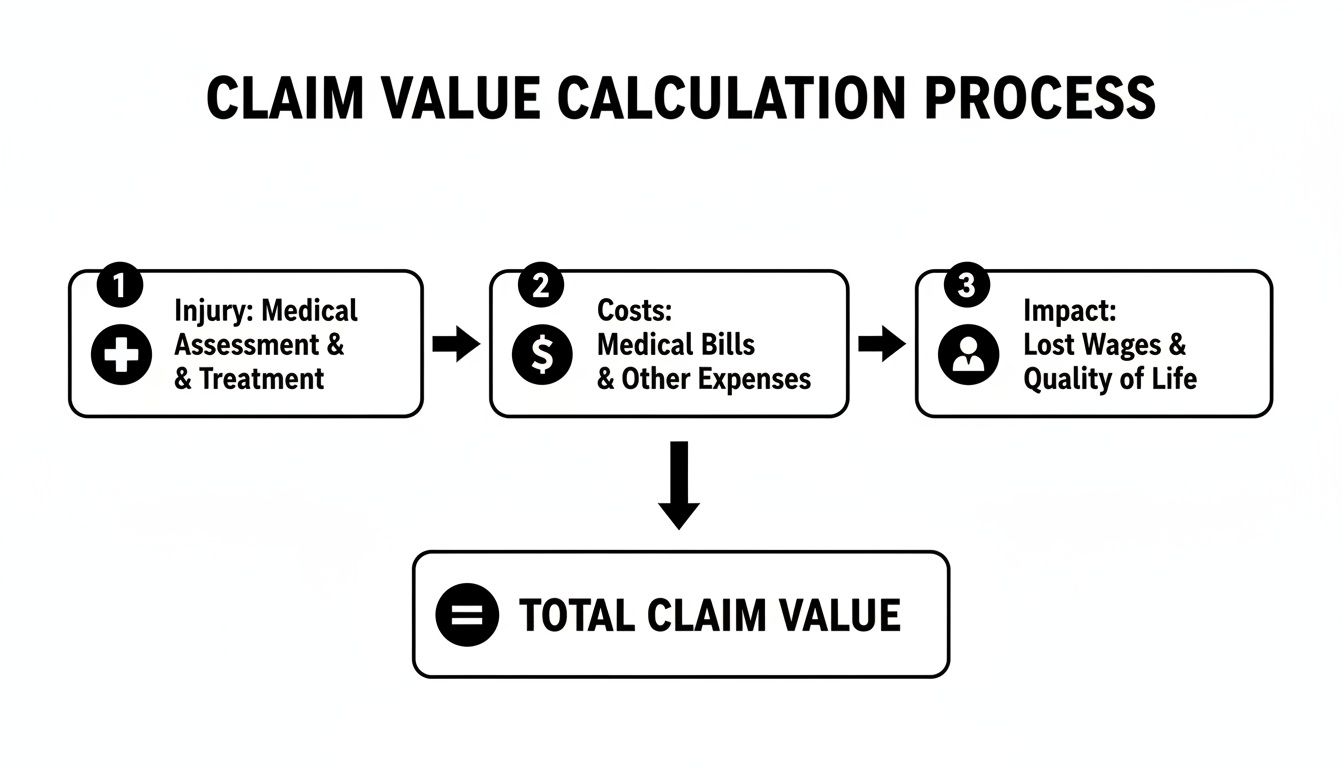
As you can see, everything starts with that initial diagnosis.
Document Everything Meticulously
Evidence is the lifeblood of a personal injury claim. You can't have too much of it. Start gathering information from the moment the accident happens.
- At the Scene: If you can, take pictures of everything—the damage to both cars, their positions, skid marks, and the general area. Get the other driver’s insurance and contact information.
- Keep a Pain Journal: This is more important than you might think. Every day, jot down your pain levels, where it hurts, and how your injuries are affecting your daily life. Can’t sleep through the night? Can't lift groceries? Write it down. This creates a detailed story of your suffering.
- Track Your Expenses: Keep every receipt and bill related to the accident. This includes medical co-pays, prescription costs, and even mileage to and from the doctor.
Be Careful What You Say
Once you report the accident, you can expect a call from the other driver’s insurance adjuster. They may sound friendly, but their job is to protect their company’s profits by paying you as little as possible.
Never give a recorded statement to the at-fault driver's insurance company without talking to a Houston car accident lawyer first. Adjusters are trained to ask tricky questions designed to get you to downplay your pain or accidentally admit partial fault.
You only need to politely say you aren't ready to discuss the details and that your attorney will be in touch. This simple sentence can protect you from having your own words used against you.
Respect the Statute of Limitations
In Texas, the clock is ticking. You have a limited time to file a personal injury lawsuit. This deadline is known as the statute of limitations. For most car accident claims, you have two years from the date of the crash to file a lawsuit.
If you miss that deadline, your right to seek compensation is gone forever, no matter how strong your case is.
After determining what your claim is worth, the next step is often sending a formal notice. A solid legal demand letter template can be a huge help. But nothing can help you if that two-year window closes, which is why it is so important to act quickly.
How a Houston Car Accident Lawyer Can Help
Trying to take on a massive insurance company by yourself can feel like a losing battle. Their adjusters are professional negotiators whose job is to protect the company's profits by finding reasons to deny your claim for compensation for whiplash injuries.
They may try to say it's just a "minor sprain" or argue it's a pre-existing condition. This is where a seasoned Texas injury attorney steps in to even the odds and fight for your rights. Understanding how specialized personal injury law firms can make a critical difference is the first step toward getting the help you need.
A good lawyer is your advocate, taking on the complicated details so you can focus on getting better.
Conducting a Thorough Investigation
The first thing we do is launch our own investigation into the accident. We never just take the police report at its word. Our team gathers all the evidence needed to build a rock-solid case that proves the other driver was negligent.
This often includes:
- Analyzing the official crash report.
- Interviewing eyewitnesses to lock in their stories.
- Collecting photos and videos from the scene, including traffic cam or dashcam footage.
- Bringing in accident reconstruction experts to show exactly how the collision happened and who was at fault.
This groundwork gives us the ammunition to shut down any attempt by the insurance company to twist the facts and blame you.
Accurately Calculating Your Full Damages
An insurance adjuster's first settlement offer will almost always be a lowball number that doesn't cover the true extent of your losses. They are betting on you not knowing what your claim is really worth.
Your Houston car accident lawyer will meticulously calculate the total value of your claim, ensuring no expense is overlooked. This includes not just your current medical bills and lost wages but also the projected costs of future physical therapy, potential long-term care, and the significant non-economic damages for your pain and suffering.
We bring in medical and financial experts to paint a complete picture of your total damages—past, present, and future.
Handling All Negotiations and Communications
The last thing you need when you're in pain is to be hounded by an insurance adjuster. The constant calls are exhausting and designed to wear you down. The moment you hire an attorney, all of that stops.
We take over every phone call and email, shielding you from their pressure tactics.
Armed with our investigation and a precise calculation of your damages, your lawyer will handle all negotiations. We’ll aggressively push back against lowball offers and fight for a settlement that is truly fair. And if the insurance company refuses to be reasonable? We are always prepared to take them to court. We build every case as if it's going before a jury, ensuring you have a powerful advocate in your corner. If you need someone to fight for you, learn more about how a Houston car accident lawyer can help.
Common Questions on Whiplash Compensation
When you're healing after a car crash, the legal process can feel confusing. It’s normal to have questions. To help you get some clarity, we've answered the most common concerns we hear from clients in Texas.
How Long Do I Have to File a Whiplash Claim in Texas?
In Texas, the statute of limitations sets a strict deadline. For most personal injury claims, including whiplash from a car accident, you have two years from the date of the crash to file a lawsuit.
If you miss that two-year window, you will likely lose your right to seek compensation forever, no matter how strong your case is. It's a deadline you cannot ignore.
What if the Other Driver Was Uninsured?
It's a frustratingly common scenario. But just because the at-fault driver doesn't have insurance doesn't mean you're out of options. Your own auto policy might include Uninsured/Underinsured Motorist (UM/UIM) coverage.
This coverage is there to protect you—it steps in to cover your medical bills and other losses when the person who hit you can't.
Should I Accept the First Settlement Offer From the Insurance Company?
Almost never. You should be very skeptical of the first offer. Insurance companies are in business to make a profit, and their initial offer is usually a lowball number to see if you'll go away quickly and cheaply.
These early offers almost never account for future medical treatments, lost earning potential, or the true impact of your pain and suffering.
Remember, once you accept a settlement, that’s it. You can't go back and ask for more money later, even if your injuries turn out to be worse than you first realized.
How Much Does It Cost to Hire a Whiplash Injury Lawyer?
This is a major concern for most people, and the answer is simple: you pay nothing upfront. At The Law Office of Bryan Fagan, PLLC, we handle personal injury cases on a contingency-fee basis.
This means we cover all the costs of investigating your accident and building a powerful case. Our fee is a percentage of the compensation we successfully recover for you.
Simply put: If we don't win your case, you don't owe us a dime. This ensures that anyone can get top-tier legal help without worrying about their financial situation.
The moments after a car crash are overwhelming, but you don’t have to face the legal system alone. The dedicated team at The Law Office of Bryan Fagan, PLLC is here to answer your questions, protect your rights, and fight for the full and fair compensation you deserve.
Contact us today for a free, no-obligation consultation to discuss your case and learn how we can help you on the road to recovery.