
A car crash can change your life in seconds—but you don’t have to face recovery alone. A serious wreck leaves behind more than just a mangled vehicle and a pile of medical bills. It leaves a very real physical and emotional mark on your life. In Texas, your suffering has a legal value, but figuring out that value is a critical step toward getting compensated for the full impact of the accident. This compensation isn't automatic—it requires a clear, strategic approach.
What Are Pain and Suffering Damages in Texas?
When you're injured in an accident, the compensation you can recover is broken down into two main categories of damages. This is the legal term for the financial compensation you are owed for your losses. You're probably already familiar with the first type, even if you don't know the official name.
Economic vs. Non-Economic Damages
First up are economic damages. These are the straightforward, black-and-white costs tied to your accident. Think of them as any loss you can prove with a receipt, an invoice, or a pay stub.
Examples of economic damages include:
- Medical bills (from the ER visit to surgery and physical therapy)
- Lost wages from the time you couldn't work
- Future lost earning capacity if you can no longer do your job
- The cost to repair or replace your vehicle
The second, and often much larger, category is non-economic damages. This is where “pain and suffering” comes in. These damages are meant to compensate you for the human cost of the crash—the immense personal struggles that don’t come with a neat price tag.
Pain and suffering is the legal term for the physical, mental, and emotional trauma an injury causes. It covers everything from the chronic ache in your back to the anxiety that grips you every time you get behind the wheel.
Defining Your Suffering in Legal Terms
In a Texas personal injury claim, pain and suffering isn't some vague idea. It’s a legitimate form of harm that we can break down into specific, recognizable components:
- Physical Pain: The actual, physical hurt from your injuries—both in the immediate aftermath and during the long road to recovery.
- Mental Anguish: This is the emotional fallout. We're talking about anxiety, depression, grief, fear, and even post-traumatic stress disorder (PTSD) that stems directly from the wreck.
- Loss of Enjoyment of Life: This covers your inability to do the things that once brought you joy. For a Houston construction worker with a severe back injury, that might mean he can no longer play catch with his kids or go fishing on the weekends.
- Disfigurement: This provides compensation for permanent scars or physical changes that impact your appearance and, with it, your self-esteem.
Insurance companies don't just guess. They have formulas they use to try and stick a number on these very human experiences. The two most common methods are the Multiplier Method and the Per Diem Method.
Understanding how these calculations work is the first step in learning how much your car accident case is worth. An experienced Houston car accident lawyer can help you gather the right evidence to build the strongest possible case for the full value of your suffering.
The Multiplier Method Explained
When an insurance adjuster picks up your auto insurance claim, they aren't just pulling a number out of thin air. They’re using a formula. The most common tool in their playbook is the Multiplier Method, and understanding it is the first step in fighting for what you're owed.
Simply put, the Multiplier Method calculates your pain and suffering by taking your hard financial losses and multiplying them by a specific number.
- Economic Damages: This is the easy-to-add-up stuff. It’s every single medical bill, the cost of physical therapy, prescription receipts, and every dollar of lost wages from being unable to work.
- The Multiplier: This is the crucial number, usually between 1.5 and 5. It’s chosen based on how severe your injuries are and the total impact the wreck has had on your life.
This isn’t just a random approach; it's the industry standard. In fact, insurance companies use the Multiplier Method in about 94% of pain and suffering claims nationwide, making it the go-to way to put a dollar figure on non-economic damages.
What Determines the Multiplier
The real battle is over the multiplier. The insurance company will always push for the lowest number possible, often starting their offer at a paltry 1.5. A good Texas injury attorney, on the other hand, builds a case to justify a much higher number.
Several key factors will move that number up or down:
- Severity of Your Injuries: A broken arm that needs surgery is going to demand a higher multiplier than a case of minor whiplash that clears up in a couple of weeks.
- Length of Your Recovery: A long, grueling recovery means a higher multiplier. Six months of painful physical therapy sessions is valued much more than a few follow-up appointments with your doctor.
- Long-Term or Permanent Impact: If the injury leaves you with a permanent disability, chronic pain, or significant scarring, the multiplier climbs toward the higher end of the scale, closer to 4 or 5.
- Impact on Daily Life: How has the crash really affected you? Can you still work, play with your kids, or enjoy the hobbies you once loved? The more your day-to-day life has been turned upside down, the stronger your argument for a higher multiplier becomes.
This flowchart breaks down how a single accident creates both the clear financial losses (economic) and the less tangible human costs (non-economic) that this method tries to value.
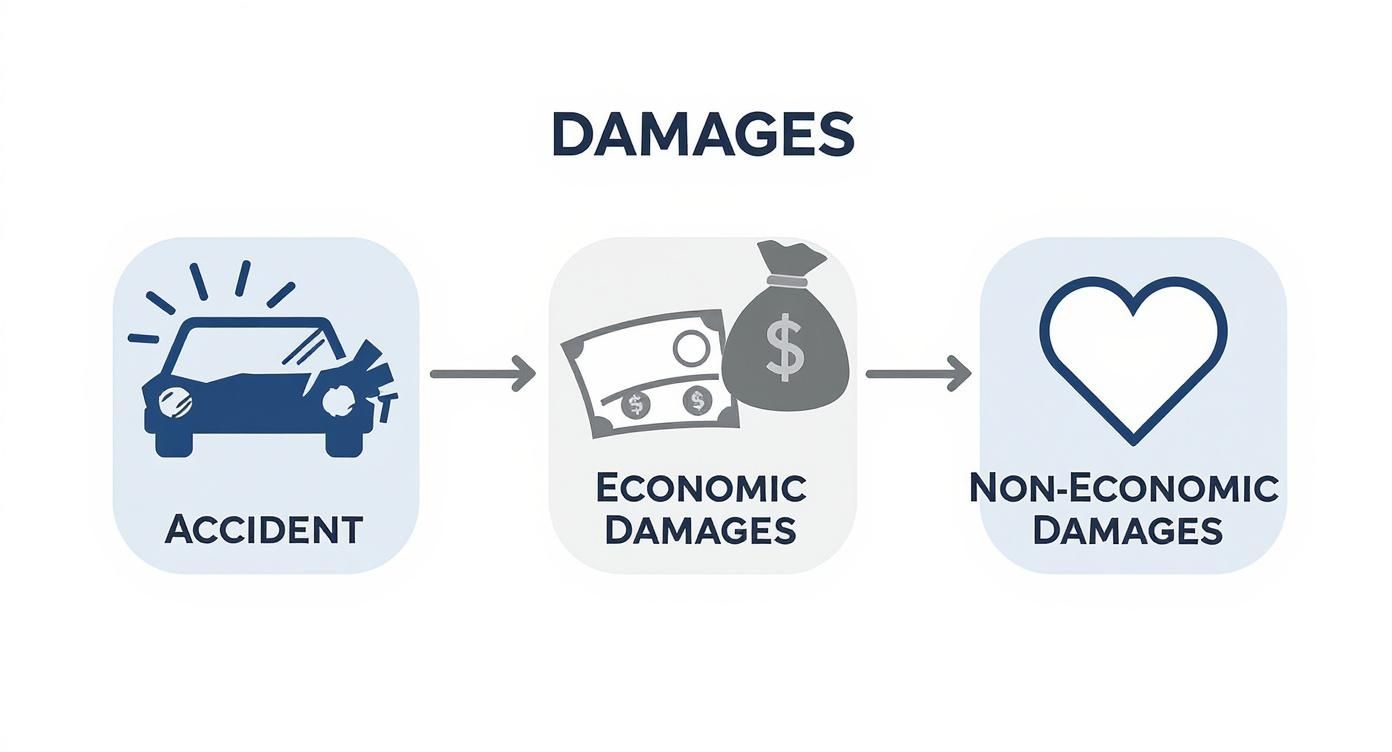
As you can see, both types of damages stem directly from the accident, and a fair settlement has to account for both.
Seeing the Multiplier in Action
Let’s walk through a real-world example. Imagine a Houston driver rear-ended on I-45. The crash damages her car and, more seriously, gives her a herniated disc in her lower back.
Her economic damages—the bills—start piling up:
- ER visit and MRI: $8,000
- Follow-up specialist visits: $2,500
- Physical therapy for 4 months: $6,000
- Lost wages from time off work: $4,500
- Total Economic Damages: $21,000
Now, the negotiation begins. The insurance adjuster might come in with an initial offer using a multiplier of 2, which would put her pain and suffering award at $42,000 ($21,000 x 2).
But a herniated disc isn't a minor injury. It can cause lifelong pain, making it difficult to lift heavy things or even sit comfortably for long periods. A Houston car accident lawyer would immediately argue that this kind of long-term impact justifies a much higher multiplier, maybe a 4 or 4.5.
With a multiplier of 4, her pain and suffering damages jump to $84,000 ($21,000 x 4). That figure does a much better job of reflecting the true cost of her ordeal. For a deeper look at settlement values, you can read our guide on what to expect from a pain and suffering car accident settlement.
This is why having an advocate matters. A difference of over $40,000 is on the line. An attorney’s job is to collect all the evidence—medical records, expert opinions, even a personal journal detailing your struggles—to prove why you deserve a higher multiplier and ensure the insurance company's lowball offer isn’t the last word.
The following table provides more examples of how different multipliers can be applied in Texas car accident claims depending on the severity of the injuries sustained.
Multiplier Method Examples Based on Injury Severity
| Injury Scenario | Economic Damages | Multiplier Range | Potential Pain & Suffering Award |
|---|---|---|---|
| Minor whiplash, fully recovered in 6 weeks | $4,500 | 1.5 – 2 | $6,750 – $9,000 |
| Broken arm requiring a cast, 3 months of physical therapy | $15,000 | 2.5 – 3.5 | $37,500 – $52,500 |
| Herniated disc requiring surgery, ongoing pain management | $75,000 | 3.5 – 5 | $262,500 – $375,000 |
| Traumatic brain injury (TBI) with permanent cognitive effects | $250,000 | 4 – 5+ | $1,000,000 – $1,250,000+ |
As these examples show, the multiplier isn't arbitrary. It's directly tied to the real-world consequences of the injury, which is why documenting everything is so critical to building a strong case.
Exploring the Per Diem Approach
Sometimes, the multiplier method just doesn’t fully capture the reality of a long, grueling recovery. That's where another approach comes in: the Per Diem method, which works by assigning a specific dollar amount to each day you were forced to suffer.
Think of it as putting a price tag on every single day you lived with pain, discomfort, and limitations caused by someone else's mistake.
This strategy is especially effective for injuries that have a fairly clear and definable recovery period. You start counting from the day of the accident and stop on the day your doctor says you’ve reached maximum medical improvement (MMI). MMI doesn't mean you're back to 100%—it just means your condition is as good as it’s going to get.

The daily rate, or "per diem," is often based on your daily earnings before the accident. The logic is simple and persuasive: if you earned $200 a day at your job, then dealing with the pain and limitations from your injury should be worth at least that much. For someone who was out of work for six months (about 180 days), the calculation would look like this:
180 days of recovery x $200/day = $36,000 in pain and suffering damages.
While this method is more straightforward, it's often better suited for less severe injuries with a clear end date. For permanent or life-altering injuries, the multiplier method usually provides a more accurate picture of the long-term suffering you will endure.
Who Is Liable in a Texas Car Accident?
Calculating your damages is one thing, but you can only recover them from the party who was legally responsible—or liable—for the crash. In Texas, liability is based on the legal concept of negligence. In plain English, someone is negligent if they fail to act with reasonable care, and that failure causes harm to someone else.
Examples of driver negligence include:
- Speeding or driving too fast for conditions
- Texting while driving or other distractions
- Driving under the influence of drugs or alcohol
- Running a red light or stop sign
After an accident, the first step is proving the other driver was negligent and, therefore, at fault. This involves gathering evidence like the police report, witness statements, and photos from the scene.
How Texas Laws Can Make or Break Your Claim
Calculating pain and suffering is just one part of the equation. To get a real sense of what your claim is worth, you have to understand how it fits into the legal landscape here in Texas. There are two specific rules that can drastically change the compensation you’re eligible for, and you can bet the insurance companies know them by heart.
Texas Proportionate Responsibility Rules
In many accidents, especially messy ones like a multi-car pileup on a Houston freeway, the insurance company will almost certainly try to argue you were partially to blame. This isn't just a random tactic; it’s a strategy tied directly to Texas's law on proportionate responsibility, also known as comparative fault.
Found in Chapter 33 of the Texas Civil Practice & Remedies Code, this rule means your final settlement can be reduced by your percentage of fault. For instance, if a jury decides you were 20% responsible for the crash, your total damage award gets cut by that same 20%.
The real kicker is the 51% Bar Rule. If you are found to be 51% or more at fault for the accident, Texas law says you get nothing. Your entire claim is wiped out.
Insurance adjusters lean on this rule hard during negotiations. Even a slight hint that you were distracted or made a late lane change can be their excuse for a lowball offer. This is exactly why having a Texas injury attorney who can push back against unfair blame is so critical.
The Two-Year Statute of Limitations
The other absolute must-know law is the statute of limitations. In simple terms, this is a strict deadline for filing a lawsuit.
In Texas, you generally have just two years from the date of the accident to file a personal injury lawsuit. Miss this deadline, and you lose your right to seek compensation through the courts forever.
This isn't a scare tactic; it’s a legal reality that hands insurance companies all the leverage. Once that two-year clock runs out, they have zero legal incentive to offer you a fair settlement because they know you can no longer sue them. Acting quickly after a crash is one of the best ways to protect your rights.
Why These Laws Are So Important in Negotiations
Understanding these laws is essential because they form the foundation of an insurance company's risk assessment. An adjuster evaluates your case through the lens of comparative fault and the statute of limitations to decide what your claim is worth to them.
The stats show just how tough these claims can be. Nationwide, pain and suffering damages are part of about 52% of all personal injury lawsuits. But here's the reality check: only 57% of those claims actually result in any payment, with the average payout hovering around $31,000. That means a huge number of victims never get a dime for their suffering, often due to legal hurdles or failing to build a strong enough case. You can learn more about these personal injury claim statistics to see what you may be up against.
A skilled Houston car accident lawyer knows these Texas-specific rules inside and out. They know how to build a case that shuts down any attempt to place unfair blame on you and ensures every legal deadline is met, putting you in the strongest possible position to recover the full and fair wrongful death compensation you deserve.
Building a Strong Case for Your Suffering
Proving pain and suffering is about much more than just telling an insurance adjuster you’re hurt. To get the compensation you deserve, you need to build a compelling story backed by undeniable evidence. It's about painting a clear picture of your life before the accident and contrasting it with the difficult reality you now face every day.
This means gathering specific documents that translate your personal experience into a language that insurance companies and juries understand. An experienced Houston injury attorney knows exactly what to collect and how to weave it all into a powerful narrative that proves the true value of your claim.

The Foundation: Your Medical Records
Your medical records are the absolute bedrock of your pain and suffering claim. Every note from a doctor, every physical therapy session, and every prescription filled helps create an objective timeline of your injuries and recovery.
These documents are vital because they:
- Establish a direct link between the car accident and your injuries.
- Detail the severity of your condition through diagnoses, MRIs, and X-rays.
- Document the treatment you needed, proving the extent of your physical pain.
Insurance adjusters will scrutinize these records. They look for consistency, so it’s critical to be completely open with your doctors about all your symptoms—both physical and emotional—at every single appointment.
Your Personal Pain and Suffering Journal
While medical records provide the cold, hard facts, a personal journal provides the human story. This is your opportunity to document, in your own words, exactly how the accident has shattered your daily life. It’s an incredibly powerful tool that fills in the gaps that medical charts simply can't capture.
A daily or weekly journal is one of the most persuasive pieces of evidence you can create. It offers a raw, honest account of your struggles, making your suffering tangible and relatable to a claims adjuster or jury.
Your journal entries should be specific. Instead of just writing "my back hurt today," be more descriptive. For example: "I couldn't lift my two-year-old out of her crib this morning because of the shooting pain in my lower back. I had to ask my spouse for help, which made me feel helpless and frustrated." See the difference?
Visual and Third-Party Evidence
Photographs and videos provide visual proof that words alone cannot convey. Take pictures of your injuries as they progress, from the initial bruising and swelling to any surgical scars. This visual timeline can be incredibly impactful.
Equally important are statements from those who know you best. Friends, family members, and even coworkers can offer powerful testimony about the changes they’ve observed in you since the accident. Their accounts can confirm that you're no longer able to participate in family activities, have lost your passion for hobbies, or now struggle with tasks you once handled with ease.
To really drive home the full extent of your limitations, it's often beneficial to include objective functional capacity evaluations. These professional assessments provide concrete data on how your injuries have diminished your physical abilities.
Evidence Checklist for Your Pain and Suffering Claim
To help you get organized, here’s a quick checklist of the evidence you’ll need to build a strong pain and suffering claim here in Texas.
| Evidence Category | Specific Examples | Why It's Important |
|---|---|---|
| Medical Documentation | Doctor's notes, surgical reports, physical therapy logs, prescription receipts, mental health records | Objectively proves the severity of your injuries and the extent of your required treatment. |
| Personal Journal | Daily entries detailing pain levels, emotional state, limitations on activities, and sleep disturbances | Provides a personal and compelling narrative of your day-to-day struggles and loss of enjoyment of life. |
| Visual Evidence | Photos and videos of your injuries over time, photos of you struggling with daily tasks | Creates a powerful visual record of your physical suffering and the real-world impact of your injuries. |
| Witness Statements | Letters or testimony from family, friends, and colleagues describing changes in your personality or abilities | Corroborates your claims from a third-party perspective, adding credibility and emotional weight to your case. |
| Financial Records | Pay stubs showing lost wages, receipts for out-of-pocket expenses (e.g., medical equipment) | While primarily for economic damages, these also help demonstrate the overall disruption to your life. |
Building a comprehensive file of evidence is not just about proving you were hurt; it's about demonstrating the full, profound impact the accident has had on every single aspect of your life. A dedicated Texas personal injury lawyer can guide you through this process, ensuring every piece of your story is heard and properly valued.
Why a Lawyer Is Your Strongest Advocate
Trying to figure out what your pain and suffering is worth on your own can feel like an impossible task. You're in the middle of healing, dealing with daily pain, and just trying to get your life back on track. The last thing you need is a fight with an insurance company whose only goal is to protect its bottom line by paying you as little as possible.
This is where a skilled Texas personal injury lawyer becomes your most important ally. Insurance adjusters are trained negotiators. They handle hundreds of claims a year and know every formula, legal loophole, and tactic designed to make you second-guess what your claim is truly worth.
Leveling an Unfair Playing Field
When you're unrepresented, the insurance company holds all the power. They might dangle a quick, lowball settlement that looks good at first but doesn't even begin to cover what you'll need down the road. They're banking on you accepting it before you realize the full, long-term impact of your injuries.
An experienced Houston car accident attorney changes that dynamic immediately. They understand the real value of your claim because they know how to calculate pain and suffering damages from a legal perspective—not just an insurer’s cost-cutting formula. They take over all the phone calls and emails, shielding you from the constant pressure.
Your attorney's job is to build a case so strong that the insurance company has no choice but to take your claim seriously. They gather the evidence, bring in experts, and prepare for trial if necessary, sending a clear message that you will not be pushed around.
From Calculation to Fierce Advocacy
A good lawyer does a lot more than just crunch numbers. They become your storyteller. They take your medical records, personal journal, and witness statements and weave them into a powerful narrative that shows the very real, human cost of the accident. They fight to make sure the multiplier or per-diem rate used actually reflects the reality of what you've been through.
A dedicated lawyer will:
- Investigate the Accident: They dig into the details, gathering police reports and tracking down witnesses to firmly establish liability. This is crucial for countering any attempt by the other side to blame you under Texas's proportionate responsibility rules.
- Accurately Value Your Damages: They don't just add up your current medical bills. They project future costs for ongoing care, physical therapy, and any impact on your ability to earn a living.
- Handle All Negotiations: Your attorney fields every call and email from the insurance company. They present your evidence-backed demand and skillfully negotiate for the maximum settlement you deserve.
- Protect Your Rights: They ensure every legal deadline, like the two-year statute of limitations in Texas, is met so your right to seek justice is protected.
Imagine trying to navigate a complex truck accident claim involving a massive commercial policy. The legal and procedural hurdles are immense. An attorney who specializes in these cases knows exactly where to look for critical evidence, like driver logs and maintenance records, that can make or break your case.
Ultimately, hiring an attorney is about more than just legal strategy. It’s about giving yourself the space and peace of mind to focus on what really matters—your recovery. You don't have to carry this weight by yourself. Making that call for legal advice might just be the most important decision you make for your future.
You have been through enough. Let a compassionate and experienced Houston personal injury attorney fight for the compensation you deserve. The team at The Law Office of Bryan Fagan, PLLC is ready to listen to your story and explain your legal options. Contact us today for a free, no-obligation consultation to learn how we can help you move forward.