A car crash can change your life in seconds—but you don’t have to face recovery alone. When another car slams into you from behind, the shock and confusion can be overwhelming. In the vast majority of rear-end collisions, the driver who hit you is presumed to be at fault. This isn't just a common assumption; it's rooted in Texas law, which expects every driver to maintain a safe following distance and be prepared for sudden stops.
Who Is Liable in a Texas Rear-End Accident?
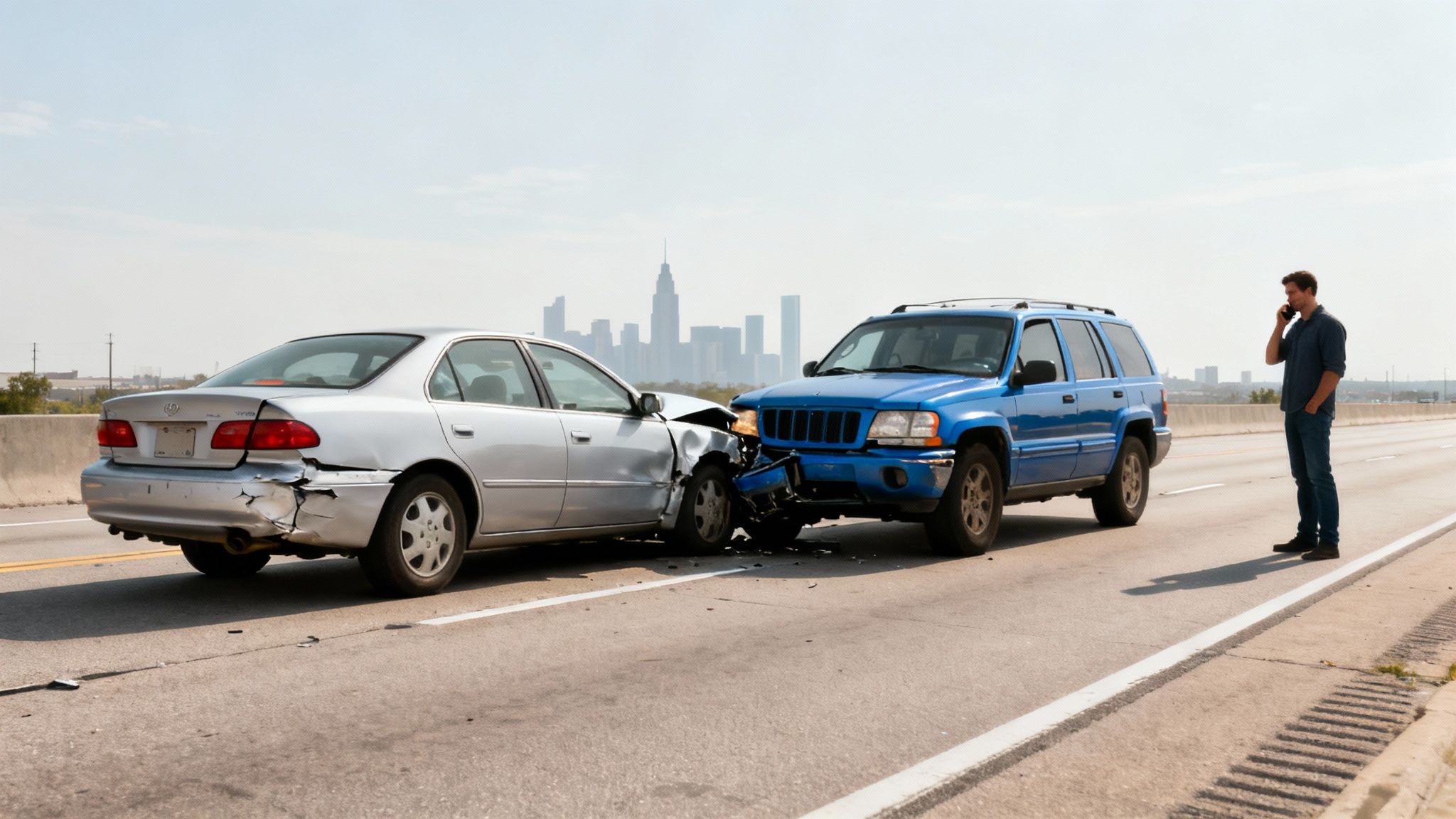
After the jarring impact of a rear-end crash, once you've made sure everyone is safe, one question cuts through the confusion: Who is at fault?
The answer is critical. It determines who is legally responsible—or liable—for the damages you've suffered. In plain English, liability means who has to pay for everything from your mounting medical bills and lost wages to the cost of repairing your car.
In Texas, the law provides a simple but powerful starting point. The driver who strikes another vehicle from behind is generally considered negligent. Negligence is a legal term that simply means someone failed to act with reasonable care, and their carelessness hurt someone else. Understanding this concept is the first step in protecting your rights.
Why the Law Presumes the Rear Driver Is at Fault
Picture a typical drive down I-45 in Houston during rush hour. Every driver has a basic responsibility to control their vehicle. This fundamental duty of care includes:
- Maintaining a Safe Following Distance: This is the golden rule of driving. Leaving enough space between your car and the one ahead gives you the time you need to react to sudden stops.
- Paying Attention to the Road: It sounds obvious, but distractions like texting, adjusting the radio, or talking to passengers can rob a driver of the crucial seconds needed to see slowing traffic.
- Driving at a Safe Speed: Speeding or driving too fast for road or weather conditions drastically cuts down the time a driver has to brake safely.
When a driver fails in any of these duties and causes a crash, they have breached their duty of care. This breach is the foundation of a negligence claim and why the law presumes they are at fault.
To help you understand why the law works this way, here’s a quick breakdown of the core reasons the rear driver is almost always considered negligent.
Why the Rear Driver Is Usually At Fault
| Reason for Fault | Explanation in Plain English |
|---|---|
| Failure to Maintain Safe Distance | They were tailgating or following too closely to stop in time if the car in front of them braked suddenly. |
| Driver Inattention | They were distracted by their phone, the radio, or something else and didn't see the traffic slowing or stopping ahead. |
| Excessive Speed for Conditions | They were driving too fast for traffic, weather, or road conditions, making it impossible to stop without hitting someone. |
| Failure to Control Vehicle | Ultimately, it's their job to keep their vehicle under control at all times and avoid hitting what's directly in front of them. |
The bottom line is simple: the driver in the back has the clearest view of the car in front of them and is in the best position to prevent the collision. They are responsible for adapting to what the lead car does.
Research from the National Highway Traffic Safety Administration (NHTSA) backs this up. In extensive studies, the NHTSA found that the following driver in a rear-end crash often fails to brake in time because they were either distracted or following too closely.
This legal presumption gives you a strong starting point for your insurance claim. But it's crucial to understand that it's not a foolproof rule. There are exceptions where the front driver can be partially—or even fully—to blame. That's why knowing the basics of Texas negligence law is the first step toward protecting your rights and getting the compensation you deserve after a car accident. A Houston car accident lawyer can help you sort through the details and fight for your rights from day one.
Understanding Texas Negligence and Liability Laws
After the shock of a rear-end collision, you'll likely hear insurance adjusters and lawyers use words like “liability” and “negligence.” When you’re already stressed and trying to recover, these legal terms can be intimidating. But they’re actually simple concepts, and understanding them is key to protecting your rights.
- Liability: This just means legal responsibility. It answers the question, “Who has to pay for the damage they caused?” In a Texas car accident, the person found liable is the one responsible for covering your losses.
- Negligence: This is the legal basis for determining liability. Negligence isn't about being a bad person—it's about being careless. It means a driver failed to act with the reasonable care an ordinary person would have used in the same situation, and that failure caused you harm.
To win a personal injury claim for your rear-end collision, your Houston car accident lawyer has to prove four specific things about the other driver's actions.
The Four Elements of a Negligence Claim
Let’s say a distracted driver rear-ended you on a busy Houston street. Here’s how we would prove the four essential elements to build your case for compensation:
Duty of Care: Every person with a Texas driver's license has a legal duty to drive safely and follow the rules of the road. This includes paying attention, keeping a safe distance, and obeying speed limits. This element is almost always a given in a car accident case.
Breach of Duty: This is where we show exactly what the other driver did wrong. A breach is the specific action—or lack of action—that violated their duty to drive safely. If the driver who hit you was texting, that's the breach. Other common breaches include tailgating, speeding, or driving while intoxicated.
Causation: Next, we have to prove that the driver's mistake was the direct cause of the crash and your injuries. In our texting driver example, the fact they were looking at their phone (the breach) is the direct reason they didn't see you stop and slammed into your car. The crash would not have happened but for their distraction.
Damages: Finally, you must show that you suffered actual harm, or damages, because of the crash. Damages aren't just the dent in your car's bumper. They include every loss you've endured, both economic (like medical bills and lost income) and non-economic (like physical pain and emotional distress).
When we can prove all four elements, the at-fault driver is held legally and financially responsible for your damages. Keep in mind that Texas law also considers whether you might have played any role in the accident. To get a clearer picture of how fault can be shared, you can learn more about how comparative negligence works in Texas. Our attorneys are skilled at navigating these rules to build a powerful case for the full compensation you deserve.
When the Front Driver Might Be at Fault
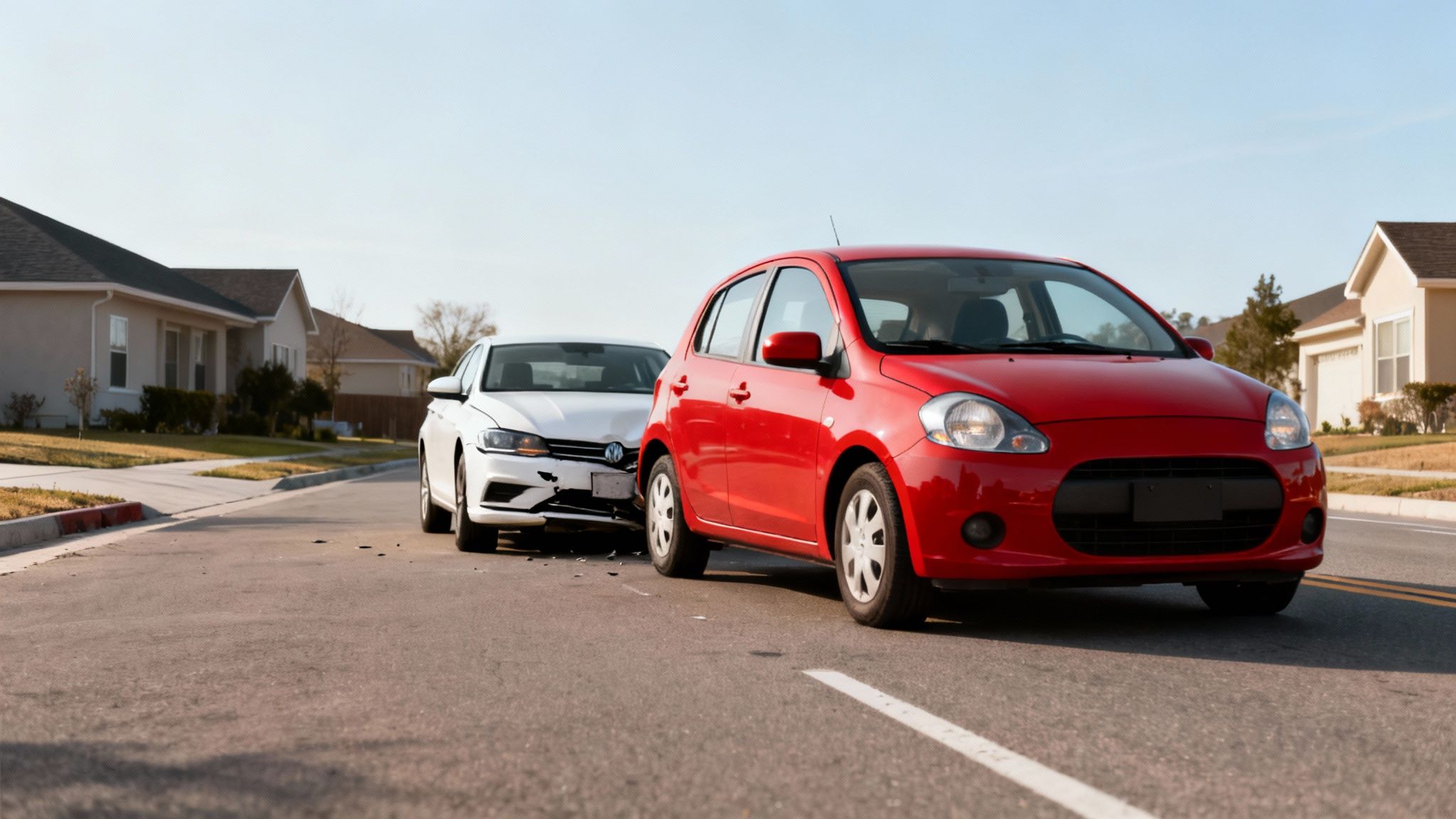
While the law almost always points the finger at the rear driver, it’s not an ironclad rule. Every driver on the road has a duty to operate their vehicle safely. Sometimes, the person who gets hit from behind may have contributed to or even caused the collision.
When that happens, figuring out who is at fault in a rear end collision gets more complicated. The at-fault driver's insurance company will likely rush to place 100% of the blame on the rear driver. But a skilled Texas injury attorney knows there’s often more to the story.
Common Scenarios That Can Shift Fault
Certain actions by the lead driver can shift some—or even all—of the legal blame for the crash. If you were the driver behind, but the collision was truly unavoidable because of what the other person did, you might not be at fault.
Here are a few real-world examples:
- Aggressive Brake Checking: A Houston driver on I-10 gets angry and intentionally slams on their brakes to intimidate you. This reckless act is impossible to anticipate and can make them liable for the crash.
- Driving with Broken Brake Lights: A car’s brake lights are the primary signal that it is slowing down. If those lights are out, the driver behind gets no warning and may not have enough time to stop safely.
- Sudden, Unsafe Lane Changes: If a driver swerves into your lane without signaling or leaves you no room to react, they have created an immediate and dangerous hazard.
- Reversing Unexpectedly: It sounds unusual, but it happens. A driver who puts their car in reverse in a travel lane or at a stoplight is acting negligently and can cause a serious collision.
- Pulling into Traffic Without Enough Room: When a driver pulls out from a side street right into your path, leaving no space to stop, they can be held responsible for the wreck that follows.
In these situations, the front driver’s actions violated their duty to drive safely, making them at least partially responsible for what happened.
How Texas’s Comparative Fault Law Affects Your Claim
Even if the lead driver did something wrong, their insurance company will still try to argue that you share some of the blame. This is where a critical Texas law known as comparative fault (or proportionate responsibility) comes into play.
Under Chapter 33 of the Texas Civil Practice & Remedies Code, a jury can assign a percentage of fault to everyone involved in a crash. If a jury decides the front driver was 70% at fault for brake checking but you were 30% at fault for following a little too closely, that division directly impacts how much money you can recover.
The 51% Bar Rule: In Texas, you can only recover damages if you are found to be 50% or less at fault. If the jury decides you are 51% or more responsible, you are legally barred from receiving any compensation.
This rule is exactly why insurance adjusters fight so hard to shift even a tiny bit of blame onto you. Every percentage point they can assign to you reduces what they have to pay.
How Speed Changes the Equation
Imagine you're stopped at a red light in Houston traffic when a truck slams into you from behind. The fault seems obvious—it’s on the driver who hit you. But statistics tell a deeper story. While rear-end collisions account for about 33% of all crashes, a major factor in fatal cases isn't just distraction; it's the speed of the car that hits you.
You can learn more by reading the findings on rear-end collisions from the NHTSA. This data shows that while the starting point for fault is often the rear driver, excessive speed dramatically increases the severity of the crash, demanding a much closer investigation into all contributing factors.
Practical Steps: How to Build a Strong Case with Evidence
When you’re trying to prove who is at fault in a rear end collision, your word alone isn’t enough for the insurance company. To protect your rights and get fair compensation for your injuries and losses, you need solid proof. Building a strong case starts the moment the crash happens, and acting quickly is your best defense against an insurance adjuster’s attempts to deny or downplay your claim.
Evidence can disappear quickly. Witnesses leave the scene, memories fade, and physical proof can be cleared away in minutes. That’s why gathering all the information you can, right away, is so important. Think of yourself as creating a snapshot of the accident that tells the whole story and leaves no room for argument.
Your Post-Accident Evidence Checklist
Every piece of evidence you collect helps paint a clearer picture of the other driver’s negligence. Each item has a specific job, whether it's establishing the facts or showing the true cost of your injuries.
Here’s a practical, step-by-step guide to the essential proof you need to start collecting:
The Official Police Report: This is often the cornerstone of your case. The officer's report will document key details like the date, time, location, and driver information. It also frequently includes the officer’s initial assessment of who was at fault. You can learn more about how to get your Houston police accident report to ensure you have this official record.
Photos and Videos from the Scene: Your smartphone is your most important tool. Take wide shots of the entire scene, including traffic signs, lights, and skid marks. Then, get close-ups of the damage to both cars from several angles. Don’t forget to photograph any visible injuries you have.
Witness Statements: A neutral third party can be incredibly persuasive. If anyone saw what happened, politely ask for their name and phone number. Their account of the crash can stop the other driver from changing their story later.
Detailed Medical Records: Your health is the top priority. Get checked out by a doctor immediately, even if you feel fine. Every visit, diagnosis, and treatment plan creates an official paper trail that links your injuries directly to the collision. This is essential for proving your damages.
Crucial Tip: Never downplay your injuries—not to the police, doctors, or anyone else. Adrenaline can mask pain, and an injury that feels minor at first can become a long-term problem. Be honest and thorough about everything you’re feeling.
Uncovering Hidden Evidence
Sometimes the most powerful evidence isn’t immediately obvious. A skilled Houston car accident lawyer knows where to dig to find proof that can make or break a case. For instance, most modern cars have an Event Data Recorder (EDR), or "black box," which can provide data on the at-fault driver's speed and braking in the seconds before impact.
We can also work to secure surveillance footage from nearby businesses or traffic cameras that might have caught the crash on video. It's also worth considering mechanical failure. Knowing the common warning signs of brake problems can sometimes be relevant if the other driver tries to blame their vehicle.
Putting together a powerful auto insurance claim is all about being thorough. By collecting this evidence, you build a foundation of facts that an insurance company can't ignore, putting you in the strongest position to get the compensation you deserve.
Essential Evidence to Collect After a Rear-End Collision
| Type of Evidence | Why It's Important | How to Get It |
|---|---|---|
| Police Report | Provides an official, unbiased account of the accident, often including the officer's initial assessment of fault. | Request a copy from the law enforcement agency that responded to the scene, such as the Houston Police Department. |
| Photos & Videos | Creates a visual record of vehicle damage, road conditions, traffic signs, skid marks, and visible injuries before the scene is cleared. | Use your smartphone to take pictures and videos from multiple angles immediately after the crash. |
| Witness Information | Offers a neutral, third-party perspective that can corroborate your version of events and counter the other driver's claims. | Politely ask anyone who saw the crash for their name and phone number. |
| Medical Records | Officially documents your injuries, treatments, and medical costs, directly linking them to the accident. | Seek immediate medical attention and follow all doctor's orders. Keep records of every visit, bill, and prescription. |
| Your Own Notes | Captures details that might be forgotten later, such as what the other driver said, how you felt, and the sequence of events. | Write down or record everything you remember as soon as possible after the accident. |
| Repair Estimates | Quantifies the financial cost of the property damage to your vehicle, which is a key component of your claim. | Get estimates from at least two reputable auto body shops. |
Gathering this information gives you a solid foundation for your claim and helps ensure you are treated fairly by the insurance companies.
Understanding the Compensation You Can Recover in Texas
Once we've established who is at fault in a rear-end collision, the next step is determining your recovery—both physical and financial. In the legal system, the money you are owed for your losses is called "damages." This is the law's way of trying to make you whole again after someone else’s carelessness turned your life upside down.
Under Texas law, you can seek compensation for two main categories of damages. Understanding both is crucial to knowing what a fair settlement should look like for your auto insurance claim.
Economic Damages: The Tangible Costs
First are economic damages. These are the concrete, calculable costs that come with a clear price tag. You can prove these losses with receipts, bills, and pay stubs.
Common examples include:
- Medical Expenses: This covers everything from the ambulance ride and emergency room visit to surgeries, physical therapy, medications, and any future medical care you may need.
- Lost Wages: If your injuries kept you out of work, you are entitled to compensation for that lost income. This also includes any loss of future earning capacity if your injuries permanently affect your ability to do your job.
- Property Damage: This is the cost to repair or replace your vehicle and any other personal property damaged in the wreck, like a laptop or phone.
Your physical well-being is what matters most. It's always a good idea to consider seeking appropriate chiropractic care after a car accident to address potential hidden injuries like whiplash.
Non-Economic Damages: The Human Cost
The second category is non-economic damages. These losses are far more personal and don't come with an invoice, but they are just as real and devastating. They are meant to compensate you for the human cost of the crash.
These damages recognize that an accident’s impact goes far beyond your bank account. They address the physical pain, emotional trauma, and the ways the crash has diminished your ability to enjoy life.
Non-economic damages cover losses like:
- Physical Pain and Suffering
- Mental Anguish and Emotional Distress
- Disfigurement or Physical Impairment
- Loss of Enjoyment of Life
Because these damages are subjective, insurance companies often try to downplay them. This is where a dedicated Texas injury attorney can fight for you, making sure your full story is heard and that these profound losses are valued correctly. You can get a better sense of what your claim might be worth by understanding the basics of Texas liability insurance and how it shapes settlements.
The visual below breaks down the simple, three-step process for gathering the core evidence needed to back up your claim for all types of damages.
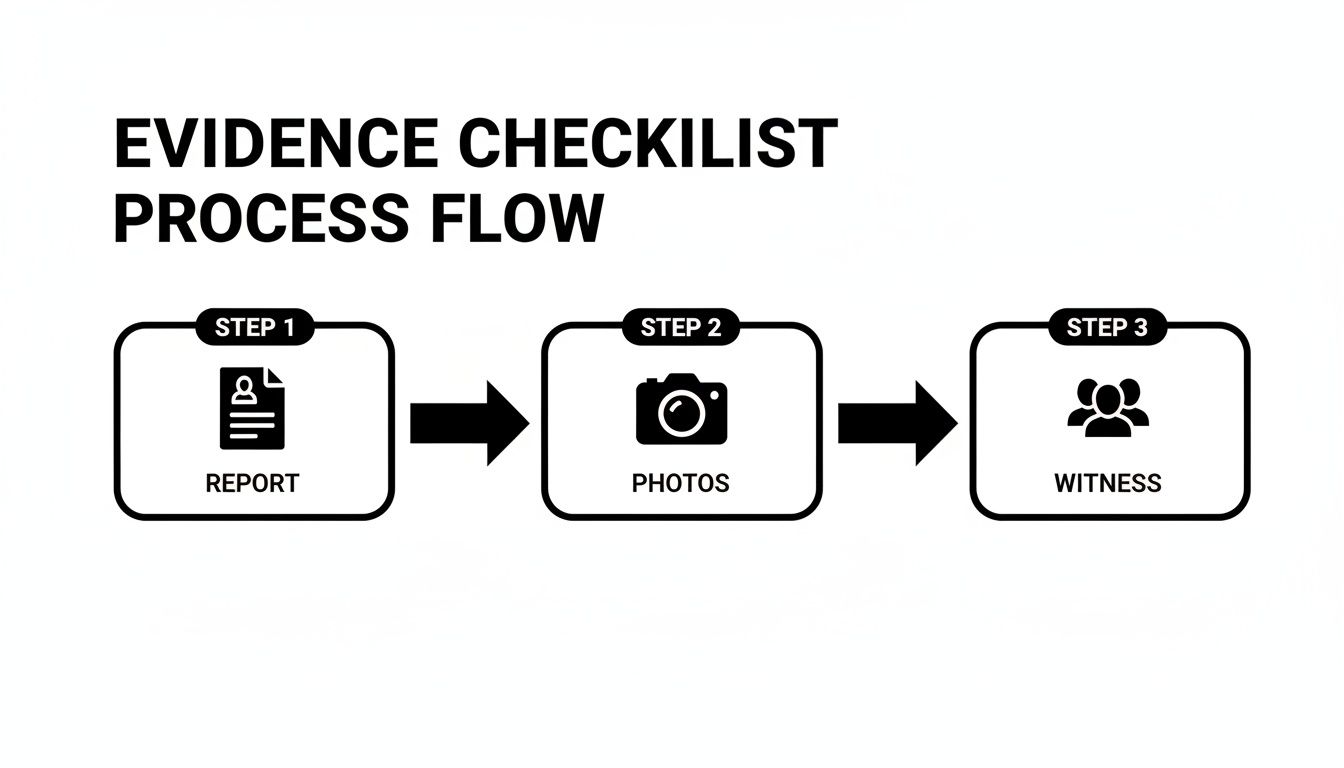
This process shows how the police report, photos, and witness statements create the foundation for proving who was at fault and the true extent of your losses, paving the way for wrongful death compensation if a loved one was lost.
When Exemplary Damages Are Awarded
In rare situations, a third type of damages may be awarded: exemplary damages, also known as punitive damages. Governed by Chapter 41 of the Texas Civil Practice & Remedies Code, these are not meant to compensate you for a loss. Instead, their purpose is to punish the at-fault driver for extreme negligence and to send a strong message to deter others from the same reckless behavior.
Exemplary damages are typically only considered in cases where the defendant acted with malice or gross negligence—for example, a drunk driver who causes a catastrophic crash.
How a Houston Car Accident Lawyer Can Help You
Trying to handle the aftermath of a car accident on your own can feel impossible, especially when you should be focused on healing. This is where a skilled Houston car accident lawyer from The Law Office of Bryan Fagan can make a critical difference.
We step in to take the burden off your shoulders, managing every detail of your case from start to finish. Our team will launch a thorough investigation to uncover the truth of how the crash happened and who is truly at fault.
Fighting for Your Fair Recovery
We meticulously gather all the evidence needed to build a powerful and undeniable auto insurance claim on your behalf. This includes securing the official police report, tracking down and interviewing witnesses, and collaborating with experts to prove the full extent of your damages.
Insurance companies are not on your side. Their primary goal is to pay out as little as possible. We know their tactics, and we are prepared to stand up to them. Our team negotiates aggressively to ensure you receive the maximum compensation you deserve. If they refuse to offer a fair settlement, we are always ready to take your fight to court.
Your focus should be on getting better, not battling with insurance adjusters. Let us handle the legal complexities so you can concentrate on putting your life back together.
Protecting Your Rights Within Texas Deadlines
After a crash, the clock starts ticking. Texas law has a strict deadline, known as the statute of limitations, for filing a personal injury lawsuit. For most car accident claims, you have only two years from the date of the accident to file. If you miss this window, you lose your right to seek justice forever.
We ensure all legal deadlines are met, protecting your rights from day one. Our firm also works on a contingency fee basis, which means you pay us nothing unless we win your case. There are no upfront costs or hidden fees, so there is no financial risk to you.
Common Questions After a Rear-End Crash
After a collision, it's normal for your mind to be racing with questions. Here are clear, practical answers to the most common concerns we hear from people in your situation.
What should I do if the other driver blames me?
First, stay calm and stick to the facts. Never admit fault at the scene, not even to be polite. Shifting blame is a common tactic some drivers use to avoid responsibility. Simply tell the responding officer exactly what happened from your perspective. This is the time to contact an experienced Texas injury attorney. We can use the evidence—the police report, photos, and witness accounts—to build a case that proves the truth. Insurance adjusters will twist any apology against you, so let your lawyer handle all communication.
How does a crash involving Uber or Lyft affect my claim?
Getting hit by a rideshare driver, or being a passenger in one during a crash, adds extra layers to the process. You could be dealing with the driver's personal policy and the massive corporate policy held by Uber or Lyft. Which policy pays depends on what the driver was doing at the moment of impact. Our firm has extensive experience with these complex claims and knows how to pursue every available source of compensation for you.
How long do I have to file an insurance claim in Texas?
The clock starts ticking the moment the crash happens. In Texas, the law that sets this deadline is called the statute of limitations. For most car accident injury cases, you have exactly two years from the date of the crash to file a lawsuit. If you miss that deadline, you lose your right to seek compensation forever. That's why it's so important to act quickly, not just to meet the deadline but to preserve crucial evidence while it's still fresh.
What if the at-fault driver has no insurance?
Discovering the other driver is uninsured is stressful, but don't panic. You still have options. If you have Uninsured/Underinsured Motorist (UM/UIM) coverage on your own auto policy, you can file a claim with your own insurance company. However, even your own insurer may try to pay as little as possible. An experienced Houston car accident lawyer can manage your UM/UIM claim and fight to make sure you get the full amount you're entitled to under your policy.
The legal system can feel overwhelming, but you don’t have to navigate it alone. The compassionate attorneys at The Law Office of Bryan Fagan, PLLC are here to listen, answer your questions, and fight for the justice you and your family deserve. We will handle the legal fight so you can focus on healing. For a free, no-obligation consultation to discuss your case, visit us online at https://houstonaccidentlawyers.net.