A car crash can change your life in seconds—but you don’t have to face recovery alone. One of the most critical documents for protecting your rights is the official Texas Peace Officer’s Crash Report (Form CR-3). This isn't just paperwork; it's the official record that insurance companies and lawyers use to determine who was at fault and what compensation you are entitled to.
Why Your Houston Accident Report Is So Important
In the chaotic moments after a wreck on a busy Houston freeway, your official accident report houston tx is likely the last thing on your mind. However, this single document quickly becomes the foundation of your entire insurance claim and any potential personal injury lawsuit. It provides a crucial, third-party account of the incident, which carries significant weight with insurance adjusters.
Imagine this real-world example: A Houston driver rear-ended on I-45 knows the other driver was texting, but the at-fault driver denies it. The police report—with its detailed diagram, officer’s narrative, and codes for contributing factors like "Driver Inattention"—provides the unbiased evidence needed to prove what really happened. Without that report, you could be stuck in a frustrating "he said, she said" battle that delays your recovery.
The Report's Role in Your Claim
The crash report is a critical tool for establishing liability, a legal term that simply means "fault." Texas follows a comparative fault rule (under the Texas Civil Practice & Remedies Code, Chapter 33), which means you can recover compensation as long as you are not found to be 51% or more responsible for the crash. An insurance company’s first step in assigning that percentage of fault often relies on the investigating officer's assessment in the report.
This report is crucial because it:
- Establishes Key Facts: It documents the date, time, location, and weather conditions.
- Identifies All Parties: The report lists names, contact information, and insurance details for every driver, passenger, and witness.
- Provides an Official Narrative: It includes the officer’s summary of events, based on physical evidence and statements from those involved.
- Supports Your Injury Claim: It officially links your injuries to the accident, which is essential for recovering damages—the money awarded for medical bills, lost wages, and pain and suffering.
The details in your Houston accident report can make or break your ability to get fair compensation. It is the primary document used to prove another driver’s negligence caused your injuries and losses.
Ultimately, this report is the starting point for everything. It helps your Texas injury attorney understand the strengths of your case and prepares them to fight back when the insurance company tries to offer a low settlement. While it isn't the only piece of evidence, its importance cannot be overstated.
For a complete checklist on what to do immediately after a collision, you can learn more about what to do after a car accident here to ensure you protect your rights from the very beginning.
How To Get Your Houston Police Accident Report
After a car crash, the official accident report is one of the most important documents you'll need. It’s the foundation for your auto insurance claim and a key piece of evidence if you need to file a lawsuit. Thankfully, obtaining your report in Houston is a straightforward process.
Knowing your options can save you time and frustration during a stressful recovery. Let’s walk through the practical steps to get your report.
Where and How to Get Your Houston Accident Report
Most people can get their report directly from the Houston Police Department (HPD) or through the Texas Department of Transportation's (TxDOT) online portal. Here’s a quick breakdown of your options:
| Source | Method | Cost | Turnaround Time |
|---|---|---|---|
| Houston Police Department | Online Portal | $6.00 | 5-10 business days |
| Houston Police Department | In-Person | $6.00 (standard) / $8.00 (certified) | 5-10 business days |
| TxDOT Crash Records | Online Portal | $6.00 | 5-10 business days |
As you can see, the methods are similar in cost and speed. The best choice for you often comes down to personal preference—whether you prefer the convenience of an online request or need a certified copy for legal purposes, which is easier to get in person.
Requesting Your Report Online
For most people, the simplest way to get a copy of their crash report is through HPD’s online system. You can search for and purchase the report directly from your computer.
To find the correct file, you'll need at least two pieces of information, such as:
- The last name of a driver involved in the crash
- The date the accident occurred
- The street name where the accident happened
- The HPD case number provided by the officer at the scene
Let's say you were in an accident on the I-610 West Loop. You would visit the HPD online portal, enter the date and your last name, and the system should locate your report. The fee is typically $6.00, payable by credit card.
This report is the official bridge between the accident itself and a successful insurance claim.
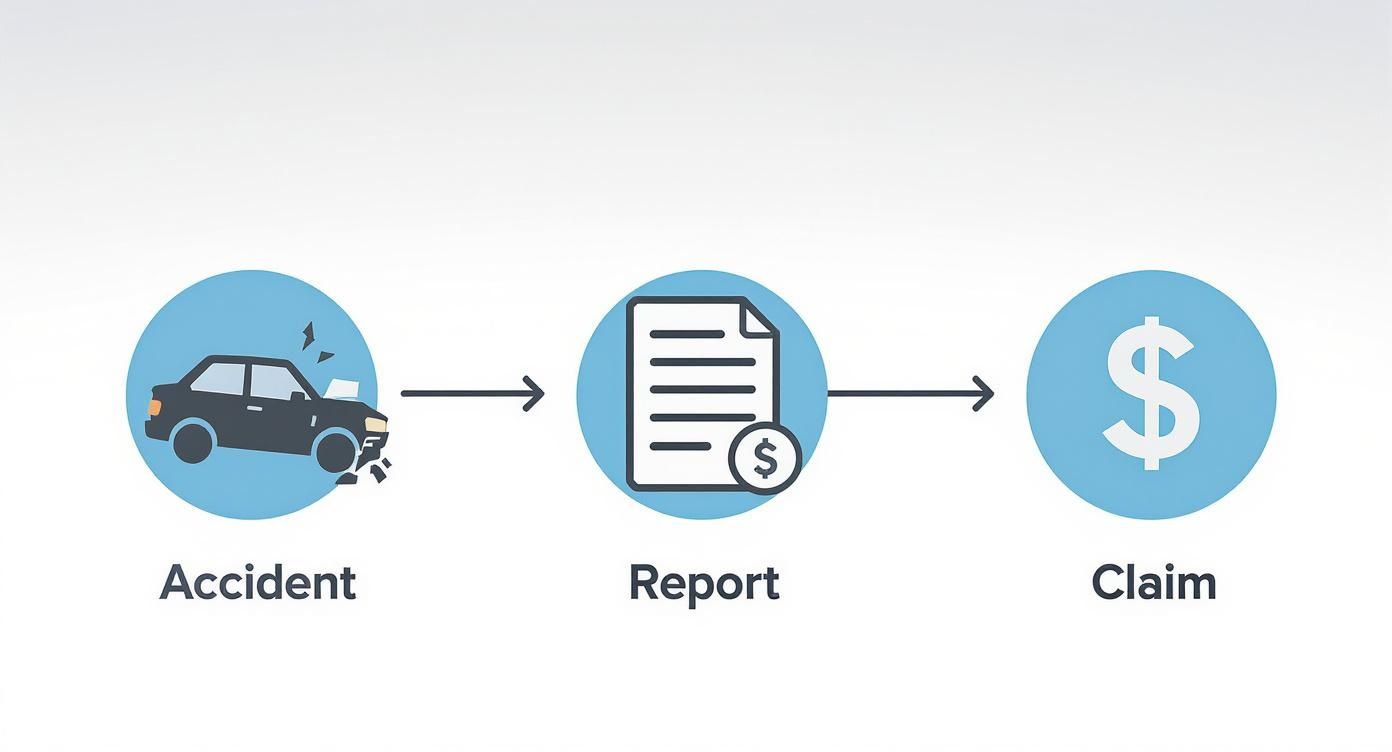
Without this document, you're just telling the insurance company your side of the story. With it, you have official evidence to back you up.
Getting Your Report in Person
If you prefer to handle this task face-to-face or need a certified copy for a lawsuit, visiting the HPD Records Division in person is your best option.
The HPD Records Division is located downtown at 1200 Travis St., Houston, TX 77002.
Before you go, make sure you bring your driver's license, the HPD case number, and a form of payment. A standard copy costs $6.00, while a certified copy—which carries more legal weight in court—is slightly more at $8.00.
A Quick Word on Timing: Don't worry if your report isn't available the day after the wreck. It typically takes 5-10 business days for the investigating officer to complete and file it. A short wait is completely normal.
Why You Should Let an Attorney Handle This
While you can get the accident report on your own, having an experienced Houston car accident lawyer do it for you is about more than just convenience.
First, we handle the cost and hassle, allowing you to focus on your recovery. More importantly, we know exactly what to look for once we get it. We immediately analyze the officer's narrative, the crash diagram, and any fault codes to spot errors or inconsistencies that could harm your claim. If we find a mistake, we know how to take action to correct it. We then use the verified report as a cornerstone when we report an accident to your insurance company.
Chasing down paperwork is the last thing you should be worried about. At The Law Office of Bryan Fagan, PLLC, our team handles every detail, from gathering evidence to fighting for the compensation you deserve. Your job is to heal. Let us handle the rest.
How to Read Your Texas Crash Report
When you finally have the official Houston accident report, it can look like a confusing mix of codes, boxes, and official jargon. The Texas Peace Officer's Crash Report (Form CR-3) is detailed, but learning how to read it is a powerful step in protecting your rights. This document is the official record of what happened, and it’s the foundation for proving fault.
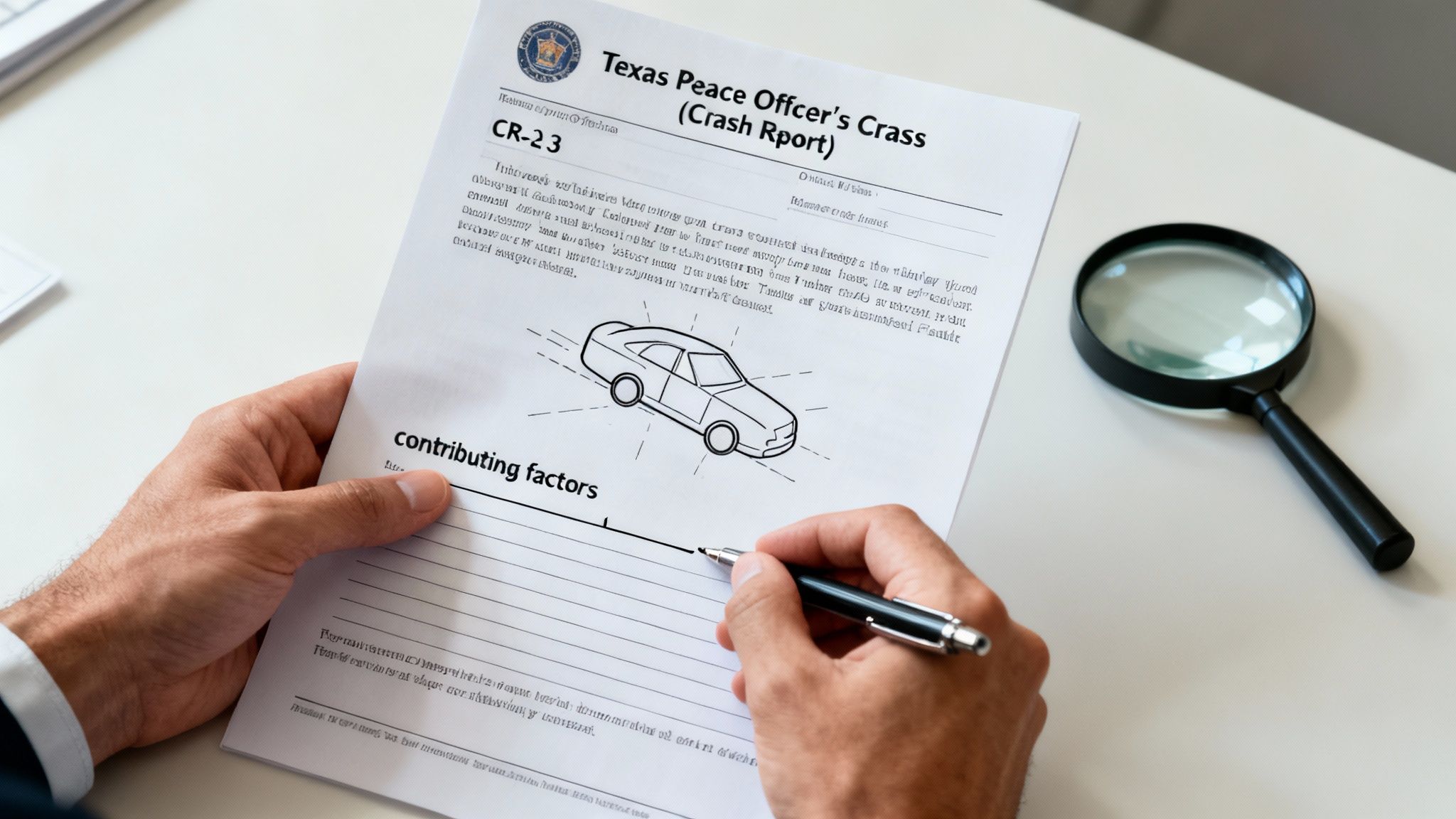
Let's break down the key sections of the report in plain English. Understanding how these pieces fit together will empower you when speaking with insurance companies and your attorney.
Key Sections to Zero In On
While every part of the CR-3 report is important, some sections carry more weight than others. When our firm reviews a client’s report, these are the first places we look to understand the core story of the crash.
Focus your attention on these three areas first:
- Page 1 – The Basics (Identification & Crash Details): The top of the first page contains the fundamental facts—who, what, where, and when. It is vital to confirm that all names, addresses, vehicle information, and the crash location are 100% accurate.
- Page 1 – Contributing Factors: This is arguably the most critical section for your claim. Here, the officer uses specific codes to state their opinion on the cause of the wreck.
- Page 2 – The Narrative and Diagram: This is the officer’s summary of the crash. It includes a hand-drawn sketch of the scene and a written description of their findings, which adds context to the codes and data on the first page.
Even a small mistake in these sections can create big problems for your claim.
The Officer's Narrative and Diagram
On the second page, you'll find the officer's diagram and written narrative. The diagram provides a bird's-eye view of the scene, showing the positions and directions of the vehicles. It’s a simple but effective tool for visualizing how the accident unfolded.
The narrative is the officer’s written summary, based on interviews with drivers and witnesses and physical evidence like skid marks. This section explains the "why" behind the officer’s conclusions.
A police officer’s narrative might state, "Unit 1 failed to yield right of way at a stop sign, striking Unit 2 which was proceeding lawfully through the intersection." This single sentence can be incredibly powerful evidence of negligence.
When you combine the narrative with the diagram, you get a clear story that an insurance adjuster—or a jury—can easily understand. A detailed narrative makes it much harder for the other driver to change their story later.
The All-Important Contributing Factors
No section of the accident report carries more weight than the "Factors & Conditions" section. This is where the officer uses numeric codes to assign what they believe caused the crash. The battle over liability (legal fault) often begins here.
For example, if you were rear-ended on I-45, the officer might assign a code for "Following Too Closely" or "Driver Inattention" to the driver who hit you. These codes are official notations that point directly to negligent behavior.
Common contributing factors on Houston accident reports include:
- Failed to Yield Right of Way: A frequent cause of T-bone crashes at intersections.
- Unsafe Speed: Driving too fast for road conditions, not just the posted speed limit.
- Driver Inattention or Distraction: Often linked to texting or cell phone use.
- Disregarded Stop Sign or Signal: A clear traffic violation that points directly to fault.
When an insurance adjuster sees one of these codes assigned to the other driver, it gives your claim for damages a major boost. Damages are the money you can recover for your medical bills, lost wages, and pain and suffering.
Taking time to understand your Texas accident report is a critical step in protecting your rights. This document gives you the leverage needed to demand a fair settlement. If anything in your report seems wrong, an experienced Houston car accident lawyer can analyze every detail and use it to build a powerful claim for the compensation you deserve.
Finding and Correcting Errors on Your Accident Report
Police officers are human, and at a chaotic crash scene, mistakes can happen. Unfortunately, a simple error on your official accident report—like a misspelled name or the wrong direction of travel—can create significant problems for your insurance claim.
Inaccuracies give insurance adjusters an excuse to delay, devalue, or deny your right to fair compensation.
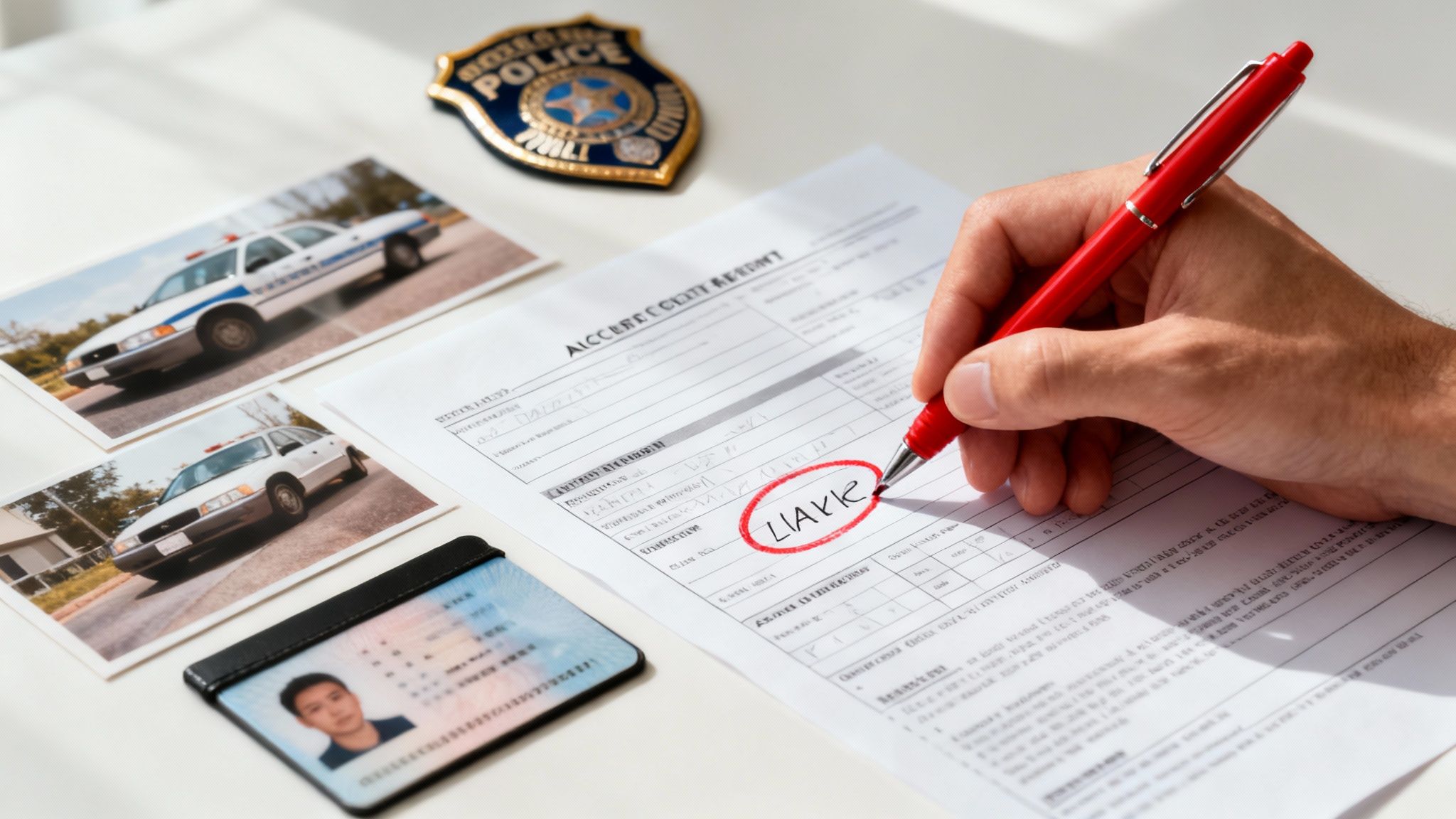
Spotting and fixing these mistakes quickly is vital. You have the right to challenge incorrect information, but you must follow the correct process.
What Common Errors Should I Look For?
When you receive your crash report, review it carefully. Compare every detail to your memory and any photos you took at the scene. Most errors fall into two categories: factual mistakes and disputed opinions.
Factual errors are objective mistakes that can usually be corrected with proof. Look for:
- Incorrect names, addresses, or insurance policy numbers.
- The wrong date, time, or location of the accident.
- Inaccurate vehicle details (make, model, license plate).
- Misidentified points of impact on the vehicles.
Disputed opinions, on the other hand, relate to the officer's judgment, such as their written narrative or their conclusion about who was at fault. These are harder to change, but not impossible.
An officer might incorrectly state that you were traveling "north" when you were actually heading south. This simple error could flip the accident diagram and unfairly shift liability onto you.
How to Request a Correction in Houston
If you find a clear factual error, the process for requesting a correction is usually straightforward. You will need to contact the law enforcement agency that filed the report, which is likely the Houston Police Department or the Harris County Sheriff's Office.
Your first step should be to contact the reporting officer or their precinct. Be prepared to provide clear evidence proving the information is wrong. This evidence could include:
- Your driver's license to correct a name.
- Your vehicle registration to fix an incorrect license plate number.
- Photos from the scene showing damage that contradicts the report.
- Contact information for witnesses who can support your version of events.
If the officer agrees it was a factual mistake, they can file a supplemental report to amend the original, making the correction part of the official record.
Why an Attorney Should Be the One to Review Your Report
While you can request corrections yourself, having an experienced Houston injury attorney review the report first is a wise step. Attorneys are trained to spot subtle issues you might miss—the same inconsistencies an insurance company will use against you.
For example, an officer’s narrative might seem neutral, but a "contributing factor" code could imply you share blame. This could reduce your settlement under Texas’s comparative fault rules. We know how to read between the lines and identify these potential traps.
If an officer refuses to amend the report, especially over a disputed opinion on fault, we don't give up. We work to build a stronger case with other evidence—like witness interviews or expert analysis—to counter the report's conclusions and prove what truly happened.
Don't let a mistake on a piece of paper dictate your future. The team at The Law Office of Bryan Fagan, PLLC, will analyze your report and fight to ensure the official record accurately supports your right to fair compensation.
How an Attorney Uses Your Report to Build Your Case
Getting the official Houston crash report is a great first step. But for a personal injury attorney, that document is just the beginning. It’s the roadmap we use to build a powerful case designed to secure the full compensation you deserve for your injuries and losses.
At The Law Office of Bryan Fagan, PLLC, we don't just file the report away. We immediately begin a detailed analysis, using the officer's findings as a starting point for our own in-depth investigation into the crash.
From Report to Strategy
The moment we obtain your accident report houston tx, our legal team gets to work. We dissect every detail, from the crash diagram to the officer’s narrative, to identify the strengths and potential weaknesses of your claim.
This review tells us what to do next. For example, if the report blames "Driver Inattention" for the other party's actions, our first move is to seek evidence of distracted driving, such as cell phone records. If the report is vague, we know we need to find independent witnesses to fill in the gaps.
Your crash report is a critical piece of evidence, but it is rarely the only evidence. A skilled attorney uses it to guide their investigation and gather the additional proof needed to build an undeniable claim.
This proactive approach is vital. In 2023, Houston saw a staggering 67,644 total car accidents, which averages out to about 185 crashes every day. On such dangerous roads, having a legal team that moves quickly and strategically from day one can make all the difference in the outcome of your case.
What if the Report is Contested or Delayed?
It happens more often than you might think. The other driver’s insurance company may dispute the officer’s findings, or the report might be delayed or was never filed at all.
This is where an experienced Houston car accident lawyer is invaluable. We don’t wait for perfect paperwork. We take action.
Our team immediately begins gathering alternative evidence to establish liability. This often includes:
- Hunting Down Camera Footage: We send preservation letters to nearby businesses and TxDOT to secure traffic and security camera video.
- Finding New Witnesses: We revisit the scene and use specialized databases to locate witnesses the police may have missed.
- Hiring Accident Reconstruction Experts: In complex crashes, we bring in forensic professionals who can scientifically prove how the collision occurred.
In tragic cases involving a fatality, the report becomes a key document for a wrongful death claim. It can provide critical information needed for actions like obtaining private autopsies due to wrongful death cases to build a strong legal foundation for the family's compensation.
The police report is a tool—not the entire case. A skilled attorney knows how to win even when that tool is flawed or missing. If you are unsure how the details in your report could impact your claim, the best next step is to learn how to find a good accident lawyer who can protect your rights.
Got Questions About Your Houston Accident Report? We Have Answers.
After a serious car accident, it’s normal to feel overwhelmed and have a lot of questions. This is a confusing and stressful time, and you deserve clear, straightforward answers. Here are some of the most common questions we hear from our clients.
How Long Do I Have To File An Injury Claim After A Houston Car Accident?
In Texas, a legal deadline called the statute of limitations applies to personal injury claims. For most car accidents, you have just two years from the date of the crash to file a lawsuit.
If you miss this two-year window, you will likely lose your right to seek compensation forever, no matter how strong your case is. This is why it is so important to speak with a Houston car accident lawyer as soon as possible. An attorney can preserve crucial evidence, interview witnesses, and ensure all legal deadlines are met, protecting your rights.
What If The Accident Report Says I Was Partially At Fault?
First, do not panic. An officer's opinion on fault is important, but it is not the final word. Texas law follows a legal doctrine known as “modified comparative fault” (also called the "51% rule").
In plain English, this means you can still recover money from the other driver as long as you are not found to be 51% or more to blame for the accident. Your final compensation will be reduced by your percentage of fault. For example, if you are found 10% at fault and your damages total $100,000, you would be eligible to receive $90,000.
An experienced Texas injury attorney knows how to challenge an unfair fault assessment. We conduct our own investigation to find evidence that minimizes your percentage of blame and maximizes your financial recovery.
Is The Police Report The Only Evidence That Matters In My Case?
Absolutely not. The police report is a starting point, not the finish line. While it is a key piece of evidence, it is just one part of a strong personal injury claim.
A winning case is built with multiple layers of proof. Other vital evidence can include:
- Photos and videos from the scene showing vehicle damage and injuries.
- Statements from eyewitnesses who saw what happened.
- Your medical records and bills, which prove the extent and cost of your injuries.
- Expert testimony from accident reconstruction specialists or medical professionals.
A skilled lawyer will gather all of this and more to build a compelling case that shows how the other driver’s negligence impacted your life.
How Much Does A Houston Accident Report Cost?
The cost is minimal. The Houston Police Department generally charges $6.00 for a standard copy of a crash report. A certified copy for court purposes costs $8.00.
When you hire The Law Office of Bryan Fagan, PLLC, you don’t have to worry about these details. We handle the process of obtaining the report for you and cover these small administrative costs as part of managing your case. Your only job is to focus on getting better.
A car crash is overwhelming, but you don’t have to face recovery alone. The compassionate and experienced Houston accident lawyers at The Law Office of Bryan Fagan, PLLC are here to answer your questions, handle the insurance companies, and fight for the full compensation you and your family deserve. Contact us today for a free, no-obligation consultation to discuss your case and learn how we can help you move forward.