A car crash can change your life in seconds, but you don’t have to face recovery alone.
If you’re a commercial driver who was just arrested for dui with a cdl, your mind is probably racing. You may be thinking about your paycheck, your route, your employer, your family, and whether one bad night is about to cost you the work you spent years building.
That fear is real. In Texas, a DWI arrest can threaten more than your freedom to drive. It can threaten your commercial future, your reputation, and your ability to stay employed even after the court case ends. The hard part is that many drivers don’t realize they’re dealing with two separate fights at the same time.
If alcohol impairment led to a crash, the situation can also affect injured people, passengers, and families pursuing a claim. In Texas personal injury law, liability means legal responsibility for harm. Damages means the losses a person can recover, such as medical bills, lost income, pain and suffering, and in fatal cases, wrongful death compensation. Under Texas Civil Practice & Remedies Code Chapters 33 and 41, fault and recoverable damages can shape both settlement value and trial outcomes.
A Houston car accident lawyer or Texas injury attorney looks at the full picture. That includes the criminal charge, the license threat, the employer consequences, any civil lawsuit, and any auto insurance claim tied to the crash.
Your Career Is on the Line What Happens After a DWI Arrest
The flashing lights come on. You pull over. A few questions turn into roadside tests. Then handcuffs. For many CDL holders, that’s the moment the arrest stops feeling like a traffic case and starts feeling like a career emergency.
A driver might be heading home in a personal vehicle, not a rig. Another may be stopped after a minor lane issue. Another may be involved in a crash and suddenly find police asking about alcohol use. The details matter, but the first emotional reaction is usually the same. Panic.
You may not even know what happens over the next few hours. Booking, bond, paperwork, a court date, and license forms can hit fast. If you need a plain-language overview of what happens after you get arrested, that resource helps explain the early steps that often confuse people.
What matters right now is this. Don’t assume the case will sort itself out. Don’t assume keeping your regular driver’s license means your CDL is safe. And don’t assume your employer will wait for the court to decide everything.
First practical point: after a DWI arrest, time starts working against you quickly, especially when your commercial license is part of your livelihood.
If the arrest involved a collision, the consequences can spread beyond the criminal case. An intoxicated-driving crash may also lead to an injury claim, higher insurance scrutiny, and questions about negligence. If you want to understand how these claims are evaluated from the victim side, this page on a drunk driving accident gives helpful context.
You’re not powerless, but you do need to act with purpose. The rest of this guide breaks the problem into manageable parts so you can see what’s happening, what’s at stake, and what to do next.
The Two Battles You Must Fight Criminal vs Administrative Penalties
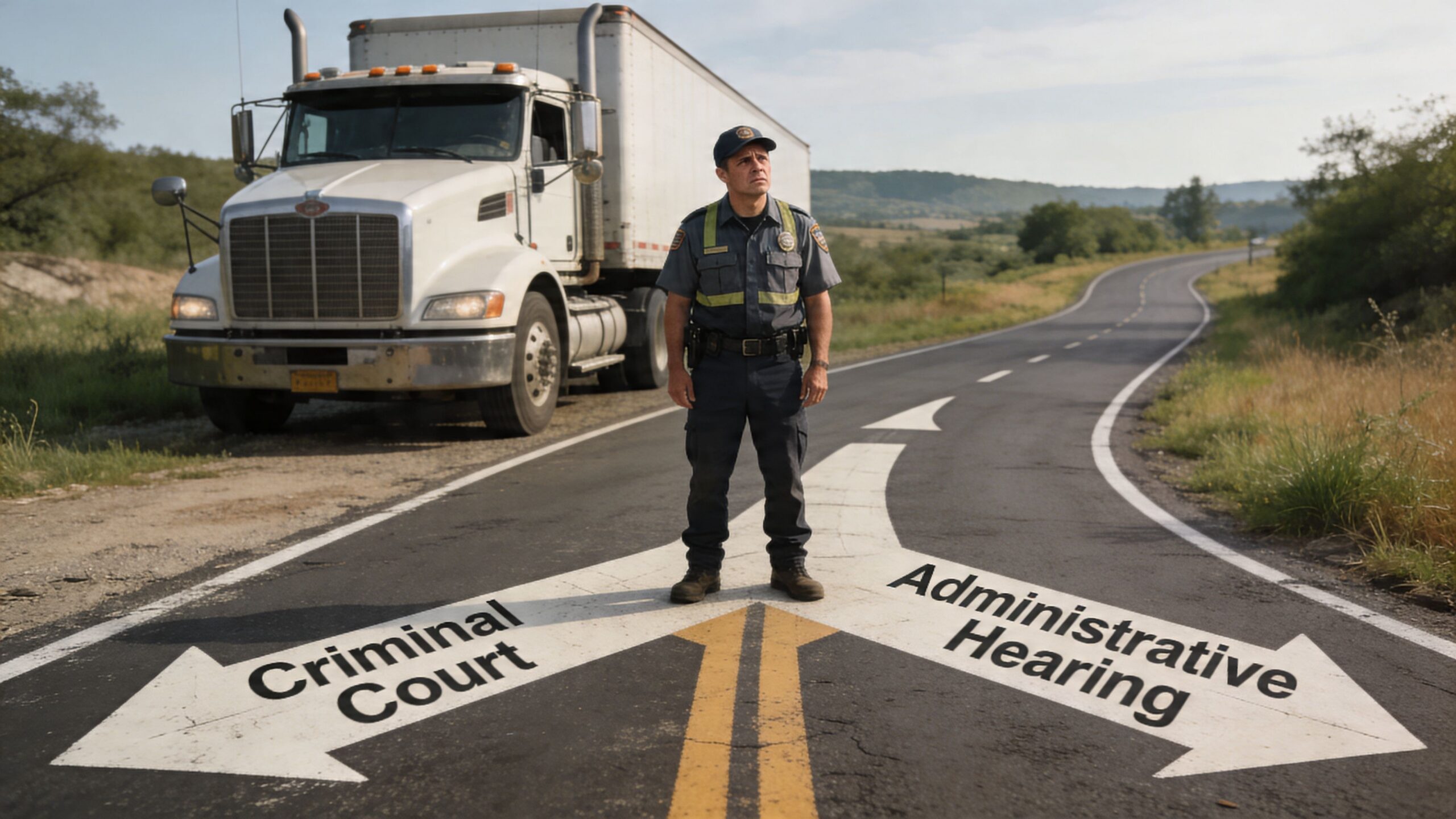
Most CDL drivers think a DWI case is just one court case. In Texas, that’s not how it works.
You are usually dealing with two separate proceedings. One is the criminal case. The other is the Administrative License Revocation, often called the ALR process. They run on different tracks. They have different decision-makers. They can lead to different outcomes.
What the criminal case decides
The criminal case asks whether the state can prove a DWI offense in court. That process may involve the prosecutor, a judge, and sometimes a jury.
The criminal side can affect:
- Your record
- Possible jail time
- Fines or probation
- Court-ordered classes or conditions
This is the part commonly pictured when one hears “DWI charge.”
What the ALR process decides
The ALR process is different. It focuses on your driving privileges, not criminal guilt. It can move forward even while the court case is still pending.
One key concept here is implied consent. In plain English, that means Texas law treats driving as consent to certain chemical testing rules after a lawful DWI arrest. Refusing a breath or blood test can trigger separate license consequences.
Criminal Case vs. Administrative (ALR) Hearing in Texas
| Aspect | Criminal Court Case | Administrative License Revocation (ALR) |
|---|---|---|
| Main purpose | Decide whether you are guilty of DWI under criminal law | Decide whether your driving privileges should be suspended or disqualified |
| Decision-maker | Judge or jury | Administrative hearing officer |
| Focus | Crime and punishment | License status |
| Possible result | Conviction, acquittal, dismissal, plea outcome | Suspension or other action affecting driving privileges |
| Evidence issues | Breath, blood, officer testimony, video, field observations | Similar evidence may be used, but the hearing has a different purpose |
| Why CDL drivers must care | A criminal result can affect record and employment | An ALR result can affect the ability to keep driving while the criminal case is still unfolding |
Why this split confuses drivers
A person can do well in one track and still struggle in the other. That’s why a dui with a cdl feels so overwhelming. You may think, “If I beat the case, I keep my career.” Sometimes it’s not that simple.
The criminal case is about whether the state proves the offense. The administrative case is about whether the state can take action against your license under the applicable rules. Those are related questions, but they are not identical.
A DWI arrest can put you in two rooms at once. One room decides criminal consequences. The other decides whether you can keep driving.
A term every injured person should know
If the arrest followed a crash, another legal word enters the picture: liability. Liability means who is legally responsible for causing harm. In Texas injury law, that matters in every auto insurance claim and every lawsuit.
Texas also uses a comparative fault system under Chapter 33. In plain English, comparative fault means more than one person can share blame for a crash. A driver’s percentage of responsibility affects what they can recover or owe. If alcohol impairment played a role, that can become powerful evidence in a civil case involving truck crashes, passenger claims, or wrongful death compensation.
Why the Rules Are Stricter for Commercial Drivers
After a DWI arrest, many CDL holders ask a fair question: why does one mistake bring harsher rules for me than for someone driving a pickup home from dinner?
The answer starts with risk. A commercial vehicle carries more weight, needs more distance to stop, and leaves less room for error. A delay of even a second can matter far more in an 18-wheeler than in a passenger car. Texas and federal regulators build their rules around that reality.
That is why a CDL holder can be in trouble at a lower blood alcohol concentration than a non-commercial driver. For commercial driving, the legal limit is 0.04% BAC, while the limit for most non-commercial drivers is 0.08%. The point is not that the law expects truck drivers to be perfect. The point is that the law expects a wider safety margin because the consequences of impaired operation can be much more severe. One source discussing those stricter standards is this article on commercial drivers facing stricter drunk driving rules.
Why the lower BAC limit exists
A loaded commercial truck works like a much larger system with more momentum, more blind spots, and more ways a small error can grow into a serious crash. A driver may feel only mildly affected. The law focuses on what that level of impairment can do to reaction time, lane judgment, braking decisions, and hazard recognition.
That same safety-first approach also explains why commercial rules can change based on the kind of driving you do and where you do it. If you need help sorting out the regulatory difference, this guide to interstate vs intrastate commercial driving rules gives useful background.
Stricter rules do not stop with the roadside arrest
For a CDL holder, a DWI allegation is rarely just about the officer’s report or the court date on the citation.
It can affect how state agencies view your driving privileges, how federal systems track alcohol-related violations, and how employers judge risk. That is one reason the two-front battle matters so much. The criminal case asks whether the state can prove the offense. The administrative side can still threaten your ability to drive commercially. Then, even beyond those two fights, your employment record may carry the event much longer than you expected.
The federal record follows the driver
Commercial drivers also face more long-term scrutiny than non-commercial drivers. The FMCSA Drug and Alcohol Clearinghouse records certain drug and alcohol violations and can become part of what future employers review before making a hiring decision. In plain terms, the problem is not limited to whether you lose in court. The problem can continue when a recruiter, safety director, or carrier checks your history months later.
For crash victims and families, these stricter standards matter in civil cases too. If a commercial driver violated a safety rule, that fact can support an argument that the driver, and sometimes other responsible parties, acted negligently.
CDL Disqualification Timelines The Immediate Career Threat
For many people, the most urgent question is not “Will I go to court?” It’s “Can I still work next week?”
That’s where a dui with a cdl becomes brutally practical. Your commercial driving privileges can be at risk fast, and the loss of a CDL often means the loss of income right away.
The first offense problem
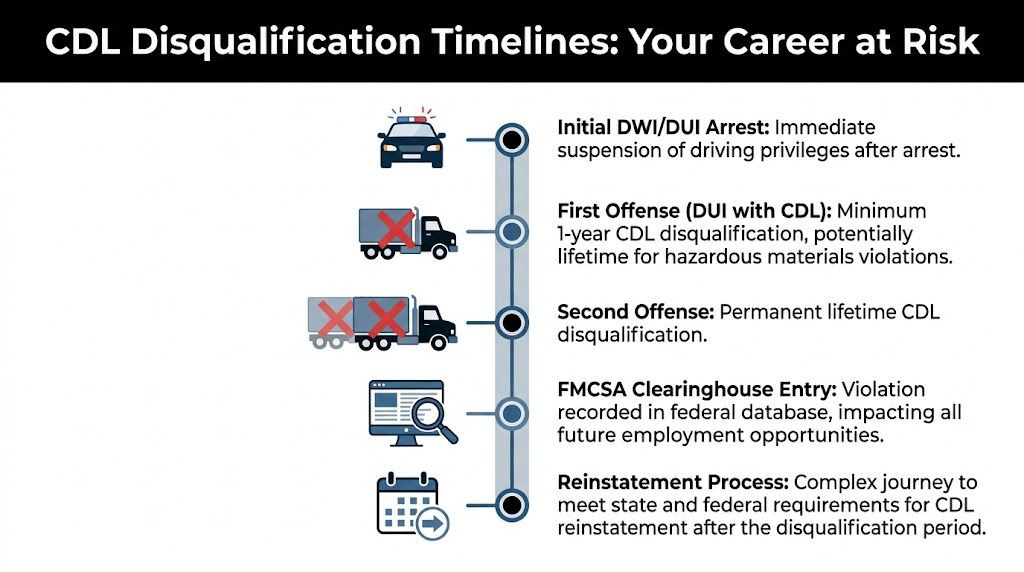
In Texas, CDL holders face a 0.04% BAC limit, and a first-offense conviction mandates a minimum 1-year CDL disqualification with no occupational license permitted under the rule described here: Texas CDL DWI consequences.
That last part catches many drivers off guard. Some people know that non-commercial drivers can sometimes seek restricted driving relief in certain situations. But for the CDL itself, the article above notes no occupational license is permitted during that disqualification period.
Refusal has its own consequences
Some drivers believe refusing chemical testing avoids the main risk. It doesn’t.
Under the same Texas source, refusing a chemical test under implied consent laws can trigger an immediate administrative suspension for up to 2 years. The refusal issue can create a serious problem even before the criminal court reaches a final outcome.
The second offense cliff
The long-term risk gets even steeper after multiple offenses. The verified data states that multiple DUI convictions can lead to a lifetime ban from holding a CDL. That means a later case can turn what once felt survivable into a permanent career barrier.
What this means in real life
A one-year loss of commercial privileges is not just a licensing inconvenience. It can affect:
- Current employment: many driving jobs require active commercial driving authority every day.
- Income stability: missed loads and lost work can start immediately.
- Family planning: mortgage payments, child support, and regular bills don’t pause.
- Future applications: even after reinstatement, the history often follows you.
Don’t treat the disqualification issue like paperwork. For many drivers, it is the case.
A simple timeline to keep in mind
Arrest happens
Police begin the criminal case, and license consequences may also start moving.ALR deadlines arrive quickly
The administrative side does not wait for the criminal court to finish.Commercial driving privilege becomes the central concern
Even if you can still drive a personal vehicle in some circumstances, that does not mean you can legally perform CDL work.Employer consequences may begin before final resolution
Some employers act based on policy, insurance rules, or federal reporting obligations.
A point many drivers miss
Losing your CDL and losing your regular license are related issues, but they are not the same thing. A person may focus on whether they can still drive to the grocery store and miss the bigger economic problem. This pressure usually comes from losing the legal ability to work in a commercial driving role.
That’s why immediate legal review matters. The sooner you understand which deadlines apply and what documents were issued at arrest, the better your chance of protecting your options.
Navigating the Texas Criminal Court Process for a DWI
The criminal court process often feels slow, formal, and hard to read. One hearing may focus on paperwork. Another may deal with plea discussions. Another may be set months later. Meanwhile, your job may already be unstable.
A typical DWI case starts with the arrest, charging documents, and an initial court setting. From there, the prosecutor reviews police reports, test results, video, and witness accounts. Your defense attorney reviews the same evidence and looks for weaknesses.
What the court is examining
The court process often turns on questions like these:
- Was the traffic stop lawful
- Did the officer have a valid reason to arrest
- Were field sobriety tests administered properly
- Were breath or blood procedures handled correctly
- Can the state prove impairment beyond a reasonable doubt
Not every DWI case is built the same way. Some rely heavily on officer observations. Some depend on chemical testing. Some involve a crash scene, witness statements, or body camera footage.
When a crash changes everything
If a DWI arrest involved injuries or a death, the criminal consequences can become much more serious. That is also where the civil side becomes important.
Take a simple example. A Houston driver is rear-ended on I-45 by a motorist later arrested for DWI. The criminal case addresses the charge against the impaired driver. Separately, the injured driver may bring an auto insurance claim and, if needed, a personal injury lawsuit seeking damages for medical care, lost wages, pain and suffering, and future treatment.
In fatal crashes, surviving family members may pursue wrongful death compensation. That is not the same as the criminal case. It is a separate civil claim for losses caused by the death.
Civil claims and Texas fault rules
Under Texas Civil Practice & Remedies Code Chapter 33, comparative fault means the court or insurer may assign percentages of fault among the people involved. If one driver was impaired, that can strongly affect the liability analysis.
Under Chapter 41, some cases may also raise issues about the type of damages being sought and the proof required. A Texas injury attorney looks closely at both chapters when evaluating claims tied to intoxicated driving.
A criminal charge punishes the conduct. A civil case addresses the harm caused to the people left dealing with the crash.
The human side of severe impairment cases
Nationally, the most frequently recorded BAC level among drinking drivers in fatal crashes was 0.18 g/dL, which is more than double the standard legal limit and more than four times the CDL limit, according to this alcohol-impaired driving data summary. That figure shows how extreme impairment often is in the most tragic cases.
Not every CDL DWI case involves a fatal crash. But when one does, both the criminal exposure and the civil liability can become life-changing. Victims and families may need immediate guidance on preserving evidence, dealing with insurers, and protecting their right to bring a timely claim.
The deadline civil claimants should remember
A statute of limitations is the legal deadline to file a lawsuit. In plain English, it means you can lose your right to sue if you wait too long. If a drunk driving crash injured you or killed a family member, that deadline matters. A Houston car accident lawyer can explain which filing period applies and whether any exceptions or special facts affect timing.
Long-Term Employment The FMCSA Clearinghouse and Background Checks
Some drivers focus on getting through court and getting the license back. That’s understandable. But with dui with a cdl cases, legal reinstatement is only part of the problem.
The other problem is employability.

The record employers can see
The verified data explains that the FMCSA Drug & Alcohol Clearinghouse ensures convictions are nationally visible, and that many carriers will not hire drivers with any recent DUI, with background checks revealing convictions from 10-20 years ago. That employment reality is discussed here: how a DUI can impact a commercial driver’s license and job prospects.
This is why many drivers say the case keeps hurting them long after court is over.
Legal reinstatement is not the same as getting hired
A driver may finish a disqualification period and still run into hard questions:
- Will a carrier’s insurer approve me
- Does this employer reject any alcohol-related history
- How will the Clearinghouse entry affect interviews
- Will a local delivery job treat this differently than over-the-road work
Those are not minor concerns. They shape whether you can return to earning a living in the field you know.
Why the return-to-duty path matters
The federal system does not just record violations. It also affects what must happen before a driver can move back toward qualifying work. Even when reinstatement is legally possible, employers may still apply stricter internal rules than the bare minimum.
That’s why many CDL holders need a plan that covers more than court. They need to think about timing, paperwork, future applications, and how to explain the event without making the situation worse.
A short explainer can help if you want a visual overview of the topic before talking strategy:
What injured families should understand
The employment side can also matter in crash litigation. After a serious collision, a company may argue about what it knew, what it checked, and whether the driver should have been on the road. In truck accident cases, hiring records, screening practices, and federal compliance issues can become part of the evidence.
That matters when a victim is trying to prove negligence and recover damages through settlement or lawsuit.
How a Texas DWI Attorney Can Help Build Your Defense
After a CDL DWI arrest, many drivers make one dangerous assumption. They think the court date is the whole case.
It is not.
You are usually dealing with two separate fights at the same time. One is the criminal prosecution. The other is the license side, including the ALR process that can affect your ability to keep driving long before the criminal case is resolved. A lawyer’s job is to treat those as two tracks, build a defense for each one, and make sure you do not miss deadlines that can close off options early.
What a lawyer looks at first
A strong defense starts with the paper trail and the timeline. In a DWI case, small details often carry a lot of weight. A few minutes here or a missing note there can change how a prosecutor, judge, hearing officer, or employer sees the case.
Early review often includes:
Why the officer stopped you
Police need a lawful reason to pull you over. If the stop was weak or unsupported, that can affect what evidence comes in.What the officer wrote down
Reports may describe balance, speech, bloodshot eyes, or odor of alcohol. Those observations are not the same as automatic proof. They need to be examined carefully.How field sobriety tests were given
These tests work more like roadside screening tools than infallible science. Instructions, conditions, footwear, weather, injuries, fatigue, and nerves can all matter.How breath or blood evidence was handled
Timing, machine maintenance, sample collection, storage, and chain of custody can all become defense issues.Whether the state can prove impairment at the time of driving
A test result taken later does not always answer the key legal question of what was happening when you were behind the wheel.
That review is not academic. It is how a defense takes shape.
A lawyer helps protect both the case and your livelihood
For a CDL holder, defense work is partly legal analysis and partly damage control. Court is only one piece of the problem. Your ability to keep earning a living can also turn on what happens with license paperwork, hearing requests, employer communications, and the record that follows you after the arrest.
A Texas DWI attorney can help you handle those pressure points in an organized way. That may include preserving records, requesting hearings on time, identifying weaknesses in the state’s evidence, preparing you for what to expect in court, and helping you avoid statements that create new problems with your employer, insurer, or licensing authorities.
That structure matters because panic leads people to talk too much, wait too long, or treat the criminal case and the license case as if they were the same. They are not.
Defense can include practical steps outside the courtroom
Some drivers also need help dealing with the personal side of the arrest. Judges, probation departments, and employers often pay attention to whether a person is taking the issue seriously. If alcohol use is becoming a recurring problem, treatment and education may matter for reasons that go beyond legal strategy.
A practical educational resource on Cognitive Behavioral Therapy for Alcohol Addiction explains one approach people use to identify triggers, change patterns, and reduce the risk of repeating the same mistake.
That will not erase a charge. It can still help your health, your family, and the decisions you make next.
If a crash happened, the civil side may need attention too
Some CDL DWI arrests involve an accident, which creates a second layer of risk. In that situation, the legal file can grow quickly. There may be insurance claims, injury allegations, property damage demands, or questions about fault.
If you are trying to sort through those issues, this guide on how to choose a car accident lawyer can help you ask better questions before hiring counsel.
The Law Office of Bryan Fagan, PLLC is one Texas firm that handles accident and injury matters involving intoxicated driving, insurance disputes, and trucking-related claims.
A practical rule applies here. Early decisions matter. The right lawyer looks at the criminal case, the ALR track, and the employment fallout together, because that is how a CDL case affects your life.
You Don’t Have to Face This Alone Protect Your Future Today
A dui with a cdl case is more than a court date. It can affect your criminal record, your license, your job, your insurance, and, if a crash happened, the rights of injured people and grieving families. The biggest mistake is waiting and hoping the system will sort itself out.
You need to know which battle is happening in criminal court, which battle is happening through ALR, and how both may affect your future. Fast, informed action gives you the best chance to protect your rights, your income, and your next steps.
If you’re dealing with a CDL DWI arrest or your family was hurt in a crash involving an impaired commercial driver, contact The Law Office of Bryan Fagan, PLLC for a free, confidential consultation. You can talk through your options with a Houston car accident lawyer or Texas injury attorney who understands liability, comparative fault, damages, auto insurance claim disputes, and wrongful death compensation under Texas law.