A car crash can change your life in seconds, but you don't have to face recovery alone.
You may be reading this after a wreck on I-45, the Katy Freeway, or a neighborhood road near home. One moment you were driving normally. The next, another driver drifted, slammed into you, or ran a light, and everything became confusion. You're hurting. Your car is damaged. Police arrive. Then you notice the other driver seems unsteady, distracted, or strangely slow to respond.
That's often when officers begin field sobriety tests.
For many injured people, that moment raises two questions at once. First, was the other driver intoxicated? Second, if the police used field sobriety tests, will that help prove your injury claim? Those are fair questions, and they matter because civil cases and criminal cases don't work the same way.
If you're asking are field sobriety tests accurate in Texas, the honest answer is: sometimes useful, never perfect. These tests can support an officer's decision to investigate or arrest. They can also become important evidence in an auto insurance claim or lawsuit against the driver who hurt you. But they are still human observations made on the side of a road, often at night, often under stressful conditions.
That doesn't mean the evidence is worthless. It means it has to be handled carefully.
As a Texas injury attorney, I want you to know two things. First, the legal system does have flaws. Second, those flaws don't prevent you from protecting your rights. A careful case review can show how field sobriety test results fit together with the crash report, witness statements, video footage, chemical testing, and the other facts that show who caused the collision.
Your Life Changed in an Instant What Happens Now?
A Houston driver rear-ended on I-45 may remember only pieces of the first hour after the crash. Airbags. Neck pain. A police officer asking questions. Another officer speaking with the other driver off to the side. Flashing lights reflecting off the pavement.
That's a common scene when officers suspect alcohol or drug impairment. They may ask the other driver to step out and perform a set of roadside exercises. If you were injured, you might not even know what those exercises were. You just know police seemed concerned.
Why this moment matters in a civil injury case
In a criminal DWI case, field sobriety tests may help establish probable cause. In a personal injury case, they can help show the other driver acted carelessly and put everyone around them at risk. That matters because your case is about liability, meaning who is legally responsible for the crash and the harm that followed.
If a driver shows signs of impairment at the scene, that fact can strengthen your argument that the wreck wasn't just an accident. It may show unsafe driving choices led directly to your injuries.
Practical rule: If police investigated the other driver for impairment, ask for the crash report, bodycam footage, dashcam footage, and any records tied to roadside testing as early as possible.
What you should do while the facts are fresh
Right after a crash, your priority is medical care. But if you're physically able, a few steps can protect your claim:
- Get treatment promptly. Follow up with the ER, urgent care, your doctor, or a specialist. Medical records connect the crash to your injuries.
- Save every document. Keep discharge papers, prescriptions, towing records, repair estimates, and messages from insurers.
- Write down what you noticed. If the other driver smelled like alcohol, slurred words, staggered, or seemed confused, make a note while your memory is fresh.
- Avoid guessing to insurance adjusters. It's fine to report the collision. It's not wise to speculate about fault or your injuries before the evidence is fully gathered.
The days after a crash often feel overwhelming. You may be dealing with pain, missed work, and pressure from insurance companies at the same time. A Houston car accident lawyer looks at the whole picture, including whether field sobriety testing supports your claim that the other driver was negligent.
What Are Standardized Field Sobriety Tests in Texas?
Not every roadside exercise is an official test. In Texas, the three best-known standardized field sobriety tests come from National Highway Traffic Safety Administration training. They are the Horizontal Gaze Nystagmus, Walk-and-Turn, and One-Leg Stand.
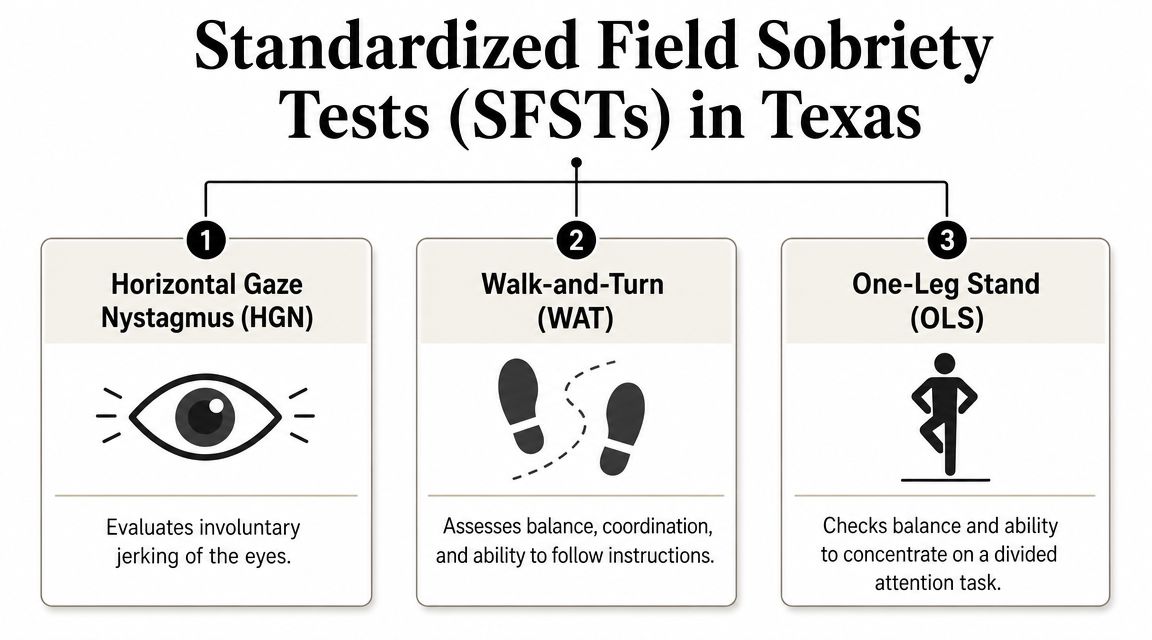
These tests are meant to be screening tools, not final proof of intoxication. Texas legal and training materials have described the three tests as roughly 77% accurate for HGN, 68% for Walk-and-Turn, 65% for One-Leg Stand, and about 82% accurate when all three are used together under the studied conditions, according to Texas sobriety testing materials summarized here.
Horizontal Gaze Nystagmus
This is often called the HGN test. The officer asks the person to follow a small object, usually a pen or light, with their eyes while keeping their head still.
The officer watches for involuntary jerking in the eyes at certain points during the movement. The theory is that alcohol or certain other impairing substances may make that jerking more noticeable.
What confuses many people is that this test doesn't look dramatic. A person can appear calm and still have an officer report “clues” on HGN. That's one reason lawyers often want to review video and the officer's exact method.
Walk-and-Turn
This test is a divided attention exercise. The person must listen to instructions, remember them, keep balance, take heel-to-toe steps, turn in a specific way, and return.
An officer may look for things like starting too soon, stepping off the line, missing heel-to-toe contact, using arms for balance, taking the wrong number of steps, or turning improperly.
For an injured crash victim, the key point is simple. This test measures more than balance. It also depends on concentration, hearing instructions, and performing under pressure.
One-Leg Stand
In this test, the person raises one foot and balances while counting as instructed.
The officer may note swaying, using arms for balance, hopping, or putting the foot down. On paper, that sounds straightforward. At the roadside, it can be much less clear.
These tests are not like stepping on a scale. An officer is making observations, and those observations can become part of the evidence after a crash.
Why the word standardized matters
“Standardized” means the tests are supposed to be given in a specific way. If the officer changes the instructions, rushes the process, or chooses a poor testing location, the reliability of the result can drop. That matters in both criminal and civil cases because the value of the test depends heavily on how it was administered.
The Science Behind SFSTs How Accurate Are They Really?
If you've heard that field sobriety tests are highly accurate, that claim usually comes from validation research on the combined three-test battery. In the National Highway Traffic Safety Administration research, the battery of HGN, Walk-and-Turn, and One-Leg Stand was reported as 91% accurate for predicting whether a driver's BAC was at or above 0.08%, while the individual tests were lower at 88% for HGN, 79% for Walk-and-Turn, and 83% for One-Leg Stand, according to the published review on PubMed.

Those numbers are important, but they don't end the discussion. They show the tests perform best when all three are used together. They also show the individual exercises are weaker when viewed alone.
Controlled study versus real roadside stop
A research setting is not the shoulder of a Texas highway after a violent crash. It isn't dark, loud, windy, or filled with flashing lights and traffic noise. It doesn't involve an injured driver watching from an ambulance while officers sort out what happened.
That difference matters because the strongest accuracy figures came from standardized conditions. Real-world stops are messier.
The same broader body of SFST discussion also reflects criticism. The later statistical review described in the PubMed summary reported the tests were “much poorer” than the original claims when BAC levels varied and mainly useful for identifying subjects with BAC substantially greater than 0.08% rather than proving impairment with precision.
What that means for your injury claim
For a civil case, you don't need field sobriety tests to function like a perfect laboratory instrument to make them useful. You need to understand what they can and can't prove.
Here's the practical way to view it:
| Evidence type | What it tends to show | Main limitation |
|---|---|---|
| Field sobriety tests | Officer-observed signs consistent with impairment | Not a direct BAC measurement |
| Crash facts | Unsafe driving behavior and causation | May not reveal why the driver acted that way |
| Witness accounts | Real-time observations of conduct | Memories can differ |
| Video footage | Visual record of the scene and behavior | Camera angle may be incomplete |
A careful lawyer doesn't treat SFSTs as magic proof. A careful lawyer uses them as one piece of a larger negligence case.
Common Factors That Can Cause a Sober Person to Fail
A failed field sobriety test doesn't always mean alcohol caused it. That's one of the biggest points people miss. Roadside testing is affected by many non-alcohol variables, including uneven pavement, footwear, age, anxiety, and medical or neurological issues, as discussed in this Texas-focused review of field sobriety test limits.

If you were hit by a driver who “failed” roadside tests, that evidence may still help your claim. But if the defense later argues the tests were unreliable, you need to understand why that argument exists and how it's addressed.
Conditions that can change the result
Some of the most common problems have nothing to do with drinking:
- Uneven ground or roadside slope. A person told to balance on gravel, a shoulder, or cracked pavement may struggle even while sober.
- Shoes and clothing. Boots, dress shoes, sandals, or restrictive clothing can affect movement.
- Age and physical condition. Older adults and people with joint, back, or leg problems may have trouble with balance tasks.
- Anxiety after a crash. A shaken driver may have trouble listening, counting, or following multi-step instructions.
- Medical or neurological issues. Balance disorders, eye conditions, prior injuries, and other health concerns can interfere with performance.
Why that matters in a wreck case
If the other driver gave poor roadside performance, the defense may say, “That doesn't prove intoxication.” Sometimes that's a fair point. But it doesn't erase the whole claim.
A lawyer can compare the test conditions with the scene itself. Was the driver standing on a sloped shoulder? Had they just been in a high-impact collision? Did bodycam show confusion, instability, or speech issues beyond simple balance problems? Those details matter.
This short video gives general background on how these tests are viewed in practice:
Poor test conditions don't automatically destroy the value of field sobriety evidence. They simply mean the evidence has to be placed in context.
For injured victims, context is everything. Insurance companies often pick apart one detail and ignore the rest. Your case should be built from the full scene, not from one checkbox on a police form.
FSTs vs Chemical Tests What Evidence Matters Most?
Field sobriety tests and chemical tests do different jobs.
Field sobriety tests are observational. An officer watches what a person does and records signs that may suggest impairment. Chemical tests, such as breath or blood testing, aim to measure alcohol concentration more directly. That usually makes chemical testing more powerful evidence when the issue is whether alcohol was present at an unlawful level.
Side-by-side comparison
| Type of evidence | How it works | Why lawyers care |
|---|---|---|
| Field sobriety tests | Officer watches balance, eye movement, and divided attention tasks | Helps explain why police suspected impairment |
| Breath test | Measures alcohol concentration through breath sample | Often used to support DWI allegations |
| Blood test | Measures alcohol or other substances from a blood sample | Can carry significant weight if procedures were followed |
Still, “more powerful” doesn't mean “untouchable.” Chemical evidence can raise issues about collection, handling, timing, and interpretation. Field sobriety tests can raise issues about instruction, environment, and officer judgment. In many cases, the strongest claim comes from combining all the available facts instead of relying on one category alone.
What this means after a crash
If the at-fault driver both performed poorly on roadside tests and later produced chemical evidence consistent with intoxication, that usually strengthens a civil injury case. If chemical evidence is unavailable, field sobriety test results may still matter, especially when paired with bad driving, witness observations, and video from the scene.
If you want more context on what a roadside failure can lead to, this article on what happens if you fail a field sobriety test in Texas explains the next steps in plain English.
In civil cases, the question is often broader than “Was the driver over the legal limit?” The question is whether the driver acted negligently and caused your injuries.
That distinction matters because personal injury claims focus on harm, responsibility, and compensation.
Using FST Results to Prove Negligence in Your Injury Claim
For accident victims, the most important question usually isn't whether the other driver will be convicted of DWI. It's whether the evidence proves that driver caused your losses. That's where field sobriety tests can matter a great deal.
How SFST evidence supports liability
Liability means legal responsibility. If the other driver was impaired, drifting across lanes, speeding, or ignoring traffic signals, that can help prove they are liable for your injuries.
In a civil case, SFST results may support a broader argument that the driver failed to use reasonable care. That is negligence in plain English. The tests don't have to stand alone. They become part of a chain of proof that can include the crash report, witness statements, photographs, medical records, and chemical testing.
Historically, law-enforcement determinations of impairment had error rates as high as 47% before standardization efforts, according to this discussion of the history of field sobriety testing. That history is one reason skilled attorneys look closely at whether officers followed the proper protocol. In a personal injury case, that review can help separate strong evidence from weak assumptions.
Texas negligence law in plain English
Texas uses a modified comparative fault system under Chapter 33 of the Texas Civil Practice & Remedies Code. Comparative fault means more than one person can share blame. Your compensation can be reduced if you were partly at fault, and if you are found more than half responsible, you generally can't recover damages.
That's why intoxication evidence can be so important. If the defense tries to shift blame onto you, proof that the other driver showed signs of impairment may help push responsibility back where it belongs.
Damages are the losses you can seek compensation for. In a car wreck case, that may include medical bills, lost income, pain and suffering, physical impairment, and property damage. In a fatal crash, surviving family members may pursue wrongful death compensation.
Texas also addresses exemplary damages in Chapter 41 of the Texas Civil Practice & Remedies Code. In some cases involving especially dangerous conduct, such as intoxicated driving, those issues may become part of the legal analysis.
A real-world civil example
Suppose a driver on a San Antonio loop crosses into your lane and causes a head-on crash. Police note odor of alcohol, poor balance, and poor performance on roadside tests. Later, your insurer and the other side's insurer start disputing fault.
A Houston car accident lawyer or other Texas injury counsel can use those roadside observations to argue the other driver's behavior was not a simple mistake. It was part of a larger pattern of unsafe conduct that led to your injuries.
For more on how intoxication evidence is developed, this overview of how prosecutors prove DWI in Texas can help you understand how the evidence is built.
Why deadlines matter
Texas injury claims are also controlled by a statute of limitations, which is the legal deadline to file suit. If you wait too long, you can lose the right to seek compensation, even in a strong case.
That's one more reason to act early. Evidence tied to impairment, including officer notes and video, is easier to preserve when someone starts asking for it right away.
A Texas Injury Attorney Can Fight for Your Rights
After a serious crash, you shouldn't have to decode roadside testing, challenge insurance tactics, and manage medical care on your own. If field sobriety tests were part of the police investigation, your lawyer should examine how they were given, what the officer observed, and how those observations fit with the rest of the evidence.
What legal help looks like in practice
A thorough injury case often includes:
- Collecting official records. That includes the crash report, citations, officer narratives, and available video.
- Reviewing fault arguments. Under Texas comparative fault rules, your lawyer should push back if the insurer tries to blame you unfairly.
- Proving damages carefully. Your claim should document treatment costs, missed work, pain, and the ways the injury changed daily life.
- Tracking deadlines. The statute of limitations and insurance notice issues can affect your rights if they're missed.
If your case involves a passenger car wreck, a commercial vehicle, or a fatal collision, the legal analysis may branch in different directions. Many injured families also need related guidance on car accident claims, truck accident cases, and wrongful death matters.
Dealing with the insurance company
Insurance adjusters may sound helpful early on. They may also look for ways to minimize your claim. They might argue the field sobriety tests were unreliable. Or they may ignore them completely if the evidence hurts their insured driver.
That's where organized advocacy matters. The Law Office of Bryan Fagan, PLLC handles Texas injury cases by investigating liability, gathering proof of damages, and communicating with insurers so clients don't have to manage every pressure point alone.
If you're still deciding when to bring in a lawyer, this article on when you should hire a DWI lawyer in Texas offers useful background on why early legal review can matter when intoxication is part of the case.
You deserve clear answers. You deserve to understand your rights. And you deserve a legal strategy built around the full truth of what happened, not just the version an insurance company prefers.
If you were injured by a driver who may have been impaired, contact The Law Office of Bryan Fagan, PLLC for a free consultation. We can review the crash, explain how Texas negligence law under Chapters 33 and 41 may affect your case, deal with the insurance company, and help you pursue the compensation you need to move forward.