Yes, you can get charged with a DWI while sleeping in your car in Texas, and the key issue isn't whether anyone saw you driving. The legal question is whether police and prosecutors believe you were operating the vehicle in a public place.
A car crash can change your life in seconds, but you don't have to face recovery alone. This question comes up when someone thinks they made the safer choice after drinking, pulled into a parking lot, and decided to sleep instead of drive. The intent may have been responsible. The legal risk is still real.
That matters for two reasons. First, a parked-car DWI can trigger criminal charges, license trouble, and expensive consequences. Second, from a personal injury standpoint, Texas drunk-driving laws exist because intoxicated vehicle control can lead to devastating collisions, severe injuries, and wrongful death claims that affect entire families.
The short answer to whether can you get a DWI while sleeping in your car in Texas is yes. What happens next often depends on the small facts people overlook in the moment.
The Sobering Truth About Sleeping It Off in Your Car
A common scene looks harmless. You leave a bar, wedding, or work event and realize you shouldn't drive. You get into your car, lock the doors, lean the seat back, and tell yourself you'll sleep until morning.
Many people assume that choice protects them from a DWI. In Texas, it may not.
Texas law focuses on whether a person was operating a vehicle in a public place, not only whether the vehicle was seen moving. A Texas defense discussion on parked-car DWI situations explains that courts have treated operation broadly enough that facts such as being in the driver's seat, where the keys are located, and whether the engine is running can all matter in a sleeping-in-the-car case, as discussed in this Texas parked-car DWI overview.
Practical rule: Good intentions help morally. They don't automatically solve the legal question.
That's one reason this myth is so dangerous. People think they avoided risk by staying off the road, but they may still create a fact pattern that looks like immediate control of the vehicle. If an officer sees someone asleep behind the wheel with accessible keys, the encounter can shift quickly from a welfare check to a DWI investigation.
Why personal injury lawyers care about this issue
At a personal injury firm, drunk-driving cases aren't abstract. They often start with a phone call from a family whose life changed after a crash with an impaired driver. Those cases involve medical care, missed work, pain, long-term rehab, and sometimes funeral expenses and wrongful death compensation.
A Houston driver rear-ended on I-45 by an intoxicated motorist may have both an insurance claim and a lawsuit for the losses caused by that crash. A family hit by a drunk driver at an intersection may suddenly need help proving fault, preserving evidence, and dealing with a resistant insurer.
The misunderstanding that traps people
The trap is simple. People hear “DWI” and think “driving.” Texas law looks harder at control than many people realize.
That doesn't mean every sleeping-in-the-car arrest should end in a conviction. It does mean you shouldn't assume that pulling over and falling asleep in the front seat automatically keeps you safe from arrest.
Why Sleeping Can Mean Operating Under Texas Law
The easiest way to understand this is to think about a loaded tool within arm's reach. The issue isn't only whether you used it. The issue is whether you had immediate ability to use it.
That is how many parked-car DWI cases are evaluated. Police and prosecutors look for signs that you had actual physical control of the vehicle and could put it in motion.
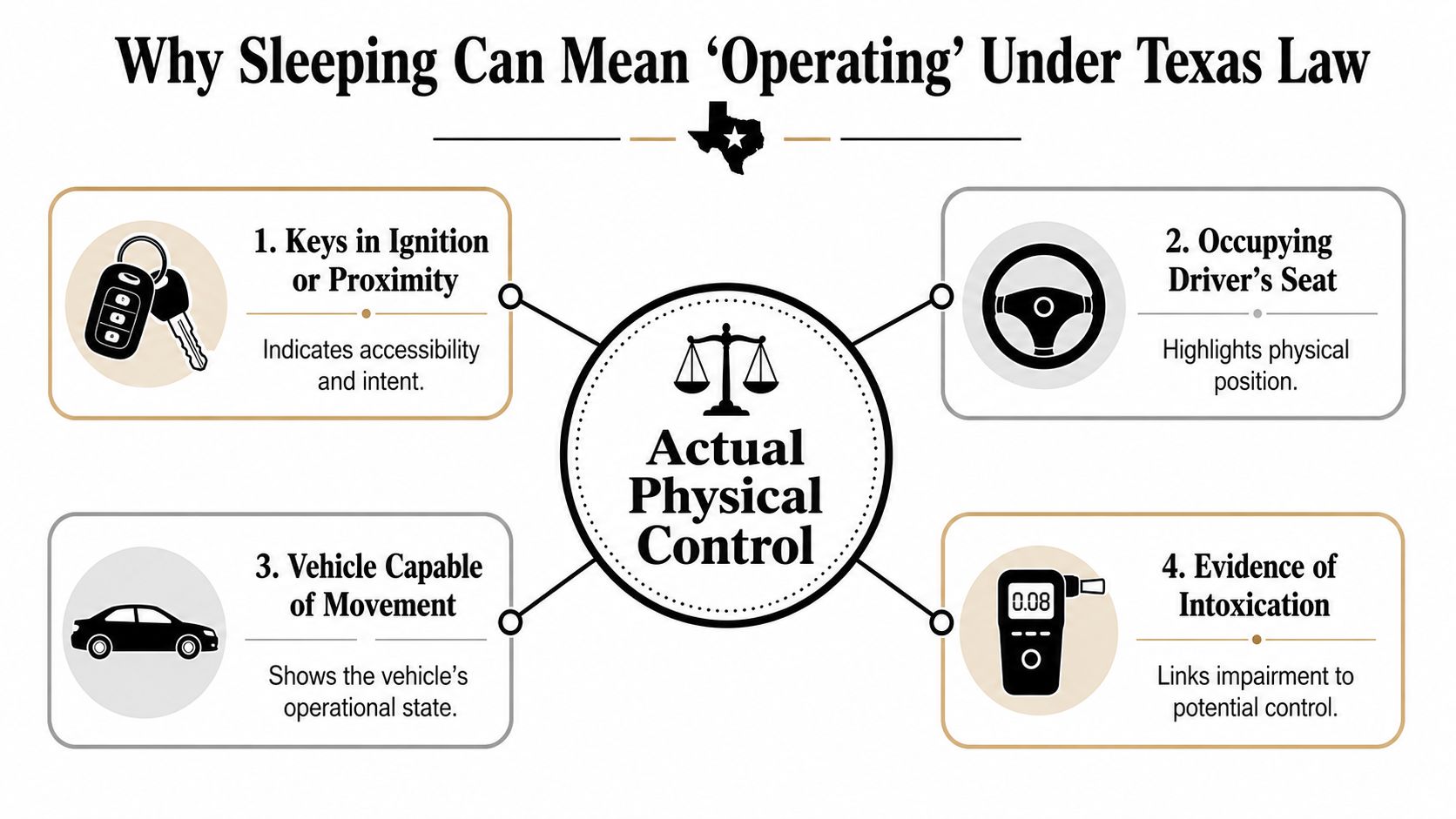
Facts officers look at
If an officer approaches a parked vehicle, these details often shape the case:
- Your position in the car. Sitting or sleeping in the driver's seat usually creates more risk than being in the back seat.
- Where the keys are. Keys in the ignition or within easy reach can support an argument that you could drive right away.
- Whether the engine was on. A running engine often makes the state's theory stronger.
- Whether the vehicle could move. A car that is ready to be driven creates a different impression than one being used only for shelter.
- Signs of intoxication. Odor of alcohol, slurred speech, confusion, or poor coordination can all become part of the officer's report.
Why the driver's seat matters so much
Sleeping in the driver's seat sends a message to police that you were in the place where driving begins. That doesn't prove guilt by itself, but it gives the state a cleaner argument. If the keys are nearby and the engine is on, the case gets harder.
By contrast, the most defensible posture is often the opposite fact pattern. Texas defense materials discussing parked-car cases note that sleeping in the back seat, with the engine off and keys not accessible, weakens the inference that the person was capable of immediate vehicle operation, as explained in this discussion of sleeping in your car and Texas DWI law.
Sleeping in a vehicle isn't one fact. It's a bundle of facts, and each one changes how the case looks.
What works and what usually doesn't
A few practical comparisons help:
| Situation | Risk level |
|---|---|
| Back seat, engine off, keys put away | Lower |
| Front seat reclined, car in park, no signs of intent to leave | Lower, but still risky |
| Driver's seat, keys close by | Higher |
| Driver's seat, engine running | Much higher |
If you're trying to reduce risk before any police contact happens, the goal is to make it obvious you are not in immediate control of the vehicle. Many people fail that test without realizing it.
A Typical Police Encounter and Your Rights
Most parked-car DWI cases don't begin with a dramatic stop. They begin with an officer walking up to a car that looks unusual for the time or place. Maybe it's parked at a gas station after midnight. Maybe it's sitting in a restaurant lot with the lights on. Maybe someone reported a person slumped over the wheel.
At first, this can look like a welfare check. The officer may knock on the window and ask if you're okay. If you wake up confused, smell like alcohol, or fumble for your wallet, the tone can change fast.
How the conversation usually unfolds
A typical sequence looks like this:
- Initial contact. The officer asks basic questions such as where you're coming from, whether you've been drinking, and why you're in the car.
- Observation phase. The officer watches your hands, eyes, speech, balance, and ability to follow directions.
- Document request. You may be asked for your license and insurance.
- DWI investigation. If the officer suspects intoxication, you may be asked to step out and perform field sobriety tests.
A parked-car encounter often catches people off guard because they think they aren't being investigated for anything. But once the officer sees facts that suggest intoxication plus vehicle control, the legal situation shifts.
For a related question about police authority in DWI investigations, this guide on whether police can pull you over without reason for DWI in Texas helps explain how these encounters begin.
What to do in the moment
You want to be calm, respectful, and careful.
- Stay polite. Arguing at the window rarely helps.
- Provide identifying information when required. Don't make a simple encounter worse by becoming combative.
- Don't volunteer extra details. Casual statements often become evidence.
- Use your right to remain silent clearly. You can say that you want to remain silent and speak with a lawyer.
- Don't consent to searches beyond what the law requires. If asked for permission, you can decline.
“Officer, I want to cooperate, but I'd like to remain silent and speak with an attorney.”
Why this matters later
The officer's report often becomes the backbone of the case. Small details can show up there in ways that are hard to undo later, such as “driver admitted drinking,” “subject was seated behind the wheel,” or “keys were in reach.”
That's why even a quiet parking-lot encounter deserves serious attention. What you say and how you position yourself during those minutes can affect both the criminal case and any related insurance problems that follow.
Common Defenses Against a Parked Car DWI Charge
An arrest doesn't end the case. In many parked-car DWI matters, the central fight is whether the state can really prove operation under the totality of the circumstances.
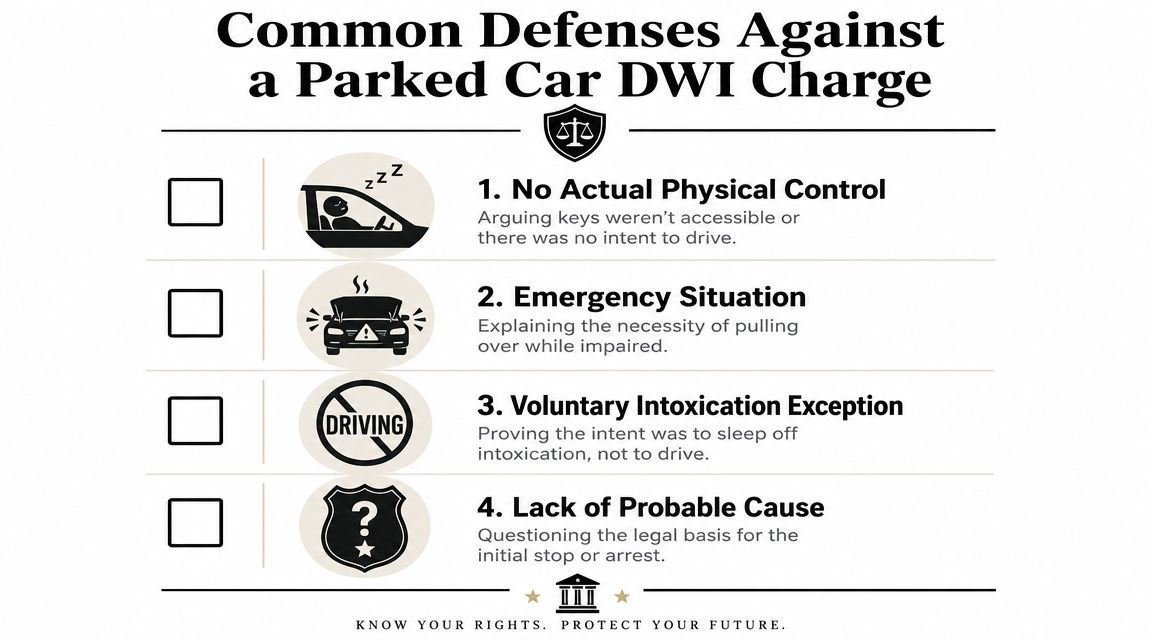
Some parked-car fact patterns support the defense better than others. Texas appellate discussions referenced in defense materials have treated some situations as non-operation when the vehicle was in park, the seat was reclined, and there was no clear evidence of intent to drive. That point is discussed in this Texas DWI defense article about sleeping in a car.
The defense often turns on intent and control
A strong defense usually asks one basic question: were you using the vehicle as transportation, or as temporary shelter?
Facts that can help include:
- Back seat use. This supports the argument that you chose not to drive.
- Engine off. That removes one of the strongest state arguments.
- Keys away from the ignition. This helps show lack of immediate control.
- Seat reclined and vehicle in park. Those facts can support non-operation.
- No statements about planning to drive soon. Your words matter.
Problems a defense lawyer may challenge
Not every arrest rests on clean evidence. Sometimes the officer's assumptions are stronger than the actual facts.
A lawyer may challenge:
- whether the officer had enough evidence to move from a welfare check into a DWI arrest
- whether the physical setting really showed immediate ability to drive
- whether the person's statements were misunderstood
- whether body camera footage matches the written report
- whether intoxication evidence was collected properly
Here is a short explainer that addresses common strategy questions:
Shelter versus transportation
This distinction matters more than people think. If the facts show you pulled over to avoid driving, that can support the defense. If the facts show you remained in a position to drive immediately, the state will lean hard on that.
A lawyer doesn't get to erase bad facts. A lawyer does organize the full picture, challenge weak assumptions, and argue that the state has not proved operation beyond a reasonable doubt.
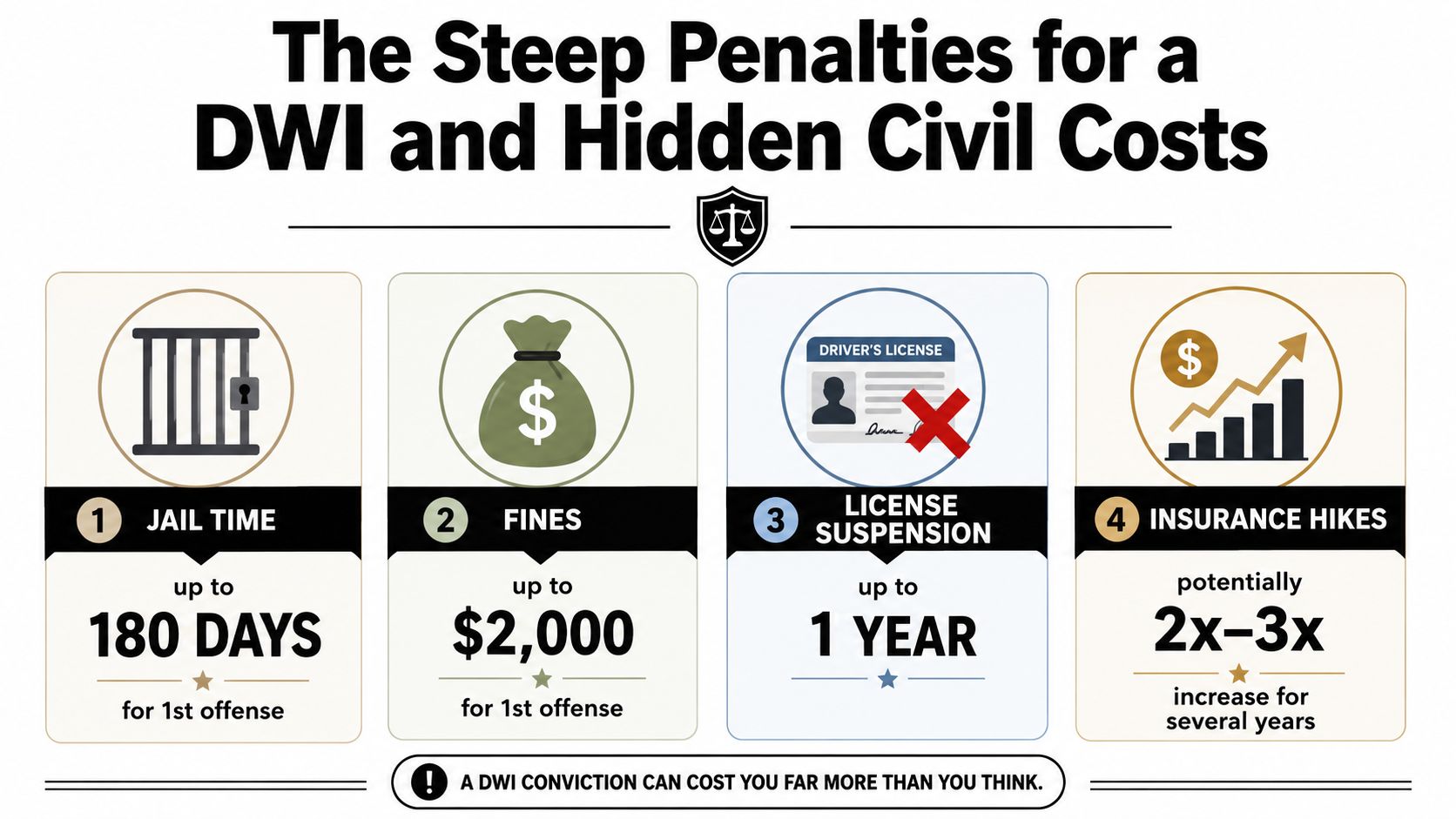
The Steep Penalties for a DWI and Hidden Civil Costs
A person can be arrested while asleep in a parked car and still face the same punishment range that applies in many other DWI cases. For a first DWI with a BAC between 0.08 and 0.14, Texas legal summaries note it is commonly charged as a Class B misdemeanor, punishable by up to 180 days in jail and a $3,000 fine. If the BAC is 0.15 or higher, it can rise to a Class A misdemeanor with up to 364 days in jail and a $6,000 fine. The same summary notes that a person generally has only 15 days after a DWI arrest to request a hearing to fight license suspension, as outlined in this overview of Texas DWI penalties and deadlines.
Anyone worried about confinement in a first case should read this article on whether you will go to jail for a first DWI in Texas.
Criminal penalties are only part of the damage
The criminal case gets immediate attention because jail, fines, license suspension, court costs, probation terms, ignition interlock requirements, and insurance increases hit fast. The longer-term risk is easier to miss. If impaired operation leads to a collision, the same conduct can also trigger a civil claim for the injuries and losses that follow.
That matters in parked-car cases because the legal fight over whether you were "operating" the vehicle does not stay neatly inside criminal court. If the facts support operation and someone gets hurt, those same facts may be used by an injured driver, passenger, or family member seeking compensation.
Liability, comparative fault, and damages
Liability means legal responsibility for the crash and the harm it caused.
Comparative fault is Texas's system for assigning percentages of blame. Under Texas Civil Practice & Remedies Code Chapter 33, an injured person's recovery can be reduced by their share of responsibility, and in some situations barred altogether if their share is too high under Texas law.
Damages are the losses an injured person may recover. In a vehicle case, that often includes medical expenses, lost wages, pain and suffering, property damage, physical impairment, and future treatment.
Under Texas Civil Practice & Remedies Code Chapter 41, Texas also allows exemplary damages in certain cases involving particularly serious conduct. Those claims depend on the facts and the evidence, and they raise the financial stakes well beyond a criminal fine.
A DWI prosecution is about punishment by the state. A civil case is about who pays for the harm.
How the civil side develops after a crash
Consider a common scenario. A driver who had been drinking is found in or near a vehicle, insists there was no real driving, then the investigation shows contact with another car in a parking lot, a rear-end collision at a light, or a pedestrian strike nearby. Now the case is no longer only about arrest, testing, and license consequences. It is also about medical records, insurance coverage, fault allocation, and whether the injured person will need future care.
For injured people, the first fight is often with an insurance company. The carrier may question whether alcohol caused the crash, whether the injuries were preexisting, or whether treatment was excessive. For the person accused of DWI, that same event can create exposure far beyond criminal court.
Dealing with insurance after a drunk-driving crash
If you were hurt in a crash involving alcohol, protect the civil case early:
- Get medical treatment promptly. Records created soon after the collision help connect the wreck to the injury.
- Preserve evidence. Photos, witness information, crash reports, and any body camera references can matter later.
- Be careful with insurer communications. Give basic facts, but do not guess about speed, fault, or the extent of your injuries.
- Treat recorded statements cautiously. Adjusters often ask broad questions before the full medical picture is clear.
- Get legal advice if fault or damages are disputed. Early review can help identify available insurance coverage and preserve proof.
The Law Office of Bryan Fagan, PLLC represents people dealing with claims involving intoxicated drivers, disputed insurance coverage, and serious injury losses after a crash.
The statute of limitations
The statute of limitations is the deadline to file suit. Missing that deadline can destroy an otherwise valid claim. The exact time limit and how it applies depend on the type of case and the facts, so early legal advice matters for both injured people and anyone facing the fallout from an alcohol-related crash.
Immediate Steps After a DWI Arrest in Texas
The hours after arrest matter. So do the first few days.
If you were arrested while sleeping in a car, don't assume the case is hopeless and don't assume it will sort itself out. Take deliberate steps.
What to do right away
Stop talking about the facts of the case
Don't explain, apologize, or try to talk your way out after the arrest. Statements made to officers, jail staff, or even friends can come back later.Write down everything you remember
Do this as soon as you can. Note where the keys were, whether the engine was on, where you were seated, what the officer said, what you said, and whether there were witnesses or video cameras nearby.Protect the license deadline
The license side of the case moves fast. A DWI arrest can trigger a separate process affecting your driving privileges, so you need to act quickly.Get legal advice early
Parked-car DWI cases often turn on small facts that are easy to lose if no one investigates promptly.
If a crash happened or someone was hurt
Sometimes the parked-car issue isn't the whole story. There may have been a minor collision in a parking lot, contact with another vehicle, or allegations that the car was moved before police arrived.
If anyone was injured, the situation can involve both criminal exposure and civil consequences. Preserve photographs, identify witnesses, notify your insurer carefully, and avoid posting about the event online. If you are the injured party rather than the person arrested, your next steps are different. Focus on treatment, documentation, and getting advice about fault and compensation.
The most expensive mistake after arrest is waiting too long because you think the case seems minor.
A simple checklist
- Be quiet about the facts
- Save paperwork
- Note the 15-day license issue
- Document the vehicle setup
- Get legal guidance before making big decisions
If you're trying to understand your rights after a DWI arrest or a crash involving an impaired driver, clear advice early can make a major difference.
If you're dealing with the fallout from a DWI arrest, or your family was injured by an intoxicated driver, The Law Office of Bryan Fagan, PLLC can help you understand your rights, the insurance process, and the next legal steps. A free consultation can help you sort out liability, comparative fault, damages, and the practical choices in front of you without added pressure.