A car crash can change your life in seconds, but you don't have to face recovery alone.
If you were hit by a drunk driver, you're probably dealing with more than vehicle damage. You may be in pain, missing work, arguing with insurance adjusters, and wondering how someone else's reckless decision created so much chaos in your life. For many families, the hardest part is that the criminal case gets attention first, while your own financial recovery feels uncertain.
In Texas, the drunk driver may face DWI charges, but that criminal case is separate from your civil injury claim. Your claim is about your losses. That includes your medical care, lost income, pain and suffering, and in fatal cases, possible wrongful death compensation for surviving family members.
One piece of evidence often sits at the center of both cases. It's the breath test. If the other driver gave a breath sample, that result can become powerful evidence in your auto insurance claim and lawsuit. But people often ask the same fair question. How accurate are breathalyzers in Texas court?
The short answer is this. Breath tests can be very important, but they are not treated like magic. Texas courts allow them, yet they also require proper procedures and supporting proof. For an injury victim, that matters because a valid breath result can help prove intoxication and strengthen liability. A weak or disputed test doesn't always destroy your case, but it does change how your lawyer builds it.
Your Life Changed in an Instant Now What
A Houston driver rear-ended on the 610 Loop may remember the same details over and over. Screeching tires. Airbags. A spinning feeling. Then a police officer speaking to the other driver while you sit in shock, trying to move your fingers and make sense of what happened.
A family struck on I-35 near Austin may get the same sinking realization in a different form. The crash wasn't “just an accident.” It may have started with a driver who drank, drove, and put everyone else at risk.

That's when the legal questions begin. Was the other driver arrested? Did police perform field sobriety testing? Was there a breathalyzer result? And most important for you, how does any of that help pay for the losses now sitting on your shoulders?
Your injury claim is separate from the criminal case
The State handles criminal charges. You handle the civil claim, usually through an insurance claim, settlement demand, or lawsuit. In your case, the main issue is liability, which means who is legally responsible for causing the crash and your harm.
If the drunk driver's breath test was collected properly, it may support your position that the other driver was impaired and acted negligently. That can make settlement discussions stronger. It can also shape how a jury views the crash.
A drunk driving crash often leaves victims with two fights at once. One is physical recovery. The other is proving what happened in a way insurance companies can't minimize.
What you should do early
In the first days after the wreck, focus on protecting both your health and your claim:
- Get medical care right away. Follow up even if adrenaline masked symptoms at the scene.
- Keep every record. Save discharge papers, bills, prescriptions, and photos.
- Ask for the crash report. It may identify whether officers suspected intoxication.
- Avoid detailed insurance statements too soon. The insurer may look for ways to reduce your claim.
- Speak with a Texas injury attorney. Breath-test evidence can help, but only if someone moves quickly to preserve it.
If you're searching for a Houston car accident lawyer because a drunk driver turned your life upside down, breath-test evidence may be one of the first things your legal team investigates.
How a Breathalyzer Test Works in Texas
A breathalyzer doesn't pull alcohol directly from a person's blood. It analyzes a breath sample and uses that reading to estimate blood alcohol concentration. That difference matters.
Picture checking the temperature outside by reading a sensor near your window instead of standing in the street with a thermometer. The reading may still be useful, but it's still an indirect measurement. In Texas DWI cases, that distinction is one reason people ask how accurate breathalyzers are in Texas court.
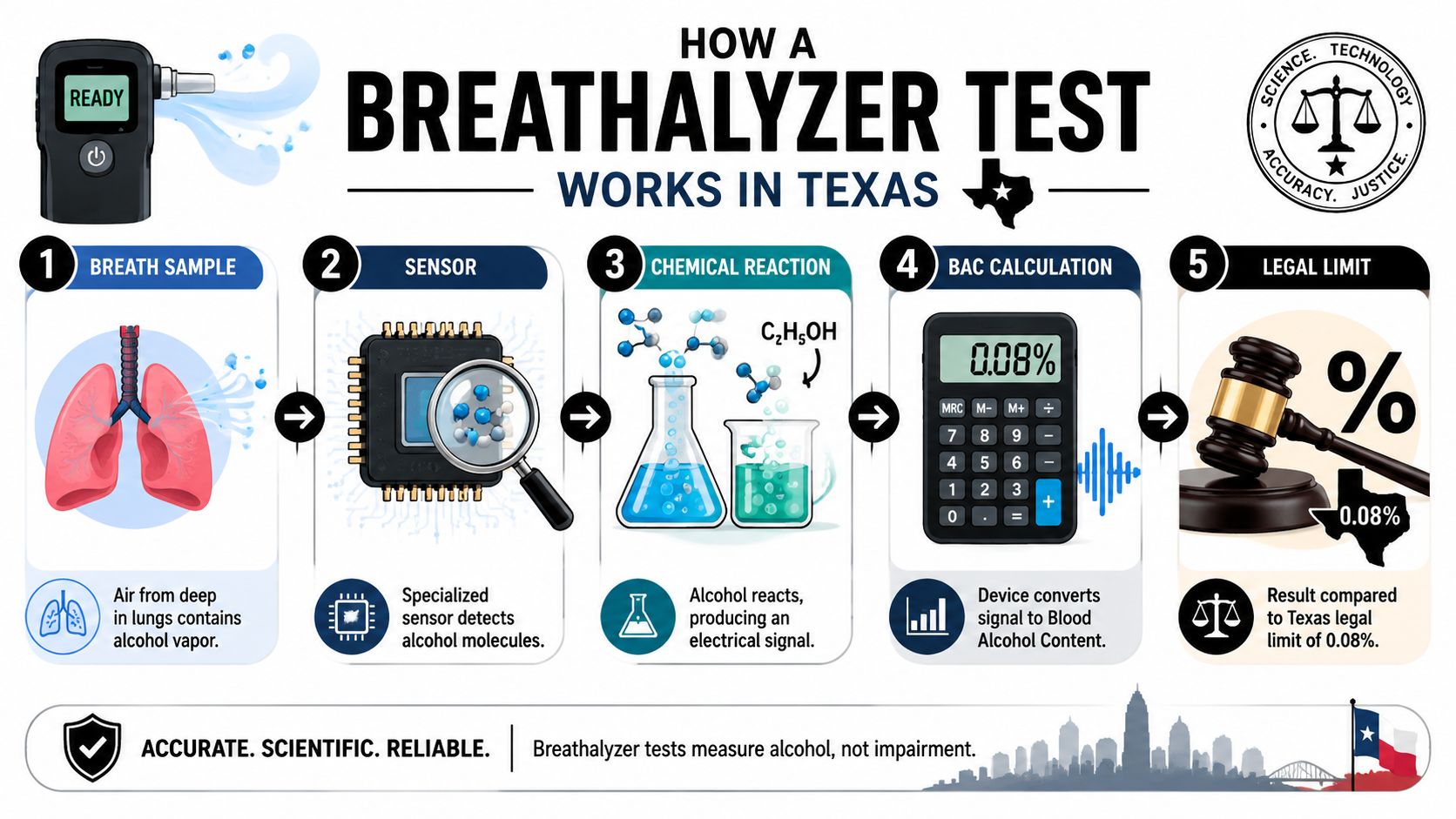
What the machine is actually doing
The machine used in Texas cases is designed to test alcohol in breath from deep lung air. It then converts that result into an estimate of blood alcohol concentration, often called BAC.
Here is the simple version:
- The driver blows into the device. The machine collects a breath sample.
- The device analyzes alcohol in that breath. It is looking for alcohol vapor, not blood.
- The machine applies its internal calculation. That turns the breath reading into a BAC estimate.
- The result is recorded for law enforcement use. That number may later show up in criminal and civil proceedings.
Texas defense-focused legal analysis notes that breathalyzer numbers are an estimate of blood alcohol concentration, not a direct blood measurement, and that results can be affected by machine error, operator error, and physiological or environmental contaminants such as improper calibration, malfunction, medical conditions, mouthwash, or other ingestible products, as discussed in this Texas breath test challenge overview.
Why the estimate still matters in your claim
A breath test can still be very persuasive. Police, prosecutors, insurers, and juries all take it seriously when it was collected the right way. For an injury victim, that can be valuable because it gives your lawyer something more concrete than “the driver looked drunk.”
This short video gives helpful background on how these tests are commonly discussed in practice.
Where people get confused
Many people assume a breath result is the same thing as a blood result. It isn't. Others assume that because the machine gave a number, the issue is settled. It's not that simple.
Practical rule: A breath test can be strong evidence, but its value depends on how the sample was taken, how the machine was maintained, and whether the result fits the rest of the evidence from the crash.
For your civil case, the question usually isn't whether the machine is flawless. The question is whether the result is reliable enough to help prove the other driver caused your injuries.
The Legal Rules for Breathalyzer Evidence in Texas Courts
Texas courts don't automatically accept a breath-test number just because it appears on paper. The legal system treats breathalyzer evidence as admissible but contestable. That means it can come into court, but it can also be challenged.
Texas DWI breath-testing typically requires a 15-minute observation period, proper device maintenance, and documentation of calibration and operator compliance before the result is considered reliable enough for court use, as described in this discussion of Texas breath-test procedure requirements.
The observation period matters
That 15-minute observation period exists for a practical reason. Officers need to watch the subject before the test to reduce concerns that something in the mouth, rather than deep lung air, affected the result.
If that step wasn't followed, a defense lawyer may attack the result. In your injury claim, your lawyer will want to know whether police documented that observation period carefully and whether the records line up.
The machine and operator also matter
A breath result stands on more than the machine alone. The records behind it matter too.
Your legal team may look for:
- Calibration records. These help show whether the device was checked and maintained.
- Operator compliance documents. These may show whether the test was given by a properly qualified person.
- Chain of documentation. The result must be collected and preserved under Texas rules.
- Supporting case materials. Police notes, video, and arrest paperwork can confirm whether the test conditions make sense.
That kind of evidence review is one reason injury lawyers often build cases much like trial files. For example, careful document work such as mastering medical record review can be just as important in a civil crash case as reviewing breath-test logs, because both help connect what happened at the scene to the injuries you're now treating.
Why this helps an injury victim
You might hear that challenges to breath tests are “defense issues.” In reality, they matter to injury victims too. If the breath test is solid, your claim gets stronger. If the defense attacks it, your attorney needs the paperwork to defend the result or pivot to other proof.
A useful companion topic is how prosecutors build intoxication cases in the first place. You can see that process in this explanation of how prosecutors prove DWI in Texas.
When the records are complete, a breath test becomes easier to trust. When records are missing, the fight often shifts from the number itself to whether anyone should rely on it.
For a serious crash claim, especially one involving lasting injuries or a fatal collision, that reliability fight can affect settlement value, trial strategy, and how insurers evaluate your losses.
Why Breathalyzer Accuracy Can Be Challenged
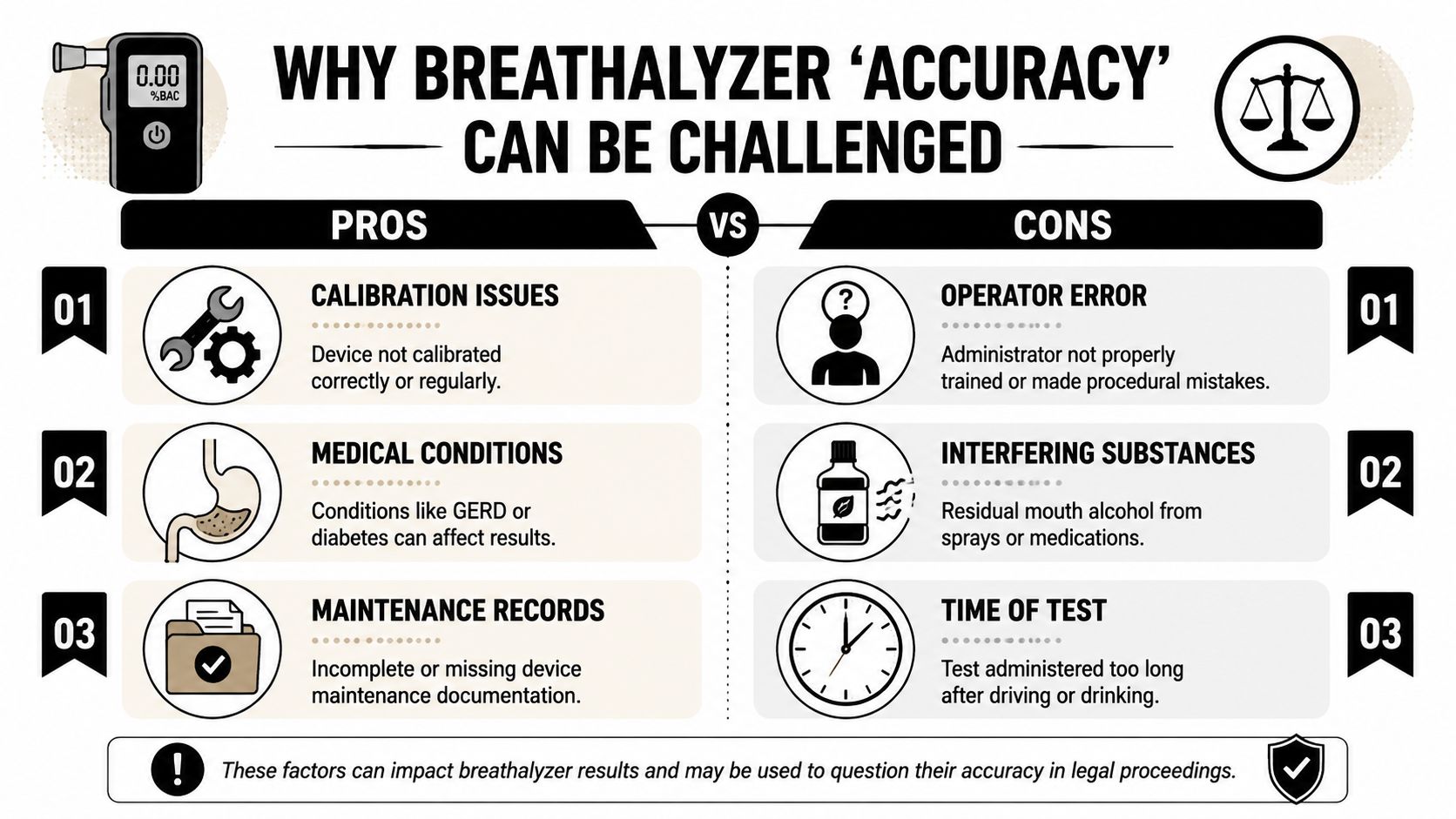
The word accuracy sounds simple, but it often isn't. A breath test may look precise because it produces a number, yet several things can affect whether that number deserves confidence.
That doesn't mean breath tests are useless. It means a good lawyer expects the other side to probe for weak spots. In a civil case, your attorney has to be ready to answer those attacks with records, testimony, and context.
Different devices can perform very differently
Independent medical research helps show why courts don't treat every breath device as equally reliable. In a diagnostic accuracy study of three commercial breathalyzers, one device had 94.7% sensitivity, another had 89.5% sensitivity, and a third had only 26.3% sensitivity when compared with a reference standard. The same study reported specificity values of 97.5%, 64.1%, and 50.6%, showing major variation by device type, according to this breathalyzer diagnostic accuracy study.
That same study noted that even a device with about 95% sensitivity can still falsely miss roughly 1 in 20 people over the limit. For a courtroom, the lesson is straightforward. Breath testing is measurement evidence with known limits, not perfect truth in machine form.
Common attack points in a crash case
When a drunk driver's lawyer challenges the breath test, the arguments often fall into familiar categories:
- Machine problems. The device may not have been calibrated or maintained correctly.
- Operator mistakes. The officer or technician may have failed to follow required procedures.
- Medical or biological issues. The defense may argue the driver had a condition that affected the reading.
- Interfering substances. They may point to mouth alcohol or products consumed near the test.
- Timing concerns. The defense may argue the test happened too long after driving to reflect the driver's condition on the road.
Why that doesn't mean your case is weak
A defense challenge is not the same thing as a successful defense. Many cases still have strong evidence of intoxication even when one aspect of the testing process is questioned.
An experienced Texas injury attorney usually looks at the full picture, including:
| Evidence type | Why it matters in your claim |
|---|---|
| Breath-test paperwork | Helps show whether procedures were followed |
| Officer observations | Supports visible signs of impairment |
| Crash facts | Can link reckless driving to intoxication |
| Video or witness accounts | May confirm behavior before or after impact |
If the breath result survives scrutiny, it becomes a powerful liability tool. If the defense raises fair questions, your lawyer may still preserve the core argument by combining the test with other evidence from the scene.
Using the Breath Test to Prove Liability in Your Injury Claim
For an injury victim, the most important question usually isn't scientific. It's legal. How does this breath test help prove the other driver owes you compensation?
The answer starts with liability. Liability means legal responsibility. If the other driver was intoxicated and caused the crash, that evidence can strongly support your claim that the driver acted negligently.
How Texas negligence law fits in
Texas personal injury claims are shaped in part by Texas Civil Practice and Remedies Code Chapter 33, which deals with proportionate responsibility, often called comparative fault. In plain English, comparative fault means the blame can be divided among the people involved.
If the defense says you were partly at fault, the court can assign percentages of responsibility. That matters because your compensation can be reduced by your share of fault. If your share is too high under Texas law, recovery can be blocked. That's one reason clear evidence that the other driver was impaired can be so important. It helps focus responsibility where it belongs.
Plain-English terms that matter
These legal words come up often in drunk driving injury claims:
- Liability. Who is legally at fault for the crash.
- Comparative fault. Whether each side shares some blame under Chapter 33.
- Damages. The money you seek for losses like medical bills, lost wages, pain and suffering, and other harm.
- Exemplary damages. Under Texas Civil Practice and Remedies Code Chapter 41, these are damages meant to punish especially dangerous conduct in some cases. Drunk driving facts may support that argument depending on the evidence.
A strong breath test can do more than show drinking. It can help explain why the crash happened, why the driver's conduct was dangerous, and why your losses should be taken seriously.
What this looks like in a real claim
Take a simple example. A Houston driver is stopped at a red light and gets hit from behind by a speeding motorist. Police note signs of intoxication, and a valid breath test supports that the other driver had been drinking. In the civil claim, that evidence may help prove the rear driver's negligence and strengthen arguments for full damages.
Those damages may include:
- Medical expenses. Emergency care, surgery, follow-up treatment, medication, therapy.
- Lost income. Time away from work, reduced earning ability, missed business opportunities.
- Pain and suffering. Physical pain, mental distress, and daily life disruption.
- Property losses. Vehicle damage and related out-of-pocket costs.
- Wrongful death compensation. In fatal cases, surviving family members may pursue damages recognized by Texas law.
Why insurance companies pay attention
Insurance adjusters don't evaluate a drunk driving crash the same way they evaluate a routine fender bender. A supported claim of intoxication can change negotiations because it affects fault, risk, and jury appeal.
That's why a Houston car accident lawyer or other lawyer handling severe crash claims will often press early for the test records, officer reports, and related evidence before those materials become harder to collect.
What if the Driver Refused the Test or It Gets Thrown Out
Some cases don't come with a clean breath-test number. The driver may refuse testing. Or the result may be challenged successfully because the records or procedures aren't strong enough.
That can feel discouraging to an injury victim, but it usually isn't the end of the claim.
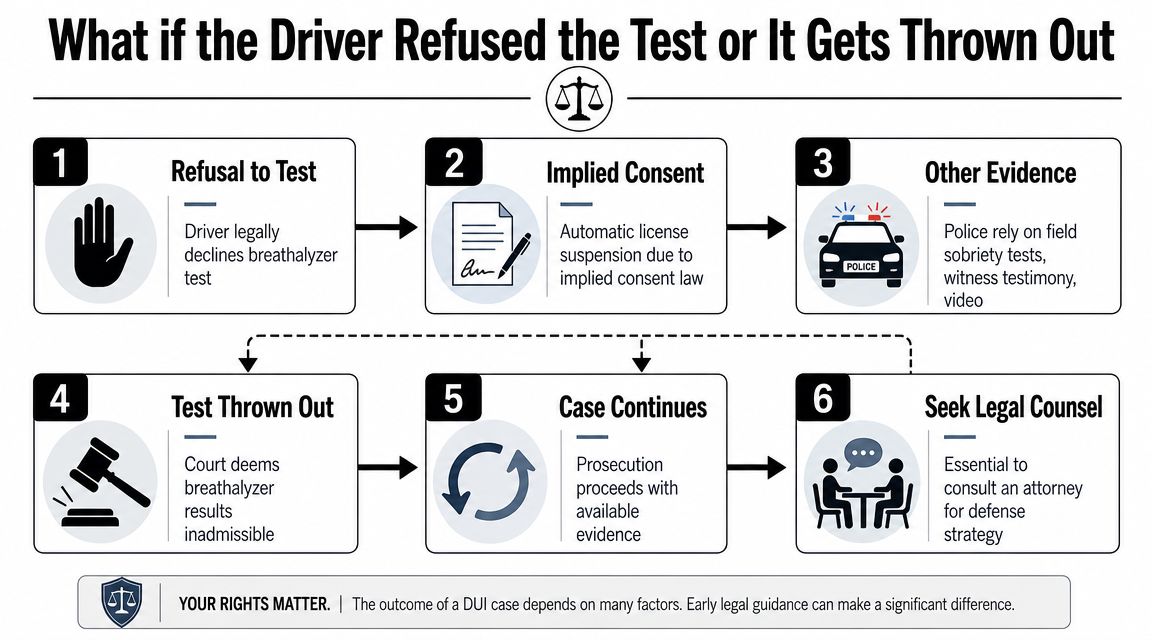
A refused test doesn't erase intoxication evidence
In civil litigation, the absence of a breath number doesn't magically turn a drunk driving crash into a normal negligence case. Your lawyer may still use the surrounding facts to show impairment.
Possible evidence can include:
- Officer testimony. What the officer saw, smelled, and heard.
- Crash report details. Notes about slurred speech, balance, driving pattern, or open containers.
- Witness statements. Passengers, bystanders, or other drivers may describe the person's condition.
- Video evidence. Body camera, dash camera, or nearby surveillance can be important.
- Field sobriety evidence. Even without a breath result, these observations may still matter.
If you've also wondered about roadside testing before arrest, this explanation of whether you can refuse roadside sobriety tests in Texas gives helpful context.
If the breath result is excluded
Breath-test admissibility in Texas often depends on procedural compliance. Texas courts and attorneys routinely attack whether the Intoxilyzer was properly calibrated, maintained, and supervised, and admissibility may depend on use of a proper reference sample and a qualified witness who can explain the result, as discussed in this Texas breath-test case law resource.
If the test is thrown out, the civil case may still move forward. Your attorney has to rely more heavily on the remaining proof.
The claim can still be strong
A civil jury doesn't need one single piece of evidence to understand what happened. Sometimes the strongest story comes from how the facts fit together.
Consider a crash where the driver crossed lanes, smelled of alcohol, failed field observations, and made inconsistent statements to police. Even without a breath result, those facts may still support liability.
Here's a useful way to consider this:
| Scenario | What your lawyer may emphasize |
|---|---|
| Driver refused testing | Consciousness of guilt and surrounding behavior |
| Test result excluded | Officer observations, driving conduct, and witness proof |
| Weak paperwork on breath test | Other reliable evidence that impairment caused the crash |
Key takeaway: A missing breath result changes the strategy. It doesn't automatically destroy the case.
This is where experience matters. A lawyer handling intoxication-related injury claims has to know how to prove the case with the evidence available, not just the evidence everyone wishes existed.
You Don't Have to Fight This Battle Alone
After a drunk driving crash, people involved aren't asking legal theory questions. They're asking practical ones. Who pays the hospital bills? What do I say to the insurance company? How do I prove the other driver was drunk if the criminal case is still unfolding?
The answer is that your civil claim can move forward, but it needs careful work. Breath-test evidence can be powerful. It can also draw challenges. That's why your case often turns on a mix of science, procedure, records, and persuasive storytelling.
What legal help actually looks like
In a serious crash claim, a lawyer may help you:
- Investigate liability. That includes police records, witness accounts, and impairment evidence.
- Handle the auto insurance claim. This reduces the chance of a harmful statement or rushed settlement.
- Document damages. Your medical care, wage loss, pain, and future needs have to be presented clearly.
- Assess Chapter 33 issues. If the defense argues comparative fault, someone has to push back with facts.
- Evaluate Chapter 41 remedies. In some cases, the facts may support a claim for exemplary damages.
Some injured people wait too long because they assume the criminal case will do the work for them. It usually won't. If you need context on timing, this article on when you should hire a DWI lawyer in Texas shows how quickly alcohol-related cases can become evidence-driven.
The Law Office of Bryan Fagan, PLLC handles Texas injury claims involving car wrecks, trucking collisions, insurance disputes, and cases involving intoxicated drivers. For many families, having a lawyer means someone else can take over the pressure of gathering records, dealing with adjusters, and preparing the case while you focus on healing.
If you're dealing with medical treatment, lost income, or a loved one's fatal crash, you deserve clear answers and steady guidance from a Texas injury attorney who understands both the legal and human side of these cases.
If a drunk driver injured you or someone you love, contact The Law Office of Bryan Fagan, PLLC for a free consultation. We can review the crash, explain your rights under Texas personal injury law, help with your auto insurance claim, and discuss whether you may be able to pursue full damages or wrongful death compensation. You don't have to sort through breath-test evidence, liability disputes, and insurance pressure by yourself.