A car crash can change your life in seconds—but you don’t have to face recovery alone. Beyond the physical wounds, a serious accident leaves emotional and mental hardships that can fundamentally change your life. In a Texas personal injury claim, proving this "pain and suffering" means translating your deeply personal experience into clear, documented evidence. This takes more than simply telling an insurance adjuster you're in pain; it requires a systematic approach to show how the accident has impacted your daily life.
Translating Your Experience into a Legal Claim
A collision on a busy Houston highway can change your life in an instant, but the aftermath often lasts for years. While medical bills and lost wages are straightforward to calculate, the deepest impacts are often the ones you can't see.
This is what Texas law refers to as “pain and suffering.” It’s a type of non-economic damage meant to compensate you for the human cost of an accident.

But this type of compensation isn't automatic. Insurance companies are businesses, and their goal is to pay out as little as possible. To them, your suffering is subjective and hard to value unless you present it with undeniable proof. Your story matters, but it has to be backed by solid evidence that paints a vivid, undeniable picture of your new reality.
Understanding the Legal Framework in Texas
Here in Texas, your right to seek compensation is built on the legal principle of liability, which is determined by proving negligence. This means you must show that another party acted carelessly (like a Houston driver texting while driving on the Katy Freeway) and that their carelessness directly caused your injuries and suffering.
The compensation you seek is legally referred to as damages, which are split into two main types:
- Economic Damages: These are the tangible financial losses with clear price tags—things like your hospital bills, lost income from missing work, and the cost to repair your car.
- Non-Economic Damages: This is where pain and suffering falls. It’s a broad category that covers physical pain, mental anguish, loss of enjoyment of life, and emotional distress. You can find a complete breakdown by reading our guide on what are non-economic damages.
Proving these non-economic losses is the real challenge.
For example, if a Houston driver rear-ended on I-45 leaves you with chronic back pain, you can't just submit a bill for "pain." Instead, you have to build a case that shows how that pain prevents you from working, playing with your children, or enjoying the hobbies you once loved. Your personal hardship must be transformed into a compelling legal argument, and that entire process starts with careful, consistent documentation from day one.
The Evidence You Need to Prove Your Suffering
When you’ve been hurt in an accident, your word alone isn't enough to convince an insurance adjuster of what you're going through. Your pain and suffering is just a line item on their claim form until you back it up with solid, undeniable proof. Building a powerful case means creating a file that tells the clear, human story of your life after the accident.
This starts with official medical reports detailing your diagnosis and treatment, but the most compelling evidence often comes from the story you tell through your own personal records.
The Power of a Personal Pain Journal
A pain journal is one of the most effective tools you have. It captures the day-to-day reality of your injuries in a way that sterile medical records can't. But vague entries like "my back hurt today" are too easy for an insurer to dismiss.
You have to get specific. Connect the pain to its impact on your life.
For example, instead of a general complaint, write something like: "My neck stiffness was an 8/10 this morning, which meant I couldn't turn my head to check my blind spot while driving my kids to school." That detail transforms a subjective feeling into a tangible, relatable limitation that an adjuster can't ignore.
Make it a habit to consistently track:
- Pain Levels: Rate your pain on a 1-to-10 scale throughout the day.
- Specific Limitations: What couldn't you do? Note every missed activity, whether it was lifting groceries, sleeping through the night, or just sitting through a movie without pain.
- Emotional State: Document the anxiety, frustration, or sadness that comes with your physical struggles. This is a real part of your damages.
- Medication Effects: When did you take your meds? Did they cause drowsiness, nausea, or other side effects? Write it down.
This detailed log becomes a powerful narrative that illustrates the true scope of your suffering. It makes it much harder for an insurance company to downplay the severity of your claim.
Gathering Statements and Records
Beyond your own journal, you'll need other documentation to create a complete picture. Think of each piece of evidence as another layer of proof that validates your experience. It's also crucial that you're diligent about organizing medical records so that your file is clear, compelling, and ready to support your auto insurance claim.
Here is a quick checklist of the evidence you should start collecting right away. Each piece helps paint a clearer picture for the insurance company and, if necessary, a jury.
| Evidence Type | What It Proves | Where to Get It |
|---|---|---|
| Medical Records | Official diagnosis, treatments, costs, and prognosis | Hospitals, doctor's offices, physical therapists, pharmacies |
| Photos & Videos | Visual proof of injuries, property damage, and recovery | Your phone, family/friends' phones, accident scene witnesses |
| Pain Journal | Day-to-day impact on your life, pain levels, limitations | A dedicated notebook or a notes app on your phone |
| Witness Statements | Third-party perspective on your "before and after" | Friends, family, coworkers, neighbors, or anyone who knew you |
Getting all of this organized can feel overwhelming, which is where a skilled Houston car accident lawyer becomes invaluable. We help you gather and organize these essential documents to build the strongest case possible.
A few key items we'll focus on include:
- All Medical Records: This means everything—from the initial ER visit to ongoing physical therapy notes and prescription receipts.
- Photos and Videos: Visual evidence is incredibly impactful. Pictures of your injuries (bruises, casts, mobility aids) and the accident scene can tell a story in a single glance.
- Statements from Others: We’ll help you ask friends, family, or coworkers to write down what they’ve observed. A letter from your spouse describing how you can no longer play with your kids, or from your boss detailing your struggles at work, provides a critical "before and after" perspective.
This collection of objective reports, personal logs, and third-party accounts is what transforms your personal pain into something tangible. It builds a foundation of proof that your Texas injury attorney can use to demand the fair compensation you deserve.
How Texas Calculates Pain and Suffering Damages
One of the first questions clients ask is, “So, what is my pain and suffering actually worth?” It's a completely fair question, but there's no simple calculator for human hardship. Instead, Texas courts and insurance companies rely on a couple of established methods to put a dollar figure on these "non-economic" damages.
Assigning a monetary value to what you've been through is a sensitive but critical part of the claims process. When it comes time to talk numbers, adjusters and legal teams usually start with one of two main approaches.
The Multiplier Method
This is the go-to method for most personal injury claims in Texas. It's a straightforward concept: we take the total of your hard costs—what we call economic damages, like medical bills and lost wages—and multiply that number by a factor, usually between 1.5 and 5.
What determines that multiplier? It all comes down to the severity of your injuries and how deeply they've impacted your life.
- A lower multiplier (1.5 to 2) might apply to injuries that, while painful, are expected to heal completely with minimal long-term disruption.
- A higher multiplier (3 to 5) is reserved for catastrophic or permanent injuries. Think traumatic brain injuries, paralysis, or anything that fundamentally changes your quality of life forever.
Let's say you were in a serious wreck on I-45 and racked up $15,000 in medical bills and physical therapy costs. If the injury left you with chronic pain and limitations, your attorney might argue for a multiplier of 3. In that case, your pain and suffering would be valued at $45,000, separate from the $15,000 you're owed for your bills.
The Per Diem Method
Another way to look at it is the "per diem" or "daily rate" method. It's less common, but it can be effective. This approach assigns a specific dollar amount for each day you live with pain, starting from the date of the accident until you reach what doctors call "maximum medical improvement."
Often, that daily rate is tied to your daily earnings from your job. The logic is powerful: if going to work is worth a certain amount per day, then enduring the daily struggle of an injury should be worth at least the same.
Important Note on Texas Law: Many people worry that Texas puts a cap on what they can recover for their suffering. The good news is that for most standard car accident claims, Chapter 41 of the Texas Civil Practice & Remedies Code does not limit non-economic damages. This protects your right to seek full and fair compensation for everything you've endured.
All of this is built on the evidence you gather. Strong medical reports, a detailed pain journal, and compelling statements from witnesses provide the bedrock for these calculations.
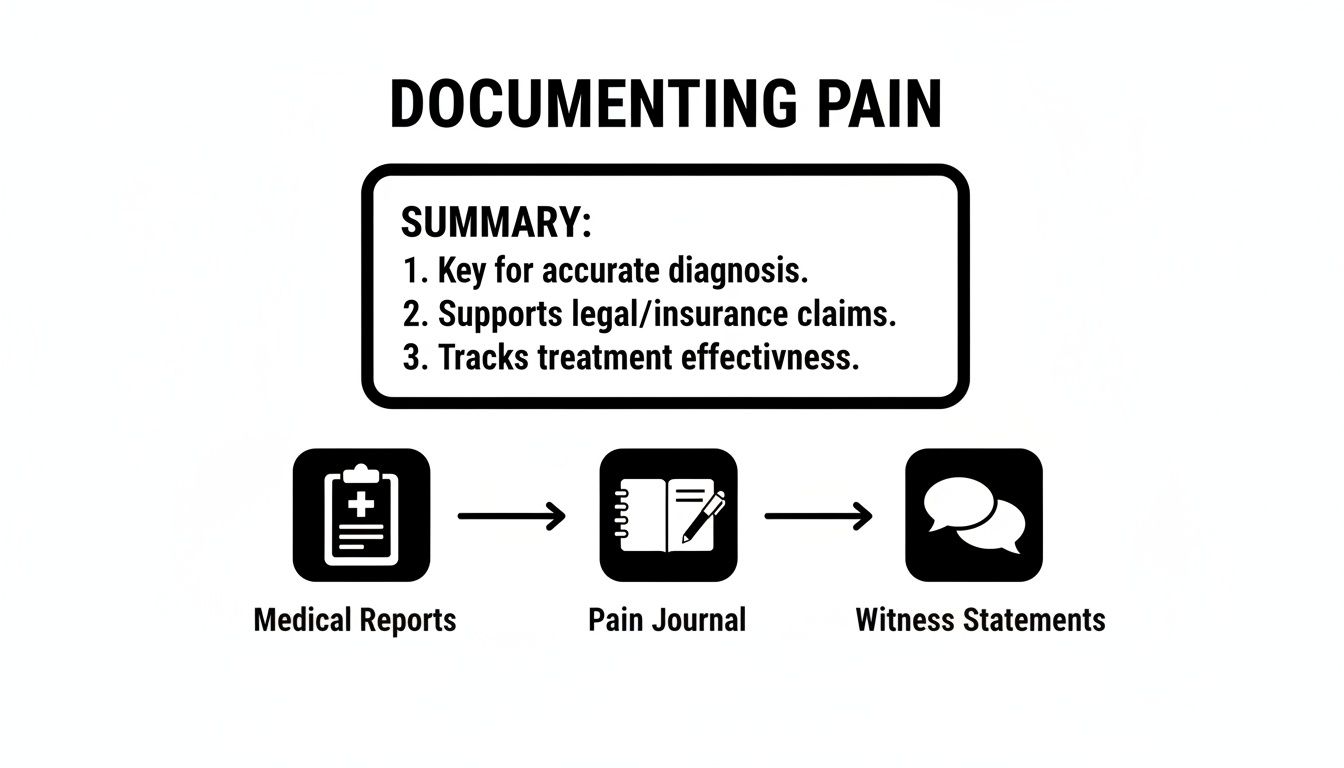
As this shows, the three pillars of proof—medical records, personal journals, and witness accounts—work together. Each one reinforces the others, painting a clear and undeniable picture of how the accident turned your world upside down.
An experienced Texas injury attorney can walk you through these methods and build a strategy to value your claim accurately. For a closer look, you can also check out our guide on how to calculate pain and suffering damages.
Using Expert Testimony to Validate Your Claim
Your own story about what you've endured is powerful, but it becomes undeniable when an expert backs it up. Insurance companies are masters at downplaying personal accounts, often dismissing them as exaggerated or subjective. It's a much harder argument for them to make when they're staring at a professional diagnosis or a data-driven opinion from a qualified expert.
This is one of the most critical ways an experienced Houston injury attorney can strengthen your case. We know who to call. We have a network of trusted professionals who can provide the authoritative, objective evidence needed to validate your experience.
The Role of Different Experts in Your Case
Depending on the nature of your accident and the specific injuries you've suffered, we might bring in several types of experts. Think of it like building a puzzle. Each expert provides a different piece, and together they create a complete, clear picture of your losses for an insurance adjuster or a jury.
Here are a few of the professionals we frequently rely on:
- Medical Experts: A doctor, surgeon, or another specialist does more than just confirm your medical records. They can testify about the long-term physical consequences of your injuries, explain complicated medical issues in plain English, and offer a professional prognosis on your future medical needs and physical limitations.
- Mental Health Professionals: A psychologist or psychiatrist is essential for diagnosing conditions like Post-Traumatic Stress Disorder (PTSD), anxiety, or depression that often follow a traumatic crash. Their testimony is the bedrock for proving the severe mental anguish that accompanies a serious physical injury.
- Vocational Specialists: This expert is key to showing the financial side of your suffering. They analyze how your injuries have wrecked your ability to work and earn a living, testifying about your diminished earning capacity, the jobs you can no longer do, and the total financial losses you’re likely to face over your lifetime.
By translating your personal experience into objective, credible evidence, these experts ensure the full scope of your suffering is understood and properly valued.
In highly specialized cases like medical malpractice, the testimony of a medical malpractice expert witness can draw a direct line between a professional's negligence and a patient's suffering. While a car accident claim is different, the principle holds true: an expert’s testimony gives your claim an authoritative voice that insurance companies find very difficult to argue with.
This professional validation transforms your personal struggle into hard evidence that holds up under scrutiny, whether in settlement negotiations or a courtroom. It's a crucial step in making sure the compensation you receive truly reflects everything you've lost.
How to Handle Insurance Company Negotiations
After a crash, it's easy to assume the at-fault driver's insurance company will do the right thing. But we’ve seen it time and time again: their primary goal is protecting their bottom line, not making sure you get the full compensation you deserve. Insurance adjusters are trained negotiators, and they have a playbook of tactics designed to challenge and minimize pain and suffering claims.
Understanding these strategies is your first and best line of defense. Knowing what to expect empowers you to protect your rights and sidestep the common traps that could sink your claim.
Common Tactics Insurance Adjusters Use
One of the first things an adjuster will do is ask for a recorded statement. You are not obligated to provide one. Talking to them without your lawyer present is a huge risk. They are experts at asking seemingly innocent questions that are carefully worded to get you to say something that undermines your own case.
Another favorite strategy involves twisting Texas's comparative fault rule against you. Under the Texas Civil Practice & Remedies Code, Chapter 33, your final compensation can be reduced by your percentage of blame for the accident.
For example, an adjuster might look at the report from a Houston intersection accident and argue you were 15% at fault for not reacting a split-second sooner. If your total damages are $50,000, they’ll use that excuse to slash their payout to $42,500. A skilled attorney knows how to fight back against this unfair blame-shifting.
Navigating Delays and Deadlines
Time is not on your side after an accident, and insurance companies count on that. In Texas, you generally have a strict two-year statute of limitations to file a personal injury lawsuit. Miss that deadline, and your right to sue is gone forever. This is a critical legal deadline.
Some adjusters will intentionally drag out negotiations, making one lowball offer after another while requesting mountains of unnecessary paperwork. Their hope is that you'll either get so frustrated you accept a terrible settlement or, even worse, run out the clock on the filing deadline.
This is exactly why having an experienced Texas injury attorney handle all communication is so critical. Here’s what we do:
- We speak their language. We know the law, we know the tactics, and we know how to shut down their arguments effectively.
- We protect you from mistakes. By managing all communications, we prevent you from accidentally saying something that could be used against you later.
- We keep your claim on track. We make sure every deadline is met and apply constant pressure to keep the process moving forward.
Trying to handle these complex discussions alone is overwhelming, especially when you should be focused on healing. To get a better sense of what to expect, you can learn more about how to negotiate an insurance settlement in our detailed guide. An attorney doesn't just help; they level the playing field, signaling to the insurer that you are serious about receiving fair compensation for everything you've been through.
Common Questions About Texas Pain and Suffering Claims
When you're trying to recover from an injury, the legal side of things can feel overwhelming. People often have a lot of questions about pain and suffering, which is understandable given how personal and subjective it is. Let's clear up some of the most common ones we hear from our clients here in Texas.
Is There a Cap on Pain and Suffering Damages in a Texas Car Accident Case?
For most car wrecks in Texas, the simple answer is no, there is no legal cap on what you can receive for your pain and suffering. These damages are considered actual non-economic damages, and the law doesn't put an arbitrary limit on them.
Where it gets a bit different is with "exemplary" or punitive damages. These are rare and are meant to punish a defendant for truly reckless behavior, like in some severe drunk driving cases that may lead to wrongful death compensation. Those do have caps under Chapter 41 of the Texas Civil Practice & Remedies Code. An experienced Texas injury lawyer can easily tell you which rules apply to your specific situation.
What if My Injuries Are Purely Emotional, Like PTSD After the Crash?
Your mental and emotional health is just as important as your physical health, and the law recognizes that. Emotional trauma like Post-Traumatic Stress Disorder (PTSD), severe anxiety, or depression are very real injuries and are absolutely grounds for a pain and suffering claim. They can be just as debilitating as a broken bone.
The key is proving it. You'll need solid documentation from a mental health professional—a therapist, psychologist, or psychiatrist. Their official diagnosis, treatment notes, and professional recommendations are the evidence needed to show the insurance company (or a jury) the true depth of your emotional distress. The connection is undeniable; recent data shows that a staggering 94% of chronic pain sufferers also deal with emotional distress. You can learn more about the effects of chronic pain from Precedence Research to see the full scope of these findings.
Can I Still Claim Pain and Suffering if I Was Partially at Fault?
Yes, you absolutely can. Texas operates under a rule called "modified comparative fault," which you can find in Chapter 33 of the Texas Civil Practice & Remedies Code. Some lawyers call it proportionate responsibility.
What it means is you can still get compensation as long as you aren't found to be 51% or more at fault for what happened. But here's the catch: your final award will be reduced by whatever percentage of fault is assigned to you. For example, if a jury awards you $100,000 but decides you were 10% to blame, you'd walk away with $90,000. This is exactly why it's so important to have a Houston car accident lawyer fighting in your corner to push back against any unfair blame the insurance company tries to pin on you.
Proving what you've endured is a huge part of getting the justice you deserve, but you don't have to take on the insurance companies by yourself. At The Law Office of Bryan Fagan, PLLC, our compassionate Texas personal injury attorneys are here to build your case from the ground up, protect your rights, and fight for every dollar you're owed. We understand what you are going through, and we are here to help.
Contact us today for a free, no-strings-attached consultation to see how we can help you get back on your feet.
https://houstonaccidentlawyers.net