A car crash can change your life in seconds—but you don’t have to face recovery alone. Amid the shock and confusion, one of the most common—and lasting—consequences is a back injury. If you're dealing with pain, stiffness, or numbness after a collision in Texas, you're not alone, and you have rights.
Your Life Changed in an Instant
The moments after a car accident are a blur. One minute you’re driving down a Houston freeway, and the next, you’re trying to make sense of the physical and emotional fallout. Back injuries are incredibly common in Texas car accidents for a simple reason: the spine just isn't built to handle the violent, abrupt force of a collision.
That sudden trauma can cause anything from a nagging muscle strain to debilitating spinal cord damage. But the impact doesn’t stop there. It ripples through your entire life, affecting your ability to work, take care of your family, or even enjoy the simplest daily activities. Getting a handle on some general car accident information can be a critical first step while you process everything.
The Staggering Reality of Crash-Related Back Injuries
This isn't just a local problem; it's a global one. A recent study revealed that road injuries were responsible for a shocking 95,734 spinal injuries worldwide in just a single year. The long-term toll is even more sobering, with over 2.63 million people now living with the ongoing pain and limitations of crash-related spinal damage.
Your Path to Recovery Starts Here
Facing a mountain of medical bills, lost income, and chronic pain is overwhelming. You’re probably asking yourself questions like:
- Who is going to pay for my medical care?
- How can I prove my back injury was caused by the accident?
- What are my legal rights under Texas law?
We created this guide to give you clear, practical answers. At The Law Office of Bryan Fagan, PLLC, our compassionate Houston car accident lawyers are here to be your ally. We are dedicated to fighting for victims like you, protecting your rights, and helping you secure the resources you need to rebuild your life.
Understanding Common Car Accident Back Injuries

It’s tough to fight for your health after a crash when you’re not even sure what’s happening inside your own body. The sudden, violent force of a car accident can unleash a whole range of back injuries, each bringing its own pain and complications. Understanding these common injuries is the first step toward having clear conversations with your doctor and, just as importantly, protecting your legal rights.
The human spine is an incredible piece of engineering—a complex system of bones, nerves, muscles, and soft tissues. But for all its flexibility, it simply wasn't built to absorb the jarring impact of a collision. Even a "minor" fender-bender can do serious, lasting damage.
Soft Tissue Injuries and Strains
Often, back injuries from car accidents involve the soft tissues—the muscles, ligaments, and tendons that support your spine. When your body is violently thrown forward and then snapped back, these tissues can stretch far beyond their limits or even tear.
- Strains: This happens when your back muscles or the tendons connecting them to bone are overstretched or torn.
- Sprains: This is damage to your ligaments, the tough, fibrous bands that connect your spinal bones to one another.
People often dismiss these as "minor," but the reality is they can cause debilitating pain, stiffness, and muscle spasms that make it impossible to work or even get through the day. A classic example is whiplash. While it’s known for neck pain, the force often radiates, straining the upper back muscles, too. If that sounds familiar, you need to understand your options for seeking compensation for whiplash.
Herniated Discs and Spinal Damage
Your spine has built-in shock absorbers. Between each vertebra sits a soft, gel-like cushion called a spinal disc. In a crash, the immense pressure can cause one of these discs to rupture or slip out of place. This is what doctors call a herniated disc, though you might hear it called a slipped or bulging disc.
When a disc herniates, its jelly-like center pushes through the tough outer wall. That protruding material can press directly on highly sensitive spinal nerves, triggering a cascade of painful symptoms.
A Houston driver rear-ended on I-45 might at first feel just a sharp pain in their lower back. But a few days later, that pain could start shooting down their leg, bringing numbness and tingling with it. That’s a textbook sign of a herniated disc pinching the sciatic nerve.
This radiating pain, often called sciatica, can be excruciating. For a deeper dive into how back problems can cause leg pain, it's worth understanding back and leg pain and its sources.
To help you make sense of what you're feeling, this table breaks down common symptoms and what they might point to.
Decoding Your Back Injury Symptoms
This table helps you connect common symptoms with potential back injuries, clarifying severity and highlighting the importance of a professional medical diagnosis.
| Symptom | Possible Injury Type | What It Might Feel Like | Level of Concern |
|---|---|---|---|
| Dull, aching pain; stiffness | Soft Tissue Strain/Sprain | A persistent, nagging ache that gets worse with movement. | Moderate: See a doctor soon. |
| Sharp, shooting pain down one leg | Herniated Disc (Sciatica) | An electric shock or burning sensation that travels from your back to your foot. | High: Requires immediate medical evaluation. |
| Numbness, tingling, or weakness | Nerve Compression/Spinal Cord Issue | A "pins and needles" feeling or loss of strength in your arms, legs, hands, or feet. | Very High: Seek emergency medical care. |
| Localized, intense pain at one spot | Vertebral Fracture | A sharp, severe pain that's tender to the touch and worsens with pressure. | Very High: Urgent medical attention is critical. |
Remember, this is just a guide. Only a medical professional can give you an accurate diagnosis. Don't guess—get checked out.
More Severe Spinal Injuries
In high-speed or direct-impact collisions, the damage can go far beyond soft tissues and discs, leading to broken bones or even catastrophic spinal cord damage.
- Vertebral Fractures: These are cracks or breaks in the bones of your spine. A particularly dangerous type, a "burst fracture," can shatter a vertebra, sending bone fragments into the spinal canal where they can damage the spinal cord.
- Spinal Cord Injuries: This is the worst-case scenario. Any damage to the spinal cord can disrupt the signals between your brain and your body, leading to partial or complete paralysis.
Because the initial symptoms of a serious injury can sometimes be delayed or feel like something less severe, getting a prompt medical diagnosis is non-negotiable. A doctor can order imaging tests like an X-ray or an MRI to pinpoint the exact source of your pain. This isn't just vital for your physical recovery—it's the critical evidence you'll need for your injury claim.
Who Is Liable for Your Back Injury in Texas?
After a wreck, your top priority is your health. But as medical bills start arriving and you're missing work, another question becomes just as important: who was at fault? In Texas, getting the compensation you need hinges on proving that someone else’s carelessness—or negligence—caused the crash.
In plain English, negligence is when a driver fails to act with the reasonable care that is expected on the road. Every person behind the wheel has a duty to drive safely. When they breach that duty by speeding, texting, or running a red light, and you get hurt as a result, they have been negligent.
Proving Negligence Under Texas Law
Proving another driver was negligent is the cornerstone of your personal injury claim. To hold them legally responsible, or liable, you and your Texas injury attorney must clearly establish four key elements:
- Duty: The other driver had a legal obligation to operate their vehicle safely.
- Breach: They failed in that duty through a reckless or careless action.
- Causation: Their failure directly caused the collision that injured your back.
- Damages: You suffered real harm, like medical bills, lost wages, and pain.
Think of it like connecting the dots. Your Houston car accident lawyer will work to gather evidence—police reports, witness statements, traffic camera footage—to draw an undeniable line from the other driver's error to the pain and financial losses you're now facing.
What if You Were Partially at Fault? Texas's Comparative Fault Rule
Accidents aren't always black and white. What happens if you shared a small piece of the blame? This is where a critical Texas law called proportionate responsibility comes into play. You'll often hear lawyers call it comparative fault.
Under the Texas Civil Practice & Remedies Code, Chapter 33, you can still recover damages even if you were partially to blame, but only as long as your share of the fault is 50% or less. If a court finds you 51% or more responsible, you are barred from recovering any compensation.
This rule is a game-changer. Your final compensation award is reduced by your percentage of fault. For example, if you're awarded $100,000 but found to be 10% at fault, your recovery drops to $90,000. Insurance companies know this and will try to shift as much blame as possible onto you to reduce their payout.
A Real-World Example of Shared Fault
Imagine you're driving through a busy Dallas intersection. A driver runs a yellow light and T-bones your car, leaving you with a severe lumbar sprain. It seems clear-cut, but later, evidence shows you were going 5 miles per hour over the speed limit. A jury might decide the other driver was 85% at fault for failing to yield, but that you were 15% at fault for speeding. Because your share of the blame is under the 51% cutoff, you can still recover money for your injuries, but your final award will be reduced by that 15%.
The impact of these crashes is staggering. Learn more about the staggering costs of traffic incidents from the National Safety Council. Because figuring out liability can get complicated, especially when shared fault is involved, having an experienced Texas injury attorney in your corner is essential to protect your rights.
Steps to Take to Protect Your Back Injury Claim
The minutes, hours, and days after a car crash are a blur of confusion and stress. Your health is the most important thing, but the actions you take right after the accident can make or break your ability to get fair compensation for your back injuries. Following these practical, step-by-step instructions can help you build a strong auto insurance claim.
Every step you take creates a documented trail connecting your injuries to the accident. This makes it much harder for insurance companies to deny or downplay what you're going through.
1. Seek Immediate Medical Attention
First things first: get checked out by a doctor, even if you feel you can "walk it off." The adrenaline pumping through your body after a crash can mask serious injuries. What feels like minor soreness could be the first sign of a herniated disc that will get much worse.
Putting off a doctor's visit gives the at-fault driver's insurance company an opening to argue that:
- Your injuries weren't that serious.
- Something else must have caused your back pain between the crash and your doctor's visit.
Getting an immediate medical record from the ER, an urgent care clinic, or your doctor creates an undeniable link between the collision and your back injuries from a car accident. This is the single most powerful piece of evidence you can have.
2. Document Everything at the Scene
If you're physically able, use your phone to capture as much information as possible at the scene.
Start taking photos and videos of:
- Vehicle Damage: Get shots of both cars from every angle, including close-ups of the impact points.
- The Surrounding Area: Snap pictures of skid marks, traffic signs, weather conditions, and any debris.
- Your Injuries: Document any visible cuts, bruises, or swelling.
- Important Documents: Take clear photos of the other driver's license, insurance card, and license plate.
Also, get the names and phone numbers of any witnesses. An independent witness can be priceless if the other driver changes their story later. For a more complete checklist, see our guide on what to do after a car accident.
3. Report the Accident and Be Cautious with Insurance Companies
Always call the police to the scene of any crash that results in an injury. A police report creates an official record and often includes the officer's initial thoughts on who was at fault. When you talk to the police, stick to the facts. Don't guess or apologize.
This caution is even more critical when dealing with insurance adjusters. Remember, the adjuster for the other driver's insurance company is not on your side. Their job is to protect their company by paying out as little as possible.
You must report the accident to your own insurer, but you are not obligated to give a recorded statement to the other driver's insurance company. Politely decline their requests and tell them your attorney will be in touch. Anything you say can be twisted to argue that you were partly at fault or that your injuries aren't as bad as you claim.
What Compensation Can You Recover? Understanding Damages
A back injury from a car crash does more than just cause physical pain—it sends a ripple effect through your entire life. When a Texas injury attorney talks about "damages," we mean the total compensation you are entitled to for every loss you've suffered. Understanding how damages are calculated is key to ensuring you don't end up paying for someone else's mistake.
In Texas personal injury law, damages are split into two main types: economic and non-economic. Both are equally important in determining the full value of your claim.
Economic Damages: The Tangible Costs
This category covers every out-of-pocket expense that can be proven with a receipt, bill, or pay stub. These are the concrete, calculable losses from the wreck.
- Medical Expenses: This covers everything from the ambulance ride and ER visit to surgery, physical therapy, prescriptions, and any future medical care you'll need.
- Lost Wages: If your back injury kept you out of work, you have the right to claim compensation for the income you lost.
- Loss of Earning Capacity: If your injury permanently impacts your ability to do your job or forces you into a lower-paying career, you can seek damages for this future loss of income.
For a deeper look at how these losses are calculated, you can learn more about special damages in our detailed article. This is why we tell our clients to keep meticulous records of every bill and lost work hour.
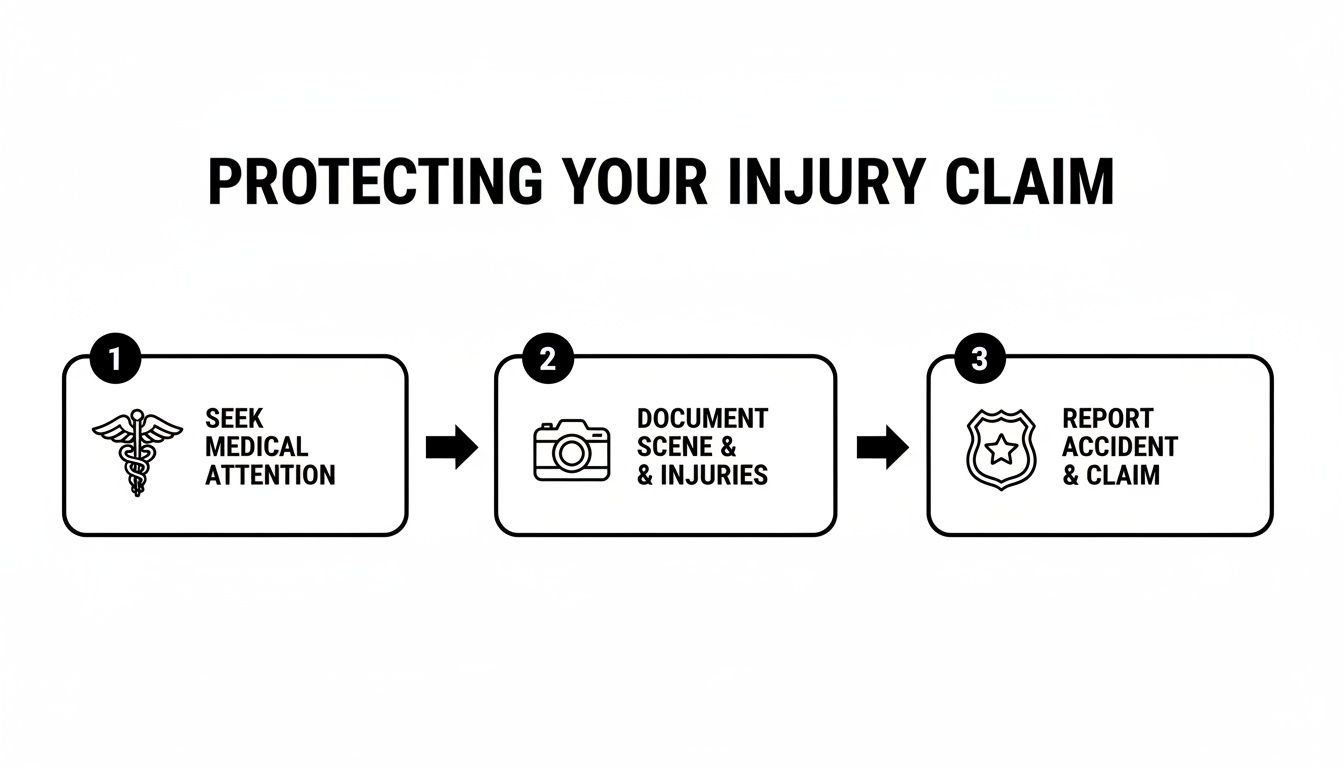
This simple flow shows just how important those first actions are. Seeking medical care, documenting everything, and reporting the accident—these form the bedrock of a strong injury claim.
Non-Economic Damages: The Human Cost
This second category is just as real but harder to put a price tag on. Non-economic damages compensate you for the personal, intangible suffering your back injury has caused.
These damages can include:
- Pain and Suffering: Compensation for the physical pain and discomfort you've endured and will continue to deal with.
- Mental Anguish: This covers the emotional toll—anxiety, depression, fear, and trauma from the crash.
- Physical Impairment: If you can no longer play sports, enjoy hobbies, or do simple daily activities, this compensates you for that loss.
- Loss of Consortium: In some cases, a spouse can file a claim for the loss of companionship and support resulting from the victim's injury.
For example: A San Antonio construction worker is rear-ended and suffers a severe herniated disc. His economic damages are clear—$80,000 in medical bills and lost pay. But the injury means he can no longer lift heavy materials, ending his career. He also can't toss a football with his son. Non-economic damages are meant to account for this devastating loss of his livelihood and quality of life, which is often worth far more than the initial bills.
The Two-Year Clock Is Ticking: Texas Statute of Limitations
It's critical to know that your right to seek compensation doesn't last forever. In Texas, the statute of limitations for personal injury claims is generally two years from the date of the accident. This deadline, found in the Texas Civil Practice & Remedies Code, is unforgiving.
If you fail to file a lawsuit within that two-year window, you will almost certainly lose your right to recover any compensation, no matter how strong your case is. This is why it is so important to speak with a Houston car accident lawyer as soon as you can.
How a Houston Car Accident Lawyer Can Help
Trying to handle a back injury claim from a car accident by yourself is a recipe for frustration. You’re supposed to be focused on getting better, but instead, you’re dealing with an insurance company whose goal is to protect its bottom line—not help you recover.
An experienced Houston car accident lawyer from The Law Office of Bryan Fagan, PLLC can level the playing field. Insurance adjusters are professionals who negotiate claims every day. They have tactics designed to minimize payouts. We know their playbook and how to counter their strategies.
Fighting Back Against Insurance Company Tactics
Insurance companies often try to downplay the severity of back injuries, especially "soft tissue" damage like strains and sprains that don’t show up on an X-ray. They may argue that your pain isn't as severe as you say or that the physical therapy your doctor ordered isn't necessary.
They might also question the cause of your injury, suggesting your back problems are from a pre-existing condition. We see these arguments coming and build a rock-solid case from day one to counter them. We work to make the insurance company see the full picture—not just the initial ER bill, but the true lifetime cost of your injury.
Building a Powerful Case on Your Behalf
While you concentrate on your recovery, your Texas injury attorney gets to work gathering everything needed to prove what happened and maximize your compensation.
Here’s what that looks like:
- Comprehensive Evidence Gathering: We’ll secure the police report, interview witnesses, and find any available traffic camera or dashcam footage.
- Expert Medical Consultation: We work closely with your doctors and can bring in medical experts to explain the nature of your back injury, why your treatment is necessary, and what your long-term prognosis looks like.
- Calculating Your True Damages: We meticulously document every economic loss, from medical bills to lost wages. Just as importantly, we calculate the non-economic damages for your pain, suffering, and the impact on your quality of life.
Our Commitment to You
The last thing you need after a serious accident is another bill to worry about. That’s why we represent all our clients on a contingency fee basis. This means you pay us absolutely nothing unless we win your case. Our fee is a percentage of the settlement or verdict we secure for you. This ensures everyone can get top-tier legal help, and it aligns our goals perfectly with yours: getting you the maximum compensation for your recovery.
Common Questions About Back Injury Claims
After a serious car accident, your mind is probably racing with questions. Getting clear, straightforward answers is the first step toward getting back on your feet. Here are some of the most common questions our clients ask about their back injuries from car accident claims.
How Long Will My Back Injury Case Take to Settle?
There’s no single answer, as every case is unique. A straightforward claim with clear fault might settle in a few months. But if your injuries are complex or liability is disputed, it could take a year or more. The most important factor is reaching maximum medical improvement (MMI)—the point where your doctor says your recovery has progressed as far as it can. We never rush a settlement before reaching MMI because we need to know the full, long-term cost of your injury to demand fair compensation.
What if the At-Fault Driver Has No Insurance?
This is an all-too-common problem on Texas roads. If you’re hit by an uninsured or underinsured driver, you can often turn to your own policy for help through your Uninsured/Underinsured Motorist (UM/UIM) coverage. This is an optional but highly recommended part of a Texas auto policy. Our team can review your policy and walk you through filing a UM/UIM claim.
Will I Have to Go to Court?
It’s highly unlikely. The vast majority of personal injury cases—more than 95%—are settled out of court through skilled negotiation. Insurance companies know that going to trial is expensive and risky for them. However, if an insurer refuses to make a fair offer, we are always prepared to take your fight to a judge and jury to get the compensation you deserve.
The road to recovery after a back injury can feel long and lonely, but you don’t have to walk it by yourself. The dedicated team at The Law Office of Bryan Fagan, PLLC is here to offer the clear guidance and aggressive representation you need to protect your future. We are ready to listen to your story, answer your questions, and fight for the justice and compensation you deserve. Contact us today for a free, no-obligation consultation to talk about your case and find out how we can help.
Contact The Law Office of Bryan Fagan, PLLC for a Free Consultation