A car crash can change your life in seconds — but you don’t have to face recovery alone. The car accident settlement timeline isn't a one-size-fits-all process; it can take a few months for minor injuries or well over a year for more complicated cases. Understanding the steps involved is the best way to regain a sense of control and protect your rights.
A Realistic Timeline for Your Car Accident Settlement
After a wreck, one of the first questions on your mind is, "How long is this going to take?" While every case is different, the road to a settlement follows a fairly predictable path.
Think of it like building a house. You can't rush pouring the foundation without risking the integrity of the entire structure. In a car accident claim, your medical recovery is that foundation. Settling your case before you know the full extent of your injuries is one of the biggest and most costly mistakes you can make.
This guide will give you a clear roadmap of the Texas car accident settlement timeline so you can set realistic expectations from the start. We’ll walk through each critical stage, from the moments after the crash all the way to receiving your final settlement check.
Understanding the Journey Ahead
The time it takes to resolve your claim isn't random. It’s dictated by essential legal and medical milestones that must be handled correctly to build a strong case and protect your financial future.
Here are the key phases that shape how long your settlement will take:
- Initial Medical Treatment: Your health is always the top priority. Getting checked out by a doctor right away creates a clear, documented link between the crash and your injuries—this is crucial evidence.
- Investigation and Evidence Gathering: While you focus on healing, your attorney gets to work. We'll gather police reports, track down witness statements, and collect photos to firmly establish liability.
- Reaching Maximum Medical Improvement (MMI): This is a critical point in your recovery. MMI is when your doctor says you’ve healed as much as you're going to. You can't know the true cost of your future medical needs until you reach this stage, so settling before MMI is a huge gamble.
- Demand and Negotiation: Once all your losses—or damages—are calculated, we package everything into a formal demand letter sent to the insurance company. This kicks off the negotiation process.
- Resolution: If we can get the insurer to agree to a fair number, the case settles. If they refuse to be reasonable, filing a lawsuit might be the only way to force them to pay what you deserve.
This timeline gives you a general idea of how long the process can take depending on how badly you were hurt.
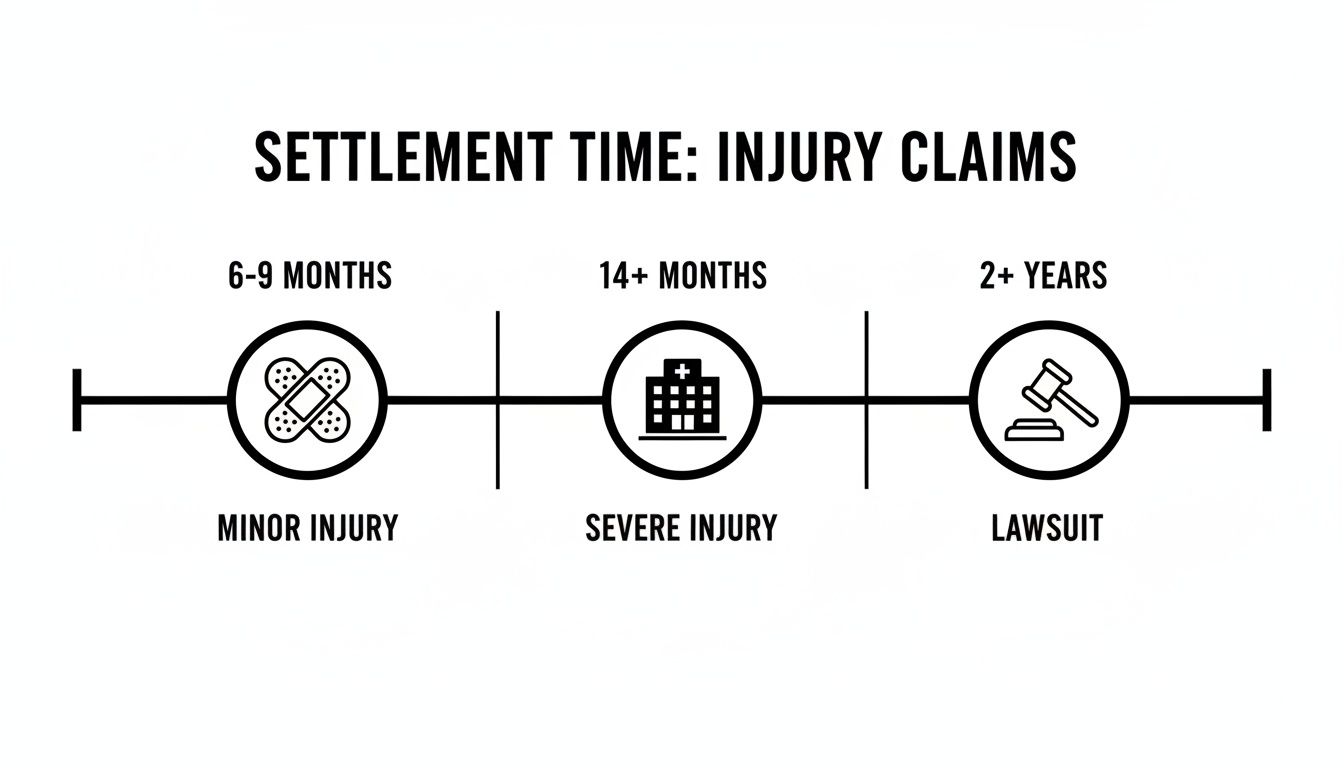
As you can see, the more serious the injury, the longer the timeline stretches, especially if we have to take the fight to court.
Estimated Settlement Timelines by Injury Severity
To give you a clearer picture, this table breaks down the general timelines you can expect for a car accident settlement in Texas, based on the severity of your injuries.
| Injury Severity | Typical Timeline Range (Without Lawsuit) | Typical Timeline Range (With Lawsuit) |
|---|---|---|
| Minor Injuries (e.g., whiplash, soft tissue strains) | 6 – 9 months | 12 – 18 months |
| Moderate Injuries (e.g., simple fractures, herniated discs) | 9 – 14 months | 18 – 24 months |
| Severe Injuries (e.g., traumatic brain injury, spinal cord damage) | 14+ months | 2+ years |
Remember, these are just estimates. Every case has unique factors that can speed up or slow down the process.
The numbers show that patience is a virtue. While about half of all auto accident injury cases settle within 14 months, cases that don't require a lawsuit often wrap up much faster—sometimes in just six to nine months.
For a more detailed look at what to expect, check out our guide on how long a personal injury case can take.
Critical First Steps That Define Your Timeline

What you do in the first 48 hours after a Texas car accident can completely change the outcome of your claim. The right moves build a rock-solid foundation for your case. The wrong ones can cause serious delays and shrink the compensation you rightfully deserve.
Each step is about protecting your health and your legal rights from the moment of impact. When you act decisively, you build a case that forces the insurance company to take your auto insurance claim seriously.
Securing Your Health and Your Evidence
Your first priority, no matter what, is your well-being. Get medical attention right away, even if you think you feel fine. Adrenaline is a powerful chemical that can easily mask serious injuries like whiplash or internal bleeding. A doctor's report creates an immediate, undeniable link between the crash and the harm you suffered.
Next, you need an official record of what happened. Calling the police to the scene ensures a formal accident report is created. This report is a crucial piece of evidence that documents the basic facts and often includes the officer's initial take on who was at fault.
For example, imagine a Houston driver is rear-ended on I-45. Even if the damage looks minor, calling HPD and having medics check for neck pain establishes two critical facts from the start: the other driver was clearly at fault, and the victim sought immediate care for their injuries.
Building Your Case at the Scene
If you're physically able to, gathering your own evidence can be a game-changer. This information helps your Houston car accident lawyer prove liability—the legal term for who is responsible for causing the wreck and your injuries.
Here’s a quick checklist of what to grab if you can:
- Photographs: Your phone is your best tool. Snap pictures of everything—the damage to all cars, any skid marks on the road, traffic signs, and the overall scene from different angles.
- Witness Information: Get the names and phone numbers of anyone who saw what happened. An independent witness can be your ace in the hole if the other driver tries to change their story later.
- Driver Details: Swap insurance and contact info with the other driver, but don't get into a debate about fault. Just stick to the facts.
This evidence helps us piece together exactly what happened, making it much harder for the insurance company to argue or drag its feet.
Your initial actions create the narrative of your case. By documenting everything, you are taking control of that narrative and preventing the insurance company from twisting the facts to deny your claim.
The Single Biggest Mistake to Avoid
It won’t take long for the other driver's insurance adjuster to call you. They might sound friendly and concerned, and they will ask you to give a recorded statement about the crash. Do not agree to this.
This is a classic tactic designed to trip you up. Adjusters are trained to ask tricky, leading questions that can get you to accidentally admit some fault, downplay how hurt you are, or contradict yourself. Any inconsistency can be used to delay or deny your settlement.
Under Texas's comparative fault rules (Texas Civil Practice & Remedies Code, Chapter 33), if you are found even partially at fault, your compensation can be reduced. If you're found 51% or more responsible, you get nothing. A recorded statement is the insurance company's best tool for shifting blame onto you.
The best response is to politely decline and tell them your attorney will be in touch. Before you say a word to any insurance company, contact a Texas injury attorney from The Law Office of Bryan Fagan, PLLC for a free consultation. We’ll handle all communications for you, protecting your rights and setting your claim up for success from day one.
The Medical Recovery Phase: Why Patience Pays Off

This next part of the car accident settlement timeline is almost always the longest, and for a very good reason—it’s the most important. After a crash, the insurance company’s goal is simple: close your case as quickly and cheaply as possible. Our goal is the exact opposite. We're here to make sure you're fully taken care of, no matter how long it takes.
Rushing this stage is a massive mistake, one that could leave you responsible for thousands in future medical bills. It all hinges on one critical medical milestone.
Reaching Maximum Medical Improvement
The foundation of a strong personal injury claim rests on reaching what's called Maximum Medical Improvement, or MMI. This is a medical term that means your doctor has determined you've healed as much as you are going to from your injuries. Reaching MMI doesn't always mean you're back to 100%, but it does mean your condition has stabilized.
Why is this so critical for your settlement timeline?
- It defines your future medical needs. Once you hit MMI, your doctor can give a clear prognosis, spelling out any future surgeries, therapies, medications, or treatments you'll need.
- It allows for an accurate damage calculation. Without a clear picture of those future costs, it's impossible for us to demand the full amount of compensation you truly deserve.
- It prevents you from paying out-of-pocket later. If you settle too early and your condition gets worse, you can't go back to the insurance company and ask for more money. You're stuck with the bill.
Waiting for MMI gives us the solid medical ground we need to build a comprehensive case for your damages—the legal term for the total losses you’ve suffered.
Understanding the Two Types of Damages
In Texas, your compensation is built around two main categories of damages. Our job is to meticulously document every single loss, from a $10 prescription co-pay to the immense emotional toll the accident has taken on your life.
1. Economic Damages
These are the tangible, calculable financial losses you’ve incurred. They're the black-and-white numbers we can prove with receipts, bills, and pay stubs.
Examples include:
- All past, current, and future medical bills (hospital stays, surgeries, physical therapy)
- Lost wages from time you had to miss work
- Loss of future earning capacity if your injuries stop you from returning to your old job
- Property damage to your vehicle
2. Non-Economic Damages
These damages are just as real, but they are harder to put a price tag on. They are meant to compensate you for the human cost of the accident.
Under Chapter 41 of the Texas Civil Practice & Remedies Code, these include things like:
- Pain and suffering
- Mental anguish and emotional distress
- Physical impairment or disfigurement
- Loss of enjoyment of life
Imagine a Houston driver who suffered a severe back injury after getting T-boned at an intersection. Their economic damages would cover the surgical bills and months of lost income. But their non-economic damages would compensate them for the chronic pain they now live with and the fact they can no longer pick up their kids and play like they used to.
We leave no stone unturned. By patiently waiting for MMI, we can gather every piece of evidence needed to show the insurance company the full, true value of your claim—not just the initial hospital bill they want to pay.
Documenting Your Recovery Every Step of the Way
While you focus on healing, we focus on building your case. This means we're carefully collecting and organizing every single document related to your recovery. Every doctor's appointment, every therapy session, and every prescription refill strengthens your claim and proves just how serious your injuries are.
For instance, getting prompt treatment for common injuries like a pinched nerve in your neck is often necessary, and documenting that medical care is crucial for your claim. Understanding your recovery path with resources like information on chiropractic care for a pinched nerve in the neck can be helpful. This detailed record-keeping makes it nearly impossible for the insurance company to argue your injuries weren't caused by the crash.
This phase of the car accident settlement timeline absolutely requires patience, but it’s a non-negotiable step toward getting the financial stability you need to move forward. The Law Office of Bryan Fagan, PLLC, will guide you through this process, making sure you get the medical care you need while we build the strongest case possible on your behalf.
Building Your Demand and Negotiating with Insurers
Once you've reached Maximum Medical Improvement (MMI), the focus shifts. Your physical healing is well underway, and now it's our turn to go on the offensive with our legal strategy. This is where your case moves from evidence gathering to active negotiation, and it all starts when we bundle every documented loss into a powerful "demand package" for the insurance company.
This isn't just a letter asking for money. Think of it as the complete story of your accident and how it turned your life upside down, backed by undeniable proof. We meticulously lay out every medical bill, every dollar of lost income, and the real story of your pain and suffering. The goal is to give the insurance adjuster a crystal-clear picture of their driver's liability and the full value of your damages.
Crafting a Compelling Demand Package
A well-crafted demand package gives the insurance company everything they need to understand exactly why they owe you a fair settlement. By presenting them with an airtight case from the beginning, we apply immediate pressure and set the tone for the entire negotiation.
A strong demand package will always include:
- A detailed narrative of how the crash happened, using the police report and witness accounts to establish fault.
- Complete medical records and bills to document every injury and the full cost of your treatment.
- Proof of your lost income, like pay stubs and a letter from your employer.
- Statements from your doctors explaining your prognosis and any future medical care you might need.
- Photos and other evidence that bring your claim to life.
When we lay all our cards on the table like this, we anchor the negotiation in hard facts, making it much harder for an adjuster to justify a lowball offer. For a closer look at what goes into this critical document, you can learn more about how a sample car accident demand letter is structured.
The Negotiation Back-and-Forth
After we send the demand, the insurance company will review it and come back with an offer. The first offer is almost always insultingly low. It’s a classic tactic. The adjuster's job is to save their company money. They're hoping you're desperate enough to grab a fraction of what your claim is truly worth.
This is where having an experienced Houston car accident lawyer becomes your shield. We take over all communication, so you never have to deal with an adjuster again. From there, we begin a calculated back-and-forth, countering their low offers with fact-based arguments, legal precedent, and relentless pressure.
An insurance company is a business, and its first priority is profit. Our first and only priority is you. We level the playing field by forcing them to negotiate based on the facts of your case and the laws of Texas, not on their internal profit goals.
Countering Common Insurance Company Tactics
During negotiations, adjusters love to use Texas's "comparative fault" rule against you. Under Chapter 33 of the Texas Civil Practice & Remedies Code, your settlement can be reduced by your percentage of fault. If you’re found to be 51% or more responsible for the crash, you get nothing.
For example, an adjuster might look at a police report from a wreck on the Katy Freeway and try to claim you were speeding slightly, even though their driver blew through a red light. They'll argue you share 10% or 20% of the blame just to slash their payout. We shut down these baseless accusations by pointing them right back to the evidence—witness statements, accident reconstruction data, and the law—to protect your right to full compensation.
This negotiation phase can take anywhere from a few weeks to several months. By managing this entire process, The Law Office of Bryan Fagan, PLLC, takes the stress off your shoulders, fights back against every lowball offer, and uses the full force of Texas law to secure the maximum recovery you deserve.
When Filing a Lawsuit Becomes Necessary
What happens when the insurance company digs in its heels and refuses to make a fair offer? It’s a frustrating roadblock in the car accident settlement timeline. Filing a lawsuit isn’t admitting defeat; it’s a powerful, strategic move that forces the other side to finally take your claim seriously.
Many people hear "lawsuit" and immediately picture a tense courtroom drama. But the reality is that over 95% of personal injury cases are settled long before they ever see a trial. Often, the act of filing the lawsuit is the very thing that unlocks a fair settlement, pushing the insurance company back to the negotiating table with a much more realistic offer. It shows them we're prepared to go the distance for you.
Yes, this step adds time to the process. But for many Texans who've been seriously injured, it's the only way to get the justice and financial stability they need to put their lives back together.
The Two-Year Deadline You Absolutely Cannot Miss
Before we get into the details of a lawsuit, there's one critical deadline every Texan needs to know: the statute of limitations. In Texas, you generally have just two years from the date of the car wreck to file a personal injury lawsuit.
If you miss that deadline, the court will almost certainly throw out your case. You lose your right to seek compensation forever, no matter how clear-cut the other driver's fault was. This is a hard-and-fast rule. Insurance companies know this deadline and will sometimes drag out negotiations, hoping you’ll run out of time.
The statute of limitations is the insurance company’s favorite legal technicality. They know if you wait too long, they might not have to pay you a single dollar. This is why getting a Houston car accident lawyer involved early is so critical to protecting your rights.
Working with an attorney ensures every deadline is tracked and met, keeping all your legal options on the table. You can dive deeper into this crucial topic in our guide on the Texas statute of limitations for car accidents.
Understanding the Litigation Process
Once a lawsuit is filed, your case officially enters the litigation process. This phase is structured to make sure both sides get all the facts and evidence before a potential trial. It might sound intimidating, but it boils down to a few key stages.
1. Filing the Petition and Serving the Defendant
We kick things off by filing a formal complaint, called a "petition," with the court. This document lays out who you're suing, why you're suing them (their negligence), and the damages you're seeking. From there, we have the at-fault driver (now the "defendant") officially "served" with the lawsuit papers.
2. The Discovery Phase
This is usually the longest part of the process, often lasting from six months to over a year. During discovery, both sides are required to exchange all evidence related to the crash. The goal is total transparency—no surprises at trial.
Discovery involves a few standard tools:
- Interrogatories: These are written questions sent to the other side, which they must answer in writing, under oath.
- Requests for Production: We formally ask for documents like medical records, repair bills, photos, or even the other driver's cell phone records.
- Depositions: This is an out-of-court interview where we question witnesses—including you and the other driver—under oath. Everything is recorded by a court reporter.
This is the phase where we build the strongest case possible and find holes in the other side's story.
3. Mediation and Final Negotiations
Before a case goes to a courtroom, Texas courts almost always require both parties to try mediation. This is a structured negotiation session guided by a neutral third-party mediator.
The mediator’s job isn't to pick a winner, but to help both sides find a middle ground and reach a settlement everyone can agree on. For instance, in a wrongful death case, mediation provides a formal setting to present the full human and financial cost of a family's loss directly to the insurance company. It is often here that the most serious settlement offers are finally put on the table. The vast majority of cases get resolved at this stage.
Filing a lawsuit is a big step, but it's not one you should fear. The Law Office of Bryan Fagan, PLLC, will handle every single detail, using the litigation process to apply maximum pressure and fight for the outcome you and your family deserve.
Getting Your Settlement Check: The Final Steps
After weeks or months of doctor's visits and negotiations, reaching a settlement agreement is a huge weight off your shoulders. The hardest part is behind you. But there are a few final, critical steps left in your car accident settlement timeline before that money is in your bank account.
This last phase is about formalizing the agreement and making sure every bill is paid. We handle this entire process for you, keeping you informed so you know exactly where every dollar is going before you get your final check.
Signing the Release and Closing Your Claim
Once we have a verbal agreement with the insurance company, they'll send over a final settlement and release agreement. This is a legally binding document that says you're accepting their settlement offer in exchange for releasing the at-fault driver and their insurer from any future liability for the crash.
We review this document with a fine-tooth comb, making sure every term is exactly as we agreed and that your interests are fully protected. Once you sign it, your claim is officially closed. You cannot come back later and ask for more money for this accident, so it's vital to get it right.
How We Handle the Settlement Money
After you sign the release, the insurance company sends the check. By law, that check comes directly to The Law Office of Bryan Fagan, PLLC, where we deposit it into a special, highly regulated client trust account. The money stays safe and untouched in this account while we tie up the last administrative loose ends.
This process ensures that all the financial obligations tied to your case are cleared up first, so you don't have to deal with them.
We essentially act as your financial shield. We take care of all the outstanding bills from your settlement so you aren’t blindsided by surprise medical bills or collection calls months down the road. This clears the slate, letting you truly move forward.
Paying Off Liens and Our Fee
It’s very common for clients to have medical bills that were initially covered by their own health insurance, Medicare, or Medicaid. These organizations often place a lien on your settlement, which is a legal right to get paid back out of the money you recover. Our team negotiates with these providers to reduce those lien amounts as much as possible, which means more of the settlement money goes directly to you.
Finally, there’s our fee. We work on a contingency fee basis, which means you have not paid a single dime out of your own pocket for our help. Our fee is a pre-agreed-upon percentage of the settlement we secured for you. Once all liens and our fee are paid from the trust account, the rest is yours. We issue your final check, and this chapter is officially closed, allowing you to focus on your future.
Frequently Asked Questions About Texas Settlement Timelines

Navigating a car accident claim brings up many questions. We've compiled clear answers to the concerns we hear most often from our clients in Texas to help you understand what's ahead.
Will My Car Accident Case Definitely Go to Trial?
It's highly unlikely. The reality is that more than 95% of personal injury cases settle long before they ever see the inside of a courtroom.
Filing a lawsuit is usually a strategic move—it signals to the insurance company that we are serious and fully prepared to fight. This step alone often prompts a much fairer settlement offer during negotiations or mediation. A trial is always the last resort, but our firm is always prepared to go to court to get you the compensation you deserve.
Why Shouldn't I Accept the First Offer from the Insurance Company?
Because an insurance company’s main goal is to protect its profits, and that means paying you as little as possible. The first offer is almost always a lowball amount that barely scratches the surface of what you truly need. It rarely accounts for future medical treatments, lost earning capacity, or the full extent of your pain and suffering.
Once you accept a settlement, it's final. You forfeit all rights to seek more money for that accident, even if your injuries get worse down the road. It is absolutely critical to speak with a Houston car accident lawyer before you sign anything.
How Does a Contingency Fee Work for My Car Accident Case?
A contingency fee arrangement means you have zero financial risk. It's simple: you pay us nothing upfront. The Law Office of Bryan Fagan covers all the costs required to build and pursue your auto insurance claim.
We only get paid if we win a settlement or verdict for you. Our fee is just a pre-agreed-upon percentage of the final amount recovered. This structure allows everyone, regardless of their financial situation, to afford expert legal representation and focus completely on their recovery.
The road to recovery can feel long and overwhelming, but you don't have to walk it alone. The experienced Texas injury attorneys at The Law Office of Bryan Fagan, PLLC are here to manage every detail of your claim, fight for your rights, and secure the fair compensation you need to move forward.
Contact us today for a free, no-obligation consultation to discuss your case and learn how we can help. https://houstonaccidentlawyers.net