Skip to content
A car crash can change your life in seconds — but you don’t have to face recovery alone. One moment you’re driving, the next you’re dealing with injuries, emotional trauma, and a mountain of unexpected bills. While you’re trying to heal, a legal countdown clock is quietly ticking. In Texas, you generally have two years from the date of the accident to file a personal injury lawsuit.
What is the Statute of Limitations in Texas?

It’s easy to get consumed by doctor’s appointments, car repairs, and just trying to get through the day. But that legal deadline—known as the statute of limitations—is one of the most critical parts of your case. In plain English, it's a law that puts a strict time limit on your right to take someone to court to seek compensation for your injuries.
The purpose of this rule is to ensure legal claims are handled while evidence is still fresh and memories haven’t faded. For you, it means that time is not on your side after a crash.
Understanding the Two-Year Rule
The clock starts running the moment the collision happens. This two-year window applies to most claims that come from a car wreck, including your physical injuries and the damage to your vehicle. This isn't just a guideline; it's the law, as stated in the Texas Civil Practice and Remedies Code § 16.003.
Missing this deadline is devastating for your claim. If you try to file a lawsuit even one day late, the court will almost certainly dismiss it. You’ll lose your right to pursue compensation forever, no matter how strong your case is or how severe your injuries are.
Why This Deadline Matters for Your Recovery
Insurance companies know this rule inside and out. They are fully aware that if you let those two years pass, they are no longer legally required to pay. You can no longer sue the at-fault driver, so the insurance company has no legal reason to offer you a fair settlement. It’s a common tactic for an adjuster to drag their feet, delay responding to your calls, or make a lowball offer, hoping you'll get frustrated and run out of time.
Think of the statute of limitations as the legal foundation of your entire claim. If that deadline passes, your ability to hold the at-fault driver accountable collapses, leaving you to bear the financial burden of their negligence alone.
Building a solid case takes time. Your legal team needs to gather police reports, medical records, and witness statements, not to mention calculate the full extent of your damages. That’s why it’s so important to get started long before the deadline approaches. Speaking with an experienced Houston car accident lawyer right after the crash ensures every deadline is met and your rights are protected from day one. To learn more about the process, check out our guide on how to file a car accident claim in Texas.
Texas Car Accident Claim Deadlines at a Glance
To make it simple, here’s a quick summary of the standard filing deadlines you need to know after a car accident in Texas.
| Type of Claim | Standard Filing Deadline |
|---|---|
| Personal Injury Claim | 2 years from the date of the accident |
| Property Damage Claim (Vehicle) | 2 years from the date of the accident |
| Wrongful Death Claim | 2 years from the date of death |
Remember, these are the standard timelines. As we'll discuss, there are some rare exceptions that can change the deadline, but for the vast majority of cases, that two-year clock is absolute.
What Happens If You Miss the Two-Year Deadline?

Failing to act within that two-year window isn’t just a setback; it’s the end of the road for your legal claim. Once the statute of limitations expires, you lose your right to file a lawsuit and demand compensation from the at-fault party. The courthouse doors are closed to your case, permanently.
This isn’t a minor technicality that a judge might overlook. It’s a hard and fast rule that Texas courts strictly enforce. It makes no difference how obvious the other driver’s fault was or how severe your injuries are. If you miss that deadline, your ability to seek justice through the legal system is gone for good.
The Power Shifts Entirely to the Insurance Company
Insurance companies live and breathe by this deadline. They know that the second the two-year clock runs out, the entire power dynamic flips in their favor. Your only real leverage—the ability to take them to court—vanishes.
Think about trying to negotiate a settlement after your time is up. The insurance adjuster has zero legal or financial reason to offer you a fair settlement. Why would they? They know you can no longer sue them to force them to pay, so they can deny your claim without facing any consequences. Some adjusters will even drag out the process on purpose, hoping you’ll run out the clock without realizing it.
A Real-World Example of a Missed Deadline
Imagine this real-world scenario: A Houston driver rear-ended on I-45 suffers a back injury that requires months of physical therapy and keeps them out of work. They spend the next year and a half going back and forth with the other driver's insurance company, which keeps stringing them along with requests for more documents and insultingly low offers.
Distracted by their recovery and trusting the adjuster's empty promises to "make things right," they let the two-year anniversary of the crash pass. The day after the deadline expires, the adjuster suddenly stops returning their calls. When they finally get a response, it’s a formal denial letter. At that point, they’re stuck with a mountain of medical debt and have no legal options left.
A missed deadline means you are left responsible for every single one of your losses—medical bills, lost income, and future care. The person who caused your pain is no longer legally accountable for the damage they caused.
The hard reality of the Texas statute of limitations is that missing the deadline can mean losing your right to compensation entirely, even for catastrophic injuries. This highlights just how critical it is to act quickly. You can see more data on why timely claims matter in these car accident statistics for Texas.
Why You Cannot Afford to Wait
Many accident victims think they have plenty of time, but building a strong personal injury case is a race against the clock. Waiting until the last minute puts everything you're fighting for at risk.
Here’s why delaying is a problem:
- Evidence Vanishes: Surveillance footage from a nearby business often gets recorded over within weeks. Skid marks on the road fade, and the crash scene itself is cleaned up and changed.
- Witnesses Disappear: People’s memories get fuzzy over time. Even worse, witnesses may move away or become impossible to track down, taking their crucial testimony with them.
- Your Claim Looks Weaker: Insurance companies and juries can become suspicious of last-minute claims. They may argue that if your injuries were truly serious, you would have taken action much sooner.
Protecting your rights means acting decisively. The single most important step you can take is to contact a Houston car accident lawyer as soon as possible. An attorney can immediately file the necessary paperwork to protect your claim, take over all communications with the insurance company, and start building a powerful case while you focus on what really matters—getting better.
How Fault and Damages Shape Your Claim
Before you can recover a single dollar for your injuries, Texas law requires you to prove who was legally responsible—or liable—for the crash. Liability simply means legal responsibility for causing harm. However, it’s rarely as simple as pointing a finger. The other driver's insurance company will often try to shift as much blame onto you as possible to reduce or deny your claim.
This is where the fight really begins, and it all comes down to a Texas negligence law called modified comparative fault, as outlined in the Texas Civil Practice & Remedies Code, Chapter 33. Understanding this rule is critical—it can make or break your ability to get the compensation you need.
The 51% Fault Rule: A Hard Line in the Sand
Think of the blame in a car accident like a pie. That pie represents 100% of the fault, and it’s up to insurance companies, lawyers, and sometimes a jury to decide how big each person’s slice is. Under Texas’s comparative fault rule, you can only recover money for your losses if your share of the blame is 50% or less.
This is commonly called the “51% bar rule.” If you are found to be 51% or more at fault for the accident, you are legally barred from recovering any compensation. It’s a strict cutoff.
Here’s how it works:
- You're 0% at fault: You can claim 100% of your damages.
- You're 20% at fault: Your final compensation is reduced by 20%.
- You're 51% at fault: You walk away with nothing.
For example, a driver gets T-boned at an intersection on Westheimer Road in Houston. The evidence clearly shows the other driver ran a red light, but perhaps you were going a few miles over the speed limit. A jury might decide you were 10% at fault. If your total damages were $100,000, your final award would be reduced by that 10%, leaving you with $90,000.
What Exactly Are "Damages" in a Car Accident Claim?
The money you seek in an auto insurance claim or lawsuit has a legal name: damages. Damages are the total sum of money awarded to compensate you for every single loss you’ve suffered because of someone else's negligence.
These losses are usually split into two categories.
Economic Damages: These are the tangible losses that have a clear price tag. They form the financial foundation of your claim.
- Medical Expenses: Everything from the ambulance ride and ER visit to surgeries, physical therapy, medications, and any future medical care you'll need.
- Lost Wages: All the income you missed out on because you were unable to work while recovering.
- Loss of Earning Capacity: If your injuries permanently affect your ability to do your job or earn a living, this compensates you for that future lost income.
- Property Damage: The cost to repair your vehicle or, if it's a total loss, its replacement value. It also covers other personal items damaged in the crash.
Non-Economic Damages: These are the intangible losses. They don't come with a receipt, but their impact on your life can be just as devastating.
- Pain and Suffering: Compensation for the physical pain, discomfort, and emotional distress your injuries have caused.
- Mental Anguish: This covers trauma-related conditions like anxiety, depression, or PTSD, as well as the loss of enjoyment of life.
- Physical Impairment or Disfigurement: This accounts for permanent limitations, scarring, or the loss of a bodily function.
Knowing what you’re entitled to is crucial. The first step is often filing a claim against the at-fault driver's policy. To learn more, check out how a third-party insurance claim works in our detailed guide. A skilled Houston car accident lawyer can help you calculate the full scope of your damages, ensuring nothing is overlooked.
Exceptions That Can Extend the Filing Deadline
While the two-year deadline for a statute of limitations car accident Texas claim feels firm, the law recognizes that some situations make it unfair or impossible for a victim to file a lawsuit on time.
In these rare cases, the law allows the two-year countdown to be paused. This legal concept is called “tolling” the statute of limitations. It doesn't erase the deadline, but it does stop the clock from ticking until the issue preventing you from filing is resolved. Proving an exception applies is complex and requires the skill of an experienced Texas injury attorney.
This infographic simplifies the key question of fault that determines if you can recover damages.
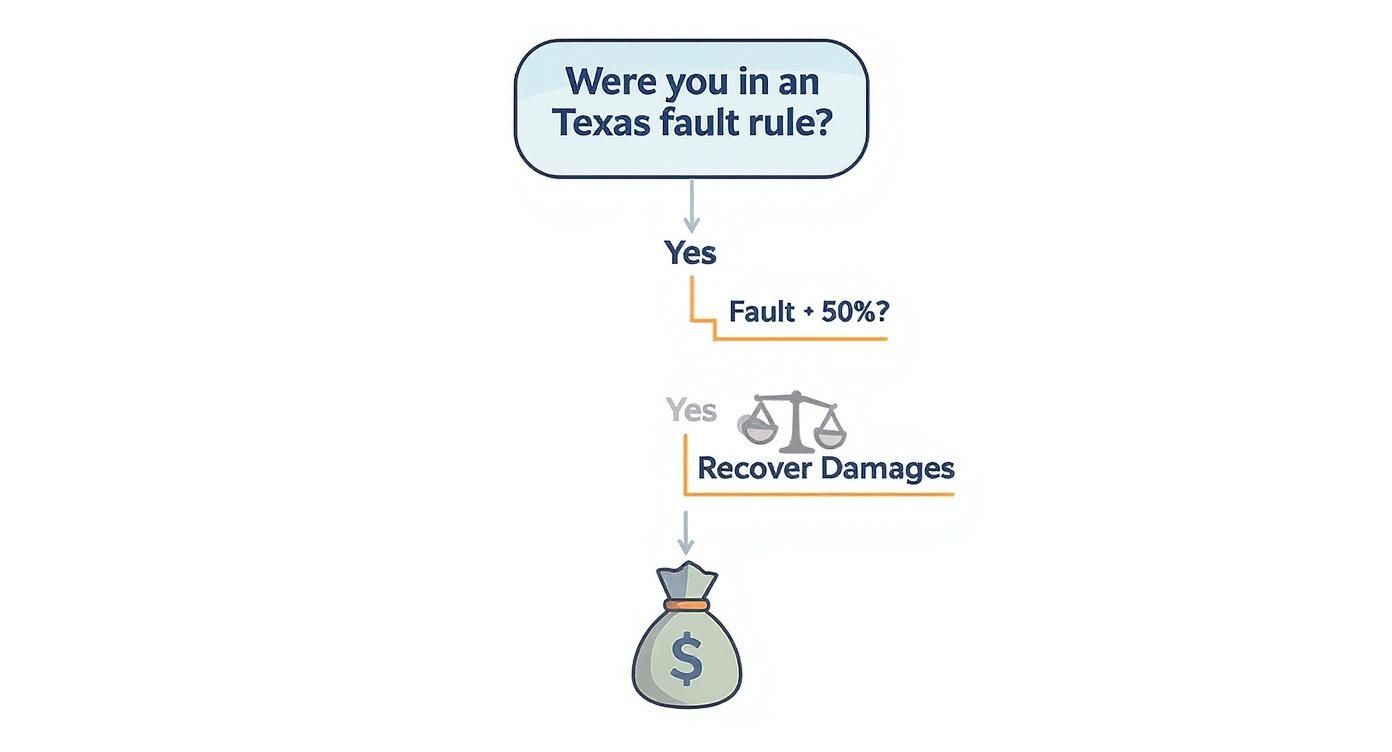
The visualization shows that your ability to recover compensation hinges entirely on being found 50% or less at fault for the accident.
The Discovery Rule for Hidden Injuries
One of the most critical exceptions is the Discovery Rule. Not every injury from a car crash is immediately obvious. You might walk away from a collision feeling banged up but generally okay, only to find out months later that you have a serious spinal injury or a traumatic brain injury with delayed symptoms.
The Discovery Rule states that the two-year clock doesn't start on the day of the crash. Instead, it begins on the date the injury was discovered—or reasonably should have been discovered.
For example, a driver in San Antonio gets into a minor fender-bender. For months, they feel fine. Then, they start having severe back pain, and a doctor diagnoses a herniated disc directly caused by the accident. In that case, their two-year deadline might start from the date of the diagnosis, not the day of the crash. This requires strong medical evidence linking the delayed injury to the original accident.
Protecting the Rights of Minors
When a child under 18 is injured in a car accident, Texas law provides special protection. Minors cannot legally file a lawsuit on their own, so it would be unfair to let their right to compensation expire before they are old enough to act.
For this reason, the statute of limitations is tolled for minors. The two-year countdown is frozen until the child’s 18th birthday. Once they become a legal adult, the clock starts ticking, giving them two years—until their 20th birthday—to file a personal injury lawsuit.
An exception to the statute of limitations is not an automatic extension. It is a specific legal argument that must be proven with clear and convincing evidence. Relying on an exception without consulting an attorney is incredibly risky and can result in losing your rights entirely.
When a Victim Is Mentally Incapacitated
Another key exception applies if the accident victim was of "unsound mind" or became mentally incapacitated due to the crash. This could happen if someone suffers a severe traumatic brain injury that leaves them unable to manage their own affairs or understand their legal rights.
Similar to the rule for minors, the two-year clock is paused during the period of incapacitation. The deadline only starts running once the person is declared legally competent again. This protection ensures that a person's inability to act doesn't strip them of their right to seek compensation.
These exceptions are narrow and almost always challenged by insurance companies. If you believe one of these situations applies to your case, it is essential to speak with a Houston car accident lawyer right away. Our team at The Law Office of Bryan Fagan, PLLC can investigate the specifics of your situation and determine the true deadline for your claim.
Navigating Claims Against Government Entities
While the standard two-year rule covers most crashes, there’s a major exception you must know. If your accident involved a vehicle owned by a government agency—like a city bus in Austin, a state-owned construction truck, or a local school district vehicle—the rules change completely.
You are now dealing with the Texas Tort Claims Act, and the clock starts ticking much faster.
This special law requires you to take a critical first step long before you can file a lawsuit. You must provide the correct government agency with a formal notice of claim detailing the incident. This isn't a simple phone call; it's a specific legal document with strict requirements.
The Extremely Short Notice Deadline
Here's the most important takeaway: this notice deadline is incredibly short and unforgiving. Forget everything you know about the two-year window.
For many government entities, you might have as little as 90 or 180 days from the date of the accident to submit this formal notice.
Missing this initial deadline is devastating for your case. If you don't provide proper notice within that short timeframe, you will almost certainly lose your right to recover any compensation. The government can have your lawsuit dismissed, even if you’re still well within the general two-year statute of limitations.
Imagine you’re hit by a city-operated sanitation truck in Dallas. You spend the next seven months focused on your physical recovery, thinking you have plenty of time. But if the city’s charter requires a notice of claim within six months, you have unknowingly lost your right to hold them accountable.
The notice of claim requirement under the Texas Tort Claims Act is an absolute prerequisite to filing a lawsuit against a government entity. It's a separate, much shorter deadline that acts as a gatekeeper to your right to seek justice.
Why Are the Rules Different for the Government?
The government sets these shorter deadlines to allow for a quick investigation while evidence is fresh. For an injured victim, however, it creates a legal minefield.
Every government body—city, county, or state agency—can have its own specific notice period and procedural rules. There's no one-size-fits-all approach.
The notice itself also has strict requirements and must usually include:
- The exact time, date, and location of the crash.
- A clear, detailed description of how the incident happened.
- The nature of your injuries and a description of the damages you've suffered.
Failing to include the required information or sending the notice to the wrong department can get your claim denied on a technicality. The system is complex and unforgiving. One mistake can cost you everything.
Because these rules are so strict, it's critical to talk with a Houston car accident lawyer immediately after any crash involving a government vehicle. An experienced attorney can identify the correct government entity, determine the exact notice deadline, and ensure a proper claim is filed on time to protect your rights.
Protecting Your Rights: Practical Steps After a Texas Car Crash

After the shock of a car crash, it’s easy to feel lost. Your first thought should always be your health and safety, but the choices you make in the hours and days that follow can significantly impact your ability to get fair compensation.
Acting with a clear plan is your best defense. It helps you build a strong foundation for your insurance claim and stops insurance companies from taking advantage of you when you're most vulnerable.
Your Immediate Action Plan
From the moment the accident happens, every step you take matters. Your first priority is to get medical help for yourself and anyone else involved. Even if you feel okay, some serious injuries—like whiplash or internal bleeding—may not show symptoms for hours or even days.
Seeing a doctor protects your health and creates an official medical record of your injuries, which is critical evidence. Once everyone is safe, here are a few other practical steps to take:
- Report the Accident: Always call 911. A police report is an official document that captures key details about the crash.
- Gather Evidence: If you can, document everything. Take photos and videos of the accident scene, vehicle damage, and any visible injuries. Exchange contact and insurance information with the other driver, and get the names and numbers of any witnesses.
- Notify Your Insurer: Let your own insurance company know about the accident, but stick to the basic facts. Do not give a recorded statement or admit any fault.
Protecting your rights isn't just about what you do at the scene. It’s about being careful in every conversation that follows. Remember, the insurance adjuster’s job is to protect their company’s bottom line, not yours.
Beyond these immediate steps, you'll need to navigate a maze of legal paperwork. This can include understanding complex requirements like the document notarization processes crucial for car accident claims. Every form you sign can impact your case.
The single most powerful step you can take is to talk to a dedicated Houston car accident lawyer right away. An experienced Texas injury attorney takes over the frustrating calls with insurance companies, ensures every legal deadline—like the critical statute of limitations car accident Texas deadline—is met, and builds a powerful case for the full compensation you deserve. For more guidance, check out our guide on the essential steps to take after a car accident.
At The Law Office of Bryan Fagan, PLLC, we handle the legal headaches so you can focus on what matters most: your recovery. Contact us for a free, no-obligation consultation to discuss your case and understand your options. You don't have to go through this alone.
Common Questions About Texas Accident Deadlines
The rules around the Texas car accident statute of limitations can feel confusing, and it’s normal to have questions. Getting clear answers is the only way to protect your right to demand fair compensation.
Here are answers to some of the most common questions we hear from our clients.
Does Negotiating with an Insurance Company Pause the Deadline?
No. This is a critical misunderstanding that can cost you everything.
Simply talking to an insurance adjuster, sending in medical bills, or negotiating a settlement offer does not stop the two-year clock. The deadline keeps ticking, no matter what the insurance company tells you.
Insurance companies know this. Some will even use delay tactics—making it seem like you’re making progress while they’re really just running out the clock. Once that deadline passes, they owe you nothing.
The only way to officially pause the timer and protect your claim is to file a lawsuit in a Texas court.
How Does the Deadline Work for a Wrongful Death Claim?
When a car accident leads to the tragic loss of a loved one, the timeline for filing a lawsuit is slightly different.
For a wrongful death claim, the two-year statute of limitations usually starts on the date of the person's death, which might be days or even weeks after the crash. For instance, if your loved one was injured in a Houston pile-up and passed away a week later from those injuries, the two-year countdown would start from the day they died, not the day of the accident.
Under Texas law, only specific family members—the surviving spouse, children, or parents—can file this type of claim. This is a sensitive and legally complex process that requires compassionate guidance from a wrongful death compensation attorney who understands what your family is going through.
Can I File a Claim If I Discovered My Injury Late?
This is where the "discovery rule" comes in, but it’s an exception that is very difficult to prove. It only applies in specific situations.
The discovery rule might pause the deadline if your injury was truly hidden and couldn't have been found with reasonable diligence right after the crash. An example might be an internal organ injury that doesn't show symptoms for months.
The discovery rule isn't a loophole for missing the deadline. It’s a narrow exception for cases where an injury was genuinely undiscoverable, even if you did everything right.
Proving your injury qualifies requires a powerful legal argument backed by solid medical evidence, and the insurance company will fight it. Because the standard is so high, you should speak with a skilled Texas injury attorney who can review your medical records and determine if this exception could apply to you.
You have a limited window to take action after a car accident. Don't let a technicality on the calendar prevent you from getting the justice and financial recovery you deserve.
At The Law Office of Bryan Fagan, PLLC, our dedicated Houston car accident lawyers are here to answer your questions, manage every deadline, and fight for your rights. We believe in empowering our clients with information and support. Contact us today for a free, no-obligation consultation to discuss your case. We are here to help. https://houstonaccidentlawyers.net