Skip to content
A car crash can change your life in seconds, but you don't have to face recovery alone.
If your family is dealing with the aftermath of an 18-wheeler wreck in Houston, you may still be replaying the impact in your mind. One moment you're heading down I-45, I-10, US-290, or the 610 Loop. The next, your car is crushed, traffic is stopped, and everything feels uncertain.
That uncertainty is often worse in truck cases. Medical bills start quickly. The trucking company's insurer may call before you've even had time to understand what happened. You may be wondering whether you need a Houston car accident lawyer, a Texas injury attorney, or someone who specifically handles commercial truck crashes. In a serious truck case, that distinction matters.
Your Life Changed on a Houston Freeway
Maybe it happened at dawn on I-10 while traffic was tightening near a merge. Maybe it happened on the 610 Loop when a trailer drifted into your lane. Families often describe the same first hours after a truck crash: confusion, fear, and the sinking feeling that this isn't a normal collision.
When a fully loaded truck hits a passenger vehicle, the damage is rarely minor. The injuries are often serious, the evidence is more technical, and the insurance fight starts early.
Houston drivers face this risk more than most. Houston is the most dangerous area in Texas for commercial-vehicle crashes, accounting for more than 16% of all big rig collisions in the state, with over 6,300 truck accidents occurring annually in the region alone. This means nearly one in six large truck accidents in Texas happens right here, according to truck crash reporting on Houston collision volume.
That matters for one reason above all others. A local truck claim isn't just about proving you were hurt. It's about understanding the roads, the traffic patterns, the commercial corridors, and the pressure points where these wrecks happen most often. Families looking for practical guidance after a major rig collision often start with information about 18-wheeler crashes on Houston freeways.
You didn't choose this fight, but you can choose how you respond to it.
If you're reading this from a hospital room, your kitchen table, or beside a family member who can't yet speak for themselves, there is still a path forward. The first step is understanding what makes these cases different.
Why 18-Wheeler Wrecks Are Not Just Bigger Car Accidents
A family hit by a tractor-trailer on I-10 or the East Freeway usually learns this fast. The case is rarely just about one driver making one bad decision. It often starts there, but it does not end there.
Truck collision cases are built differently because the evidence is different, the safety rules are different, and the money at stake makes the defense more aggressive. In Houston, where commercial traffic pours through the Port, the Ship Channel, and major freight corridors like I-45, US-59, and Beltway 8, those differences matter from the first week.
Liability often reaches beyond the driver
Liability means legal responsibility for the crash. In a regular car wreck, that question may stop with the person behind the wheel. In an 18-wheeler case, the answer often sits higher up the chain.
Texas truck cases can involve the driver, the motor carrier, the company that loaded the trailer, the maintenance provider, or another business whose decisions put an unsafe truck on the road. Federal Motor Carrier Safety Administration rules shape many of these cases because carriers must follow specific requirements for driver qualification, inspections, maintenance, and hours of service, as outlined in FMCSA safety regulations for commercial motor carriers.
That changes the investigation. The question is not only who hit you. The question is who allowed a dangerous truck, tired driver, bad load, or ignored mechanical problem to reach a Houston freeway.
Truck cases involve company records and safety rules
A serious truck claim usually turns on records a family cannot get on its own. Those records may include driver logs, electronic data, dispatch communications, inspection reports, maintenance files, hiring records, and post-crash testing results.
Some of the most important questions are practical:
- Was the driver working too many hours before the wreck?
- Did the company hire or keep a driver with a poor safety history?
- Was the cargo loaded in a way that made the trailer unstable?
- Did a repair shop or maintenance vendor miss worn brakes, tires, or lights?
If your case involves a commercial carrier, a Houston Truck Accident Lawyer handles representation for victims of commercial truck collisions in Houston.
I tell families this all the time. Trucking companies often try to package a complicated case as a simple lane-change crash or a routine rear-end collision. That framing protects the company, not your family.
A normal auto claim may rise or fall on the police report, a few witness statements, and vehicle photos. A truck case often requires a much wider review because the full story is buried in company records, onboard data, and safety paperwork the carrier controls.
Common Causes of Devastating Truck Crashes in Texas
Truck crashes usually come from pressure, neglect, or both. Drivers are pushed to keep moving. Companies try to keep loads on schedule. Maintenance gets delayed. Small bad decisions pile up until someone on a Houston freeway pays the price.
Fatigue, distraction, and speed
One of the clearest danger signals in a truck case is exhaustion. The National Transportation Safety Board found that driver fatigue contributes to approximately 31% of fatal truck crashes. In Texas, common causes also include distracted driving and speeding, according to Houston truck accident statistics discussing fatigue and driver pressure.
That finding matches what families often report after a wreck. The truck drifted. Braking came too late. The trailer kept moving even after traffic slowed.
A few common examples:
- Fatigued driving on the 610 Loop can look like a slow lane drift that ends in a sideswipe or underride crash.
- Distracted driving on US-290 may involve a driver looking down at a phone, GPS, or dispatch message instead of stopped traffic.
- Speeding on I-45 often makes a bad situation worse because a heavy truck needs more distance and more time to stop safely.
Maintenance and cargo failures
Not every truck case begins with driver error. Some begin in the yard, the loading dock, or the repair shop.
A worn brake system, bad tires, or steering trouble can turn routine traffic into a disaster. Unsecured or uneven cargo can shift during a curve or sudden stop. That can cause a rollover, jackknife, or lane departure even if the truck driver tries to correct it.
A truck can be dangerous before it ever reaches the freeway.
Families also need to think about insurance realities. In some cases, more than one vehicle is involved, and one at-fault driver may be uninsured or underinsured. That issue comes up often enough that many people look for guidance on Uninsured Driver Accidents in Houston, which covers how to recover when the at-fault Houston driver has no insurance.
The cause of the wreck shapes the whole claim. It tells you what records matter, which company may be responsible, and what evidence your lawyer needs to secure first.
Who Pays for Your Injuries Under Texas Law
After a truck crash, most families ask the same question. Who pays for all of this?
The short answer is that the legally responsible party, and sometimes more than one party, may owe damages. Damages means the money the law allows you to seek for losses caused by someone else's negligence. That can include medical care, lost income, pain, and in fatal cases, wrongful death compensation.
Texas negligence and comparative fault
Texas negligence law focuses on whether someone failed to use reasonable care and caused harm. In truck cases, that can include unsafe driving, poor maintenance, unsafe loading, or company decisions that put profit ahead of safety.
Texas also follows a modified comparative fault rule under Chapter 33 of the Texas Civil Practice and Remedies Code. Comparative fault means responsibility can be divided between the people involved in the crash rather than placed entirely on one side.
Under Texas Civil Practice and Remedies Code Section 33.001, a claimant is barred from recovering any damages if their percentage of responsibility for the accident exceeds 50 percent. Being found 51% at fault means you get zero compensation, as stated in Section 33.001 of the Texas comparative fault statute.
What that looks like in real life
Take a simple example. A Houston driver is rear-ended by a commercial truck on I-45. The trucking insurer argues the driver changed lanes too abruptly and should share blame. If the evidence shows the truck was still mostly at fault, the injured driver may recover reduced damages. If the insurer succeeds in pushing the driver's fault over the legal line, the claim fails.
This is why blame-shifting matters so much in an auto insurance claim. Trucking insurers often try to frame the crash as a shared mistake instead of a preventable commercial safety failure.
To consider this practically:
| Term | Plain-English meaning |
|---|---|
| Liability | Who is legally responsible |
| Negligence | Carelessness that causes injury |
| Comparative fault | Shared blame reduces recovery |
| Damages | Money claimed for losses |
| Statute of limitations | Filing deadline for a lawsuit |
Why Chapters 33 and 41 matter
Chapter 33 deals with proportionate responsibility. It controls how fault is divided and when recovery is barred. Chapter 41 addresses damages in Texas civil cases, including rules that can affect certain categories of recovery in serious injury litigation.
Those chapters matter because a truck case is rarely just a medical story. It's a proof story. You need evidence that shows what happened, who caused it, and how the insurer is trying to shift the blame.
For readers comparing fault rules in transportation cases, this overview of interstate and intrastate trucking issues can help clarify why trucking operations are treated differently from ordinary drivers. If you're also sorting through a job-related injury overlap, a practical outside resource is this guide for injury patients in Chicago Ridge, which explains how workers' compensation and personal injury claims can intersect.
Insurance companies don't need to prove you caused everything. They only need enough blame on you to reduce or defeat the claim.
Critical Deadlines and Vanishing Evidence
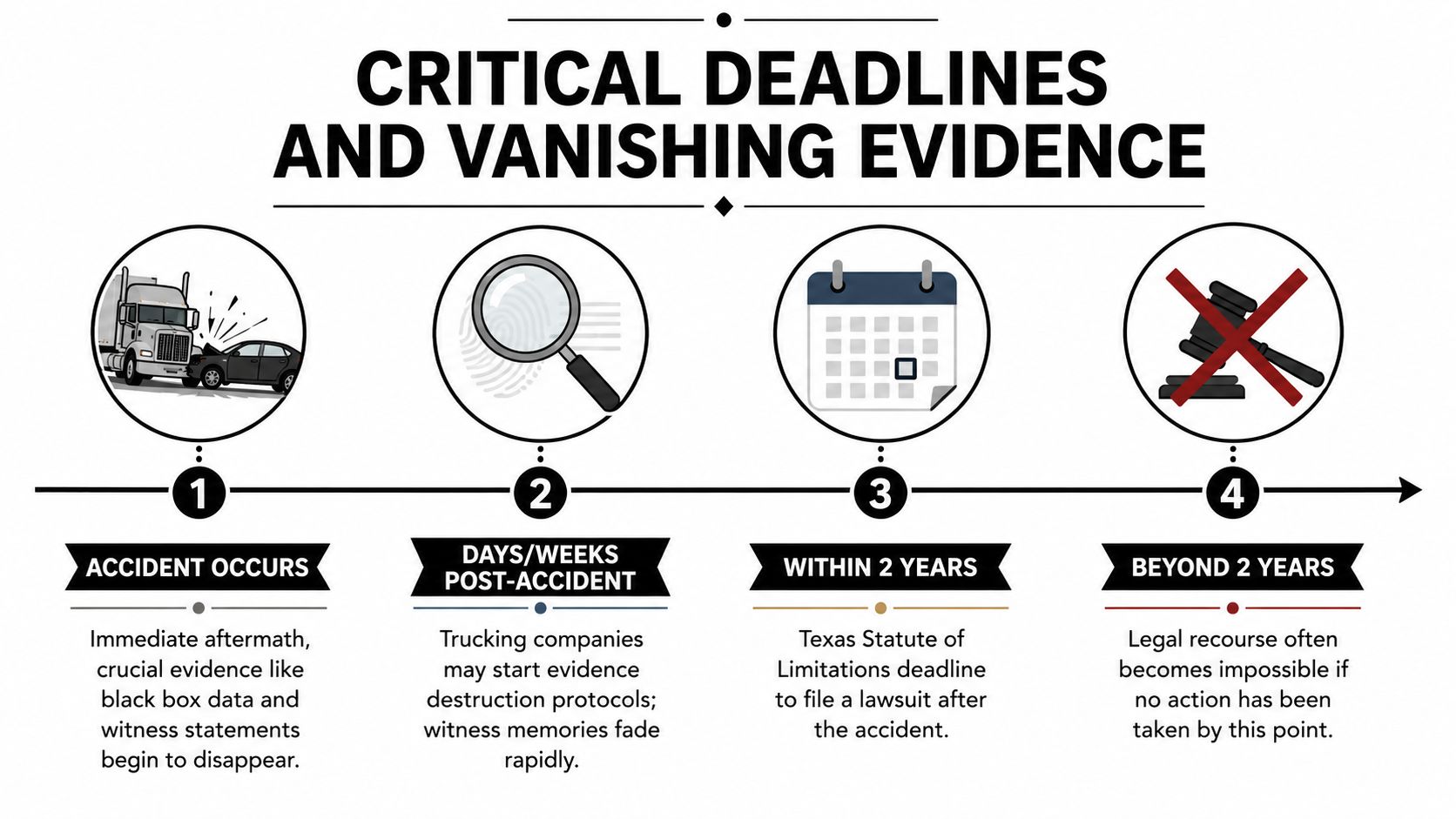
A family leaves Memorial Hermann after a long night, gets home, and hears the same advice from three different people: wait, let things settle, you have two years. After a truck wreck on I-10, the Gulf Freeway, or the North Loop, that delay can cost you proof that never comes back.
The filing deadline is not the evidence deadline
Texas law usually gives an injured person two years to file a personal injury lawsuit after a crash. A statute of limitations is the court deadline. Miss it, and the claim is usually barred no matter how serious the harm is.
That legal deadline is only part of the problem.
In a Houston 18-wheeler case, some of the best evidence starts fading out long before the two-year mark. Electronic control module data can be overwritten. Driver log information may be replaced by newer records. Trucks get repaired and put back on the road. Skid marks wash away after the next storm. If you want a clearer picture of how timing affects case value, review these truck accident settlement factors and case timing issues.
What disappears first
The early work in a truck case usually centers on preservation. That means identifying what exists, who controls it, and how to keep it from being lost through routine business practices.
A lawyer may act quickly to secure:
- Electronic truck data that can show speed, braking, throttle use, and sudden maneuvers
- Hours-of-service records that may point to fatigue, log violations, or gaps in reporting
- Inspection and maintenance files that can show recurring mechanical problems
- Dispatch messages and internal communications that may reveal delivery pressure or route demands
- Dash cam footage, photos, and witness statements while details are still fresh
- Scene evidence such as road debris patterns, gouge marks, and vehicle damage before repairs change the picture
In Harris County cases, timing matters because multiple parties may hold different pieces of proof. The trucking company has some records. The insurer may send its own investigators within hours. A shipping broker, maintenance contractor, or trailer owner may have other records your family never sees unless someone asks for them early and in the right way.
Why waiting helps the defense
Delay gives the other side room to argue. They may say the truck was repaired before anyone could inspect it, the driver no longer remembers the trip clearly, or the physical evidence on the roadway is gone. Those arguments are harder to answer once the proof has been lost.
Early legal action does not mean rushing into a lawsuit. It means sending preservation requests, identifying the right defendants, and making sure a crash on a Houston freeway is documented before routine record destruction and repair work erase the facts.
In truck cases, time does not just affect the deadline to sue. It affects what you can still prove.
What Is Your Truck Accident Claim Worth
Families often want a number right away. That's understandable, but a truck claim's value depends on the specific harm done to your life, your work, your health, and your future.
Start with the categories.
Economic and non-economic damages
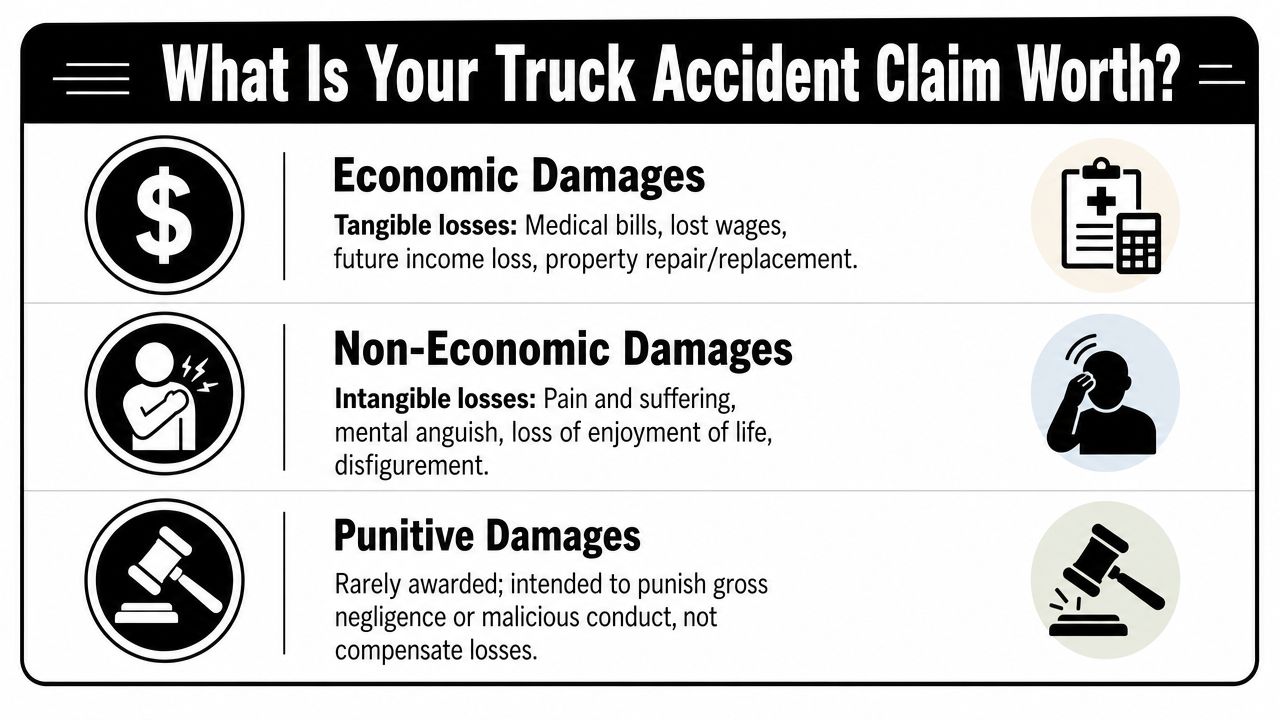
Economic damages are losses you can usually document with bills, records, or income information. These often include medical expenses, lost pay, reduced future earning ability, and property damage.
Non-economic damages are human losses that don't come with a receipt. Pain, mental anguish, physical impairment, disfigurement, and loss of enjoyment of life usually fall into this category. In a fatal case, surviving family members may pursue wrongful death compensation tied to the loss they have suffered.
Texas law also recognizes punitive damages in limited situations under Chapter 41. These are not meant to repay a loss. They are meant to punish especially serious wrongdoing. They are not available in every case.
Here is a short overview:
| Damage type | What it usually covers |
|---|---|
| Economic | Medical bills, lost wages, future care, vehicle loss |
| Non-economic | Pain, suffering, mental anguish, impairment |
| Punitive | Rare cases involving gross misconduct |
This video gives a helpful overview of truck accident compensation issues in plain terms.
Fault still affects the final amount
Even when your losses are clear, comparative fault can reduce recovery. Texas's modified comparative fault system reduces your recovery by your share of fault. For example, if you have $100,000 in damages but are found 20% at fault for a collision on I-45, you can only recover $80,000, as explained in this Texas personal injury example on shared fault and reduced damages.
That example shows why claim value is never just about adding up bills. It's also about defending your side of the story. The better the evidence on liability, the more protected your damages are from being cut down by the insurer.
Many people compare examples and timelines before deciding what to do next. This resource on trucking accident settlements can help you understand how truck cases are typically valued and negotiated.
A Houston car accident lawyer handling truck litigation should look beyond today's expenses. Serious injuries can affect future treatment, family caregiving, return-to-work plans, and daily function for a long time.
How to Choose the Right Lawyer for Your Fight
After a serious wreck on I-10, the family usually asks the same question: who can take this on? That is the right question. A truck crash case in Houston can turn into a fight with the driver, the carrier, multiple insurance companies, and outside investigators before you have even had time to understand the medical records.
Choose counsel the way you would choose a surgeon. Look for someone who handles commercial vehicle cases regularly and can explain, in plain language, what happens next.
What to look for
Ask direct questions in the first meeting, and pay attention to how clearly they are answered.
- Truck-case experience. Your lawyer should know how to get and read driver logs, electronic data, dispatch records, maintenance files, and hiring documents.
- A real plan for early evidence. In Houston truck cases, footage disappears, vehicles get repaired, and records can be lost if nobody acts quickly.
- Clear advice. You should leave the consultation understanding fault issues, insurance layers, and what your family should do over the next few weeks.
- Trial ability. Many cases settle, but settlement value often depends on whether the trucking company believes your lawyer will try the case.
- Support during the claim. Someone in the office should be handling insurer contact, paperwork, and updates so you are not chasing adjusters between doctor visits.
- Contingency fees. Most injured families need a fee arrangement that comes out of the recovery, not upfront payments.
What should make you cautious
Be careful with sales language and easy promises. A lawyer who talks only about fast money may be skipping over the hard part of a truck case, which is proving fault, preserving evidence, and building damages that will hold up under attack.
Watch for vague answers. If you ask who investigates the crash, who orders records, or whether the lawyer has handled 18-wheeler cases on roads like I-45, Beltway 8, or US-59, you should get a straight response.
The Law Office of Bryan Fagan, PLLC is one Texas firm that handles auto and trucking accident claims for injured people and families.
The right lawyer should lower your stress, not add to it. By the end of the meeting, you should know who will work on the file, what the first steps are, and how your family will be kept informed.
Frequently Asked Questions About Houston Truck Accident Claims
What if the trucking company's insurance calls me
Keep the conversation short. Confirm basic contact information if needed, but don't give a recorded statement or guess about fault. In a serious truck case, even a casual comment can be used later to reduce your claim.
Do I still have a case if I was partially at fault
Maybe, yes. Texas uses comparative fault rules, so partial responsibility doesn't automatically end a case. The key question is whether your share of fault stays low enough to allow recovery and how much the insurer is trying to place on you.
How long does an 18-wheeler accident case usually take to resolve
It depends on medical treatment, liability disputes, and how hard the trucking side fights the claim. Some cases resolve through negotiation after the evidence is gathered. Others take longer because the defense contests fault, the injuries are severe, or the case needs to be tried.
What should I do right after a truck wreck
Focus on medical care first. Then preserve anything you have, such as photos, discharge papers, bills, names of witnesses, and the crash report number. Avoid posting details online. If possible, speak with a Texas injury attorney before dealing in depth with the trucking insurer.
Can my family file a claim after a fatal truck crash
Yes, in many situations surviving family members may have the right to seek wrongful death compensation under Texas law. These cases are emotionally difficult and fact-heavy, so early legal guidance matters.
If you or someone you love was hurt in a truck wreck, help is available. The team at The Law Office of Bryan Fagan, PLLC offers a free consultation for accident victims and families who need answers about liability, insurance, damages, and next steps after a Houston 18-wheeler crash. You don't have to sort through medical bills, an auto insurance claim, and pressure from the trucking company on your own. Reach out to discuss your rights and your options in clear, practical terms.