Skip to content
A car crash can change your life in seconds, but you don’t have to face recovery alone.
If you were hit by an 18-wheeler on I-45, sideswiped by a delivery truck in Houston traffic, or lost someone you love in a fatal truck wreck, you’re probably dealing with more than pain. You’re dealing with ambulance bills, missed work, insurance calls, and a growing fear that the trucking company is already building its defense.
That fear is understandable. Trucking accident settlements are different from ordinary auto insurance claims. They involve bigger injuries, more records, more people pointing fingers, and more pressure to settle before you know what your case is really worth. The good news is that Texas law gives you tools to fight back when you know how the process works.
Your Life Changed in an Instant We Are Here to Help
A commercial truck crash doesn’t just interrupt your routine. It can split life into before and after.
One day you’re driving to work, picking up your kids, or heading home on a Texas highway. The next, you’re in an emergency room trying to answer questions you’re not ready for. How badly are you hurt? Who pays the bills? Will you be able to work again? What happens if the trucking company says the wreck was partly your fault?
Those questions are common after a serious truck wreck. They’re also urgent. In 2023, over 5,100 people were killed in crashes involving large trucks across the United States, with approximately 125,000 others injured, and nearly 76% of those deaths were occupants of passenger vehicles according to large truck crash statistics. That tells you something important. In many of these cases, the people suffering the most harm were not in the truck.
What most families are feeling right now
A worried client usually isn’t thinking in legal terms. They’re thinking:
- Can I trust the insurance adjuster: The adjuster may sound helpful, but their job is to protect the insurer’s money.
- How will I pay for treatment: Serious injuries often bring ongoing care, not just one hospital visit.
- What if I can’t go back to work: Lost income can become just as stressful as the injury itself.
- Do I really need a lawyer: In truck cases, that question matters early because key evidence can disappear fast.
You don’t need to know everything today. You need to avoid the mistakes that make a good case weaker.
There is a path forward. It starts with understanding why trucking accident settlements work differently, who may be responsible, what damages may be available under Texas law, and how to protect the evidence that gives your claim value. A skilled Texas injury attorney can help you through that process, whether your case settles through an auto insurance claim or has to be litigated.
Why Truck Accident Claims Are Different
A truck wreck case isn’t just a bigger version of a car crash claim. It runs on a different set of rules, records, and pressures.
The first difference is the amount at stake. A commercial truck collision often causes far more severe injuries than a typical passenger vehicle wreck. The second difference is the legal framework. Trucking companies and drivers may be subject to federal safety rules, including recordkeeping and hours-of-service requirements, and those records can matter when proving negligence.
The evidence is broader and more technical
In a regular car crash, the key evidence may be the police report, photos, repair estimates, and medical records. In a trucking case, the investigation often expands to include driver logs, dispatch records, maintenance history, onboard data, company hiring files, and cargo information.
That matters because liability means legal responsibility for the crash. In a truck case, you may be proving not only that the driver made a mistake, but that the company allowed unsafe conduct, ignored maintenance, or failed to follow safety rules.
Insurance and regulation change the strategy
Truck claims also tend to involve commercial insurance carriers and defense teams that respond quickly. They often know that the damages could be substantial if the injuries are serious and fault is clear. That changes how they investigate, what they ask for, and how hard they push comparative fault arguments from the start.
Here’s a simple side-by-side comparison.
| Factor | Typical Car Accident | Commercial Truck Accident |
|---|---|---|
| Insurance | Personal auto policy | Commercial policy, often with layered coverage and aggressive adjusters |
| Liable parties | Usually one or two drivers | Driver, trucking company, maintenance provider, cargo loader, manufacturer, and others |
| Evidence | Police report, photos, witness statements, medical records | Those same items plus logs, ELD data, maintenance records, company policies, and inspection files |
| Governing rules | Texas traffic and negligence law | Texas law plus federal trucking regulations that may help prove negligence |
| Defense tactics | Standard fault dispute | Early blame shifting, rapid evidence control, and company-driven claim response |
Why specialized help matters
A Houston car accident lawyer can handle many injury claims, but trucking litigation requires a deeper look at commercial practices and preservation of evidence. Even practical business issues can point to legal issues. For example, fleet operators often focus on routing, maintenance, and cost savings for fleet managers. When safety corners get cut in pursuit of efficiency, that can become part of a liability case.
A truck claim is built on records. The side that gets those records first usually has an advantage.
If you’re unsure whether your case involves an interstate carrier or a local operation, the legal distinction can affect the records and rules involved. This overview of interstate versus intrastate trucking rules in Texas is a useful starting point.
Who Is Liable in a Texas Truck Wreck
Many assume the truck driver is the only person responsible. Sometimes that’s true. Often it isn’t.
In a truck wreck, several companies may have touched the trip before the crash ever happened. One hired the driver. Another maintained the brakes. Another loaded the trailer. Another insured the risk. A settlement can rise or fall based on whether your lawyer identifies every party whose conduct helped cause the collision.
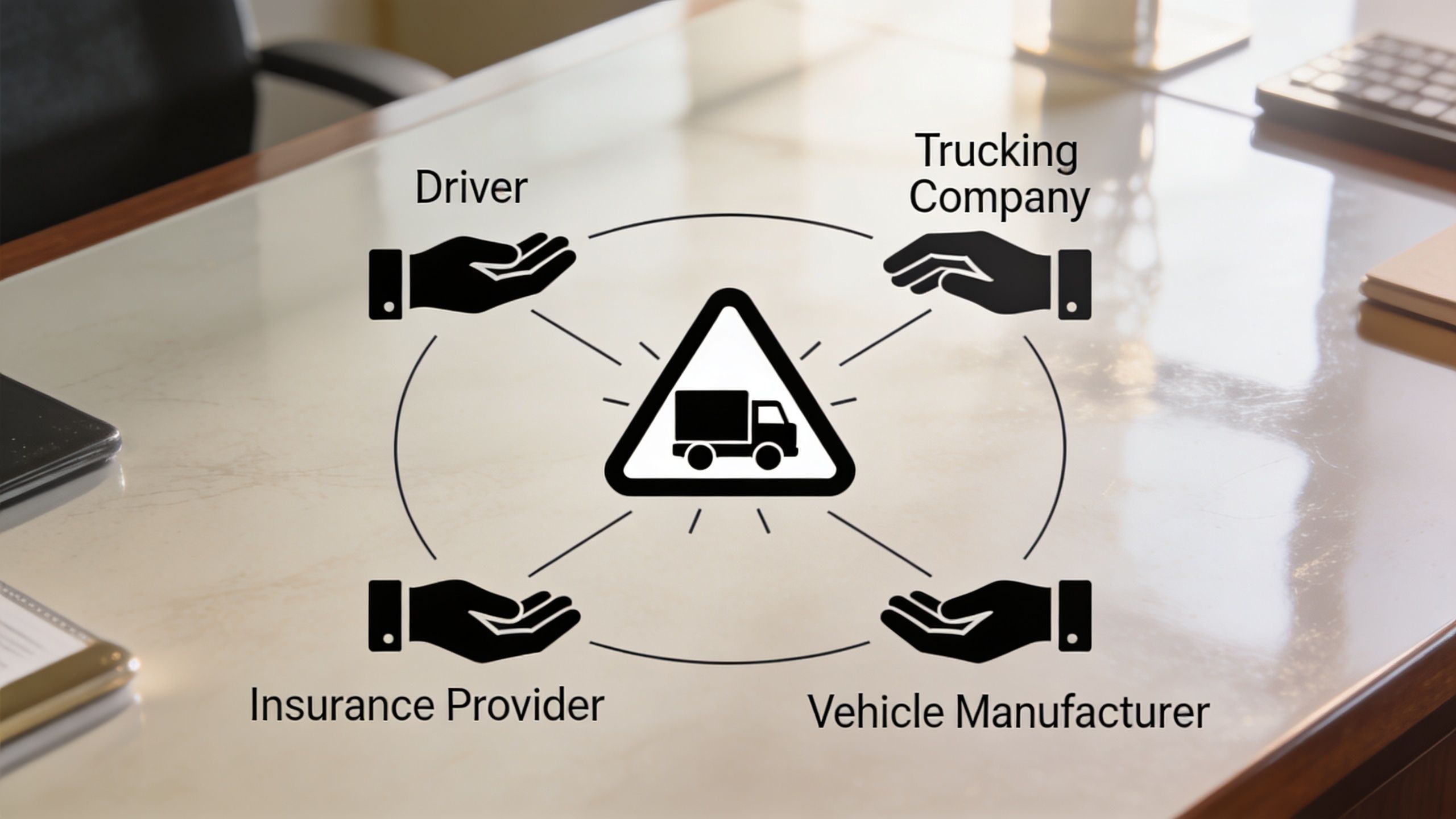
The parties who may share responsibility
A trucking case often starts with the driver’s conduct, but it shouldn’t end there.
- The driver: Speeding, distraction, fatigue, unsafe lane changes, or following too closely may all matter.
- The trucking company: A carrier may be responsible for poor hiring, weak training, bad supervision, unrealistic schedules, or pressure to ignore safety rules.
- A maintenance contractor: Brake failures, tire issues, and neglected inspections can point to a third party.
- A manufacturer: If a defective part contributed to the wreck, product liability may come into play.
- Cargo handlers: Improper loading can affect balance, stopping distance, and rollover risk.
Texas comparative fault can reduce your recovery
Texas follows modified comparative fault under Texas Civil Practice and Remedies Code Chapter 33. In plain English, comparative fault means the court or insurer may assign part of the blame to more than one person, including the injured person.
Texas 51 percent bar rule: If you are less than 51% at fault, your recovery is reduced by your share of fault. If you are 51% or more at fault, you recover nothing.
A verified example shows how this works. If total damages are $500,000 and you are found 20% at fault, your recovery drops to $400,000. If you are found 51% or more at fault, you recover nothing, as explained in this discussion of Texas truck crash comparative fault.
A real-world example helps. A Houston driver is rear-ended by a commercial truck on I-45. The trucking company admits impact but argues the driver braked suddenly and had worn brake lights. If the evidence shows the victim shares a small part of fault, the claim may still succeed, but the payout can be reduced. That’s why the early investigation matters so much.
What Chapter 41 means in severe misconduct cases
Texas Civil Practice and Remedies Code Chapter 41 deals with exemplary damages, sometimes called punitive damages. These are not available in every case. They are reserved for situations involving especially serious misconduct, such as gross negligence. In truck cases, that might be argued when a company ignores obvious safety risks or allows plainly dangerous conduct.
The practical point is simple. Liability in a truck wreck is rarely just about who touched whose bumper. It’s about who created the conditions for the crash.
Understanding the Damages You Can Recover
Once fault is being addressed, the next question is what your case may include. In injury law, damages means the losses the law allows you to recover from the person or company that caused the harm.
That doesn’t just mean the first ambulance bill. In serious truck cases, damages often reach into every part of daily life, from future care to household income to the strain on your family.
Economic damages and non-economic damages
Economic damages are the losses you can usually document with bills, records, pay stubs, or expert opinions. These often include:
- Medical costs: Emergency care, surgery, follow-up treatment, therapy, medication, and future treatment needs
- Lost wages: Time missed from work during recovery
- Reduced earning ability: If you can’t return to the same job or can’t work the same number of hours
- Other financial losses: Out-of-pocket expenses tied to the crash
Non-economic damages are harder to measure, but they are just as real. These can include physical pain, emotional distress, physical impairment, disfigurement, and loss of enjoyment of life. If a parent can no longer lift a child, sleep through the night, or return to everyday routines, that loss matters.
For a closer look at how lawyers value these losses, this guide on how damages are calculated in Texas injury cases can help.
Catastrophic injury and wrongful death claims
Some truck wrecks cause life-changing harm. Verified reporting notes that catastrophic trucking accidents often result in settlements from $750,000 to over $5 million because an 80,000-lb truck can cause injuries with lifetime costs exceeding $2 million, including spinal cord damage or traumatic brain injuries according to this overview of Houston truck accident settlement ranges.
When a family loses someone in a fatal collision, the claim may include wrongful death compensation. In plain English, that may cover losses tied to the loved one’s financial support, services, care, and relationship with the surviving family. A related survival claim may also address the harms the person experienced before death.
Some losses show up on invoices. Others show up when a family realizes life will never return to what it was.
Exemplary damages under Chapter 41
Texas Chapter 41 allows exemplary damages in limited cases involving serious wrongdoing. These claims require careful legal analysis and stronger proof than an ordinary negligence case. They are not routine, but they can matter where the facts show extreme indifference to safety.
What Determines Your Trucking Accident Settlement Value
Two truck crashes can look similar on the highway and produce very different results in settlement talks. The reason is that value comes from a combination of proof, harm, and available coverage.
A lawyer looking at trucking accident settlements focuses on how the evidence tells the story. Was fault obvious or contested? Did the records support the victim’s injuries clearly? Is the person expected to make a full recovery, or are the losses permanent?
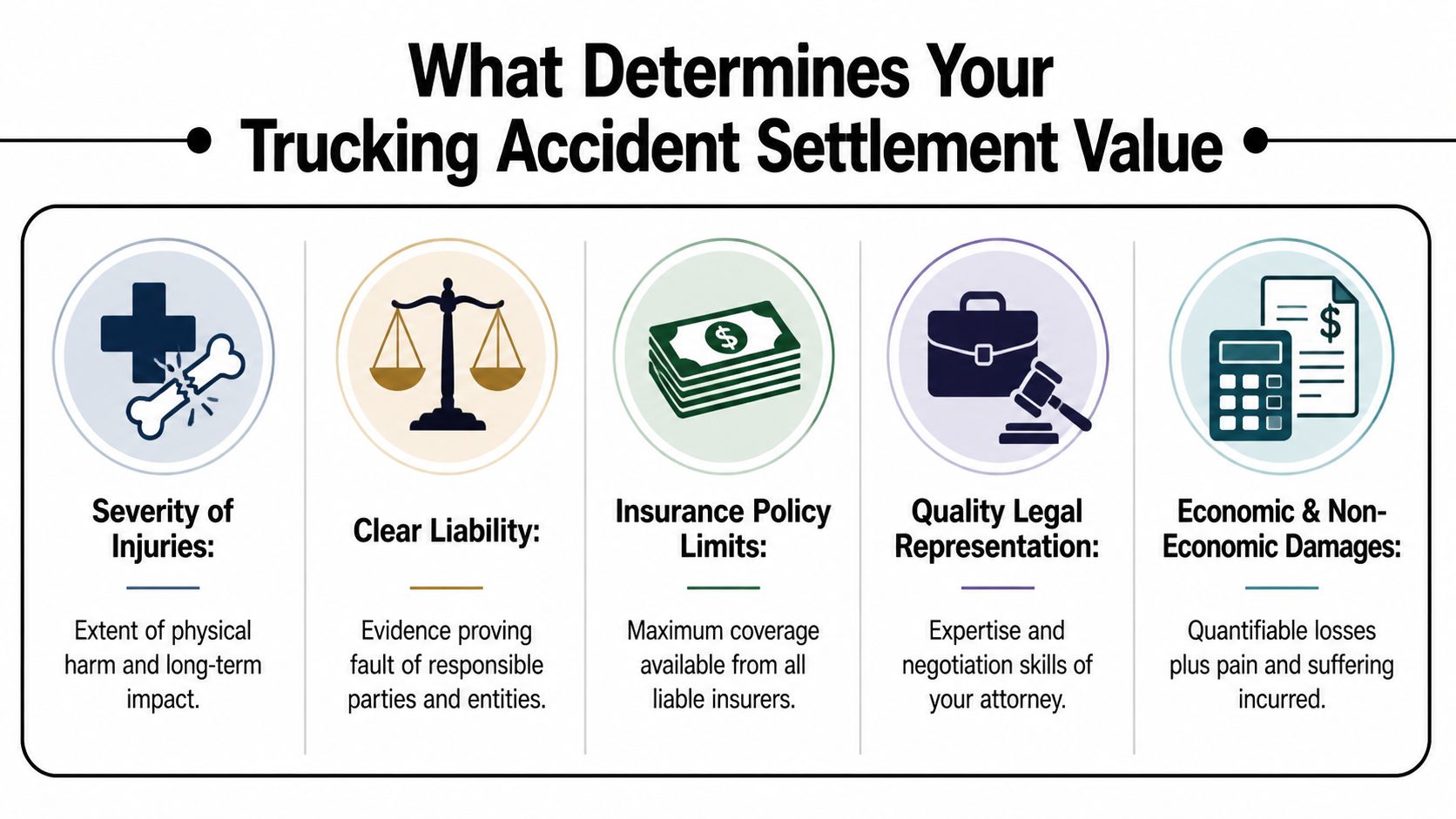
The biggest drivers of settlement value
Verified guidance shows that truck accident settlements typically range from $50,000 for minor injuries to over $1 million for severe cases, and wrongful death and catastrophic injury claims frequently surpass $5 million when there is clear evidence of trucking company negligence, such as violations of federal safety regulations, as discussed in this review of truck accident settlement ranges.
The practical factors usually include:
- Injury severity: A soft-tissue injury and a permanent spinal injury won’t be valued the same way.
- Future impact: If your treatment is ongoing or your ability to work has changed, the case value changes too.
- Clarity of liability: Strong evidence of negligence usually strengthens your negotiating position.
- Insurance limits: Even a strong case is shaped by the coverage available.
- Quality of presentation: Medical records, expert support, and a clear demand package matter.
What works and what doesn’t
Here’s what tends to help:
- Consistent treatment: Medical gaps give the defense room to argue you weren’t badly hurt.
- Early evidence preservation: Key trucking records can disappear or become harder to obtain.
- Careful communication: Casual statements to adjusters can be twisted into fault arguments.
- Realistic timing: Cases often gain value when the medical picture is clearer.
What usually hurts a case:
- Settling too early
- Posting about the crash online
- Ignoring follow-up treatment
- Assuming the police report decides everything
This video gives a useful overview of factors that can affect claim value in injury cases.
A practical outside perspective can also help if you’re trying to understand how lawyers frame value before formal negotiations. This PI attorney's guide on settlement value is useful background reading.
Strong cases are rarely built on one dramatic fact. They’re built on many small facts that line up.
The Texas Truck Accident Claim and Settlement Timeline
After a truck wreck, people want two things right away. Medical stability and financial relief. The legal process can help, but it works best when each step is handled in the right order.
Texas also has a statute of limitations, which is the legal deadline to file a lawsuit. In plain English, if you wait too long, you can lose the right to pursue your claim in court. Deadlines can depend on the facts of the case, so it’s smart to get legal advice early.
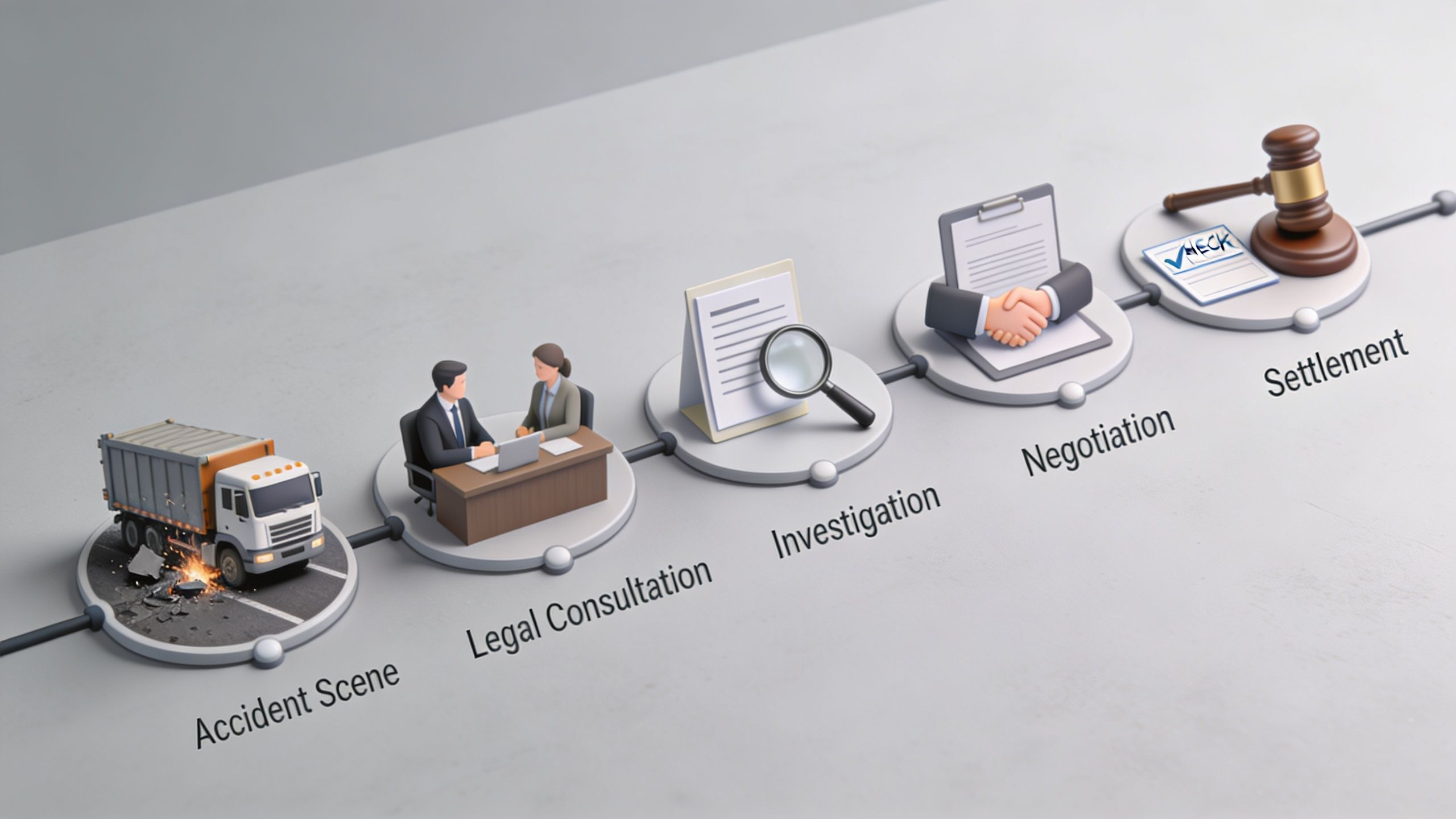
What to do first
If you’re physically able after the crash:
- Call 911 and get medical help. Your health comes first.
- Report the collision. A formal crash report helps preserve the basic facts.
- Photograph what you can. Vehicle positions, damage, road conditions, and visible injuries can matter.
- Get witness information. Independent witnesses can become important later.
- Don’t give a recorded statement to the trucking insurer right away. You may not know the full facts yet.
How the claim usually develops
After the immediate crisis, the claim often follows this pattern:
- Medical treatment continues. This creates the records that show the extent of your injuries.
- Your attorney investigates. That may include obtaining reports, scene evidence, company records, and vehicle data.
- A spoliation letter goes out. This demands preservation of critical evidence.
- A demand package is prepared. This sets out liability, damages, and the amount sought.
- Negotiations begin. The insurer may deny, delay, partially accept, or counteroffer.
- A lawsuit may be filed. If the offer doesn’t reflect the case, litigation may be necessary.
One of the most important early steps in a truck case involves onboard data. Verified guidance states that the federally mandated black box or Electronic Logging Device on most commercial trucks can prove speeding or driver fatigue, and a Texas injury attorney can send a spoliation letter to preserve that data, as explained in this article on preserving ELD evidence after a truck crash.
Settlement or trial
Most injury cases resolve through settlement, but not all should settle early. A fair resolution depends on knowing the full extent of your damages and having enough evidence to challenge the defense position.
The Law Office of Bryan Fagan, PLLC handles truck wreck claims by gathering records, evaluating liability under Texas law, and negotiating with insurers while preparing cases for litigation when needed.
The fastest offer is often not the best offer. In truck cases, speed usually helps the insurer more than the injured person.
Take the First Step Toward Your Recovery Today
Truck wreck claims are hard on families because they combine medical uncertainty with legal complexity. You may be dealing with commercial insurers, multiple defendants, federal safety issues, and blame-shifting under Texas comparative fault rules at the same time.
You don’t need to manage that alone. A lawyer can protect your rights, handle insurer contact, preserve records, and evaluate whether the offer on the table reflects your losses. That includes reviewing liability under Chapter 33, considering whether Chapter 41 may apply in serious misconduct cases, and building a claim that accounts for both financial losses and the human cost of the crash.
Why early legal help changes the case
Early action can help with:
- Evidence preservation: Trucking records don’t stay available forever.
- Insurance strategy: Once the insurer knows you’re represented, informal pressure tactics often change.
- Case value analysis: A quick offer may look helpful but still miss future care, future income loss, or major pain and suffering.
- Family protection: In fatal cases, prompt guidance can help families understand possible wrongful death compensation and next steps.
If you want to understand what happens after you hire counsel, this guide to a lawyer letter of representation after an accident is a helpful place to start.
Whether your crash happened in Houston, Dallas, Austin, San Antonio, or another Texas community, the right next step is a conversation. It costs nothing to ask questions. It can cost a lot to wait too long.
If you or your family is facing the aftermath of a truck wreck, contact The Law Office of Bryan Fagan, PLLC for a free, confidential consultation. We handle trucking accident settlements on a contingency fee basis, which means you don’t pay us unless we recover compensation for you. If you need a compassionate Houston car accident lawyer or Texas injury attorney to guide your auto insurance claim or pursue wrongful death compensation, we’re ready to help you protect your rights, your recovery, and your future.