Skip to content
A car crash can change your life in seconds, but you don't have to face recovery alone.
If you're reading this after a wreck in Houston, you may be dealing with pain, calls from insurance adjusters, a damaged car, and a growing fear about bills and missed work. That feeling is common. So is the confusion. Many people don't know whether they need a Houston car accident lawyer, how an auto insurance claim works, or what their rights look like under Texas law until they're already under pressure.
You still have options. You still have rights. And with the right information, you can make careful decisions that protect your health and your case.
Your Life After a Houston Accident
The first day after a crash often feels unreal. One minute you're heading down I-45 or trying to merge onto a feeder road. The next, you're in an ambulance, on the phone with your family, or standing beside a car you can barely recognize.
That isn't rare in Houston. In Harris County, which includes Houston, there were 10,139 car accidents in a single year involving distracted driving, resulting in 16 fatal crashes and 231 suspected serious injuries, according to Justia's Houston personal injury lawyer page. Those numbers matter because they show your situation isn't isolated. Drivers across Houston are hurt every year because another person looked away, failed to brake, or made a reckless choice.
A common example looks like this. A Houston driver gets rear-ended in traffic near downtown. At the scene, they think they're sore but okay. By the next morning, their neck is stiff, their back hurts, and they can't focus well enough to work. Then the insurance company calls and asks for a statement before they've even seen a specialist.
That's when people start asking the right questions. Who pays for treatment? What if the other driver denies fault? What if symptoms get worse? What if you can't return to work right away?
Important: The legal process can feel unfamiliar, but it usually starts with basic steps, getting medical care, preserving records, and understanding who caused the crash.
If you're trying to regain some control after a collision, it helps to start with a simple guide to auto accident recovery in Houston. Small decisions made early can shape what happens later.
You don't need to know everything today. You just need to avoid the mistakes that can make recovery harder.
Types of Cases a Houston Personal Injury Lawyer Manages
Personal injury law covers more than one kind of accident. A Houston personal injury lawyer usually handles cases where someone's careless conduct causes injury, financial loss, or death. In plain English, if another person or company failed to act safely and you got hurt, there may be a claim.
Car crashes and everyday traffic collisions
Initial thoughts on vehicle accidents often involve standard wrecks between passenger vehicles. These include rear-end crashes, intersection collisions, lane-change wrecks, and multi-car pileups.
A simple example is a driver who's stopped at a light on Westheimer and gets hit from behind by someone checking a phone. That may lead to a claim for medical bills, lost wages, vehicle damage, and pain and suffering. If you're specifically dealing with a passenger vehicle wreck, Houston Car Accident Lawyer resources can help you understand that kind of case more closely.
Truck and commercial vehicle cases
Truck cases are different because more parties may be involved. The driver, the trucking company, a maintenance contractor, or a cargo-related business may all become part of the investigation.
These claims often require careful review of driving records, company policies, and vehicle data. A crash with an 18-wheeler on a Houston freeway doesn't get treated the same way as a fender bender in a parking lot.
Rideshare and delivery driver claims
Uber, Lyft, and delivery app crashes raise complicated coverage questions. Sometimes the issue is whether the driver was logged into the app, transporting a passenger, or between jobs when the crash happened.
This area also becomes difficult when the injured person was the rideshare or delivery driver. Those cases can involve disputes over classification, insurance layers, and who should pay wage-related losses.
Wrongful death claims
When a crash causes a fatal injury, surviving family members may have a wrongful death claim. These cases are about accountability, financial support, and the lasting human impact of a death that should never have happened.
A family may pursue wrongful death compensation after a fatal drunk driving wreck, a distracted driving crash, or a commercial vehicle collision. These claims often involve both immediate losses and the deeper disruption caused by losing a parent, spouse, or child.
Catastrophic injury cases
Some injuries change daily life for months or years. These may include traumatic brain injuries, spinal trauma, severe orthopedic injuries, burns, or internal organ damage.
A low-speed collision can still cause serious harm. For example, a person who walks away from a crash on Monday may learn weeks later that they suffered a brain injury or internal bleeding that wasn't obvious at first.
Road-specific and location-based cases
Some lawyers also focus on crashes in known high-traffic corridors. For collisions along the Katy corridor, I-10 / Katy Freeway Accident Lawyer in Houston addresses representation for collisions on the I-10 Katy Freeway corridor.
Different accidents create different legal problems. The right fit is often a lawyer who understands the type of collision, the insurance issues involved, and the kind of proof needed to show fault and damages.
Who Is at Fault? Texas Negligence and Liability Explained
After a crash, people usually ask, “Who is liable?” That question drives almost every part of a personal injury case.
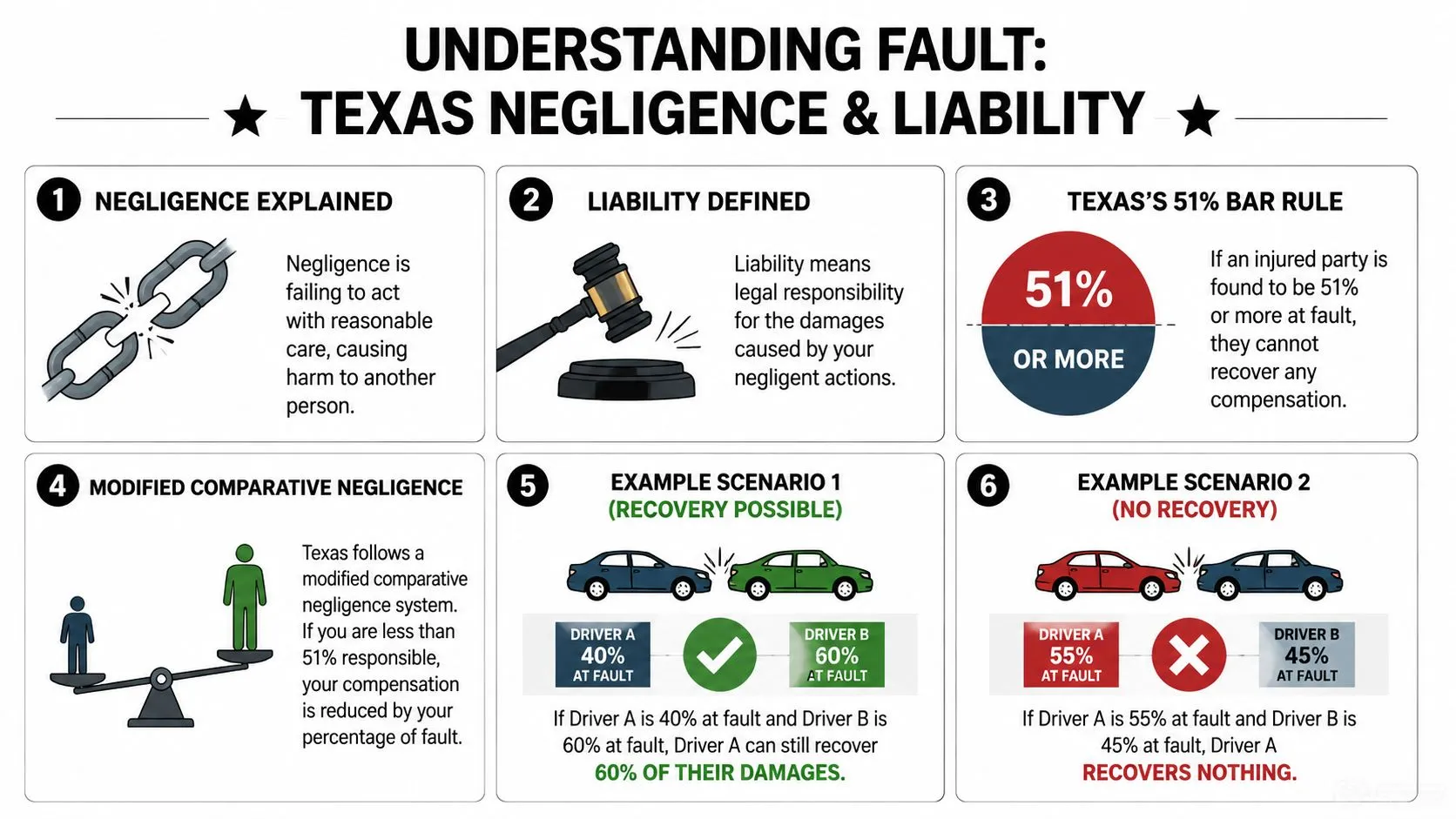
Liability means legal responsibility. If a driver caused the wreck, that driver may be liable for the harm that followed.
Negligence means failing to use reasonable care. In traffic cases, that can mean texting while driving, following too closely, speeding, running a light, or failing to keep a proper lookout.
Here is the basic rule many injured people need to know early:
How Texas comparative fault works
Texas uses a comparative fault system under Chapter 33 of the Texas Civil Practice & Remedies Code. Under Texas Civil Practice and Remedies Code Section 33.001, a claimant is barred from recovering compensation if their responsibility exceeds 50 percent. If you are 50% at fault, your recovery is reduced by 50%. If you are 51% at fault, you recover nothing, as explained by Crain Brogdon's summary of Texas negligence laws.
That rule is often called the 51% Bar Rule.
A simple example helps. Say a Houston driver is hit on I-45 after changing lanes without signaling, but the other driver was also speeding and not paying attention. If a jury decides the injured driver was 50% responsible, that driver can still recover, but the recovery is reduced by that fault percentage. If the injured driver is placed at 51% responsibility, the claim is barred.
Plain-English legal terms that matter
These terms come up in almost every case:
- Liability means who is legally responsible.
- Comparative fault means blame can be shared between both sides.
- Damages means the losses caused by the accident.
- Statute of limitations means the legal deadline to file suit.
- Negligence means someone failed to act with reasonable care.
Texas personal injury cases also involve Chapter 41 of the Texas Civil Practice & Remedies Code, which addresses damages. In everyday terms, damages are the money a person may seek for what the crash took from them.
What damages can include
Damages usually fall into two broad groups:
| Type of damages | What it usually means |
|---|---|
| Economic damages | Financial losses such as medical bills, treatment costs, lost income, and other out-of-pocket losses |
| Non-economic damages | Human losses such as pain, suffering, physical impairment, and how the injury affects daily life |
A Texas injury attorney has to do more than say you were hurt. The lawyer has to connect the other party's conduct to the wreck, the wreck to your injuries, and your injuries to your losses.
Practical rule: Don't assume fault is obvious just because the crash “looked” straightforward. Insurance companies often argue that the injured person shares blame because reducing fault reduces what they may have to pay.
Why evidence changes the fault story
Two people can describe the same crash in very different ways. That's why fault cases are built with evidence, not just opinions.
Useful proof may include:
- Police reports that record the scene and identify involved drivers
- Photos and videos showing lane positions, damage, debris, and traffic controls
- Witness statements from people who saw the collision happen
- Vehicle data when commercial or newer vehicles preserve braking or speed information
In some lawsuits, defendants may also try to point to someone else as a responsible party. Texas law allows that in certain circumstances under Chapter 33, which is one reason early investigation matters so much.
Your Step-by-Step Guide to the Personal Injury Claim Process
Once the immediate emergency has passed, individuals often want to know what happens next. The process feels less intimidating when you break it into steps.
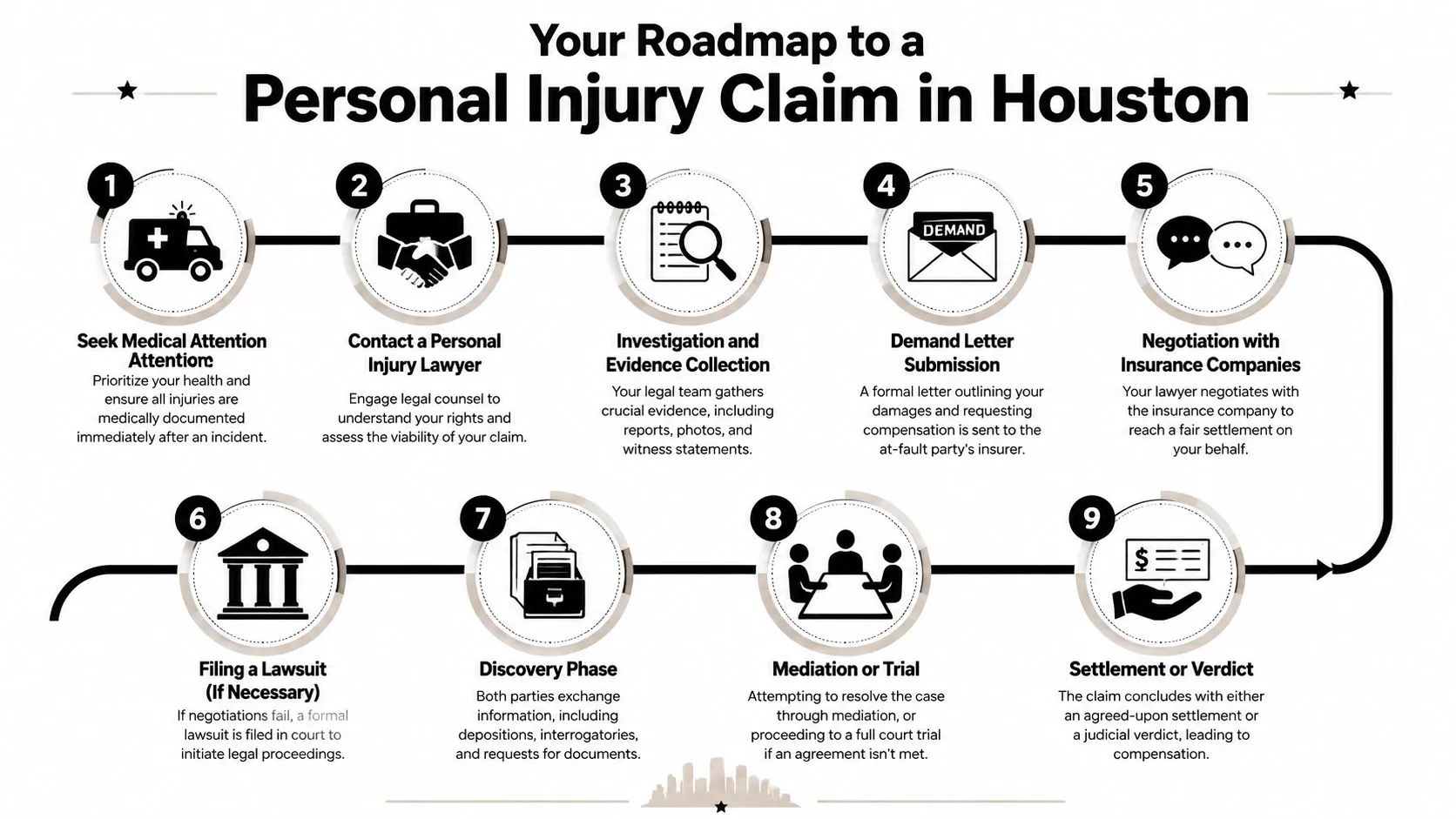
This visual gives you a quick overview of the claim path many cases follow.
Step one through step three
Start with your health. Even if you think you'll feel better in a day or two, get checked by a medical professional and follow treatment advice. Medical records often become the first clear link between the crash and your injuries.
Then contact a lawyer before giving detailed statements to the other side's insurer. If you want a broader overview first, this guide on what a personal injury claim is can help you understand the structure of a case.
Your legal team then begins gathering evidence. That may include the crash report, scene photos, witness information, treatment records, billing records, repair estimates, and proof of missed work.
Step four through step six
After the facts are clearer, the lawyer usually prepares a demand package. This is a formal presentation of your claim to the insurance company. It explains what happened, why the insured party is liable, what injuries you suffered, and what compensation is being sought.
Then comes negotiation. During negotiation, skill is paramount. According to Gain Servicing's personal injury statistics, 95–96% of approximately 400,000 personal injury claims filed annually in the U.S. are resolved through pre-trial settlements. That means most cases do not end in a courtroom verdict, but they still require serious preparation.
If settlement talks stall, a lawsuit may be filed. Filing suit doesn't always mean a trial is inevitable. It often means the case moves into a more formal stage where both sides must exchange information.
A strong negotiator is usually a lawyer who prepares every case as if it might be tried. Insurance carriers notice when a file is organized, documented, and ready for court.
For many injured people, the paperwork itself becomes overwhelming. If you want a practical look at how firms organize early forms and records, you can learn about legal client intake from Superdocu. It's a helpful way to understand why lawyers ask for medical records, insurance details, and employment information so early.
Step seven through step nine
After a lawsuit is filed, the parties enter discovery. That's the stage where they exchange documents, answer written questions, and sometimes take depositions under oath.
Some cases then go to mediation, where a neutral third party helps both sides try to settle. Others proceed to trial if the dispute remains unresolved.
Later in the process, this video may help you understand how claim development often works in real life.
The case ends in one of two main ways: a settlement agreement or a verdict. Either way, the key is building the claim carefully from the beginning.
Here's the practical order to follow after a Houston crash:
- Get medical care first so your injuries are diagnosed and documented.
- Report the collision and preserve the basic accident information.
- Photograph everything you can including vehicles, injuries, road conditions, and visible damage.
- Avoid casual recorded statements to the at-fault insurer before getting legal advice.
- Track every loss including treatment, prescriptions, travel for care, and missed work.
- Stay consistent with treatment because gaps in care often become arguments against your claim.
- Let your lawyer handle insurer communication once representation begins.
The Texas Statute of Limitations and Evidence You Must Collect
Many people think the deadline in a personal injury case is simple. They assume the clock always starts on the day of the crash and runs the same way for every injury.
That assumption can cause serious harm.
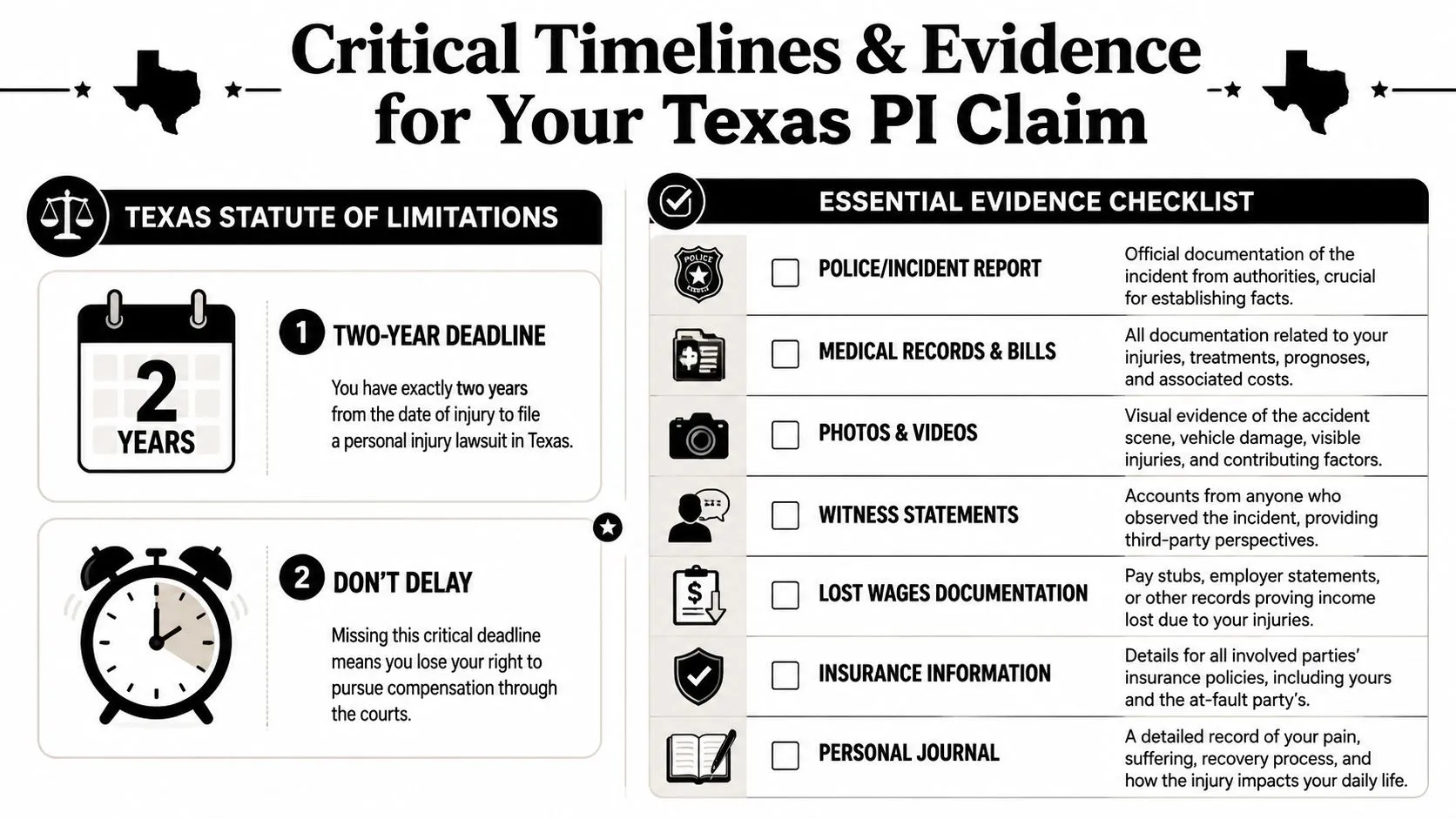
Texas has a statute of limitations for personal injury claims. In plain language, the statute of limitations is the deadline to file a lawsuit. If you miss it, you can lose the right to ask the court for compensation.
This timeline graphic highlights the deadline issue and the records you should preserve.
The delayed-injury problem many people miss
Here's where readers often get tripped up. Not every injury fully appears on the crash date.
A person may feel shaken but stable after a low-impact collision. Weeks later, they develop headaches, dizziness, memory trouble, abdominal pain, or symptoms tied to an internal injury. When that happens, the legal deadline may become more complicated than people expect.
A 2024 Harris County Medical Society study found that 42% of Houston car accident victims with delayed internal injury diagnoses filed claims after the 2-year deadline because they were unaware of the discovery rule exception, according to Abraham Watkins' discussion of delayed diagnosis and limitations. The discovery rule can extend the clock if an injury was not reasonably discoverable earlier.
That doesn't mean every delayed symptom automatically extends a deadline. It means you shouldn't assume you're out of time or that the date is always straightforward.
If your symptoms appeared later, don't guess about the filing deadline. A delayed diagnosis case needs legal review quickly because timing arguments can decide the whole case.
For a general outside explanation of timing issues, ProPlaintiff.ai's guide to deadlines is a useful companion read. For Texas-specific guidance, review this page on statutes of limitations in Texas.
Evidence you should start collecting now
Even before fault is fully disputed, you can protect your claim by preserving the right records.
- Crash report helps fix the date, location, and involved parties.
- Medical records and bills show when symptoms began, what doctors found, and what treatment you needed.
- Photos and video can capture visible injuries, car damage, skid marks, road conditions, and traffic signals.
- Witness information becomes valuable if memories fade.
- Pay records can help prove lost earnings and missed time from work.
- Insurance information keeps coverage questions from slowing down the case.
- A personal journal can document pain, sleep problems, missed family activities, and daily limitations.
Why early documentation matters
Insurance companies often focus on gaps. They may argue there's a gap between the crash and treatment, a gap between symptoms and diagnosis, or a gap in proof of lost income.
You can reduce those arguments by being organized. Save discharge instructions. Keep appointment dates. Store receipts. Write down how your injuries affect driving, sleeping, working, and basic chores.
That kind of recordkeeping won't replace legal advice, but it gives your attorney something solid to work with when the other side questions your claim.
How to Choose the Best Houston Personal Injury Lawyer for You
A week after a Houston crash, many injured people are still trying to answer basic questions. Why does my shoulder hurt more now than it did that day? Why is the insurer already asking for a statement? Do I need a lawyer yet, or should I wait until the diagnosis is clearer?
Those questions matter because hiring a personal injury lawyer is not only about filing paperwork. It is about choosing someone who understands timing. In Texas, delayed-onset injuries can create real problems if a lawyer treats your case like a routine fender bender instead of a developing medical story with a legal deadline attached.
A good consultation should leave you calmer and better informed.
What you should listen for
Start with clarity. A lawyer should be able to explain fault, insurance coverage, damages, and deadlines in plain English. If you leave the call with more legal terms than answers, that is a sign the lawyer may not communicate well when your case gets more difficult.
You also want a lawyer who pays close attention to your medical timeline. Some injuries announce themselves right away. Others work more like a hairline crack in a foundation. The problem is present early, but the full damage shows up later. In Houston injury cases, that detail can affect both proof and timing, especially if the insurer argues your later symptoms came from something other than the accident.
Ask whether the lawyer has handled cases with delayed treatment, delayed diagnosis, or symptoms that worsened over time. That question is often more revealing than asking how many cases the firm has handled in general.
One factual option in this space is The Law Office of Bryan Fagan, PLLC, a Texas-based firm that handles auto accident cases, including claims involving distracted drivers, uninsured or underinsured motorists, trucking crashes, and fatal collisions.
Questions to ask during a consultation
Use these questions to see whether the lawyer is a fit for your case, not just whether the firm has a polished intake process.
| Question Category | What to Ask |
|---|---|
| Case experience | Have you handled cases involving this type of crash and these kinds of injuries? |
| Delayed symptoms | How do you handle a case if pain, numbness, or other symptoms appeared days or weeks after the collision? |
| Texas deadlines | How do you evaluate the filing deadline if an injury was not fully diagnosed right away? |
| Insurance strategy | Who will deal with the insurance company, and what should I say or avoid saying? |
| Communication | Will I speak with my lawyer directly, and how often should I expect updates? |
| Evidence review | What records do you want to see first, and what gaps could hurt the case? |
| Litigation readiness | If the insurer disputes the injury or offers too little, are you prepared to file suit? |
| Fees | Is this a contingency fee case, and will I owe anything upfront? |
Listen closely to how the lawyer answers, not just what answer they give. A careful attorney will usually explain what is known, what still needs proof, and what should happen soon to protect the claim.
Red flags you should not ignore
Stress makes it easy to miss warning signs. Slow the conversation down and look for these problems.
- Promises about a specific payout early in the case. No ethical lawyer can know that yet.
- Pressure to sign immediately before your questions are answered.
- Little interest in your symptom timeline or whether your diagnosis changed after the first ER visit.
- Vague fee explanations that leave you unsure about case costs and expenses.
- No clear plan for disputed causation if the insurer says your injury is preexisting or unrelated.
- No discussion of filing deadlines even though Texas time limits may keep running while doctors are still figuring out the full injury.
That last point gets overlooked often. A lawyer does not need to create panic, but the lawyer should explain that waiting for a perfect diagnosis can be risky. The legal clock and the medical timeline do not always move at the same speed.
Ask how the lawyer handles hard facts. A strong answer should cover delayed symptoms, inconsistent early records, comparative fault, and insurer arguments about causation.
How contingency fees usually work
Most personal injury lawyers work on a contingency fee. You usually do not pay attorney's fees upfront. The lawyer is paid from a recovery if the case succeeds, subject to the fee agreement you sign.
That arrangement can help if you are already dealing with treatment bills, missed work, and a car that still needs repairs. Still, ask for the fee agreement in writing. Read how the percentage is calculated, what case expenses may be charged, and what happens if there is no recovery.
Organization matters here too. Good lawyers build cases from records, timelines, and receipts, not memory alone. For the practical side of tracking costs during a legal matter, ReceiptsAI for legal professionals shows how expense documentation can be organized. It does not replace legal advice, but it highlights a simple truth. Clean records make it easier for your attorney to prove what the injury has cost you.
Common Questions About Houston Personal Injury Claims
What if I was partly at fault?
You may still have a case. Texas follows comparative fault rules, so partial responsibility doesn't always end the claim. The exact outcome depends on how fault is assigned under Texas law and how strong the evidence is.
How much is a personal injury case worth?
There's no single answer. Value depends on the seriousness of the injury, the medical proof, lost income, future care, pain and suffering, and how clear liability is. As a general benchmark, the average payout among surveyed plaintiffs in personal injury cases is $52,900, and the average auto liability claim for bodily injury in 2024 rose to $27,373, according to Casepeer's personal injury statistics. Those figures are not a prediction for your case. They show that outcomes vary widely.
What if the other driver has no insurance or not enough insurance?
That situation may still leave options. Your own policy may include uninsured or underinsured motorist coverage, and there may be additional issues involving vehicle ownership, employment-related driving, or other potentially liable parties. A lawyer can review all possible sources of recovery.
Do I need a lawyer for an auto insurance claim?
Not every crash requires legal representation, but many do. If your injuries are serious, fault is disputed, symptoms appeared later, or the insurer is pushing for a quick statement or low offer, legal help can be important.
Can I afford a Houston car accident lawyer?
Many injury firms handle cases on contingency, which usually means no upfront attorney's fee. Ask for the fee agreement in writing and make sure you understand it before signing.
What should I do today?
Get medical care if you haven't already. Preserve every record you can. Don't guess about deadlines, especially if your symptoms developed over time. And don't let the insurance company define your case before you understand your rights.
If you were hurt in a crash and need clear guidance on your rights, contact The Law Office of Bryan Fagan, PLLC for a free consultation. You can talk through what happened, learn how Texas negligence and damages rules may apply, and get help understanding your next steps without pressure or obligation.