A car crash can change your life in seconds, but you don't have to face recovery alone.
If you're reading this after a truck wreck in Houston, you may be sitting in an ER, waiting on a repair estimate, trying to calm your family, or wondering why the trucking company's insurer has already called. That confusion is normal. A collision with an 18-wheeler can leave you dealing with pain, missed work, damaged property, and a lot of pressure before you've even had time to process what happened.
Truck crashes in Houston aren't rare events. They happen on roads people use every day, including I-45, I-10, and Loop 610. The legal issues are also different from a typical fender bender. That's why many people start looking for a Houston truck accident lawyer soon after a serious collision. They want answers, not jargon. They want to know what to do next, what evidence matters, and how Texas law affects their rights.
One issue deserves immediate attention: the truck's electronic logging device, often called ELD data. That record can help show whether a driver had been on the road too long, whether fatigue played a role, and whether the company followed safety rules. In many cases, waiting too long can make that evidence harder to get.
A Houston Truck Accident Can Change Your Life in Seconds
You may have been driving home like any other day. Traffic slows. A commercial truck doesn't stop in time. In a moment, your plans for the week are replaced by ambulance bills, calls to your employer, and questions from insurance adjusters.
That kind of shock is common after a major truck collision. So is the feeling that nobody around you understands how serious it is. Friends may compare it to a car wreck. Insurers may treat it like a routine claim. But a heavy-truck crash often affects every part of daily life at once.
Why Houston drivers face this risk so often
Houston is at the center of Texas trucking traffic, and the crash volume reflects that reality. Harris County records over 4,000 commercial truck crashes annually, more than double the next-highest county in Texas, and nearly one in six large truck accidents in the state happens within Houston's boundaries according to Texas truck accident statistics for Harris County and Houston.
That matters because high-volume crash areas create high-pressure claims. Police reports, witness memories, roadway footage, company records, and medical treatment all start moving quickly. If you don't act early, key evidence can slip away.
Practical rule: Treat a truck crash differently from a normal insurance claim. The first few days can shape the entire case.
What many families need most right away
Potential clients don't need legal buzzwords on day one. They need a short list:
- Get medical care first. Your health comes before paperwork.
- Preserve what you have. Save photos, discharge papers, receipts, and voicemails.
- Be careful with statements. Don't guess about fault when you're shaken and in pain.
- Ask early about truck evidence. ELD data, driver logs, and company records may matter more than eyewitness opinions.
A rear-end collision on I-45 is a good example. In a regular car claim, the dispute may focus on repair costs and basic liability. In a truck case, the same crash may also involve fatigue records, company supervision, maintenance history, and multiple insurance layers. That's why legal help can make the process feel more manageable. A good Texas injury attorney should help you understand your rights in plain language, not make things harder.
Why Truck Accidents Are More Complex Than Car Wrecks
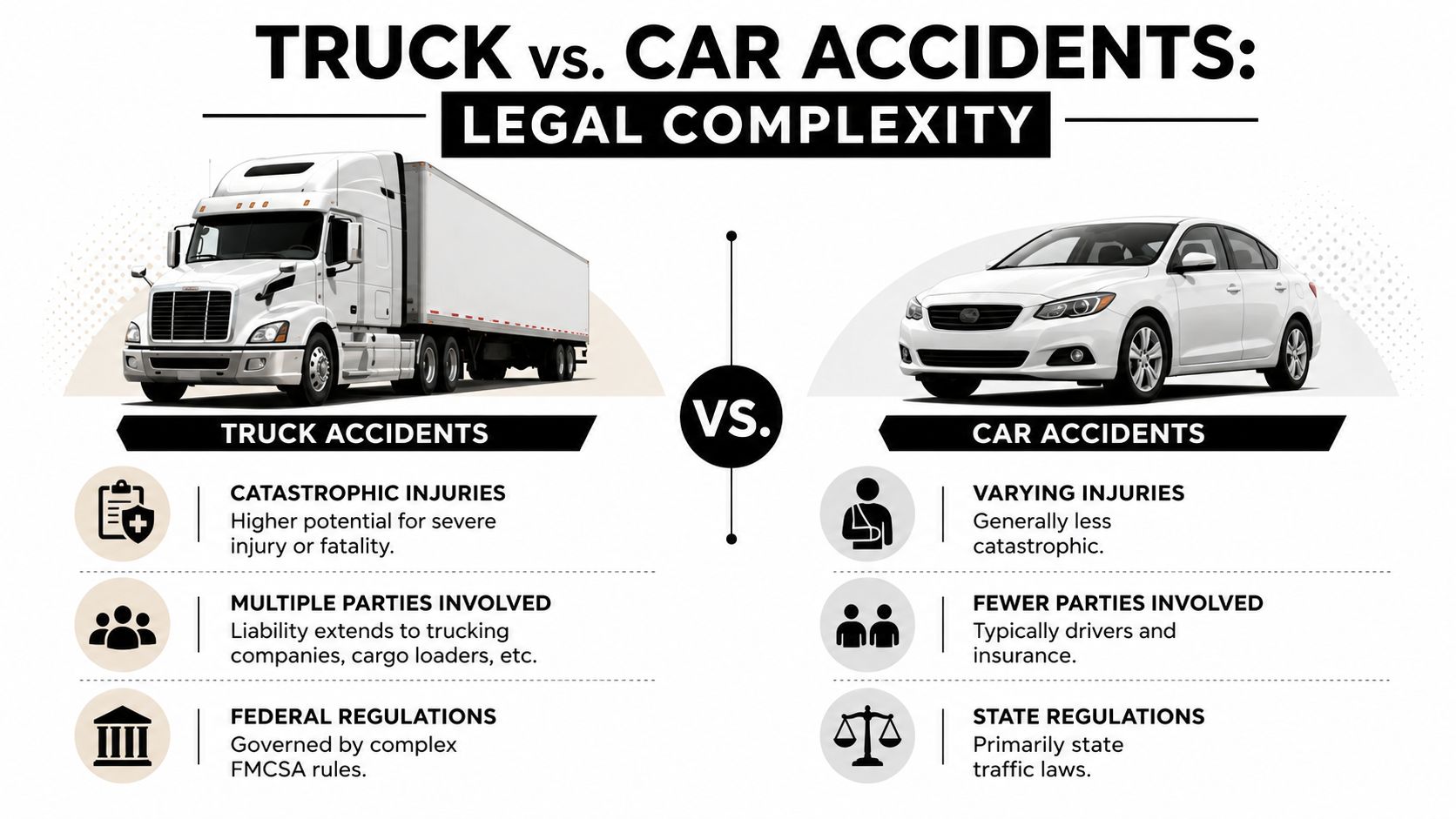
A truck accident case isn't just a larger version of a car wreck. It usually involves more serious injuries, more rules, and more people who may share responsibility.
Texas saw 720 deaths from large truck crashes in 2024, the highest total in the nation, while Houston recorded 301 traffic fatalities in 2024, a 15% increase from the previous year according to large truck crash fatality data from the NSC. Those numbers help explain why truck litigation often becomes more intensive than an ordinary auto insurance claim.
The injuries are often more severe
A passenger vehicle offers very little protection against a loaded commercial truck. When impact forces are higher, the claim usually includes more medical providers, longer treatment, and tougher disputes over future care.
That changes the legal work. Your lawyer may need to gather hospital records, surgical records, therapy notes, and work-loss proof early. If the crash caused a fatal injury, the legal issues may also include wrongful death compensation for surviving family members.
The rules are broader than ordinary traffic law
Truck cases can involve state negligence law and trucking-specific safety requirements. Some disputes center on driving hours, rest breaks, inspections, maintenance, training, or supervision. If fatigue is suspected, records tied to hours of service can become central.
If you want background on one trucking rule that often comes up in fatigue discussions, this overview of the new 14-hour rule for truck drivers gives useful context.
More than one party may be legally responsible
In a normal two-car crash, the focus is often just on the drivers and their insurers. A truck case can be wider.
A claim may involve:
- The truck driver for careless driving, distraction, speeding, or fatigue
- The trucking company for supervision, retention, dispatch decisions, or responsibility for the driver's conduct
- A cargo loader if the load shifted or was not secured properly
- A maintenance provider or parts maker if brakes, tires, or other equipment failed
A strong truck case often turns on company records, not just the crash scene.
That's one reason people searching for a Houston car accident lawyer after a trucking collision often realize they need someone comfortable with commercial vehicle cases in particular. The injuries may look similar on the surface. The evidence usually doesn't.
Critical First Steps After a Houston Truck Crash
The first hours and days after a truck wreck are about protecting your health and your claim at the same time. You don't need to do everything perfectly. You do need to avoid the mistakes that make recovery harder later.
A simple checklist helps.
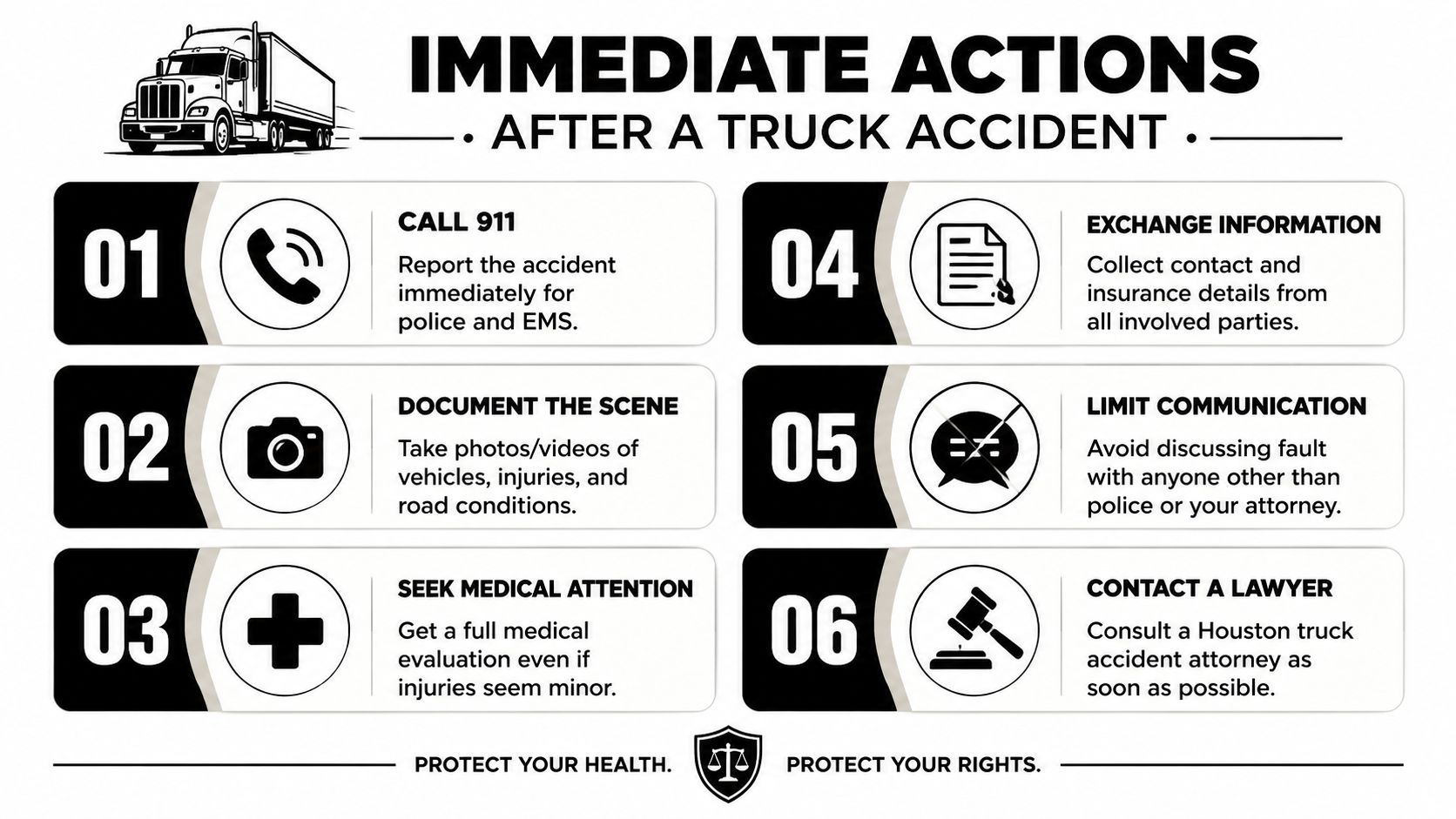
What to do at the scene and right after
Call 911
A police report creates an early record of what happened. Emergency medical care also protects both your safety and your documentation.Get medical attention even if you think you can walk it off
Some injuries get worse after adrenaline wears off. Follow-up care matters too, not just the first visit.Take photos and video if you can do it safely
Capture vehicle positions, damage, road conditions, skid marks, debris, and visible injuries.Exchange information
Get the driver's name, employer, truck number, insurance details, and contact information for witnesses when possible.Don't discuss fault
A simple “I'm sorry” can be twisted later. Stick to facts when speaking with police.Notify your insurer carefully
Report the crash, but don't guess about injuries or blame.
For broader guidance after any vehicle collision, this article on 18-wheeler crashes is a useful starting point.
A related local resource is Houston Car Accident Lawyer, which provides representation for car accident victims in Houston and Harris County. Many post-crash basics overlap, but truck cases add evidence issues you should treat as urgent.
Here's a short video overview that can help you think through those first decisions.
The evidence most people miss
The most overlooked step is asking for preservation of the truck's electronic records right away. That usually means your lawyer sends a spoliation letter, which is a formal written demand telling the trucking company to keep evidence and not destroy it.
Victims must demand the trucking company's ELD data within days or risk its deletion. 2025 NHTSA reports cited on a Houston truck accident attorney page state that ELD data is 90% more effective than witness testimony in proving driver fatigue, a factor in 38% of fatal Houston truck accidents according to Houston truck accident attorney discussion of ELD evidence.
Why ELD data can change a case
An ELD can help show:
- How long the driver had been on duty
- Whether rest periods matched the logs
- When the truck was moving and when it stopped
- Whether a fatigue defense is supported by data instead of memory
Take a common example. A Houston driver is rear-ended by a tractor-trailer on Loop 610. The truck company says the driver was alert and the crash happened because traffic changed suddenly. Witnesses disagree. If ELD records show the driver had been operating for a long stretch before impact, that record may give your lawyer objective proof that fatigue needs serious scrutiny.
That's why one of the first calls after medical care should be to a lawyer who knows how to demand and preserve trucking evidence fast.
Unraveling Liability in a Texas Truck Accident Claim
After a crash, people often ask one question first: who is liable? In plain English, liability means legal responsibility. If a person or company caused the crash, that party may be liable for your losses.
Texas truck cases usually begin with negligence. Negligence means failing to use reasonable care. A truck driver who speeds through slowed traffic, drives while distracted, or keeps driving when too fatigued to react safely may be negligent.
The building blocks of a negligence claim
Most truck injury claims come down to four ideas:
| Legal term | Plain-English meaning |
|---|---|
| Duty | The driver had a legal duty to act with reasonable care |
| Breach | The driver or company failed to meet that duty |
| Causation | That failure caused the crash |
| Damages | You suffered losses such as medical bills, lost income, or pain |
Damages means the harm the law can compensate. In a truck case, damages may include financial losses and human losses, such as pain or disability.
Texas law also recognizes comparative fault, often called proportionate responsibility. That means more than one party can share blame. If you were partly responsible, your compensation can be reduced by your percentage of fault.
Why fault percentage matters so much
Under Texas Civil Practice and Remedies Code § 33.001, you cannot recover damages if your share of responsibility is greater than 50 percent according to Texas Civil Practice and Remedies Code section 33.001.
That rule confuses many people, so here's a simple example. Suppose a jury decides your total damages are $100,000. If the jury finds you 20% responsible, your recovery is reduced by 20%, so you could recover $80,000 before other legal adjustments. If the jury finds you 51% responsible, you recover nothing.
Insurance companies often look for small facts they can use to argue you share more blame than you really do.
That's why wording matters after a crash. If you tell an adjuster, “I may have stopped suddenly,” they may try to turn that into a comparative fault argument. Your lawyer's job is to push back with evidence, context, and a full reconstruction of what happened.
Trucking company liability is often separate from the driver
A company may also be responsible for what its driver did. Texas law allows vicarious liability in the right circumstances. In plain terms, that means an employer can be legally responsible for an employee's negligence while the employee was doing job-related work.
To prove that kind of employer responsibility in Texas, a plaintiff must show the driver was an employee at the time of the crash and was acting within the course and scope of employment. There is also a legal presumption when the driver is operating a company-owned truck, as discussed in this Texas vicarious liability analysis involving employer responsibility.
That issue can matter a lot in serious injury and fatal cases. Families dealing with the loss of a loved one may also need information from a Houston Wrongful Death Lawyer, which concerns representation for Houston families who lost a loved one to negligence.
Texas negligence law also includes broader rules found in Chapters 33 and 41 of the Texas Civil Practice and Remedies Code. Chapter 33 deals with fault allocation. Chapter 41 addresses certain damages issues in civil cases, including exemplary damages in appropriate circumstances.
The Timeline for Your Truck Accident Case
One reason people delay getting legal advice is that they don't know what a case will look like. The process feels abstract until someone lays it out in plain terms.
Most truck accident claims follow a path. The exact timing depends on medical treatment, the amount of evidence, and whether the insurer disputes liability or damages.
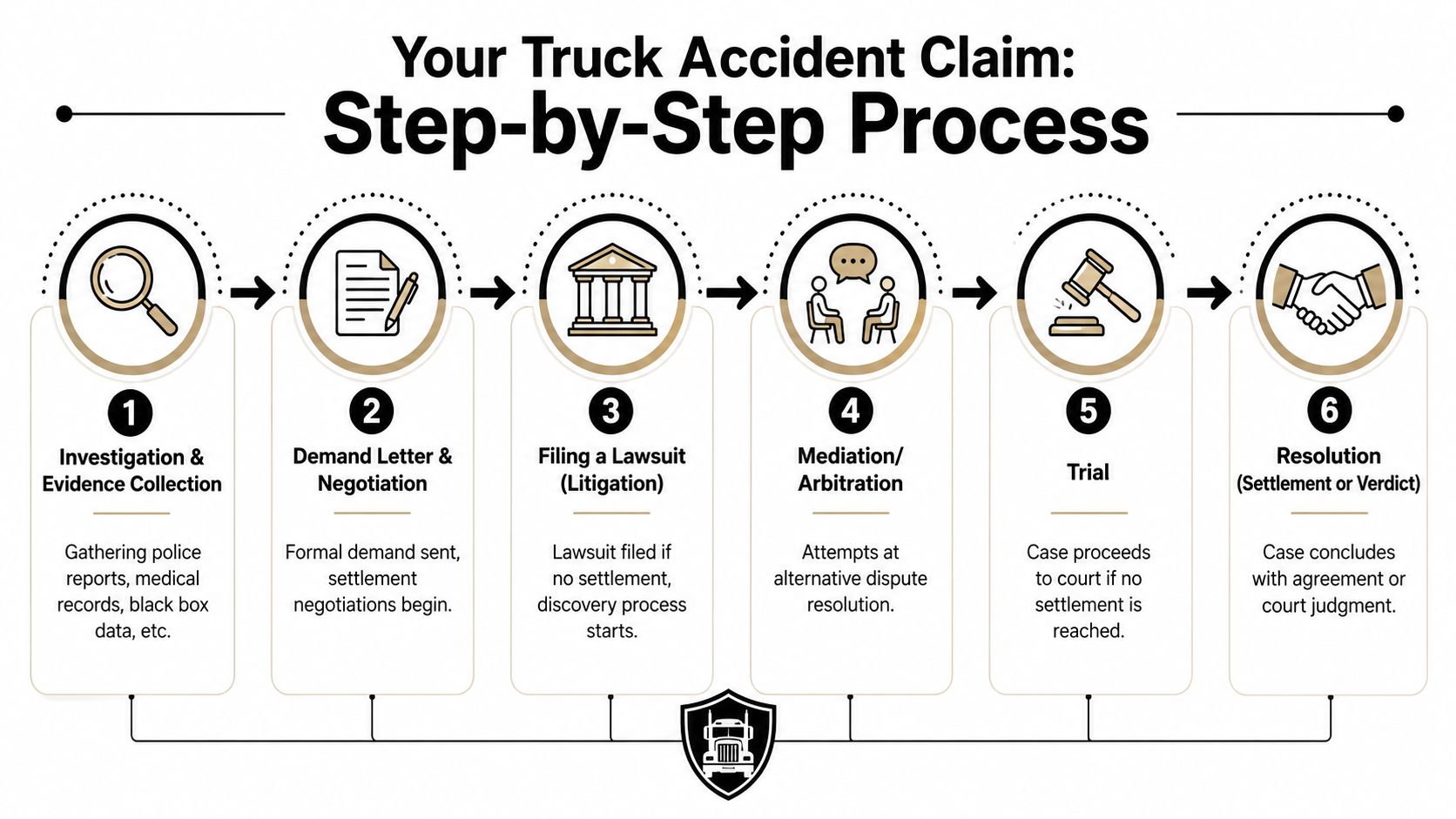
The usual stages of a claim
Investigation begins
Your lawyer gathers police reports, medical records, photos, witness statements, and trucking evidence.Claim presentation
Once your injuries and losses are documented, the insurer receives a demand package explaining liability and damages.Negotiation
Many cases resolve here, but only after the other side sees the claim is prepared carefully.Lawsuit if needed
If negotiations stall, a lawsuit allows formal discovery, depositions, and court oversight.Mediation or trial preparation
Cases are often discussed in structured settlement talks before trial.Resolution
The case ends in a settlement or verdict.
The deadline you cannot ignore
Texas gives injured people a limited time to sue. The statute of limitations is the legal deadline for filing a lawsuit. In Texas personal injury cases, that deadline is exactly two years from the date of the accident, and missing it means losing the right to compensation, as explained by Texas Law Help on the two-year statute of limitations under section 16.003(a).
That doesn't mean you should wait almost two years. Early action helps preserve evidence, especially in truck cases where company records and electronic data may not be kept forever.
A case can feel quiet at first. That doesn't mean nothing is happening. Good legal work often starts long before a lawsuit is filed.
Why early preparation can improve negotiations
Insurance companies evaluate risk. When they see a file built around medical proof, documentation, preserved records, and trial-ready facts, the conversation changes. That doesn't guarantee a result. It does put you in a stronger position.
A Houston driver struck by a commercial truck on I-10 may think the case is only about fixing a vehicle and reimbursing an ER visit. Months later, the same claim may involve therapy, time off work, ongoing pain, and a dispute over future care. That's why many lawyers prepare truck cases as if litigation may be necessary from the beginning, even while working toward settlement.
If you're also trying to understand how a claim moves from evidence collection to negotiation and resolution, it helps to think of the legal process as a series of decisions, not one giant event. Each step builds on the last.
Understanding the Compensation You Can Recover
People often use the word “compensation” broadly, but Texas injury law uses the term damages. Damages are the losses the law may allow you to recover when someone else's negligence causes harm.
In plain English, those losses usually fall into two groups: economic damages and non-economic damages. In rare cases involving especially serious misconduct, Texas law may also allow exemplary damages under Chapter 41 of the Texas Civil Practice and Remedies Code.
Economic damages
These are the direct financial losses tied to the crash. They can include:
- Medical bills such as ambulance care, hospital treatment, surgery, medication, and therapy
- Lost wages if you missed work while recovering
- Reduced earning ability if your injuries affect the kind of work you can do in the future
- Rehabilitation costs for ongoing physical or occupational therapy
- Property damage to your vehicle and other personal items
A good way to think about economic damages is this: if the loss can usually be tracked with bills, records, pay stubs, invoices, or estimates, it likely fits here.
Non-economic damages
These losses are real, even though they don't come with a receipt.
They may include physical pain, mental anguish, physical impairment, disfigurement, and loss of enjoyment of daily life. If you can't sleep, can't pick up your child, can't drive without panic, or can't return to the routine you had before the crash, those harms matter.
Your case is not only about what you paid. It's also about what the injury took from your daily life.
Wrongful death and severe injury claims
When a truck crash causes a fatal injury, surviving family members may have a different type of claim. Those cases may involve funeral-related losses, lost financial support, and the personal loss that follows a preventable death. That's where the phrase wrongful death compensation usually comes into play.
If you want a broader discussion of how lawyers and insurers approach claim value without relying on promises or fixed numbers, this overview of truck accident settlements can help.
One point is worth remembering. Damages aren't self-proving. You usually need records, testimony, and a clear story that connects the crash to the losses you're claiming. That's one reason organized documentation matters so much after a wreck.
How to Choose the Right Houston Truck Accident Lawyer
Not every personal injury lawyer handles truck cases the same way. If your crash involved a commercial vehicle, you should feel comfortable asking direct questions before hiring anyone.
A careful choice now can make the months ahead less stressful. You want clear communication, realistic advice, and someone who understands both injury law and trucking evidence.
Questions worth asking in a consultation
Consider asking:
- How often do you handle truck accident cases in Texas?
- Who will work on my file day to day?
- How do you preserve evidence like ELD records and company documents?
- How do you deal with comparative fault arguments from insurers?
- Are you prepared to file suit if the insurer won't offer a fair resolution?
Listen to how the lawyer answers. Clear, calm answers usually matter more than polished sales language.
What plain communication looks like
A strong attorney should explain basic terms in words you can use. For example:
- Liability means who is legally responsible.
- Comparative fault means your compensation can be reduced if you share blame.
- Damages means the losses the law may compensate.
- Statute of limitations means the filing deadline.
If a lawyer can't explain those ideas clearly, it may be hard to trust that office with the practical parts of your claim.
Fees and decision-making
Many Texas injury firms, including The Law Office of Bryan Fagan, PLLC, handle personal injury matters on a contingency-fee basis. That means the fee is tied to the outcome of the case rather than paid up front. You should still ask for the fee agreement in writing and make sure you understand costs, communication, and who has authority to approve settlement decisions.
You may also want to look at how firms present information to the public. Good legal education online can help you judge whether an office values clarity. For readers interested in that side of the industry, this guide to SEO strategies for law firms offers useful context on how law firms build informative online content.
A final example helps. Suppose a Houston family is contacted by a trucking insurer within days of a fatal crash. They don't just need someone to open a claim. They need a lawyer who can spot preservation issues, protect the family from harmful statements, and evaluate whether the company, driver, or others may be responsible. That is very different from handling a minor property-damage-only case.
The right Houston truck accident lawyer should leave you more informed after the first conversation, not more confused.
If you were hurt in a commercial truck crash, or if your family is facing the aftermath of a fatal collision, legal guidance can help you protect evidence, understand Texas law, and make informed decisions about your recovery. The Law Office of Bryan Fagan, PLLC offers free consultations for accident victims and families who want clear answers about liability, insurance, deadlines, and next steps. You don't have to sort through this alone. Reach out to discuss your rights and your options.