Skip to content
A car crash can change your life in seconds, but you don't have to face recovery alone.
If you were thrown from your bike, taken to a Houston emergency room, or are now sitting at home with pain, bills, and nonstop calls from insurance adjusters, you're probably feeling pulled in ten directions at once. You may be worried about work, your motorcycle, your medical care, and whether the other driver will ever be held responsible. That confusion is normal.
A motorcycle wreck is different from a typical car crash. Riders often suffer harder impacts, more serious injuries, and more blame from insurance companies. Many injured people quickly learn that getting medical treatment is only part of the battle. The other part is protecting your rights before an adjuster twists your words or rushes you into a low offer.
When in need of a Houston motorcycle accident lawyer, you likely require more than a phone number. You need clear answers about fault, insurance, deadlines, and what to do next under Texas law. You also need to understand one issue many riders never hear about until it's used against them: the assumption of risk defense.
Your Life Changed in Seconds But You Are Not Alone
A Houston motorcycle collision can leave you shaken long after the crash scene clears. One moment you're riding through a familiar intersection or merging onto the freeway. The next, you're in pain, your bike is damaged, and strangers are asking questions you may not be ready to answer.
That feeling of chaos is real, and so is the risk riders face in this city and across Texas. According to Houston motorcycle accident data discussed here, motorcycles make up fewer than 2% of all registered vehicles in Texas, yet they are involved in 14% of fatal traffic crashes and 11% of serious injury accidents statewide. The same source reports 671 motorcycle crashes in Houston in the most recent reporting year, including 36 fatal accidents, and states that 85% of Houston motorcycle crashes result in at least a "possible" injury. It also notes that motorcyclists are 35 times more likely to die in a crash than car occupants.

Why this feels so overwhelming
After a wreck, people are often forced to handle several problems at once:
- Medical decisions that can't wait, including follow-up care, imaging, medication, and therapy
- Insurance pressure from adjusters who want statements early
- Financial strain when you miss work or can't return to the same job duties
- Family stress when a spouse, parent, or child suddenly becomes a caregiver
A rider may know the other driver caused the crash and still feel uncertain about what comes next. That's because legal claims don't run on common sense alone. They run on evidence, timing, and how Texas law applies to the facts.
Practical rule: The days right after a motorcycle crash often shape the entire claim. What gets documented, preserved, and said early can affect what you're able to recover later.
What hope looks like right now
Hope doesn't mean pretending you're fine. It means getting organized. It means understanding your rights before someone else defines them for you. It means knowing that a serious injury claim can include more than today's bills, especially when your recovery may take months or longer.
A compassionate legal team can help you make sense of the insurance maze while you focus on healing. For many riders, that starts with learning what a lawyer does behind the scenes and why that work matters so much in Houston motorcycle cases.
What a Houston Motorcycle Accident Lawyer Actually Does
Many people think a lawyer's job starts in court. In reality, most of the important work begins long before a lawsuit is filed. A Houston motorcycle accident lawyer often acts like a case manager, investigator, negotiator, and legal shield all at once.
When you're injured, that matters. You shouldn't have to chase records, argue with adjusters, and decode Texas negligence law while trying to recover.

Investigating the crash
A strong case doesn't rely only on the police report. That report matters, but it may not tell the full story. A lawyer may gather:
- Scene evidence such as photos of skid marks, debris, road layout, and damage patterns
- Witness accounts from people who saw the lane change, left turn, rear-end impact, or sudden stop
- Video footage from traffic cameras, nearby businesses, or residential systems before it disappears
- Medical records that connect the crash to your injuries in a clear timeline
Take a simple example. A Houston driver rear-ended on I-45 may only need to show that the other motorist followed too closely. A motorcycle case is often harder. An insurer may argue the rider braked sharply, changed lanes without warning, or was hard to see. Good evidence pushes back on those claims.
Taking over insurance communications
Insurance adjusters are trained to gather statements that help their company limit payment. They may sound friendly. They may say they "just need the basics." What they often want is a version of events they can later use against you.
A lawyer can step in and handle:
- Recorded statement requests
- Document submissions
- Settlement discussions
- Disputes over fault
- Pushback on medical treatment
That separation helps protect you from saying something incomplete while you're medicated, exhausted, or still learning the extent of your injuries.
Let your medical providers treat your injuries. Let your lawyer deal with the adjuster.
Calculating the full claim
A legal claim should reflect the whole impact of the wreck, not just the first stack of bills. That includes current losses and future consequences if your injury changes your work, mobility, or daily life.
A lawyer also tracks legal issues many riders don't know to watch for, including comparative fault arguments under Texas law, insurance coverage limits, and whether the facts support a lawsuit for personal injury or, in fatal cases, wrongful death compensation.
If your crash involved another kind of vehicle, related resources can help you compare how these claims work, including Houston car accident lawyer representation for passenger vehicle cases. Riders injured in collisions with commercial vehicles may also need guidance similar to truck accident claims, while families facing a fatal loss may need to explore wrongful death and insurance issues at the same time.
Navigating Key Texas Motorcycle Laws
Texas injury law can sound technical, but the core ideas are straightforward once they're translated into plain language. The rules that matter most in a motorcycle case usually fall into four buckets: who was careless, who is legally responsible, how fault is shared, and how long you have to act.
Plain-English legal terms
Liability means legal responsibility. If a driver caused your crash by acting carelessly, that driver may be liable for your losses.
Negligence means failing to use reasonable care. In a motorcycle case, that might involve turning left without yielding, following too closely, drifting into a lane, or driving while distracted.
Damages means the losses the law may allow you to recover. That can include financial harm and personal harm.
Comparative fault means more than one person can share blame for a crash. Texas follows a modified comparative fault system under Texas Civil Practice & Remedies Code, Chapter 33. If you're partly at fault, your recovery can be reduced. If your share of responsibility is too high, you may be barred from recovery.
Statute of limitations means the legal deadline to file a lawsuit. In Texas personal injury cases, that deadline is often two years, but the exact application can depend on the facts. Waiting too long can put your claim at risk.
How comparative fault works
Texas doesn't require you to be perfect to have a claim. But it does matter how fault is assigned.
Here is a simple example using a hypothetical $100,000 award.
| Your Percentage of Fault | Your Recoverable Damages (from a $100,000 award) | Outcome |
|---|---|---|
| 0% | $100,000 | Full recovery allowed |
| 10% | $90,000 | Reduced by your share of fault |
| 25% | $75,000 | Reduced by your share of fault |
| 50% | $50,000 | Recovery still allowed |
| 51% or more | $0 | Recovery barred under Texas comparative fault rules |
If a jury decides you were 25% responsible because you were speeding while the other driver made an unsafe turn, your recovery would be reduced to $75,000 in this example.
The motorcycle-specific problem many riders don't expect
Motorcyclists often face a defense that car drivers rarely hear in the same way. In Texas, insurers often argue that riders assumed the risk of road dangers by choosing to ride.
According to this discussion of Texas motorcycle claims, insurers routinely argue that motorcyclists assume road risks such as uneven pavement and debris, potentially reducing compensation by 20–40% even when a driver was clearly negligent. That same source states that the National Highway Traffic Safety Administration reported in 2024 that 38% of Texas motorcycle accident settlements were reduced due to assumption of risk arguments, and explains that this defense targets the rider's presence on the road, not the rider's safety gear.
Many injured riders often get blindsided. They think, "I was wearing a helmet, I was in my lane, the other driver hit me, so the case should be simple." But the insurer may still argue:
- You accepted roadway hazards by riding a motorcycle in traffic
- You should have anticipated debris or rough pavement
- Your injuries are worse because motorcycles offer less protection
- Your choice to ride contributed to the severity of the outcome
A helmet can matter in some injury arguments, but it doesn't erase an insurer's assumption of risk claim. That defense focuses on the fact that you were riding, not just on what you were wearing.
Why Chapters 33 and 41 matter
Chapter 33 governs proportionate responsibility. That's the comparative fault framework described above.
Chapter 41 addresses exemplary damages, sometimes called punitive damages, in limited situations involving especially serious misconduct. Those claims aren't part of every case, but the chapter matters when the facts suggest more than ordinary carelessness.
In practice, these laws shape negotiation from the start. Insurance companies look for ways to assign fault to you, reduce damages, or narrow what they owe. A strong response usually depends on evidence that shows what really happened and why the other side's blame-shifting doesn't hold up.
Immediate Steps After a Houston Motorcycle Crash
The first hours after a motorcycle wreck are messy. You may be hurt, angry, or too shaken to think clearly. That's why it helps to follow a short action plan.
Start with safety and medical care. Then protect the evidence your future claim may need.
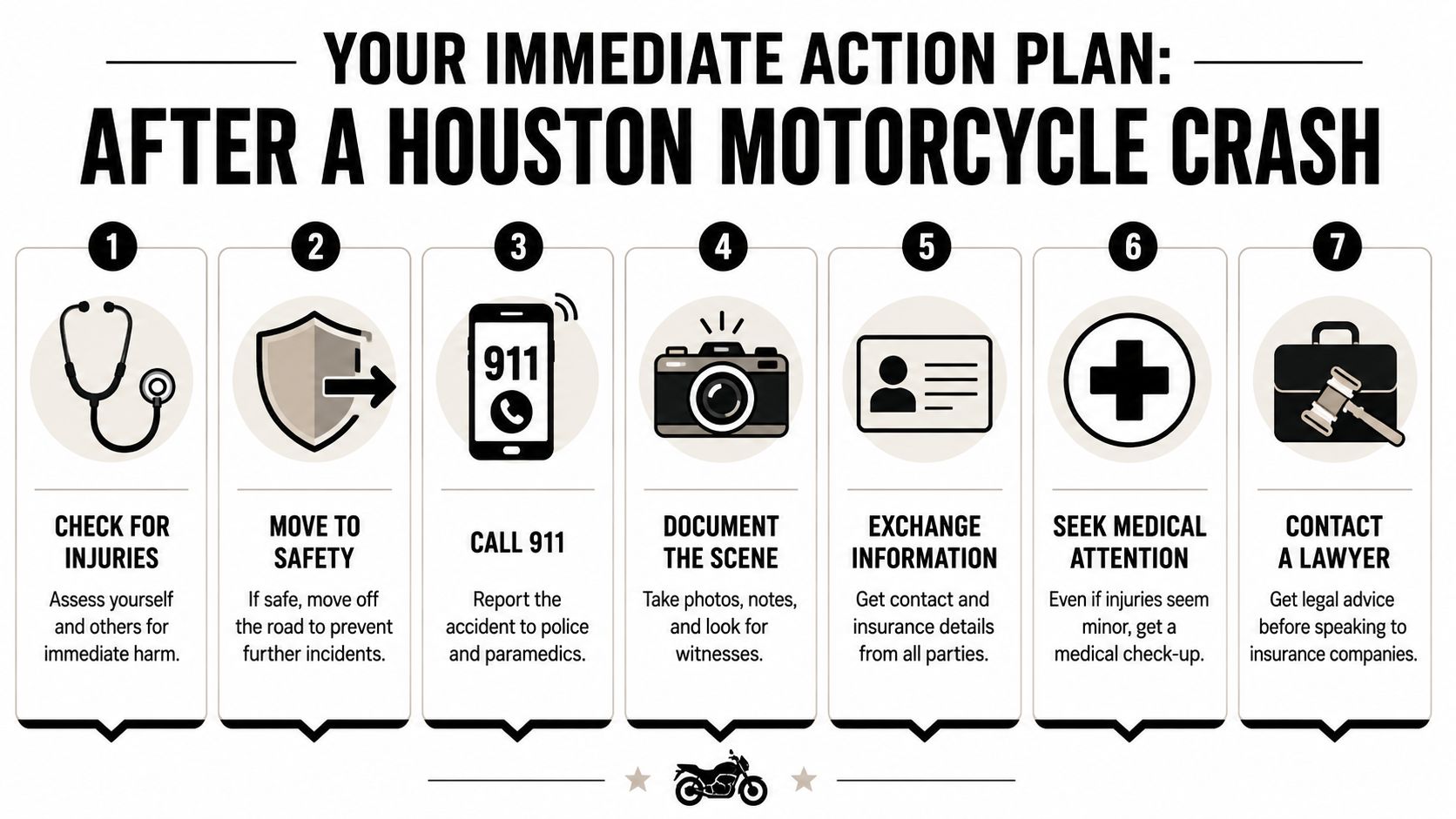
What to do right away
Check for injuries and get to safety
If you can move safely, get out of active traffic. Don't remove protective gear if doing so could worsen an injury.Call 911
Ask for police and emergency medical help. An official response can create important records.Take photos and video
Document your motorcycle, the other vehicle, roadway conditions, debris, skid marks, visible injuries, and the surrounding area.Exchange basic information
Get the other driver's name, contact information, license plate, and insurance details.Look for witnesses
Ask nearby drivers, pedestrians, or workers for names and phone numbers.
Here is a helpful video overview that reinforces those first steps:
What not to do
Some mistakes happen because people are trying to be polite. Others happen because adjusters move fast.
- Don't admit fault even casually. Saying "I didn't see them" or "maybe I was going too fast" can be used against you.
- Don't give a recorded statement to the other driver's insurer before getting legal advice.
- Don't downplay your injuries at the scene. Adrenaline can hide pain.
- Don't skip follow-up care if a doctor tells you to come back, get imaging, or begin therapy.
A factual resource that may help during this stage is Houston Motorcycle Accident Lawyer, which provides representation for motorcyclists injured in Houston crashes.
Build a claim file early
Create one folder, paper or digital, and keep everything in it:
- Medical paperwork from ER visits, specialists, and physical therapy
- Receipt copies for prescriptions, gear replacement, and transportation to appointments
- Work records showing missed time or changed duties
- Insurance letters and emails from every company involved
If a symptom appears days later, write it down. If your shoulder stiffens, your sleep gets worse, or riding becomes impossible, note the date and what changed. Those details can matter.
Calculating the True Value of Your Accident Claim
The value of a motorcycle accident claim isn't just the first hospital bill and the cost to repair your bike. A fair claim tries to measure what the crash took from you financially, physically, and emotionally.
Texas personal injury law generally separates those losses into economic damages and non-economic damages. In some unusual cases involving especially serious wrongdoing, Chapter 41 may also come into play.
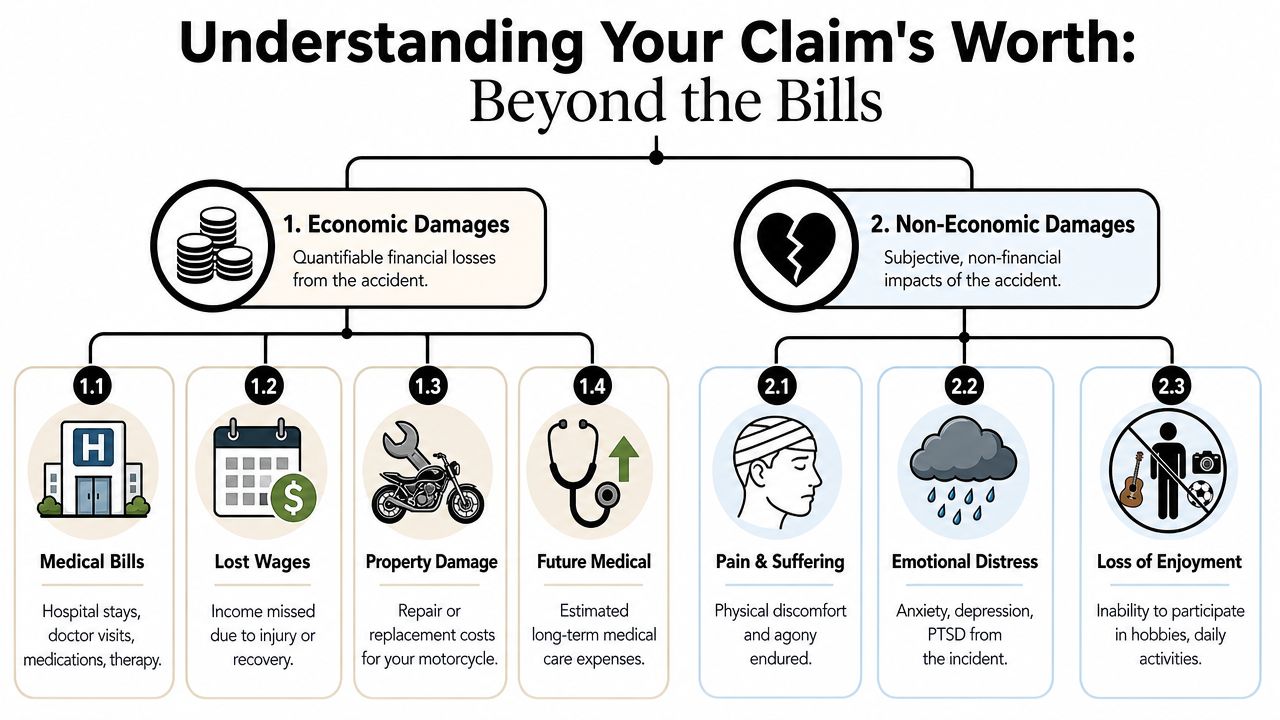
Economic damages
These are the losses you can usually document with bills, statements, wage records, or estimates.
- Medical expenses such as emergency care, surgery, follow-up visits, medication, imaging, rehab, and therapy
- Lost income when you miss work during recovery
- Reduced earning ability if your injury changes the kind of work you can do
- Property damage to your motorcycle, helmet, phone, and riding gear
- Out-of-pocket costs like transportation to treatment or help with tasks you can't do on your own
If your injury requires transportation over long distances for specialized care, outside cost references can help you understand the scale of medical travel. For example, the Med Jets by Air Trek pricing guide gives useful context about air medical transport expenses in serious situations.
Non-economic damages
These losses don't come with a standard invoice, but they're often a major part of the case.
Important: Pain that keeps you from sleeping, driving, working, or enjoying daily life is still a legal loss, even if it doesn't appear on a receipt.
Common examples include:
- Pain and suffering
- Mental anguish
- Physical impairment
- Loss of enjoyment of normal activities
- Disfigurement or visible scarring
A real-world example
A Houston rider is struck by a driver who changes lanes without checking a blind spot. The rider suffers a leg injury, road rash, and a shoulder injury that doesn't fully heal right away.
At first, the rider focuses on the emergency room visit and the damaged motorcycle. But over time, more losses appear. Physical therapy continues. Sleep becomes difficult. The rider misses work, then returns with restrictions. Weekend activities stop. Family members begin handling errands and childcare because lifting and driving hurt.
That is why early settlement offers can be misleading. They often focus on the most obvious short-term losses and ignore how the crash affects your future.
Why lawyers look beyond today's bills
An experienced Texas injury attorney usually asks broader questions:
| Category | Questions that matter |
|---|---|
| Medical care | Will you need future treatment, therapy, follow-up imaging, or specialist care? |
| Work impact | Can you return to the same job, same schedule, and same physical duties? |
| Daily life | What activities can you no longer do without pain or help? |
| Long-term effect | Are there lasting limits, visible scars, or ongoing emotional symptoms? |
A complete claim should reflect your actual life, not just the first chapter of your recovery. That's true in motorcycle cases, car wrecks, truck collisions, and serious insurance disputes alike. It also matters in fatal cases where a family may need to pursue wrongful death compensation for losses that continue long after the crash.
How to Choose the Right Houston Injury Attorney
Choosing a lawyer after a serious crash can feel uncomfortable. You may be in pain, short on time, and unsure what questions to ask. Treat the consultation like an interview. You're hiring someone to protect your rights during a high-stakes dispute.
The right attorney doesn't just file paperwork. That person should understand motorcycle cases, insurance tactics, and the way Texas negligence law affects settlement value.
Questions worth asking
Bring a short list and write down the answers.
How often do you handle motorcycle injury cases?
Motorcycle claims have their own bias problems and evidence issues.Who will communicate with me?
You need to know whether updates will come from a lawyer, a case manager, or a call center.How do you respond when the insurance company blames the rider?
This question helps reveal whether the attorney understands comparative fault and assumption of risk arguments.Are you prepared to file suit if the insurer won't offer a fair resolution?
Some firms settle quickly because they don't want litigation. You deserve to know the approach.How do fees work?
Most injury firms use a contingency fee model, which usually means the fee comes from the recovery rather than an upfront retainer.
Red flags to notice
A rushed consultation can tell you a lot.
If a lawyer promises a specific result before reviewing the evidence, that's a warning sign.
Watch for these problems:
- Vague answers about who will handle your case
- Pressure to sign immediately without clear explanation
- No discussion of motorcycle-specific defenses
- Little interest in your medical care or recovery path
- Dismissive talk about trial, insurers, or Texas fault rules
What a good fit feels like
A strong attorney should explain legal terms in plain English, answer questions directly, and take your concerns seriously. You should leave the meeting with more clarity than you had before.
If you're comparing options, ask how the lawyer handles related claims involving car crashes, trucking collisions, insurance disputes, and fatal injuries. A broader practice can matter when a motorcycle case overlaps with uninsured driver issues or a family claim after a death.
Frequently Asked Questions About Motorcycle Accident Claims
How long will my case take to resolve
It depends on your medical recovery, the dispute over fault, and how the insurance company responds. A case often shouldn't be valued too early if your doctors still don't know the full extent of your limitations.
Will I have to go to court
Not always. Many injury claims are resolved through negotiation. But a lawsuit may become necessary if the insurer denies liability, blames you unfairly, or refuses to address the full value of your damages.
What if the other driver has no insurance
You may still have options, depending on the policies available and the facts of the crash. This is one reason it's important to review every possible source of coverage instead of assuming the case ends with the at-fault driver's policy.
What does comparative fault mean for me
It means the other side may argue that you share some of the blame. If that happens, your recovery may be reduced under Texas law. As discussed earlier, fault allocation can become a major issue in motorcycle cases because insurers often try to portray riders as risky by nature.
Does wearing a helmet guarantee full compensation
No. Safety gear may matter in some injury arguments, but it doesn't automatically stop an insurer from raising other defenses. In motorcycle cases, one of the hardest fights is often over how the insurer frames your choice to ride.
How much does it cost to hire a lawyer
Many personal injury lawyers work on a contingency fee. That usually means you don't pay attorney's fees upfront. The fee is typically paid from the recovery if the case succeeds. Ask for a clear explanation of costs, expenses, and how the agreement works before you sign.
Can my family bring a claim after a fatal motorcycle crash
Possibly. Texas law may allow surviving family members to pursue claims related to a loved one's death. Those cases can involve both liability issues and wrongful death compensation, so it's important to get specific legal guidance quickly.
Should I talk to the insurance adjuster first
It's usually safer to get legal advice before giving detailed statements, especially if the adjuster represents the other side. Early conversations can shape how fault and injuries are described for the rest of the claim.
If you're dealing with pain, medical bills, missed work, and pressure from insurers, you don't have to sort it out by yourself. The Law Office of Bryan Fagan, PLLC helps Texas accident victims understand their rights, pursue compensation, and move forward with confidence. A free consultation can give you clear answers about liability, your auto insurance claim, possible damages, and the next steps in your case, without pressure and without upfront attorney's fees.