
A car crash can change your life in seconds, but you don't have to face recovery alone.
If a drunk driver hit you, you may be dealing with pain, car repairs, missed work, and a criminal case that seems to go nowhere. Days turn into weeks. Weeks turn into months. You call for updates and hear that the DWI case is still pending. That can feel insulting when your life has already been turned upside down.
A lot of injured people end up searching for how long does a DWI stay pending in Texas because they want a simple answer. They want to know when the driver will be punished, when the case will be over, and when they can finally move forward.
The hard truth is that the criminal case may move slowly. But that delay does not mean you have to put your own recovery on hold.
A Crash Changes Your Life but Justice Feels Slow
The crash lasted a few seconds. The fallout can last for months.
You are trying to heal, keep up with work, arrange rides, deal with the car, and make sense of medical bills that keep showing up. Then you learn the drunk driver's DWI case is still pending. Another setting. Another delay. No clear answer about when anything will happen.
That delay can feel personal, even when it is not. From an injured victim's point of view, it may seem like the court is giving the driver endless time while you deal with pain and disruption every day.
A common Texas scenario looks like this. A driver is hit by someone police arrest on suspicion of intoxication. The injured person goes to the emergency room, starts follow-up care, and misses time from work. Meanwhile, the criminal case inches along through hearings, motions, and reset dates. The system may be addressing legal issues, but to the victim it can feel like no one is addressing the harm already done.
Practical rule: The DWI case focuses on whether the driver will face criminal penalties. Your injury claim focuses on what the crash cost you and what it will take to make you financially whole.
That difference is easy to miss at first. Many victims assume the criminal case must finish before anything else can happen. It is a reasonable assumption, but it is often wrong.
A pending DWI charge means the criminal case is still being worked through the court system. It does not mean your own claim has to sit still. In fact, waiting can create problems for you. Treatment records need to be gathered. Witness memories fade. Video footage can disappear. Insurance companies often begin evaluating defenses long before the criminal case ends.
For this reason, accident victims need to understand an important point early. The State's timetable is not the timetable for your recovery or your right to seek compensation. Even if the criminal case feels slow, you still have rights, options, and steps you can take now.
Two Paths to Justice Criminal Charges vs Your Civil Claim
After a drunk driving crash, many injured people assume the criminal case will take care of the whole problem. That assumption is understandable. The arrest feels like the start of justice.
But the arrest only starts one case.
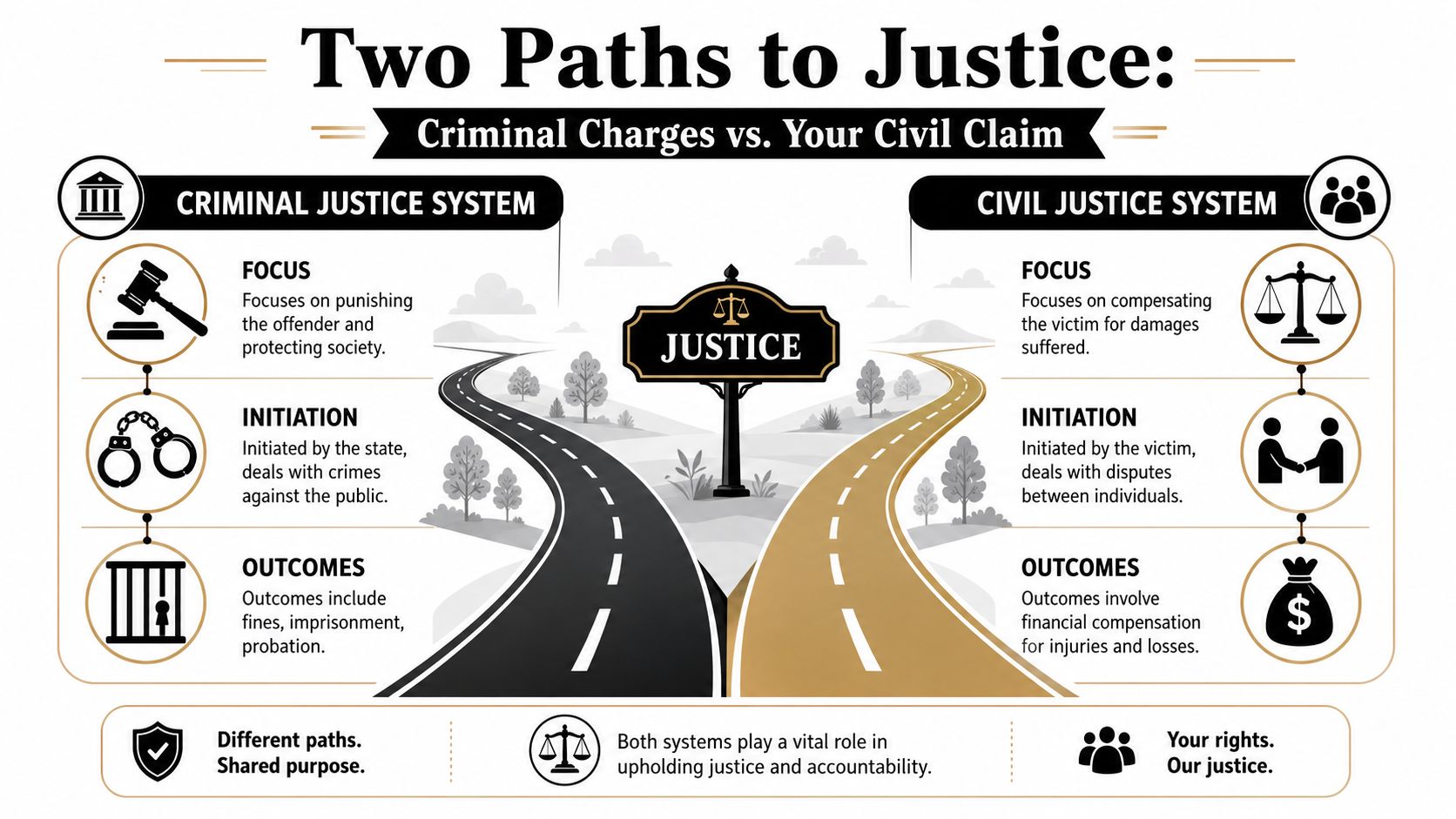
Texas usually has two separate legal tracks after a drunk driving collision. One is the criminal case against the driver. The other is your civil claim for compensation. They may grow out of the same wreck, but they do different jobs, follow different rules, and can move at different speeds.
A simple way to view it is this. The criminal case asks, "Should the driver be punished?" Your civil case asks, "What will it take to cover the harm done to you?"
The criminal case
The criminal case is brought by the State of Texas against the driver. The prosecutor controls that case, not the injured victim. Its goals are public safety, punishment, and enforcement of criminal law.
That means some parts of the criminal process may matter a great deal to the State and the defense, while doing very little to help you pay for surgery, replace lost income, or deal with the daily effect of your injuries.
For victims, that can feel frustrating. A court date gets reset, lawyers argue about evidence, and months pass. Meanwhile, your bills keep arriving on time.
Your civil case
Your civil claim is your claim. It is often made against the drunk driver and the insurance coverage that may apply. Its purpose is financial recovery for the losses the crash caused.
That can include:
- medical expenses
- lost wages or reduced earning ability
- vehicle damage
- physical pain
- mental anguish
- other losses tied to the collision
Some legal terms can make this harder to follow than it needs to be.
- Liability means who legally caused the crash.
- Damages means the losses the law may require the at-fault party to pay.
- Insurance claim means your request for payment under the available policy or policies.
A civil case works a lot like an accounting of harm. The criminal court looks at wrongdoing against the public. The civil claim measures the effect on your life.
Why these cases can move at different speeds
The two systems work like separate lanes on the same highway. They begin at the same collision, but they do not have to arrive together.
| Track | Main purpose | Who controls it | Possible result |
|---|---|---|---|
| Criminal | Punish wrongdoing | The State | Jail, probation, fines, license consequences |
| Civil | Compensate the victim | You and your lawyer | Settlement or court judgment for financial losses |
That difference matters more than many victims realize.
A pending DWI charge can stay unresolved for a long time because the defense may challenge the stop, the testing, witness statements, or other evidence. If you want a fuller look at that process, see this guide on how long a DWI case can take in Texas from start to finish.
Your civil claim does not have to sit on a shelf while that happens.
In fact, waiting for the criminal case to finish can hurt your civil case. Records can be harder to collect. Video can disappear. Witness memory can weaken. Insurance companies may start building defenses long before a criminal verdict ever arrives.
What your lawyer does, and what the prosecutor does
The prosecutor represents the State's interests. Your personal injury lawyer represents yours.
Those are not the same thing.
A prosecutor may seek a plea deal that resolves the criminal case. That outcome might matter emotionally, but it does not automatically pay your medical bills. Your lawyer's job is to prove fault, document your losses, identify insurance coverage, and press for compensation that reflects what this crash has cost you.
Texas negligence law also matters here. Under Texas Civil Practice & Remedies Code Chapter 33, fault can be compared between the people involved. This is often called comparative fault. If the defense argues that you were partly responsible, that argument can affect the value of your civil recovery.
In serious injury or wrongful death cases, Texas Civil Practice & Remedies Code Chapter 41 may also come into play because it addresses exemplary damages in some cases involving especially wrongful conduct.
One more point causes confusion for many families. Information about arrests and criminal records often stays online long after the wreck, which can affect how people view the case publicly. For background on that issue, see ContentRemoval.com's arrest record guide.
The key takeaway is simple. The criminal case may punish the drunk driver. Your civil case is the path that can help you recover what you have lost.
The DWI Criminal Case Timeline in Texas
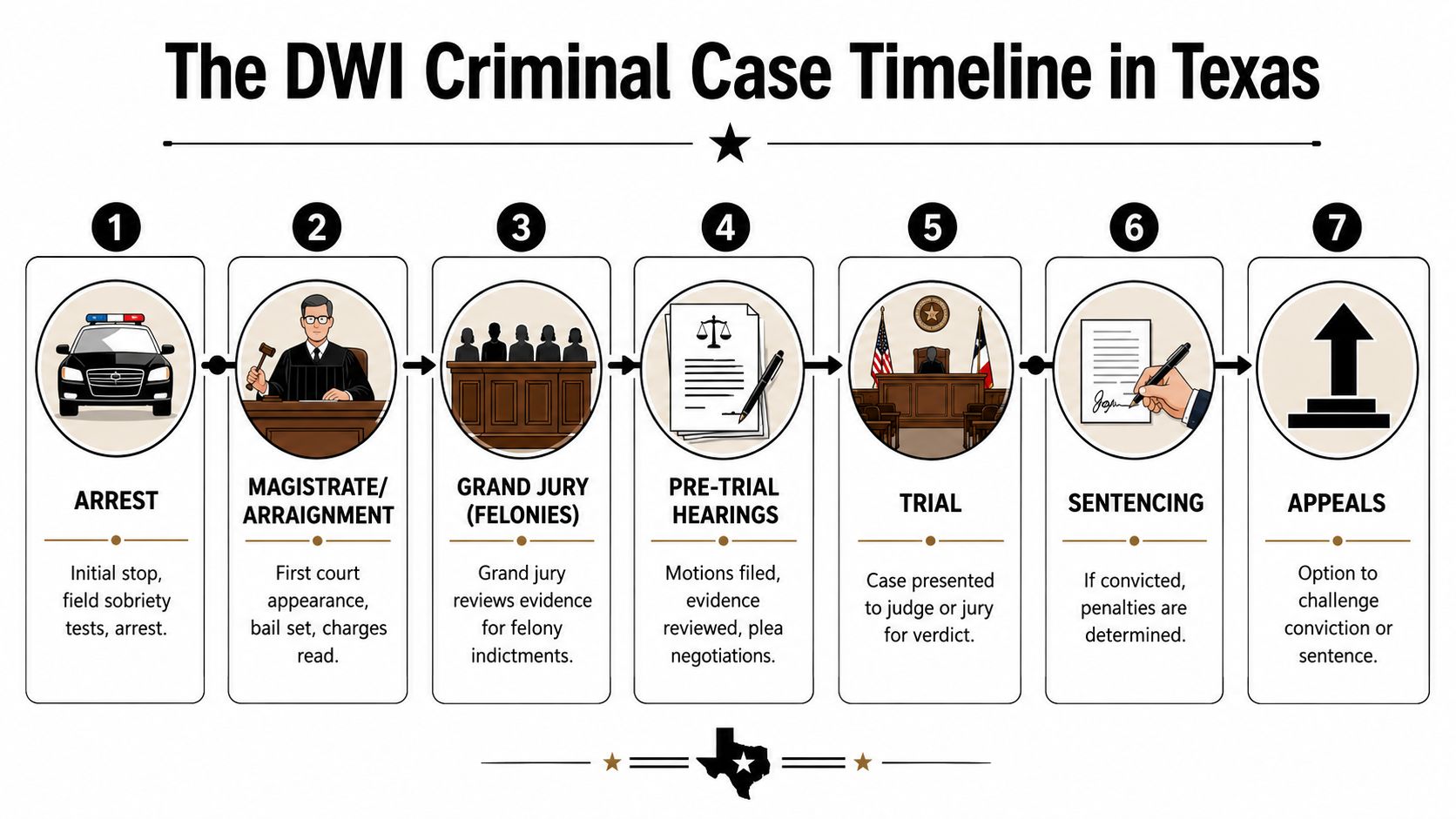
After a drunk driving crash, many victims expect the criminal case to move in a straight line from arrest to punishment. Texas DWI cases rarely work that way. A better comparison is a line at a busy hospital. Everyone knows why they are there, but each step still depends on paperwork, staffing, legal challenges, and the court's schedule.
Arrest and first court steps
The criminal case usually begins with the stop, investigation, arrest, booking, and an early appearance before a judge or magistrate. If the charge is more serious, a grand jury may also become part of the process.
Families often hear about that first court date and assume a resolution is close. Usually, it is not. Early settings often deal with bond conditions, formal charging decisions, and scheduling. In other words, the system is getting the case in place before it decides the outcome.
That delay can feel personal when you are the one dealing with surgeries, missed work, or a loved one's funeral. But the criminal court is focused on whether the State can prove the charge beyond a reasonable doubt, not on paying for the losses the crash caused in your life.
Pretrial work is where time adds up
Most of the waiting happens before any trial date.
Prosecutors gather records. Defense lawyers review police reports, body camera footage, blood test records, and witness statements. They may file motions arguing that the stop was unlawful, the testing was flawed, or certain evidence should be excluded. Each issue can require another hearing, another response, and another reset on the calendar.
From the outside, that can look like nothing is happening. Inside the case, a lot may be happening at once.
If you want a fuller step by step explanation of those criminal stages, this guide on how long a DWI case can take in Texas from start to finish explains the process in more detail.
Resolution can come through a plea, a trial, or later review
Many DWI prosecutions end in a plea agreement. Others go to trial. If there is a conviction, sentencing follows, and sometimes appeals or other post-conviction proceedings come after that. So a case can remain "pending" far longer than victims expect, even after months of court appearances.
That timeline matters emotionally. It may matter for closure. It does not control your right to pursue compensation.
Your civil claim runs on a separate track. Evidence from the criminal case can still help your injury case, but you do not need to wait for a guilty plea or conviction before protecting your own claim. For many victims, that is the most important point to understand. The criminal case asks whether the driver should be punished by the State. Your civil case asks who will pay for your medical care, lost income, pain, and other harm.
For defendants who are concerned about what remains visible online while charges are still unresolved, resources like ContentRemoval.com's arrest record guide explain public record and privacy issues. For victims, the practical lesson is different. A slow criminal docket does not erase the crash, and it should not keep you from acting on your own rights.
A pending DWI case may take months or longer. Your need for treatment, income, and answers starts much sooner.
Common Reasons a DWI Case Stays Pending for Months or Years
Victims often think delay means the case is weak or that the court doesn't care. Usually, neither is true. DWI cases are often technical, and that gives both sides many issues to argue over.
The defendant has a lot to lose
One reason these cases are fought hard is the long-term effect of a conviction. Texas-focused legal sources state that a DWI conviction can remain on criminal and DPS driving records indefinitely, and some describe DPS retention as 75 years, which is effectively a lifetime (Lavine Law Firm on Texas DWI record duration).
If someone knows a conviction may follow them for life, they have a strong incentive to delay, negotiate, or attack every part of the case.
The legal process itself creates delay
Here are common reasons a pending DWI case drags on:
- Evidence challenges: The defense may question the traffic stop, field sobriety testing, blood draw, or arrest procedure.
- Witness scheduling: Police officers, lab personnel, and experts may not all be available on the same date.
- Court congestion: Busy county dockets can push hearings and trials further out.
- Negotiation strategy: Prosecutors and defense lawyers may continue talking while motions are pending.
In a large metro area, this can feel endless to victims. In a smaller county, a different backlog may slow things down. Either way, criminal court runs on the court's calendar, not on your treatment schedule or your rent due date.
Pending doesn't mean your civil case is weak
A long criminal case can make victims doubt themselves. That doubt is understandable, but it can be misleading.
A drunk driving injury claim can still be strong even while the DWI charge is unresolved. The civil case looks at crash facts, driver conduct, your injuries, and the available insurance. It does not depend on a quick criminal conviction to become valid.
Why Your Personal Injury Claim Should Not Wait
The criminal case may crawl. Your bills won't.
If you're hurt, it is usually a mistake to wait for the DWI prosecution to end before taking action on your civil side. Medical providers, insurers, and employers won't pause their own timelines just because the criminal court has reset another hearing.

Your civil deadline has its own clock
One of the most important legal terms to know is the statute of limitations. That means the deadline for filing a lawsuit. If you miss it, the court can bar your claim even if the facts are on your side.
For a closer look at deadlines, this article on Texas statutes of limitations explains why waiting can put a case at risk.
The driver may have every reason to fight the criminal charge for as long as possible. A Texas DWI source notes that when a DWI arrest does not lead to conviction, it may become eligible for expunction after the statute of limitations runs, often cited as 2 years for a misdemeanor and 3 years for a felony (Doug Murphy on Texas DWI records and expunction). That motivation has nothing to do with your right to pursue civil damages now.
Texas negligence law focuses on fault and harm
In a personal injury case, you must show that another party's negligence caused your injuries. Negligence means failing to use reasonable care. A drunk driver who causes a crash may create strong evidence of negligence, but your claim still needs proof.
That proof often includes:
- Medical records: These connect the crash to your injuries.
- Income evidence: Pay stubs or employer records can show lost wages.
- Crash evidence: Photos, witness statements, and the police report help establish liability.
- Insurance information: This shapes the path of your claim and any settlement talks.
Under Chapter 33, comparative fault can become a major issue. If the insurer argues you were speeding, distracted, or changed lanes unsafely, it may try to reduce your recovery. That is true even if the other driver was intoxicated.
A real-world example
A Houston driver is hit by an impaired motorist on I-45. The victim suffers a shoulder injury, needs ongoing treatment, and misses work. The criminal DWI case keeps getting reset. Meanwhile, the victim's health insurer asks questions, the car insurer pressures for a statement, and household bills keep coming.
That person doesn't need to wait for a criminal verdict to start building a civil case. They need to document treatment, preserve records, and evaluate all available damages.
If the crash caused a fatality, the family may also have a wrongful death compensation claim. In plain language, that is a civil claim brought by eligible surviving family members for losses tied to the death. The criminal DWI case and the wrongful death case are related in facts, but they are still separate proceedings.
A criminal conviction can help a civil case. It is not the starting line for one.
If you're comparing options for legal help, a Houston car accident lawyer can handle the injury claim while a defense lawyer and prosecutor handle the criminal case. That division of work matters because each side of the legal system asks different questions and pursues different outcomes.
Steps to Take Now to Protect Your Right to Compensation
When a drunk driving crash turns your life upside down, simple steps matter. They protect your health first, then your claim.
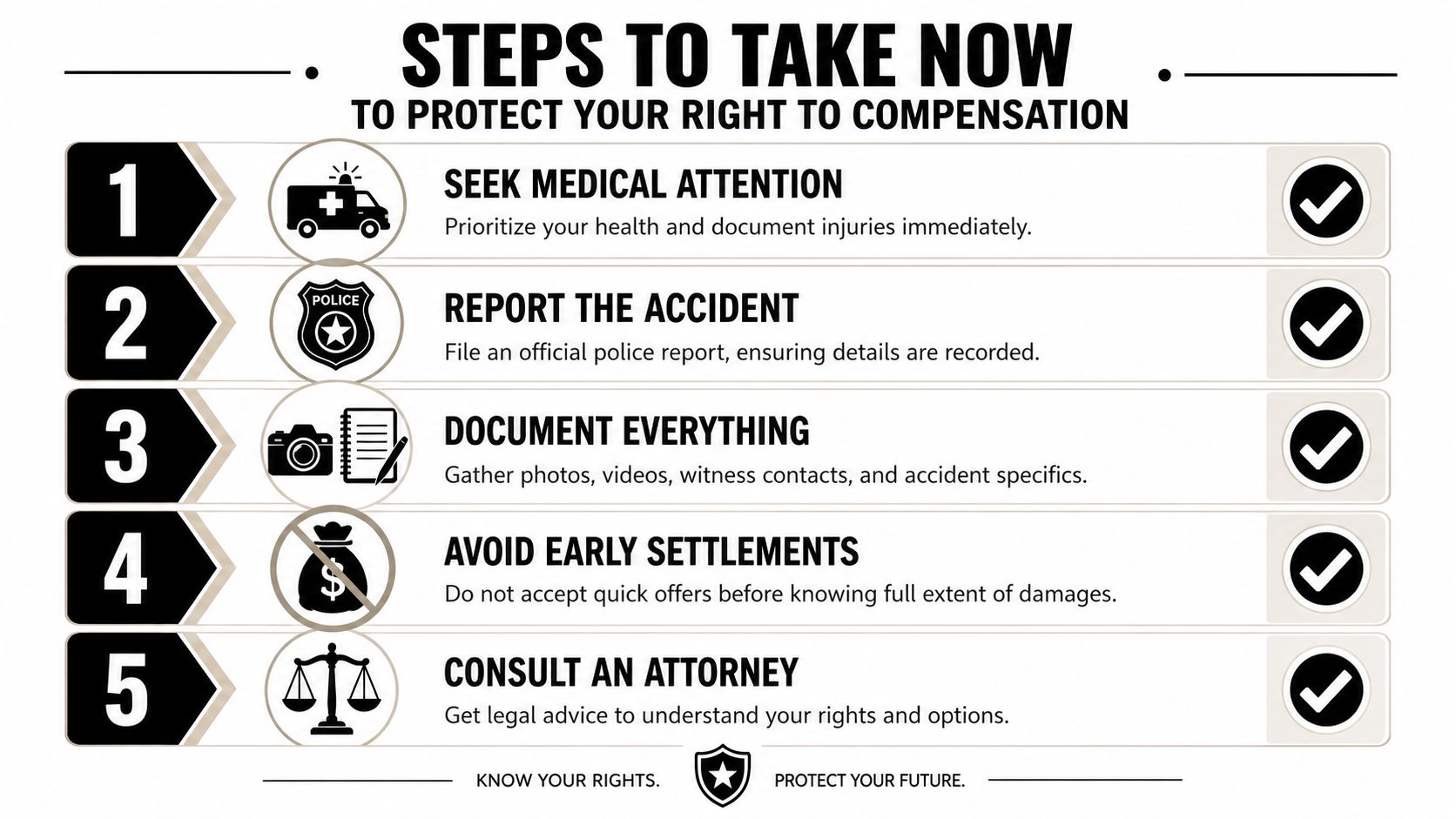
Five practical moves
Get medical care right away.
Even if adrenaline made you feel "fine" at first, follow up with a doctor. Medical records help protect both your health and your injury claim.Request the crash report and keep every document.
Save discharge papers, prescriptions, repair estimates, photos, and receipts. If the report notes suspected intoxication, that can be important evidence.Be careful with the other insurer.
You may get a fast call asking for a recorded statement or a quick settlement. Be cautious. Early statements can be used to minimize your injuries or shift blame.
A short video can help reinforce those first steps after a serious wreck:
Track how the crash affects daily life.
Write down missed work, pain levels, follow-up visits, and activities you can no longer do normally. Those details can support your damages claim.Talk with a lawyer early.
If you're unsure when legal help makes sense, this article on when to hire a DWI lawyer in Texas offers useful timing guidance. For injury victims, one option is to speak with The Law Office of Bryan Fagan, PLLC, which handles Texas crash and personal injury claims and can evaluate liability, comparative fault, and insurance issues.
Frequently Asked Questions for Drunk Driving Accident Victims
Can I still recover compensation if the driver isn't convicted?
Yes. A civil injury case and a criminal DWI case are separate. A not-guilty result in criminal court does not automatically defeat your civil claim.
Do I need to wait to file an auto insurance claim?
No. Waiting can hurt you. Evidence is easier to gather early, and insurance companies often begin evaluating the crash long before the criminal case ends.
What does liability mean in my case?
Liability means who is legally responsible for causing the crash. In a drunk driving case, liability may seem obvious, but insurers may still argue about comparative fault, medical causation, or the value of your damages.
Will criminal restitution pay for everything?
Usually, victims should not assume the criminal court will fully cover their losses. Your civil claim is the process designed to pursue compensation for medical bills, lost earnings, pain and suffering, and, in fatal cases, wrongful death compensation.
What if the driver keeps delaying the criminal case?
That can be frustrating, but it doesn't take away your civil rights. You can still gather records, work with your doctors, pursue your claim, and make informed decisions about settlement or filing suit with a Houston car accident lawyer or other Texas injury attorney.
If a drunk driver hurt you or someone you love, you don't have to sit back and wait for the criminal court to decide everything first. You may have immediate rights under Texas personal injury law, and acting early can make a real difference in your recovery. The team at The Law Office of Bryan Fagan, PLLC helps accident victims understand liability, comparative fault, damages, insurance issues, and wrongful death compensation options after serious Texas crashes. Contact the firm for a free consultation to talk through your next steps, your timeline, and your right to seek compensation.