A car crash can change your life in seconds, but you don't have to face recovery alone.
You may have stepped onto a Houston METRO bus expecting an ordinary ride to work, school, a doctor's appointment, or home. Then the bus jerked, another vehicle slammed into it, or the driver braked so hard that you were thrown forward. Now you're hurting, confused, and trying to figure out who pays your medical bills, whether you need an auto insurance claim, and why everyone keeps saying a METRO case is different.
It is different. A claim against Houston METRO isn't handled like a typical wreck between private drivers. Special notice rules can apply early. Government liability rules can limit what you recover. And if you wait too long, you can lose your right to bring a claim before a lawsuit is ever filed.
This guide is here to make that process easier to understand. If you're looking for a Houston car accident lawyer or a Houston METRO bus accident lawyer, the goal is the same. Protect your rights, preserve evidence, and make informed choices while you heal.
A Bus Ride That Changed Everything
Maria was riding a METRO bus through Houston on a normal weekday morning. She had her bag in her lap and her mind on work. Then traffic shifted fast. The bus lurched, people shouted, and she hit the seat in front of her shoulder-first.
At first, she told herself she was probably fine. That happens a lot after a crash. Your body is running on adrenaline, and pain can show up later. By that evening, Maria's neck was stiff, her back hurt, and she couldn't sleep. The next day, she started wondering whether she should call the bus company, her health insurer, or a Texas injury attorney.
That confusion is common. A METRO crash can leave you with the same questions people ask after any serious collision. Who was at fault? Who is liable? How do you prove your injuries came from the crash? Can you recover damages for lost income, pain, and treatment? If a loved one died, can your family seek wrongful death compensation?
A public bus claim adds another layer. METRO is tied to government rules, and that changes the process from the start. You may need to act long before the usual statute of limitations runs out. You may also be dealing with more than one responsible party, including the driver, METRO, a maintenance contractor, or another motorist.
When people miss deadlines in these cases, it usually isn't because they ignored the claim. It's because no one explained that METRO cases move on a shorter clock.
The good news is that you do have rights. If someone else's negligence caused the crash, Texas law may allow you to pursue compensation. The key is acting early, documenting carefully, and understanding the rules before an adjuster or agency decides your case for you.
Why Suing Houston METRO Is Not a Typical Injury Claim
A collision involving a private driver usually follows a familiar pattern. Insurance companies investigate, people exchange information, and the injured person may file a claim or lawsuit under standard Texas personal injury rules. A Houston METRO claim is different because the law gives government-related entities extra protection.
The government shield and the limited exception
Lawyers often call that protection sovereign immunity or governmental immunity. In plain English, it means you usually can't sue a government entity the same way you would sue a private person or company.
Texas created a limited exception through the Texas Tort Claims Act. That law opens the door for some injury claims against government entities, but only if you follow the rules closely. If you don't, the door can close fast.

That's why a Houston Metro bus accident lawyer has to think differently from day one. In a regular car wreck, the first big issue may be insurance. In a METRO case, the first big issue is often whether proper notice was given and whether the claim fits within the legal waiver that allows suit at all.
Why these cases deserve close attention
Bus crashes can cause serious injuries because of the size of the vehicle, the number of passengers, and the way people are seated or standing. In 2021, Texas experienced a total of 540 bus crashes statewide, resulting in 931 suspected injuries and 21 fatalities, according to Texas bus crash statistics discussed here. Those numbers show why these cases matter, especially in a major transit area like Houston.
Texas negligence law still matters in a METRO case. Under Texas Civil Practice & Remedies Code, Chapters 33 and 41, the court looks at fault, shared fault, and damages. Here are the plain-English terms that often confuse people:
- Liability means legal responsibility for the crash or your injuries.
- Negligence means someone failed to use reasonable care.
- Comparative fault means more than one person can share blame.
- Damages means the money the law may allow for losses caused by the injury.
- Statute of limitations means the deadline for filing a lawsuit.
A simple example helps. A Houston driver rear-ended on I-45 may bring a claim against the driver who hit them. A METRO passenger hurt in a bus wreck may need to look at the bus operator, METRO itself, and any outside driver who helped cause the crash. The legal path is narrower, and the paperwork is less forgiving.
Practical rule: If a government entity may be involved, assume the deadline is sooner than you think and get legal advice before you speak at length with an adjuster.
The Clock Is Ticking Critical Deadlines for Your METRO Claim
The most dangerous mistake in a Houston METRO case is assuming you have plenty of time. You may hear “two years” and think that's the only deadline that matters. It isn't.
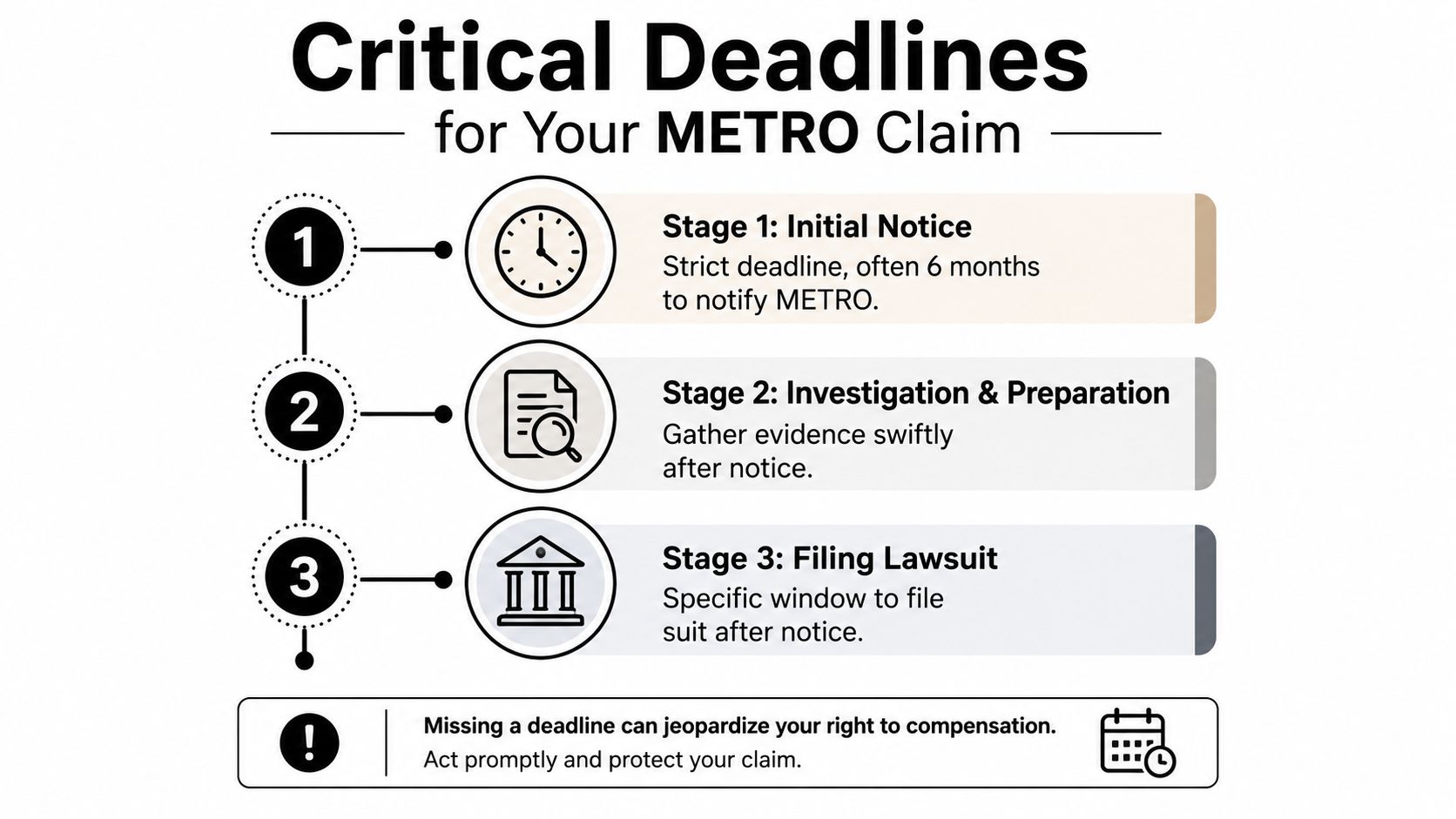
Many people confuse a claim notice with filing a lawsuit. They aren't the same thing. In a METRO case, an earlier notice deadline can come first, and missing it can destroy the case before the usual lawsuit deadline arrives.
The three deadlines people mix up
There are three time periods you need to understand.
| Deadline | What it usually means | Why it matters |
|---|---|---|
| 90 days | An early administrative claim deadline often associated with METRO or the City of Houston | Missing this earlier step can end your claim |
| 6 months | Notice period under the Texas Tort Claims Act for government claims | This is separate from the earlier METRO-related deadline |
| 2 years | General Texas personal injury lawsuit deadline | This applies to filing suit, not replacing earlier notice rules |
Most writing on this topic misses the difference between the 90-day administrative deadline and the 6-month notice rule. As noted in this discussion of Houston METRO accident claims, missing the earlier 90-day window can extinguish the right to compensation even when the longer notice period or lawsuit deadline hasn't expired.
What Texas law adds to the timeline
For many personal injury claims in Texas, the standard statute of limitations is two years under Texas Civil Practice and Remedies Code Section 16.003. The same source explains that a wrongful death claim generally uses a two-year deadline measured from the date of death.
That two-year deadline is important, but in a METRO case it is not the first deadline you should worry about.
A separate issue is notice. One source discussing Houston bus accident claims explains that claims against public transit authorities can require notice within six months, while claims involving the City of Houston can face a 90-day requirement under the city charter, as summarized in this overview of a Houston bus accident lawyer.
Another source goes even further and warns that claims against Houston METRO may require formal notice within 60 days, while also describing stricter local deadlines in the Houston area, as explained in this article about a Houston bus accident lawyer.
That's exactly why people get lost. The labels sound similar, but they refer to different procedural steps.
Here is the safest way to approach it:
- Assume the shortest deadline controls until a lawyer confirms otherwise.
- Give written notice promptly.
- Do not wait for treatment to finish before protecting the claim.
Later in the process, it may help to understand Texas statutes of limitations for injury cases and how Filing an Injury Claim in Harris County Courts works in local civil practice.
A quick video may also help frame the issue before you gather records and send notice.
If you take away one point from this article, let it be this. A METRO case can die on a calendar issue long before anyone debates fault or injury value.
Protecting Your Rights What to Do After a METRO Bus Crash
The first hours and days after a bus wreck matter. Your health comes first, but the steps you take now also shape the strength of your claim later.
Start with medical care and basic reporting
Get medical attention as soon as you can. If you're offered emergency care, accept it if you may be injured. If symptoms show up later, go to urgent care, your doctor, or the emergency room without delay.
Report the incident to the bus driver and law enforcement if they respond. Ask how to get the incident report number. If you're able, write down the route, bus number, location, and time while it's still fresh.
For a broader checklist, this guide on what to do after a car accident covers many of the same evidence-preservation basics that apply after a METRO crash.
Build your evidence before it disappears
To prove negligence in Texas, injured people need evidence such as photos of the scene, official reports, sworn witness statements, medical records, and a personal journal. That guidance appears in this explanation of Texas comparative negligence and proof.
Use that rule in a practical way:
- Photograph the scene: Take pictures of the bus, nearby vehicles, visible injuries, seat areas, and anything on the roadway that may matter.
- Get witness information: Passengers often leave quickly. Names and phone numbers can be hard to recover later.
- Keep every medical paper: Discharge instructions, imaging records, prescriptions, and follow-up notes help connect the injury to the crash.
- Write daily notes: A short pain journal can show how the injury affected sleep, work, travel, and routine tasks.
- Save expense records: Transportation costs, medication purchases, and missed-work documentation can support damages.
A comparison can help. In a private-vehicle case, your first call may be to your auto insurer about an auto insurance claim. In a METRO case, evidence on the bus itself may matter just as much. Bus records, driver information, maintenance history, and internal reports can become central.
If another vehicle caused or contributed to the wreck, resources about a Houston Car Accident Lawyer may also be relevant because part of your case may look like a standard traffic collision claim against a private driver.
Keep your statements short when speaking with insurers. Give basic facts, then get legal advice before offering a recorded statement or guessing about fault.
Investigating Liability Who Can Be Held Responsible
People often assume the bus driver is the only target in a METRO case. Sometimes that's true. Often, it isn't.
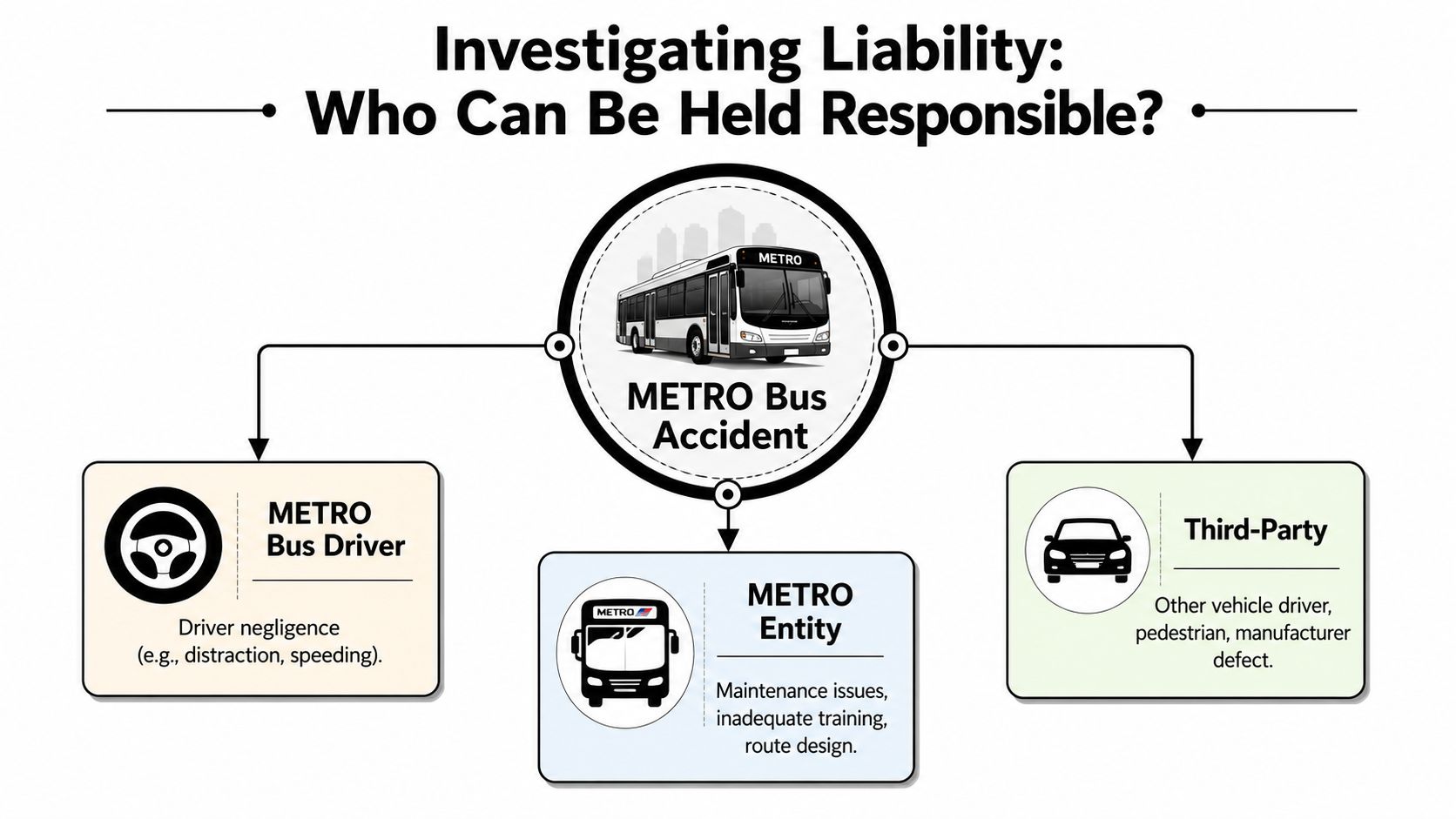
Liability means legal responsibility. Negligence means someone acted carelessly and caused harm. In a bus crash, several people or entities may share responsibility for what happened.
The obvious possibility and the less obvious ones
A bus driver may be liable if the driver was distracted, failed to yield, braked unsafely, or otherwise operated the bus without reasonable care.
But a deeper investigation may reveal other responsible parties:
- METRO itself: The agency may face claims tied to training, supervision, vehicle upkeep, or operational decisions.
- A maintenance contractor: If outside repairs were done poorly, that contractor may be part of the case.
- Another driver: A private motorist may have cut off the bus, run a light, or caused the collision directly.
- A manufacturer: In some cases, a defective part may have contributed to loss of control or injury severity.
Why comparative fault matters in Texas
Texas follows a comparative fault approach under Chapter 33. That means more than one party can share blame, and your recovery may be affected if the defense argues you also contributed to your injury.
A real-world example makes this easier to see. Say a Houston driver rear-ended a METRO bus at an intersection. A passenger standing in the aisle falls and suffers a back injury. The driver of the car may be liable for causing the impact. But investigators may also ask whether the bus operator stopped suddenly before the impact, whether the bus was operated safely, and whether a mechanical issue made the event worse.
That kind of layered investigation matters for another reason. A claim against a private party may not face the same restrictions that apply to a claim against METRO. So identifying every responsible defendant can affect both accountability and recovery options.
Some of the best evidence in these cases isn't visible at the scene. Driver logs, maintenance records, onboard video, and internal reports often tell the fuller story.
Understanding Compensation for Your METRO Accident Injuries
After a serious crash, a common question arises: What can I recover?
In Texas, personal injury damages usually fall into two broad categories. Economic damages cover financial losses. Non-economic damages cover the harder-to-measure human losses that come with pain and disruption.
What damages may include
Economic damages can include medical bills, future treatment, lost wages, and other out-of-pocket losses tied to the injury. Non-economic damages can include pain, suffering, emotional distress, and loss of enjoyment of daily life.
If your injuries require braces, walkers, lift chairs, or other recovery tools, practical resources can help you understand what equipment exists and how it may fit into your broader care needs. One useful overview is Top Mobility's guide to mobility equipment.
For a fuller discussion of how lawyers and insurers think about losses, this page on how damages are calculated in injury claims can help you see how records, bills, and daily limitations fit together.
The cap that changes METRO cases
Claims against government entities don't work like claims against private bus companies. Under the Texas Tort Claims Act, damages recoverable from government entities like Houston METRO are capped at $250,000 per person and $500,000 per single occurrence, according to this discussion of a Houston bus accident injury lawsuit.
That cap can feel harsh, especially in cases involving major surgery, long rehabilitation, or permanent disability. It means your actual losses may be larger than what METRO can be required to pay.
A simple comparison helps:
| Claim type | Damage cap discussed here |
|---|---|
| Government entity claim | $250,000 per person and $500,000 per occurrence |
| Private bus company claim | No government cap of this type |
This is one reason lawyers investigate other defendants so closely. If a private driver, contractor, or manufacturer contributed to the crash, those claims may offer additional recovery paths outside the government cap framework.
Texas law also addresses punitive or exemplary damages in Chapter 41, but those issues depend heavily on the facts and legal posture of the case. In most injured-person cases, the immediate focus is proving liability, documenting losses, and identifying every responsible party before important deadlines expire.
Frequently Asked Questions About Houston METRO Accident Claims
Can I still recover if METRO says I was partly at fault
Maybe. Texas uses comparative fault, which means fault can be shared. If the defense claims you contributed to your own injuries, that argument can affect your recovery.
For example, METRO may argue you ignored a warning, stood in an unsafe spot, or failed to hold on while the bus was moving. Those arguments aren't automatic winners. They have to be supported by facts. A Texas injury attorney looks at witness statements, bus video, scene evidence, and medical proof before accepting that kind of blame shift.
What if I was hurt but didn't feel pain until later
That happens all the time in crash cases. Soft-tissue injuries, head injuries, and back problems may not fully show themselves right away. The important thing is to get evaluated once symptoms appear and to tell the provider the pain started after the bus wreck.
Delayed treatment can create a defense argument, but it doesn't automatically defeat your case. It just means your records and timeline need to be handled carefully.
Do I file with METRO, my own insurance, or both
Sometimes both may be involved, depending on the facts. If another driver caused the crash, there may be a third-party liability claim and possibly an auto insurance claim through available coverage. If the bus operation itself played a role, notice to METRO may also be required.
Many people often misunderstand this point. Insurance reporting and legal notice are not the same thing. Telling an insurer about the crash doesn't necessarily satisfy a METRO or government notice requirement.
What does liability mean in a bus accident case
Liability is legal responsibility for causing the crash or your injuries. In a bus case, that can include the bus operator, METRO, another driver, or a third party involved in maintenance or equipment.
Think of it this way. A private driver may cause the initial collision, but a separate failure in bus maintenance may worsen the injuries. Both issues matter when your lawyer evaluates the case.
What if a family member died after a METRO crash
A fatal bus crash may create a wrongful death compensation claim under Texas law. The timing rules and notice requirements still matter, and the legal process can become even more sensitive and urgent.
Families often need help collecting records, preserving evidence, and understanding who can bring the claim. In those moments, a Houston car accident lawyer or Houston Metro bus accident lawyer can help the family focus on the legal steps while they deal with grief.
Should I talk to the adjuster alone
You can report basic facts, but be careful. Adjusters often ask for recorded statements early, before you know the full extent of your injuries or the legal deadlines involved.
A safer approach is to share only the essential identifying information first, then speak with counsel before discussing fault, medical history, or settlement. If you need help dealing with insurer tactics, a resource like Dealing With Insurers After a Houston Accident explains how these communications usually work.
You Don't Have to Navigate This Alone
A Houston METRO case asks a lot from an injured person at the worst possible time. You're trying to heal, keep up with work and family, and make sense of a process that uses unfamiliar words like immunity, notice, comparative fault, and damages.
The hardest part is that the legal system won't slow down just because you're in pain. Early notice rules can arrive before your treatment is even settled. Liability may involve more than one party. And the claim against METRO may be limited even when your losses are not.
That's why experienced legal guidance matters in these cases. A lawyer can help preserve evidence, sort out deadlines, identify all liable parties, and evaluate whether your case includes both a government claim and a private-party claim. The Law Office of Bryan Fagan, PLLC handles Texas injury and vehicle collision matters involving liability, damages, and insurance disputes.
If you're curious about how injured people evaluate law firms online, this article on finding new legal clients in 2026 offers useful background on how firms present information and how people search for legal help.
You don't need to have every answer before you make the call. You just need to protect your rights before the calendar and the paperwork start working against you.
If you were hurt in a Houston bus crash, contact The Law Office of Bryan Fagan, PLLC for a free consultation. You can speak with a team that helps Texas injury victims understand liability, deadlines, damages, insurance issues, and next steps after a serious collision. If you're dealing with a METRO claim, a private vehicle claim, or a case involving wrongful death compensation, getting timely legal guidance can help you protect your rights and focus on recovery.