A car crash can change your life in seconds, but you don't have to face recovery alone.
If you're reading this, you may be dealing with pain, car repairs, missed work, and constant calls from insurance adjusters. You may also be hearing something that feels insulting after a rear-end crash on Highway 6 or near US-59: the impact was “minor,” so your injury must be minor too.
That's not how real recovery works. In Sugar Land, many valid injury claims get pushed down not because the crash didn't matter, but because the insurance company wants to frame it that way early. A Sugar Land car accident lawyer should know how these cases are fought, how Texas negligence law works, and what evidence makes insurers take a claim seriously.
Why a Local Sugar Land Lawyer Matters for Your Case
A local case isn't built in the abstract. It's built from roads, intersections, witnesses, medical records, and the way jurors understand everyday driving in this area.
A lawyer who regularly handles Sugar Land crashes starts with context. Highway 6 congestion, merge points near US-59, shopping traffic around Town Square, and neighborhood traffic patterns all affect how collisions happen and how fault should be analyzed. That local knowledge can shape what evidence gets collected first and which arguments are likely to work.
Local knowledge changes strategy
An out-of-town firm may treat your crash as just another file. A local-focused lawyer is more likely to recognize the patterns behind a rear-end wreck in stop-and-go traffic or a disputed intersection crash where both drivers tell a different story.
That matters when the defense says you stopped suddenly, changed lanes too late, or exaggerated your symptoms. In practice, the strongest claims are built early, with scene photos, vehicle damage analysis, witness interviews, and a clear timeline of treatment.
Practical rule: The lawyer who understands the roadway, the local court process, and the common insurance defenses in this region usually starts with better questions.
Sugar Land cases need a local lens
A strong legal strategy isn't only about filing paperwork. It's about presenting your case in a way that makes sense to people in Fort Bend County. That includes adjusters, defense lawyers, and, if needed, a local jury.
Here's where a local approach often helps:
- Crash investigation: A lawyer can focus on the exact traffic conditions and recurring problem spots that help explain how the collision occurred.
- Insurance pressure points: Insurers often reuse familiar defense themes in local rear-end and soft tissue cases. A lawyer who sees those arguments often is better prepared to counter them.
- Court readiness: If negotiations stall, your case needs to be trial-ready, not just demand-letter-ready.
If you're comparing firms, this guide on how to find a good car accident lawyer can help you ask sharper questions before you sign anything.
What victims often overlook
Many people choose counsel based on the first ad they see or the first person who calls back. That's understandable. But after a crash, convenience shouldn't be your only filter.
You want someone who can explain your rights in plain English, spot weak points before the insurer uses them against you, and build a case that reflects what happened on Sugar Land roads, not a generic template.
Common and Catastrophic Accidents on Sugar Land Roads
The crashes that happen in Sugar Land often look ordinary at first. Then the medical treatment starts. Neck pain shows up the next morning. A shoulder won't rotate normally. Sitting, sleeping, and working become hard.
That's especially true in rear-end collisions. Rear-end collisions account for nearly 30% of all roadway crashes in Texas. In Houston, distracted driving contributed to over 10,000 crashes in 2023, and Sugar Land experiences heightened DUI crash risks near entertainment districts along Highway 6, especially on weekends according to Sutliff & Stout's Sugar Land crash overview.
The crashes people call minor
A common Sugar Land example is the commuter who gets hit from behind in heavy traffic near US-59. The bumper damage may not look dramatic, but the body absorbs force differently than a vehicle does. Whiplash, back strain, and disc injuries can follow even when the police report uses words like “minor.”
Another common scene is the intersection collision. A driver turns left, another says they had the light, and now fault is disputed. Those cases often depend on timing, witness statements, and whether nearby businesses or dashcams captured the impact.
If you want a broader overview of collision patterns, this page on different car crash types gives a useful starting point.
Real-world examples
A Houston driver rear-ended on I-45 may deal with the same injury pattern as a Sugar Land driver struck on Highway 6. The legal issue is often similar too. The insurer tries to separate the collision from the injury by arguing the force wasn't enough.
A family hit by an impaired driver after a weekend dinner faces a different problem. Liability may be obvious, but the injuries can be severe, and the damages can extend far beyond the emergency room. In fatal cases, surviving family members may need guidance about wrongful death compensation and what recovery may be available under Texas law.
Some of the hardest cases aren't the ones where fault is unclear. They're the ones where the insurance company admits the crash happened but minimizes what it did to your body.
Injuries don't always show up where you expect
After a crash, pain can extend beyond the neck and back. Pelvic symptoms, hip pain, and deep core discomfort can appear days later and interfere with walking, sitting, or returning to work. For readers dealing with those symptoms, this resource on managing post-car crash pelvic pain may help you understand why follow-up care matters.
For local awareness, Houston's Most Dangerous Intersections and Roads is a factual local resource on where serious crashes recur across Houston and Harris County.
Commercial and rideshare crashes raise the stakes
Some collisions involve more than two private drivers. A delivery van, a company truck, or a rideshare vehicle can complicate everything. The key issue becomes identifying every responsible party and every available insurance policy early, before evidence disappears or coverage positions harden.
Determining Fault Under Texas Negligence Laws
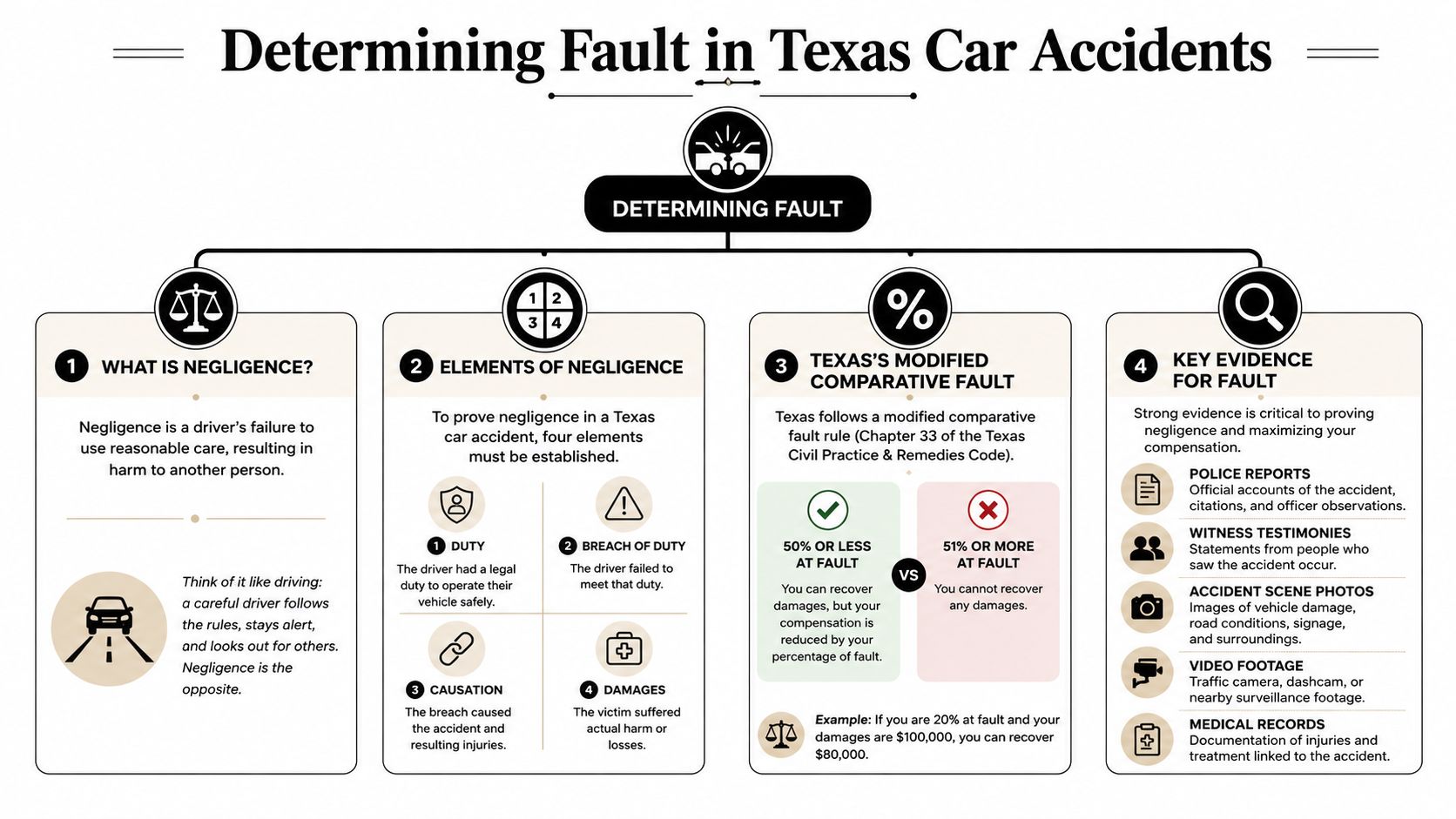
Texas car accident cases start with a basic idea: negligence. In plain English, negligence means someone failed to use reasonable care and another person got hurt because of it.
Every driver has a basic duty to watch the road, follow traffic signals, leave enough space, and drive sober and alert. When a driver breaks that duty by texting, tailgating, speeding, or running a light, that breach can create legal liability, meaning legal responsibility for the harm that follows.
The four building blocks of a claim
Most injury cases come down to four parts:
| Part | What it means |
|---|---|
| Duty | The other driver had a legal obligation to drive safely |
| Breach | That driver failed to meet that obligation |
| Causation | The unsafe conduct caused the crash and your injury |
| Damages | You suffered losses such as medical bills, lost income, or pain |
Damages is the legal word for what the law allows you to recover. That can include financial losses and human losses, such as pain, limits on daily life, and ongoing treatment needs. Chapter 41 of the Texas Civil Practice & Remedies Code is part of the broader Texas damages framework lawyers consider when evaluating what can be recovered and how those claims are presented.
Comparative fault in plain English
Texas also uses what many people call comparative fault. The statute calls it a proportionate responsibility system. Under Texas Civil Practice and Remedies Code Chapter 33, a defendant is liable only for the share of harm they caused, and if a plaintiff is found more than 50% responsible, the plaintiff can't recover damages.
That rule matters because insurance adjusters often try to move blame onto you. They may argue you braked too hard, followed too closely, were distracted, or failed to avoid the crash.
Here's the simple version:
- If you're 50% or less at fault: you can still recover, but your recovery is reduced.
- If you're more than 50% at fault: Texas bars recovery.
For a plain-language explanation, this guide to comparative fault is a useful companion.
Fault isn't decided by whoever speaks first. It's decided by evidence.
What actually proves fault
The best evidence is usually practical, not dramatic:
- Photos and video: Vehicle positions, skid marks, debris, traffic lights, weather, and road layout
- Witness accounts: Especially from neutral bystanders
- Police report: Helpful, though not always final
- Medical timeline: Fast treatment can connect symptoms to the crash more clearly
- Vehicle data and expert review: Sometimes necessary in disputed-impact cases
Texas also allows defendants to point to a nonparty who may share blame. Under Section 33.004, a motion to designate a responsible third party generally must be filed on or before the 60th day before trial, unless the court allows an exception for good cause. That procedural rule can affect strategy in multi-vehicle and commercial cases.
Your Step-by-Step Guide After a Sugar Land Car Crash
Right after a crash, individuals are typically running on adrenaline. That's why a simple checklist helps. You don't need to do everything perfectly, but a few early steps can protect both your health and your case.
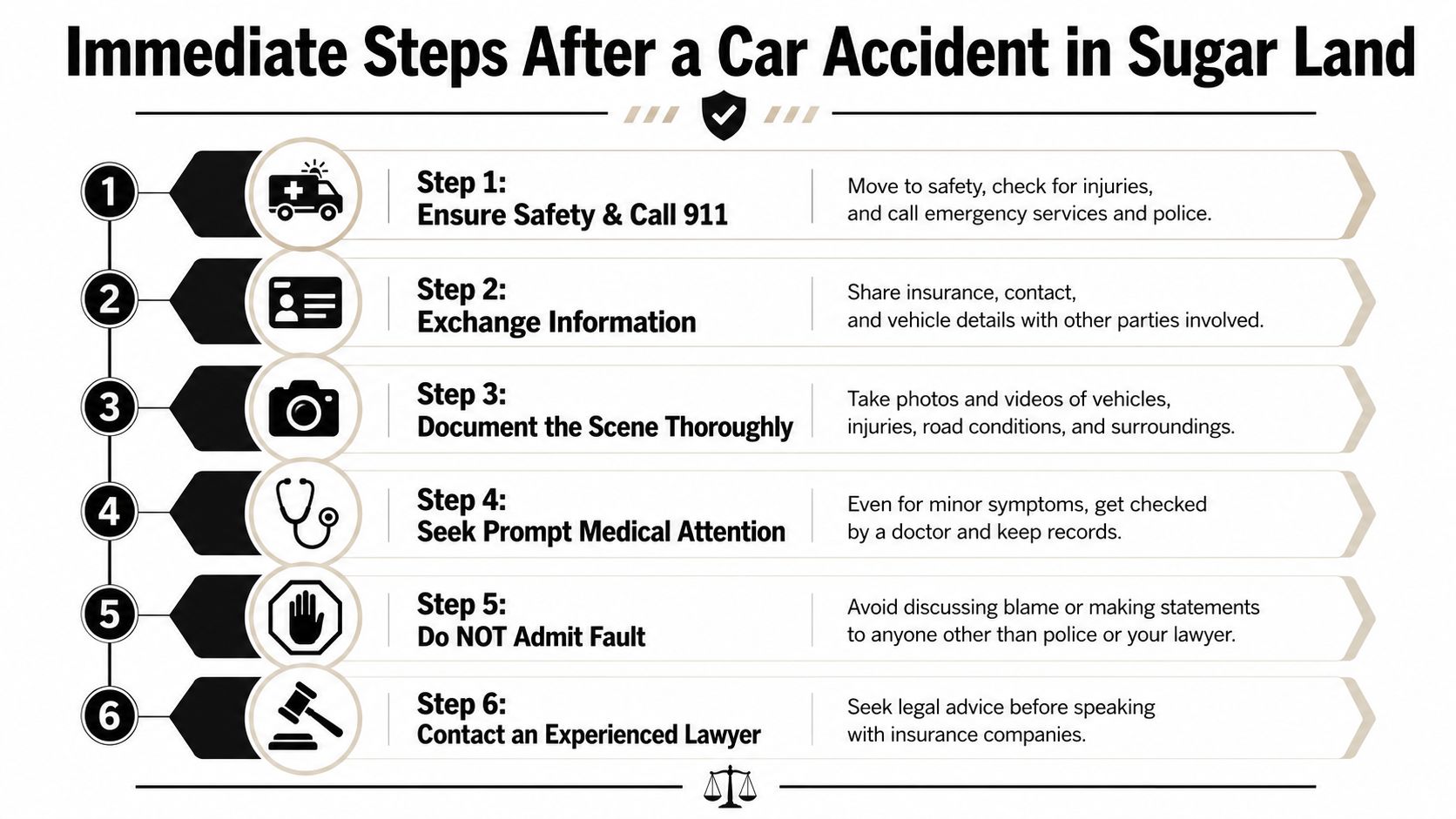
This quick visual sums up the immediate priorities.
What to do first
Get to safety and call 911
If vehicles can be moved safely, get out of active traffic. Ask for police and medical help if anyone may be hurt.Exchange information
Get names, insurance details, plate numbers, and vehicle descriptions. If there are witnesses, ask for contact information too.Document the scene
Take photos of the vehicles, the surrounding road, visible injuries, glass, debris, lane markings, and anything that shows how the crash happened.
After you've left the scene, this video gives a straightforward overview of the next decisions that matter.
What to do in the next day or two
Some of the most important steps happen after the tow truck leaves.
- Get medical care quickly: Even if you think you're just sore, get evaluated. Delayed pain is common, and medical records matter.
- Report the crash to your insurer: Keep it factual. Report the basic event, but don't guess about injuries or fault.
- Be careful with the other driver's insurer: You're not required to give a recorded statement just because an adjuster asks.
- Save everything: Bills, discharge papers, prescriptions, work notes, repair estimates, and photos of bruising or swelling.
“I'm still getting evaluated and I'm not ready to discuss fault or the full extent of my injuries.” That's often a safer response than trying to explain too much too soon.
The filing deadline that can end your claim
Texas gives you a limited window to file suit. The statute of limitations for filing a car accident personal injury claim is strictly two years from the date of the incident, and failing to file a lawsuit within this window permanently bars the victim from seeking compensation, as discussed in this Sugar Land limitations overview.
A statute of limitations is the legal deadline to bring your case. Miss it, and your claim can be lost even if the other driver was plainly at fault.
Steps to file an auto insurance claim
Filing an auto insurance claim usually means opening the claim promptly, identifying the vehicles and drivers involved, submitting basic documents, and continuing to update treatment records. The process sounds simple, but what helps your claim is consistency. The timeline in the report, the photos, the medical records, and your work-loss documents should all fit together.
If the insurer starts pushing for a fast settlement before your treatment picture is clear, that's usually a sign to slow down and get legal advice.
How a Lawyer Builds Your Compensation Claim
A strong injury claim doesn't come from one demand letter. It comes from layers of proof that fit together. That's how a lawyer turns “I was hurt” into a documented case for compensation.
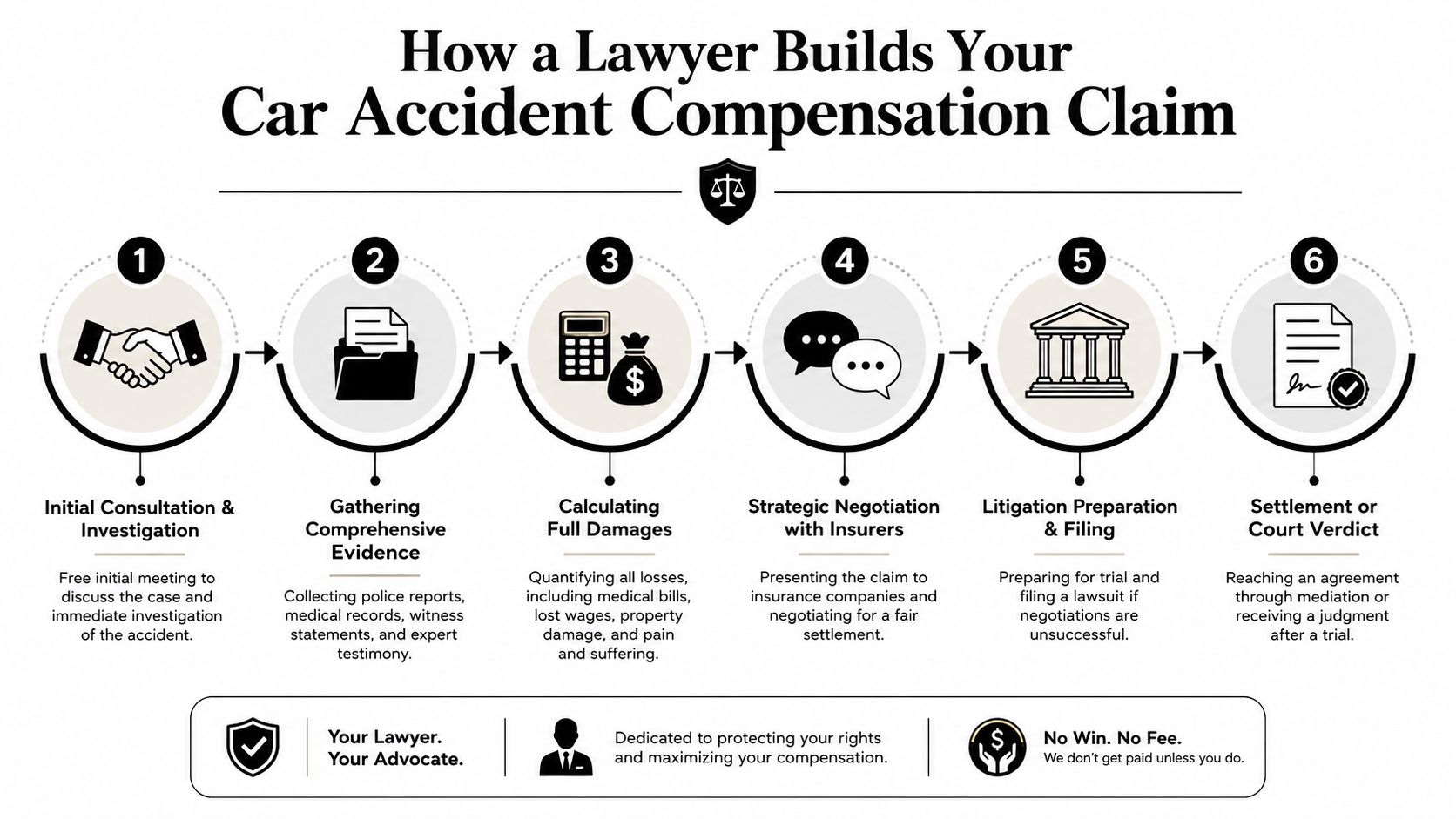
The work happens behind the scenes
The first job is investigation. That can include obtaining the crash report, preserving scene evidence, reviewing photos, locating witnesses, checking for video, and identifying any coverage issues early.
The second job is building the damages story. That includes more than hospital bills. A lawyer should evaluate how the injury changed your work, sleep, mobility, family life, treatment needs, and future care.
When that work is done well, the claim becomes harder to dismiss as a routine rear-end case.
Countering the minor impact defense
A common challenge in Sugar Land cases arises: in rear-end crashes, insurers frequently argue that a low-speed collision couldn't have caused serious injury. In Sugar Land, liability in rear-end collisions often requires countering insurance company arguments that a “minor impact” couldn't cause serious injuries like whiplash or herniated discs, making expert analysis critical to prove the full extent of damages, as noted in this Sugar Land rear-end injury discussion.
That defense works when the victim has gaps in treatment, weak documentation, or no clear explanation tying the symptoms to the crash. It loses force when the file is built carefully.
A lawyer may strengthen that kind of claim by focusing on:
- Early medical documentation: Complaints recorded close in time to the crash usually carry more weight than symptoms first reported much later.
- Functional impact evidence: Notes showing trouble sleeping, lifting, driving, sitting, or working help explain why the injury is real.
- Specialist input: In the right case, imaging review, orthopedic records, neurology records, or accident reconstruction can close gaps the insurer wants to exploit.
What compensation can include
Compensation usually falls into two broad categories.
| Type of damages | Examples |
|---|---|
| Economic damages | Medical bills, future treatment, lost wages, property loss |
| Non-economic damages | Pain, physical limitations, loss of normal daily activities |
If the crash caused a death, a family may also need advice about wrongful death compensation and survival claims. Those cases require a careful review of who can bring the claim and what losses may be recoverable under Texas law.
A fair claim value comes from complete proof, not from the adjuster's first number.
Negotiation only works when trial prep is real
Insurance companies can tell when a case is being handled seriously. If a lawyer is ready to file suit, develop experts, and prove damages in court, negotiations usually become more grounded in evidence.
That's one reason some injured Texans speak with firms that focus on vehicle collisions, including a Houston car accident lawyer or another Texas injury attorney familiar with serious injury litigation. The Law Office of Bryan Fagan, PLLC is one option victims consider for Texas motor vehicle injury cases, including rear-end, rideshare, trucking, and uninsured-driver claims.
Navigating Complex Claims Involving Trucks, Rideshares, and the Uninsured
Some crashes look like car wrecks but behave like commercial cases. A pickup striking you may involve only one personal auto policy. A delivery vehicle, tractor-trailer, or rideshare car can involve overlapping insurers, employment questions, app status questions, and fights over who was really “on the job.”

Trucking claims involve more than one target
With a truck crash, the driver may not be the only party that matters. Depending on the facts, the case may involve the company that employed the driver, the company that owned or maintained the vehicle, and commercial insurers defending the claim aggressively from day one.
That changes the evidence picture. A lawyer may need to act quickly to preserve driver logs, dispatch records, maintenance records, onboard data, and communications about the trip. These cases also tend to produce stronger defense efforts early, because the financial exposure is often significant when injuries are severe.
Rideshare coverage depends on app status
Rideshare collisions confuse many victims because there isn't always one obvious insurance policy. A key challenge in rideshare accidents is determining which insurance policy applies, as Uber/Lyft's $1M policy is only active during a trip, often leaving victims to rely on their own underinsured motorist coverage if the driver was idle, according to this Sugar Land rideshare liability discussion.
That means a case can turn on timing:
- Was the driver offline?
- Was the driver waiting for a ride request?
- Was the driver en route to pick someone up?
- Was the passenger already in the vehicle?
Those facts affect which insurer should pay and whether your own UM/UIM coverage becomes important.
What UM and UIM mean for you
Uninsured/underinsured motorist coverage is protection in your own policy that may help when the at-fault driver has no insurance or not enough insurance. Many people don't think about it until after a serious crash.
In practice, UM/UIM can matter in several situations:
- Hit-and-run crashes: The driver disappears, but your own policy may still provide coverage.
- Low-policy cases: The at-fault driver has coverage, but not enough for your losses.
- Rideshare disputes: The platform denies responsibility based on app status and the driver's individual coverage is limited.
If you're trying to understand how insurers read property-loss and reconstruction issues after a serious event, some of the same documentation habits show up in other coverage fights too. This article on 360 Hazardous Cleanup fire claim insights is useful for understanding why records, photos, and early documentation often shape the outcome of insurance disputes.
In a complex vehicle case, the first question often isn't “Who hit whom?” It's “Which policy applies, and what evidence proves it?”
What doesn't work in complex cases
What usually fails is waiting too long, assuming the app company will cooperate, or treating a truck crash like a routine fender-bender. By the time the injured person realizes coverage is disputed, key records may already be harder to obtain.
What works is early preservation, a clear liability theory, and a careful review of every potentially available policy.
Frequently Asked Questions About Sugar Land Accident Claims
How much does it cost to hire a car accident lawyer
Most car accident cases are handled on a contingency fee. That means you don't pay attorney's fees up front. The lawyer is paid only if compensation is recovered for you through a settlement or verdict. During a free consultation, ask how case expenses are handled and when fees are earned.
Will I have to go to court
Usually, no. Many claims resolve through insurance negotiations or settlement discussions before trial. Still, your lawyer should prepare the case as if it may be presented to a jury. That preparation often improves settlement advantage because the insurer knows the file is ready if negotiations fail.
What if the insurance company already offered me money
Don't assume the first offer reflects the full value of your claim. Early offers often come before your treatment is complete and before the full impact on your work and daily life is documented. Once you sign a release, you usually can't go back and ask for more later.
What do liability, comparative fault, damages, and statute of limitations mean
These terms sound technical, but they're manageable:
- Liability means legal responsibility.
- Comparative fault means your compensation can be reduced if you share part of the blame.
- Damages means the losses the law may compensate.
- Statute of limitations means the deadline to file suit.
When should I talk to a lawyer
Sooner than many expect. The right time is usually before you give detailed statements, accept a settlement, or assume the insurer is evaluating your case fairly.
If you were hurt in a Sugar Land crash, you don't have to sort through fault disputes, medical records, and insurance pressure by yourself. The Law Office of Bryan Fagan, PLLC offers free consultations for accident victims and families who need clear answers about their rights, their next steps, and their recovery options. If you're looking for a compassionate, practical Sugar Land car accident lawyer, reach out to discuss your case. You won't pay unless compensation is recovered for you.