A car crash can change your life in seconds, but you don't have to face recovery alone.
If you're reading this, there's a good chance you're dealing with pain, paperwork, missed work, and calls from insurance adjusters who want answers before you've even had time to think. That's common after a wreck in Pasadena. People are shaken up, unsure what to do next, and worried about how they'll pay for treatment or fix a car they still need for daily life.
This guide is written the way I'd explain it to a client sitting across my desk. Clear steps. Plain language. No legal jargon unless it helps you protect your rights. If you've been searching for a Pasadena TX accident lawyer, you probably don't want hype. You want to know what matters now, what mistakes to avoid, and how Texas law affects your case.
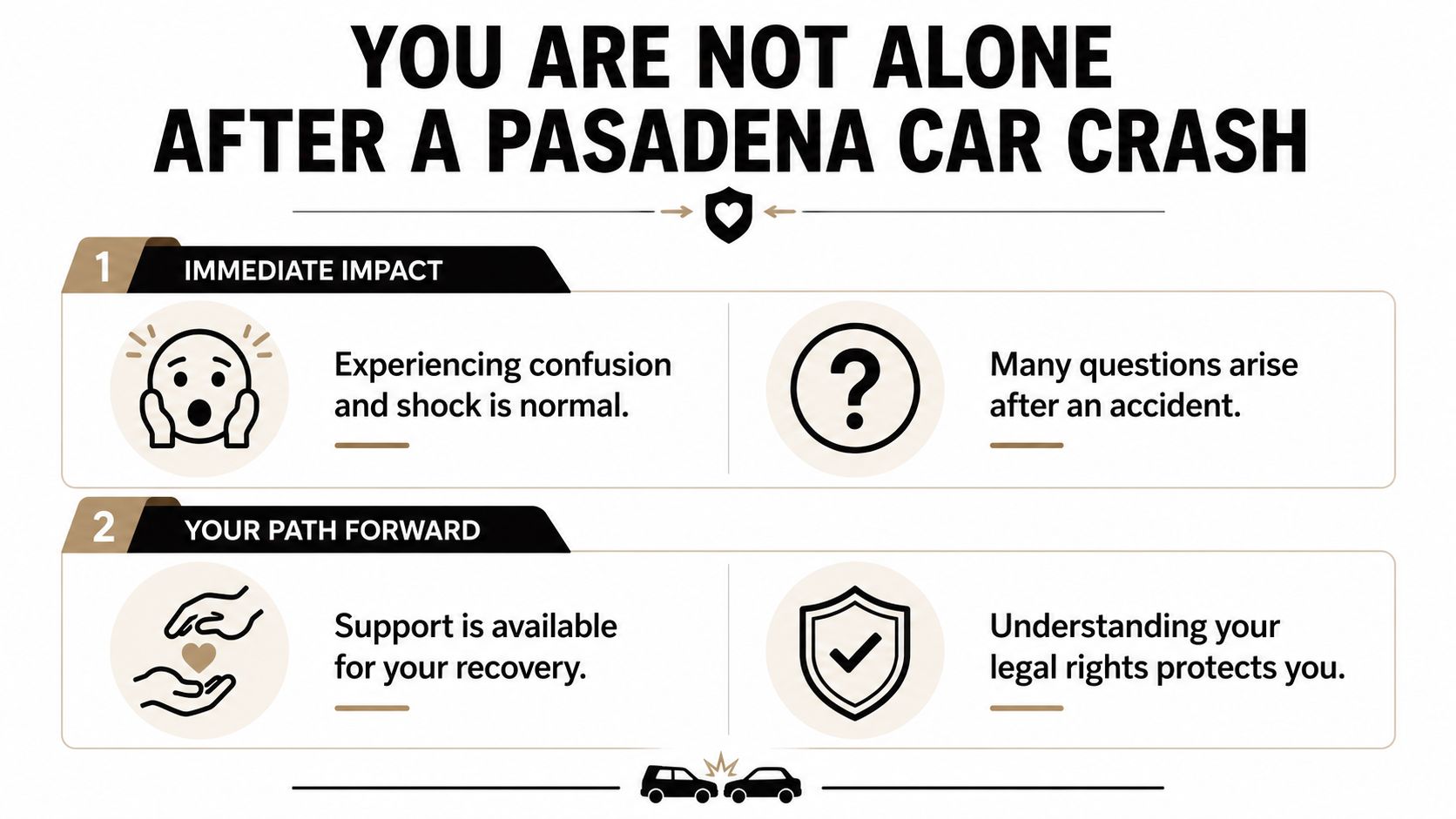
After a Pasadena Car Crash You Are Not Alone
A crash in Pasadena often happens in an ordinary moment. You're heading down SH-225, trying to get through an intersection before traffic backs up. Or you're driving home after work, stopping suddenly because the line ahead stalls. Then there's impact, airbags, noise, and confusion.
That confusion is normal. So is the feeling that everything suddenly got complicated.
Pasadena drivers face real risk on local roads. Between January 1, 2023 and September 24, 2024, Pasadena, Texas experienced 6,904 traffic accidents, including 16 fatal incidents and 19 deaths, according to Pasadena traffic accident statistics for 2023 and 2024. That same source notes that rear-end crashes are common, and intersection collisions often happen when drivers fail to yield or run red lights.
What people usually feel in the first days
After a wreck, someone involved isn't thinking about legal rules first. They're thinking about basic survival.
- Medical worries: You may not know whether your pain is temporary or the start of a long recovery.
- Money pressure: Bills keep coming, even if you can't work.
- Insurance stress: Adjusters may sound friendly, but their job is to close claims for as little as possible.
- Uncertainty: You may not know who should pay, what your policy covers, or whether you even have a case.
Experiencing shock and asking the same questions over and over after a collision is normal.
Why local knowledge matters in Pasadena
Pasadena crashes aren't all the same. Local traffic patterns matter. Heavy commuter traffic mixes with industrial traffic. Busy intersections create sudden stops. On roads around SH-225 and nearby corridors, even a “simple” wreck can turn into a complicated claim if there's a commercial vehicle, missing camera footage, or a dispute about who had the right of way.
A Houston driver rear-ended on I-45 may face one set of issues. A Pasadena driver hit near an industrial route may face another, especially if a company vehicle or truck is involved.
That's why the early days matter so much. The right medical care, the right documents, and the right advice can change the direction of your claim. You don't need to know everything today. You just need to avoid the mistakes that can hurt your case later.
What a Pasadena Accident Lawyer Does for Your Case
A Pasadena accident lawyer helps build your case before the insurance company has a chance to define it on its own. That work often starts in the first days after the crash, while evidence is still available and before key details get lost.
On Pasadena roads, that early work can matter more than people expect. A collision near SH-225 may involve industrial traffic, a company vehicle, multiple insurers, or footage from nearby businesses that does not stay available for long. A hit-and-run can create a second layer of problems because your claim may turn into an uninsured motorist case, which means your own carrier may start questioning how the wreck happened.
The lawyer investigates what happened
A case is built the same way a mechanic diagnoses a problem. You do not guess from one symptom. You check the parts, compare what fits, and rule out what does not.
For a car wreck claim, that usually means gathering and preserving evidence such as:
- Crash reports and other official records
- Photos and video from the scene, nearby stores, traffic areas, or dash cams
- Witness statements while memories are still fresh
- Medical records that connect your injuries to the collision
- Vehicle damage evidence showing angle of impact and crash force
That investigation is especially useful when the other side starts shifting blame. If you are not familiar with how partial blame can affect compensation, this explanation of Texas comparative fault rules after a crash gives helpful background.
If the crash involved a person on foot, Houston Pedestrian Accident Lawyer is one example of legal representation focused on pedestrians struck by vehicles in Houston.
The lawyer handles insurance communication with a purpose
Insurance adjusters are trained to ask questions in a way that sounds routine. The problem is that routine questions can produce answers that later get used against you.
A lawyer steps in to handle those calls, organize claim paperwork, and keep the record clear. That includes property damage issues, injury documentation, and communication with your own carrier if UM or UIM coverage may apply. In Pasadena cases involving hit-and-run drivers, this can be a major issue because your insurer may ask for proof that an unknown driver caused the crash and that reasonable reporting steps were taken.
One sentence can matter.
For example, saying “I'm okay” at the wrong time may be treated as proof that you were not hurt, even if you later learn you have a concussion, back injury, or soft tissue damage. A lawyer helps make sure casual conversation does not become claim evidence.
Practical rule: Treat every insurance statement as part of the case record.
The lawyer proves the full value of your losses
A claim is worth more than the first stack of bills. A lawyer looks at how the crash changed your health, your work, and your daily routine, then ties those losses to records that an insurer, judge, or jury can evaluate.
That may include:
- Medical care you already received
- Future treatment, such as therapy, injections, or follow-up visits
- Lost income from missed work
- Reduced earning ability if you cannot return to the same job
- Pain and physical limitations that affect daily life
- Insurance coverage questions, including whether more than one policy may apply
Local experience helps because a Pasadena crash involving a plant worker, contractor, delivery vehicle, or commercial truck may raise issues that do not show up in a standard two-car collision. A lawyer looks for those details early, because they can affect both fault and available coverage.
The lawyer prepares the case for negotiation and, if needed, court
Strong cases are usually prepared as if someone else will examine every page later. That means deadlines are tracked, records are organized, and evidence is preserved in a form that can hold up if the claim ends up in Harris County litigation.
Many claims settle. The reason they settle on better terms is often simple. The insurance company sees a file that is documented, timely, and ready to be proved. That changes the conversation from “How little can we pay?” to “What can we defend?”
A lawyer's job is not only to file paperwork. It is to protect the story of what happened, connect the evidence to your injuries, and keep your case from being reduced to an adjuster's shorthand version of the wreck.
How Fault Is Determined in a Texas Car Accident
Fault is one of the most misunderstood parts of any crash case. People often assume the police report decides everything, or that the driver who hit first is always fully to blame. Texas law is more detailed than that.
Negligence in plain English
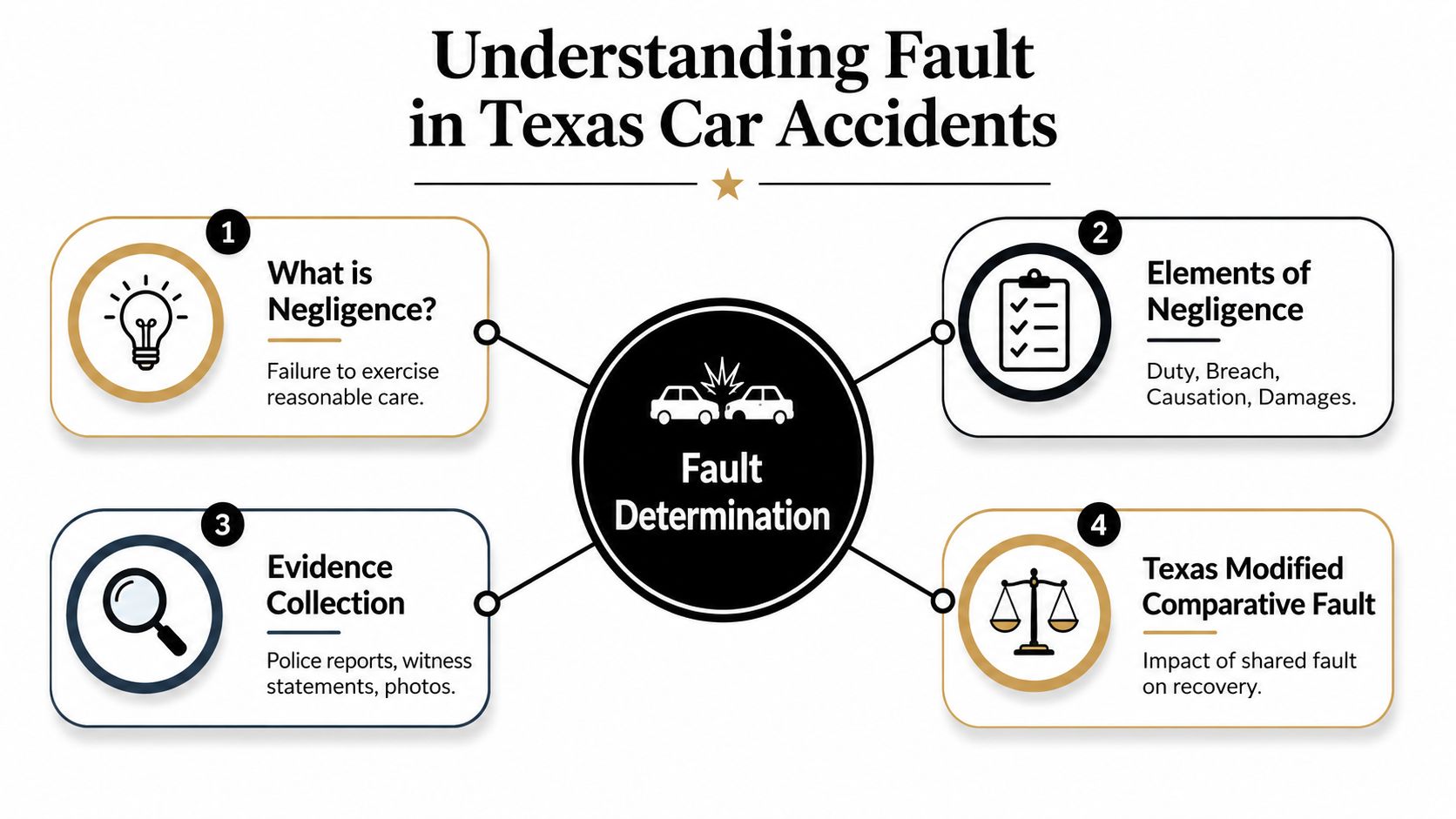
Most car accident cases are based on negligence. That means one person failed to use reasonable care and caused harm to someone else.
Texas negligence claims require four elements: duty, breach, causation, and damages, as explained in this discussion of Texas comparative negligence and liability.
Here's what those words mean in everyday language:
| Element | Plain-English meaning |
|---|---|
| Duty | The driver had a responsibility to act safely |
| Breach | The driver failed to act safely |
| Causation | That failure caused the crash |
| Damages | You suffered actual harm, such as injury or financial loss |
A simple example helps. A Houston driver rear-ended on I-45 at a stoplight may show duty because every driver must keep a safe distance. The other driver may have breached that duty by not paying attention. If the rear-end impact caused neck pain and medical treatment, that supports causation and damages.
For readers who want a simple explanation of shared blame, this guide on comparative fault definition is a useful starting point.
Shared fault under Texas law
Texas uses proportionate responsibility, which many people call modified comparative fault. If an injured person is found 51% or more responsible, they cannot recover financial damages from other at-fault parties, according to Texas proportionate responsibility and the 51% bar rule.
If you're 50% or less at fault, you can still recover, but your compensation is reduced by your share of responsibility.
Later, when damages are calculated, Texas law reduces the award by your percentage of fault before other adjustments. The Texas Tech Law Review gives this example in its discussion of Texas Civil Practice & Remedies Code § 33.012(a): a $100,000 award becomes $80,000 if the injured person is found 20% responsible.
Here's a short video that walks through fault issues in car accident cases.
Why fault disputes happen so often
Insurance companies look closely at anything they can use to argue that you share blame. They may point to speed, distraction, following distance, lane position, or what you said at the scene.
Even when fault seems obvious, the insurance company may still argue you contributed to the crash.
That's why evidence matters so much. Photos, witness statements, scene details, medical records, and vehicle damage all help tell a consistent story. Under Texas Civil Practice & Remedies Code Chapter 33, fault isn't just about who feels responsible. It's about what can be proven.
Chapter 41 also matters in some cases. That chapter addresses exemplary damages in cases involving especially serious wrongdoing. Those claims are more limited and fact-specific, but they can come into play when conduct goes beyond ordinary carelessness.
Common Accident Types on Pasadena Roads
Pasadena has traffic problems that generic legal articles often miss. This isn't just suburban congestion. Local roads carry commuters, delivery vehicles, industrial traffic, and large commercial trucks moving through corridors tied to plant and shipping activity. That mix creates very specific crash patterns.
Rear-end and intersection crashes
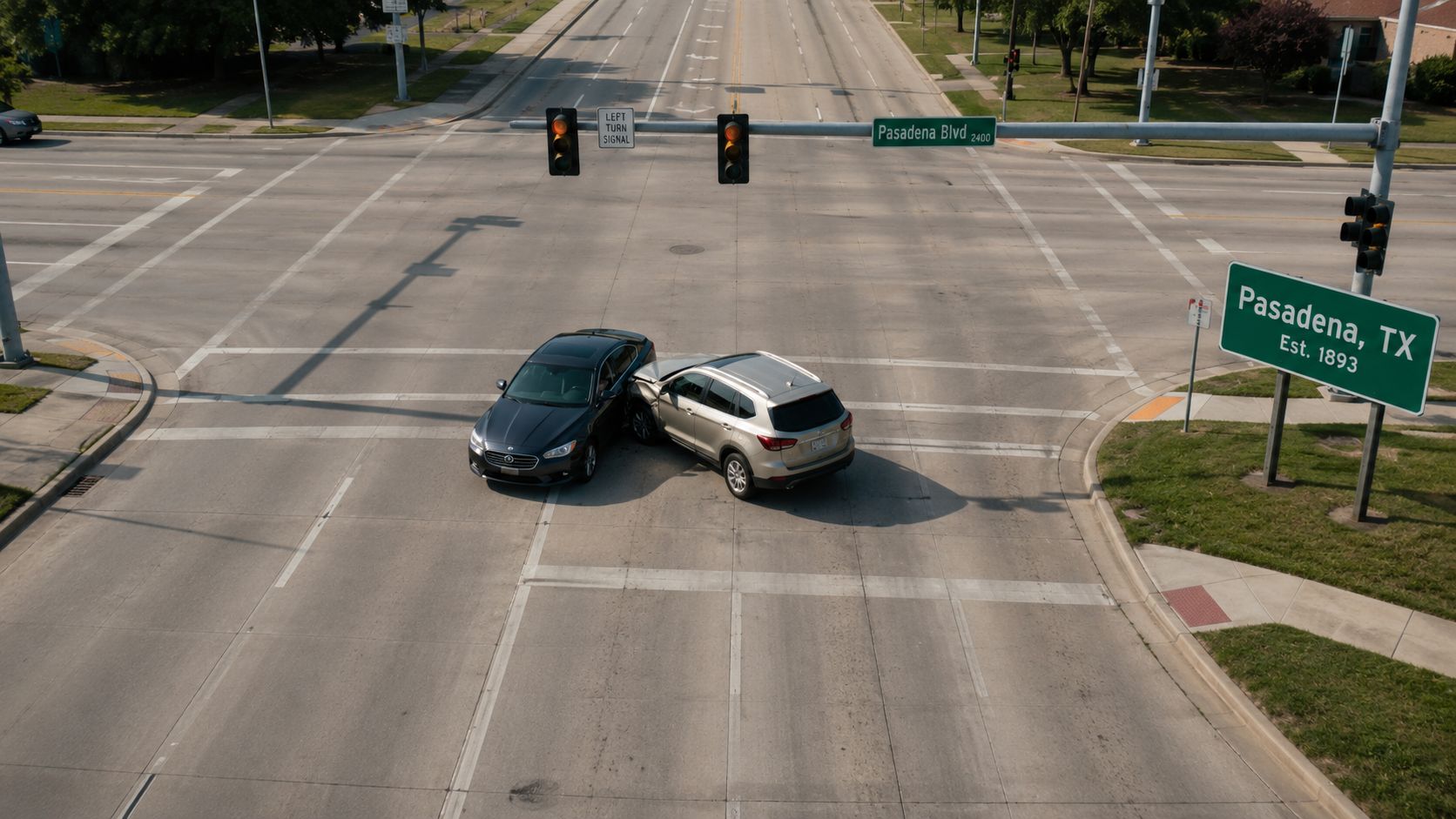
A common Pasadena scenario is a stop-and-go rear-end wreck. One driver brakes hard in heavy traffic. The driver behind reacts too late. The first driver may walk away thinking it was minor, then wake up the next day with neck stiffness, headaches, or back pain.
Intersection collisions can be even worse. A T-bone crash often happens when one driver misjudges a light, turns across traffic, or fails to yield. These cases can become disputes about timing, lane position, and visibility.
In both types of wrecks, the same question comes up fast: who had the legal duty, and who broke it?
Commercial truck crashes near SH-225
Truck cases are different from ordinary car wrecks. Pasadena, TX, located along State Highway 225 and surrounded by industrial corridors, presents increased risks for commercial truck accidents governed by complex federal and state regulations, including Federal Motor Carrier Safety Administration rules on hours of service, cargo loading, and vehicle maintenance, as discussed in this overview of Pasadena truck accident issues.
That matters because truck claims may involve more than the driver. A case can also involve the trucking company, maintenance provider, cargo loader, or another business tied to the trip.
A few examples:
- Driver fatigue: A truck driver may have been on the road too long.
- Mechanical problems: Bad brakes or poor maintenance may have contributed.
- Cargo issues: Improper loading can affect stopping distance or vehicle balance.
Those cases often require company records, inspection information, and fast evidence preservation.
Hit-and-run crashes and UM UIM problems
A hit-and-run claim creates a different kind of problem. The challenge isn't only finding the other driver. It's also accessing coverage under your own Uninsured/Underinsured Motorist, often called UM/UIM, policy.
In Harris County, victims can face a procedural hurdle when the at-fault driver is never found. As explained in this Pasadena auto accident discussion, courts often require a thorough investigation showing the driver can't be identified before insurers honor these claims. Many people are surprised by that. They assume having UM/UIM coverage means the claim will be straightforward. It often isn't.
If a driver disappears after the crash, don't assume your insurer will automatically pay UM/UIM benefits without proof and investigation.
Drunk driving and dram shop issues
Some Pasadena-area wrecks involve alcohol. When they do, the legal case may include more than a claim against the driver. In some situations, Texas law allows a dram shop claim against an establishment that served an obviously intoxicated person who later caused a crash.
Those cases are fact-heavy. They may involve receipts, witness accounts, timing, and surveillance footage. If the crash caused a fatality, surviving relatives may also have a claim for wrongful death compensation.
Rideshare and delivery vehicle crashes
Uber, Lyft, and delivery drivers add another layer of insurance complexity. A rideshare crash may involve the driver's personal policy, a company policy, or a dispute about what the driver was doing in the app at the time.
That's why these cases often turn on records that aren't available to the public right away. App activity, trip status, and insurer coordination all matter.
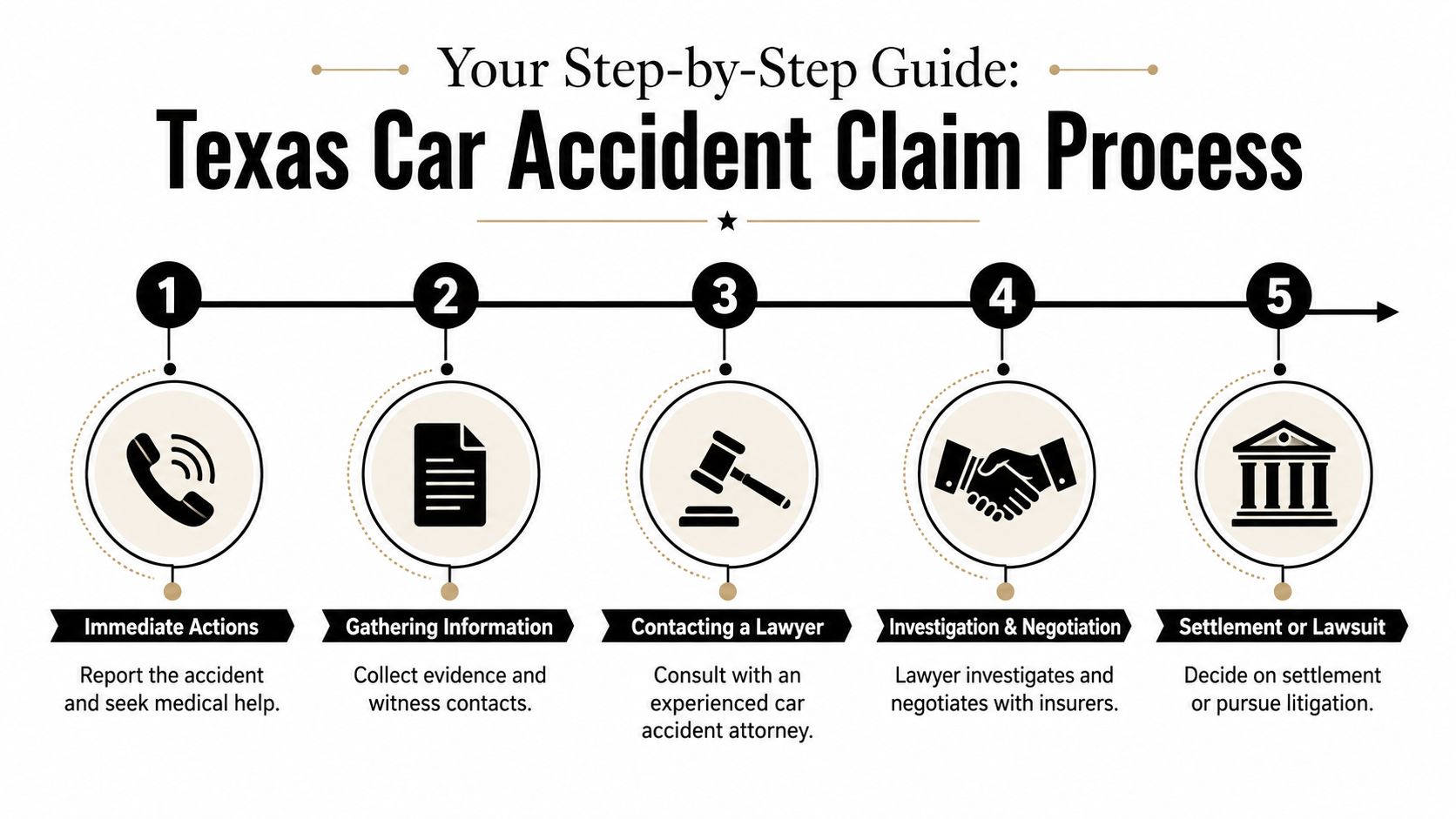
Navigating the Texas Car Accident Claim Process Step by Step
The claim process feels less overwhelming when you break it into stages. Instead of a lecture on procedure, those involved need to know what to do first, what to save, and what to expect next.
In Harris County, dangerous crash patterns include impaired driving, speed-related collisions, and inattention. Alcohol-impaired driving caused 3,604 DUI crashes in 2024 that killed 142 people, while “Failed to Control Speed” caused 17,234 crashes and “Driver Inattention” contributed to 10,620 crashes, according to Harris County and Pasadena crash data. Those facts matter because the cause of the crash affects the evidence you need to collect.
Step 1 at the scene
Your first job is safety.
- Call for help: Report the crash and request medical assistance if anyone is hurt.
- Get checked out: Some injuries show up hours later, not immediately.
- Document what you can: Photos of vehicles, road position, debris, visible injuries, and traffic signs can help later.
If you can speak safely with witnesses, get names and contact information. If police respond, ask how to obtain the report.
Step 2 open your claim carefully
Report the crash to your own insurer. Give basic facts. Stay accurate. Don't guess about speed, injury severity, or fault.
If you want a simple companion guide, this article on how to file a car accident claim outlines the process in plain language.
Step 3 organize your proof
This stage often decides whether a claim stays strong or slowly weakens.
Create one folder, digital or paper, for:
| Document | Why it matters |
|---|---|
| Police report | Basic account of the crash |
| Medical records | Connects injuries to the collision |
| Bills and receipts | Shows financial loss |
| Photos | Preserves scene and vehicle damage |
| Work records | Supports lost income claims |
Step 4 expect negotiation
Once treatment is clearer and records are collected, the claim is usually presented to the insurance company. That often includes a demand package with medical records, proof of losses, and an explanation of fault.
The adjuster may accept, deny, or push back. That doesn't always mean the case is weak. It often means the negotiation has started.
Keep your medical treatment consistent if your doctor recommends follow-up care. Gaps in treatment can give insurers an argument they'll use against you.
Step 5 decide whether to settle or file suit
Some cases settle through negotiation. Others need a lawsuit before the insurer takes the claim seriously. Filing suit doesn't mean your case will definitely go to trial. It means you are using the court process to protect your rights and keep pressure on the defense.
One reason timing matters is the statute of limitations. In Texas personal injury cases, waiting too long can end the claim entirely. I cover that more directly in the FAQ below because it's one of the most important deadlines in your case.
Understanding the Compensation You Can Recover
After a serious wreck, people usually ask one practical question: what can I recover? In Texas, compensation is called damages. Damages are the losses the law recognizes after someone else's negligence causes harm.
The two broad categories are economic damages and non-economic damages. Chapter 41 of the Texas Civil Practice & Remedies Code also matters in certain cases involving exemplary damages, but most claims begin with the first two categories.
Types of compensation in a Texas car accident claim
| Damage Type | Description |
|---|---|
| Economic damages | Financial losses you can document, such as medical bills, lost wages, property damage, and other out-of-pocket costs |
| Non-economic damages | Human losses that don't come with a receipt, such as pain, mental anguish, physical impairment, and loss of enjoyment of life |
Economic damages
These are usually easier to identify because they appear on bills, pay records, invoices, or repair estimates.
A few common examples include emergency care, follow-up treatment, prescription costs, therapy, mileage to appointments, and income you lost while recovering. If your injuries affect your ability to do your old job, future income loss may also become part of the case.
For a fuller explanation of valuation, this guide on how to calculate damages helps show how lawyers and insurers look at losses.
Non-economic damages
These damages are real, even though they're harder to measure. Pain that keeps you from sleeping, anxiety while driving, limits on lifting your child, or a lasting scar all affect your life.
A woman hurt in a side-impact crash may have modest car damage but severe shoulder pain that changes how she works and sleeps. A man with a back injury may return to work but live with daily restrictions. Those losses matter.
A word about reduced recovery
If you share fault, your damages may be reduced under Chapter 33, as covered earlier. That's why proving liability matters just as much as proving injury. A strong case has both.
Insurance companies rarely volunteer the full scope of recoverable damages. They focus on closing claims. Your job is to understand what the law allows, then support it with records, testimony, and consistent medical evidence.
Your Questions Answered About Pasadena Accident Claims
People usually have the same urgent questions after a wreck. The answers below are the ones that matter most in the first days and weeks.
How much does it cost to hire a Pasadena accident lawyer
Many personal injury firms handle these cases on a contingency-fee basis. That usually means you don't pay attorney's fees up front, and the fee is paid from a recovery if the case succeeds. You should always ask for the fee agreement in writing and make sure you understand how case expenses are handled.
How long do I have to file a lawsuit
Under Texas Civil Practice & Remedies Code Section 16.003, the statute of limitations for filing a personal injury lawsuit after a car accident in Pasadena, TX is strictly two years from the date of the crash, as noted in this Pasadena car accident law discussion.
That term, statute of limitations, means the filing deadline set by law. If you miss it, the court can dismiss your case even if your injuries are serious and the other driver was clearly at fault.
Should I give a recorded statement to the other driver's insurer
Usually, you should be careful here. The other insurer is looking for ways to limit what it pays. A recorded statement can lock you into wording before you know the full extent of your injuries.
If you're unsure, talk to a lawyer first. Waiting for advice is often safer than trying to sound helpful and accidentally damaging your own claim.
What if I was partly at fault
Texas follows a shared-fault system covered earlier in this guide. In plain terms, partial fault doesn't always end a case. But it can reduce what you recover, and too much assigned fault can bar recovery completely.
That's one reason to avoid casual admissions like “I'm sorry” or “I didn't see them” at the scene. Those words may not reflect legal fault, but insurers may still use them that way.
What if the driver who hit me had no insurance or fled
You may still have options through your own policy, especially UM/UIM coverage. But these claims can become document-heavy and contested. Keep every record, report the crash promptly, and don't assume your insurer will fill in the gaps without proof.
What does liability actually mean
Liability means legal responsibility. If another driver's negligence caused your injuries, that driver may be liable for the losses that followed. Proving liability usually takes evidence, not just belief.
If you're hurt and unsure what to do next, contact The Law Office of Bryan Fagan, PLLC for a free consultation. You can get clear answers about fault, insurance, deadlines, and possible compensation without pressure. If you're dealing with medical bills, lost income, or a family member's fatal crash, legal help is available, and you don't have to sort through the process alone.