A car crash can change your life in seconds, but you don't have to face recovery alone.
If you're reading this, there's a good chance you're dealing with pain, car damage, missed work, calls from insurance, and a lot of uncertainty. In Harris County, one of the first documents that can help you regain control is the official Texas Peace Officer's Crash Report, often called the CR-3. It may look like routine paperwork, but in practice it often becomes the first document an insurance adjuster, claims handler, or Houston car accident lawyer reviews.
Think about a common Houston scenario. A driver is rear-ended on I-45 during the morning commute. At the scene, everyone is shaken. A few hours later, neck pain starts. By the next day, the at-fault driver's insurer is already asking questions. In that moment, details matter. The report can tie the crash to a place, a time, the vehicles involved, the responding officer's observations, and any early fault findings.
That matters because your claim is about proof. You may know the other driver caused the wreck, but an auto insurance claim doesn't move on what feels obvious. It moves on records, timelines, and documented facts. The crash report is often where that paper trail starts.
Your First Step Toward Recovery After a Houston Crash
The first 24 to 72 hours after a Houston wreck are often messy. You are in pain, your car may be in a tow yard or body shop, and the insurance company is already asking for a statement. In that window, the crash report often becomes the first neutral record of what happened.
For people searching “Harris County accident report how to get,” the real issue is not just how to order a document. It is how to protect the facts before the other driver's insurer starts shaping the claim. A Texas Peace Officer's Crash Report, or CR-3, usually lists the date, location, drivers, passengers, vehicle information, insurance details, witness information, and the investigating officer's initial observations. Those details often become the starting point for liability decisions, reserve setting, and settlement strategy.
Insurance adjusters read this report closely. They look for anything they can use to reduce what they pay. A missing injury notation may be cited later to question medical treatment. An incomplete location entry can create room to dispute how the impact happened. If the officer notes a contributing factor that points to you, even unfairly, that can affect how fault is argued from the start.
Why this step carries legal weight
A crash claim turns on proof. Your memory matters, but insurers and defense lawyers give more weight to records created near the time of the collision.
Get the report early. Read every line. Keep it with your photos, medical records, repair estimates, and receipts.
That simple step helps in more ways than many people realize. Under Texas Civil Practice & Remedies Code Chapter 33, fault can be shared among the people involved in the crash. If the insurer can shift part of the blame to you, it can try to reduce what it owes. The report is not the final word on liability, but it often frames the first argument about who caused the wreck. I have seen adjusters rely on that framing long before they review the full medical file or talk to every witness.
A few legal terms in plain English
- Liability means legal responsibility for causing the crash.
- Comparative fault means more than one driver can share blame, which can reduce compensation.
- Damages means losses tied to the wreck, including medical bills, lost income, vehicle damage, and pain.
- Statute of limitations means the deadline to file suit.
If you are hurt, this report is more than paperwork. It is often the first document that supports your side of the story, and the first one the insurance company studies for weaknesses.
Which Agency Has Your Report Houston PD, HCSO, or TxDPS
The biggest mistake people make is requesting the report from the wrong place. In Harris County, that can waste days and add stress when you're already trying to heal.
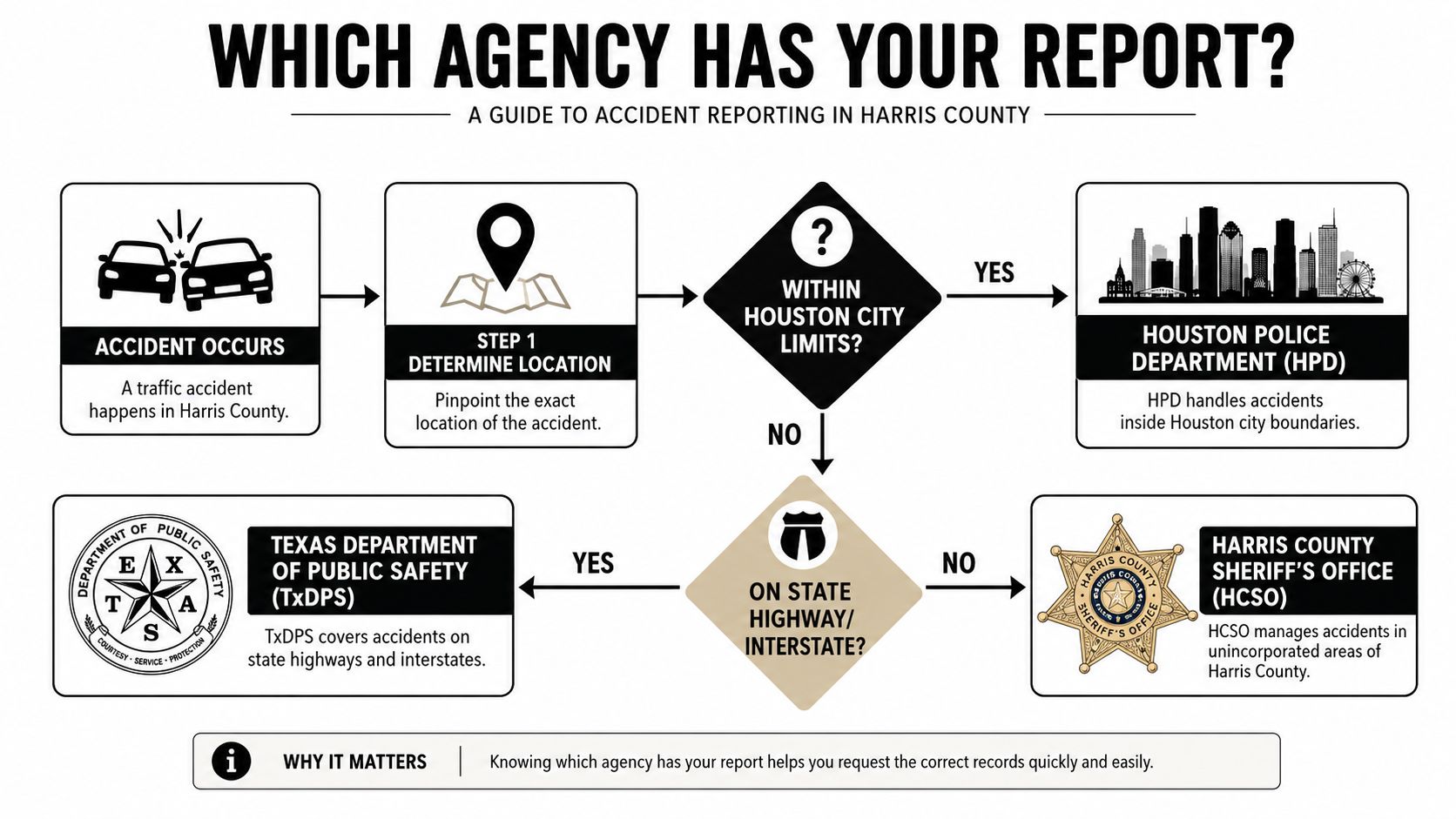
Start with where the crash happened
If the wreck happened inside Houston city limits, the report is usually handled by Houston Police Department. For HPD crashes, the report is processed at 1200 Travis Street and can be retrieved through the Texas Department of Transportation's CRIS system, as explained in this guide on how to obtain a car accident report in Houston.
If the crash happened in an unincorporated part of Harris County, such as areas around Cypress or other county zones outside city jurisdiction, the report is generally handled by the Harris County Sheriff's Office.
If the collision happened on a state highway or interstate and a state trooper investigated, the report may belong to Texas Department of Public Safety instead.
A few Houston examples
A rear-end wreck on Westheimer inside city limits may point to HPD.
A crash on a county road in an unincorporated area may point to HCSO.
A serious collision on a major highway where a state trooper handled the scene may point to TxDPS.
That's why location matters. The same county can involve different agencies depending on city boundaries and who responded.
How to confirm before you request
If you aren't sure which agency took the report, call before paying for anything.
- For Houston city cases: Call HPD's non-emergency line at (713) 884-3131.
- For county cases: Call the HCSO Records Division at (713) 274-9220.
- For fatal cases: If your family is dealing with the loss of a loved one, a crash report is only one part of the file. A Houston Wrongful Death Lawyer handles representation for Houston families who lost a loved one to negligence.
Requesting from the wrong database doesn't just slow things down. It can send you in circles while the insurer keeps moving the claim forward on its own timeline.
How to Request Your Harris County Accident Report
A few days after a Houston crash, many injured drivers hit the same wall. The insurance adjuster asks for the report number, treatment has already started, and the report still has not shown up where they expected. At that point, the request process is no longer just paperwork. It affects how quickly you can confirm who the officer blamed, whether the other driver's information is accurate, and what the insurer will use to value your claim.
The right request method depends on what you need right now. Online requests are usually the fastest. Mail can make sense if you want a dated paper trail. In-person requests help when you need someone to confirm whether the report is available before you leave the office.
Online requests
If Houston Police Department investigated the crash, the usual online route is the Texas Department of Transportation's CRIS system. If Harris County Sheriff's Office handled it, the report is commonly obtained through the sheriff's designated online reporting portal. For either route, small entry errors cause big delays. A wrong date, misspelled name, or incorrect report number can make it look like no record exists.
That matters because insurers do not wait for you to sort it out. They start building their version of the crash immediately. A practical breakdown of the search details you may need is covered in this Houston accident report guide.
If you are ordering online, gather these details first:
- Full name of a driver or passenger involved
- Date of the collision
- Location of the crash
- Driver's license number, if available
- Vehicle identification information, if available
- Report number, if you were given one at the scene
By mail
Mail requests are often used for HPD records, especially when someone wants a copy sent to a home address with supporting paperwork. Before sending anything, confirm the current form, fee, mailing address, and whether a self-addressed stamped envelope is still required. Missing one document can slow the request or cause it to be rejected.
Mail is slower, but there is a trade-off. You create a clean record of what was sent and when it was sent. That can help if a delay later affects medical billing, rental reimbursement, or an insurance deadline.
In-person requests
In-person requests work well for crash victims who are confused about where the report is, whether it is ready, or whether a certified copy is worth getting. For HPD cases, that usually means going to the records processing location. For HCSO cases, it may mean visiting a district substation or county office that handles records.
I usually tell clients to ask one extra question while they are there. Ask whether the copy being issued is a standard report or a certified one, and ask which version is more useful for the dispute they expect. A standard copy is enough for many insurance claims. A certified copy can help when liability is contested or the report may be needed later in litigation.
Harris County accident report request methods
| Method | Agency | Where to Go / Website | Cost | What You Need |
|---|---|---|---|---|
| Online | HPD | TxDOT CRIS | Check current agency fee | Identifying details tied to the crash |
| Online | HCSO | Sheriff's designated online crash report portal | Check current agency fee | Crash details and party-identifying information |
| By Mail | HPD | Records Division, 1200 Travis, Houston, TX 77002 | Check current agency fee | Required request form, return envelope if required, payment |
| In Person | HCSO | District substation or county office | Check current agency fee | Basic crash information and identification |
| In Person | HPD | 1200 Travis Street processing location | Check current agency fee | Report details and payment |
What tends to work best
The best choice depends on the claim.
- Use the agency's online system if you already know who investigated and you want the fastest route.
- Use mail if you want proof of the request and do not mind waiting longer.
- Go in person if the crash was serious, the report has been hard to locate, or you may need a certified copy.
- Ask a family member or your lawyer to help if injuries, medication, or stress are making the process harder.
One wrong click here can create a real problem later. If you order from the wrong place, wait a week, and then learn the report was held by another agency, the insurer has had another week to frame the crash before you have even read the officer's narrative. That is why getting the report is not just an administrative step. It is one of the first ways to protect your side of the case.
Decoding Your Texas Car Accident Report
Once the report arrives, many people skim it and stop at the officer's conclusion. That's a mistake. Every section can matter.
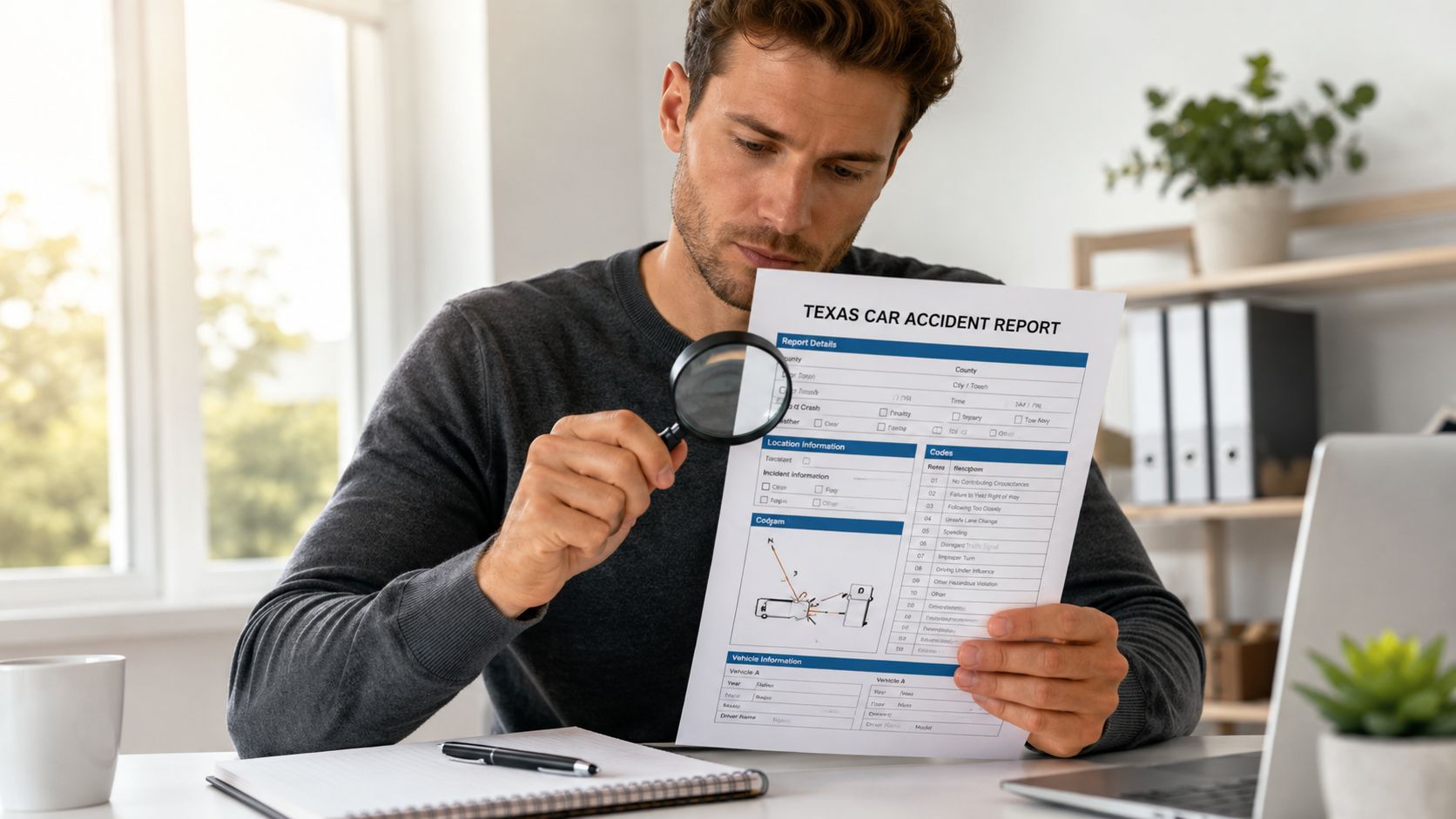
The parts that usually matter most
The officer's narrative is where you'll often see the first written account of how the collision happened.
The vehicle and driver information matters because insurers use it to match policies, ownership, and the people involved.
The contributing factors area can be critical. If the report points to conduct like unsafe driving behavior, that can support your liability argument.
For a closer breakdown of the form itself, this guide on how to read a police accident report can help you understand what each section means.
How insurers use the report against victims
Insurance companies don't treat a report as the final word, but they do use it as an anchor. If the report says you appeared uninjured, they may question later treatment. If a diagram seems unclear, they may argue the impact happened differently. If there's any sign you contributed to the crash, they may lean hard on comparative fault.
That's where Texas law matters. Under Chapter 33, comparative fault means your compensation can be reduced if you share responsibility. Liability means who was legally at fault. Damages means what the crash cost you physically, financially, and personally.
The report doesn't end the case. It frames the first argument about fault.
A practical issue many people miss
The standard fee for a Texas CR-3 is $6.00, but online systems often add a $1.50 to $3.00 processing surcharge, and users need to verify the investigating agency by report prefix because ordering from the wrong portal has a 0% retrieval success rate, according to this breakdown on how to get a Houston police report.
That's more than an ordering tip. It shows how exact this process is. If the wrong system won't return the report at all, small errors can easily snowball into delays that affect your claim timeline.
What to Do If Your Report Is Incorrect or Unavailable
You pull up your crash report because the adjuster is asking questions, and the report is missing, delayed, or wrong. That problem matters fast. Insurers use gaps in the file to argue that your injuries were minor, that the vehicles were identified incorrectly, or that fault is still uncertain.
A delayed report usually means the agency has not finished processing it yet. An incorrect report calls for a different response. In both situations, act early and keep your own records organized.
If the report is not available yet
Reports are not always released right away, especially after a serious collision or an active investigation. Start by calling the records division for the agency that worked the crash and ask a direct question: is the report pending, approved for release, or held for further review?
While you wait, protect the parts of your claim that do not depend on the CR-3. Save scene photos, vehicle damage photos, witness contact information, tow records, discharge paperwork, and every medical visit summary. If the insurer contacts you before the report is available, stick to confirmed facts and avoid guessing about speed, fault, or whether you were hurt.
That restraint helps. Insurance companies look for inconsistent statements they can use later.
If the report contains mistakes
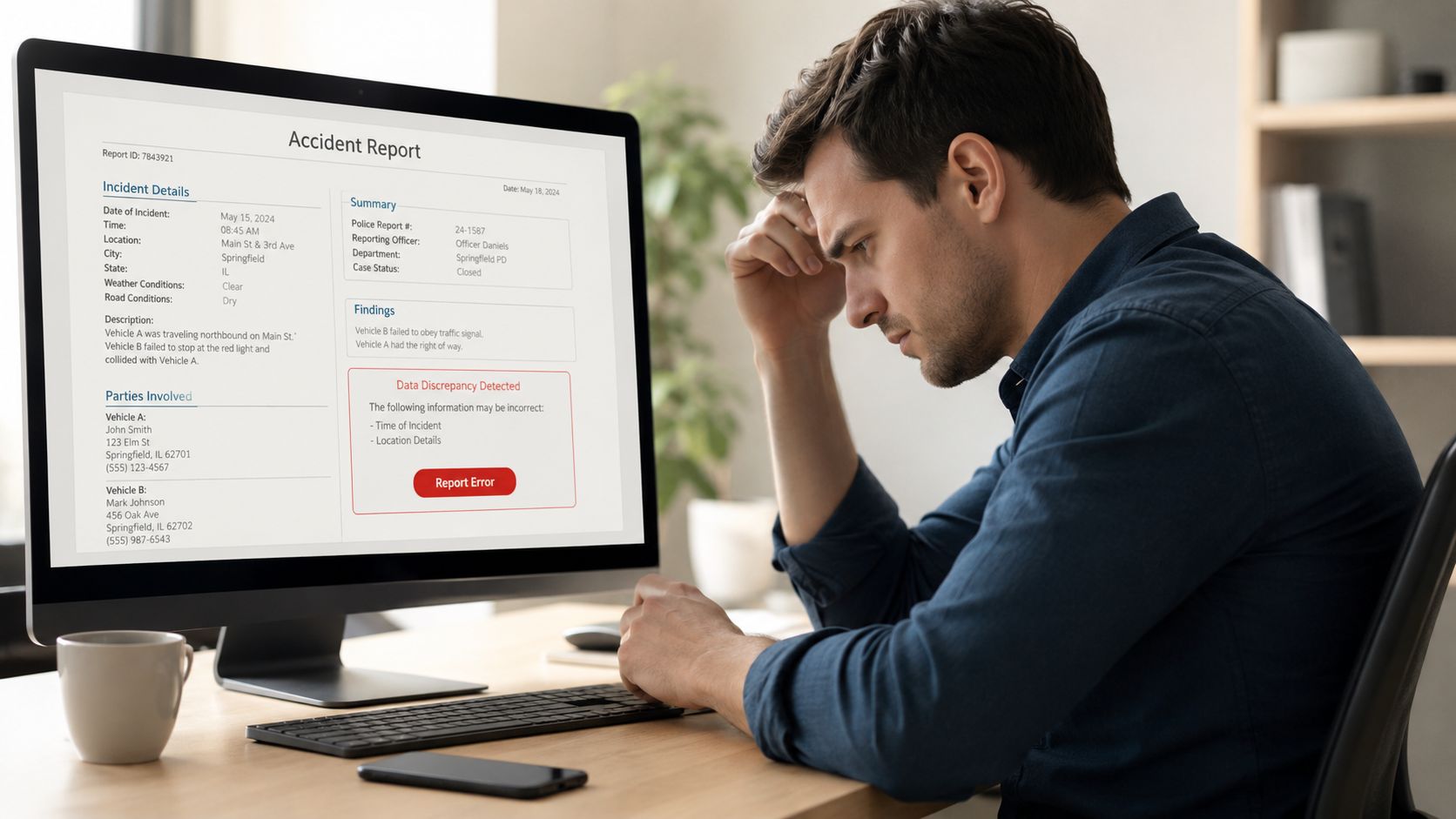
Read the report line by line. Check names, addresses, insurance details, vehicle descriptions, the crash location, the direction of travel, and the officer's notes about injury. A small error can create a larger claim problem. If your name, plate number, or vehicle is wrong, the carrier may delay verification. If the report says "no injury" and you sought treatment later that day or the next morning, the adjuster may argue your symptoms came from something else.
For HCSO cases, reports are not available through the City of Houston system and must be accessed through the LexisNexis Police Reports portal. If you need help locating a sheriff's office report, the HCSO Records Division can be reached at (713) 274-9220, as noted in this overview of obtaining Houston-area crash reports.
Ask the agency what correction process applies to your situation. Some factual errors can be clarified with supporting records. Others may require a supplemental statement or a follow-up with the investigating officer. Be specific. Point to the exact line that is wrong and match it with a document that fixes it, such as your insurance card, vehicle registration, medical record, or photographs from the scene.
What to do right away
- Call the records office: Confirm whether the report is pending, released, or eligible for correction.
- Write down each error: List the page or field that is wrong and the document that contradicts it.
- Keep treatment consistent: If pain developed after the crash, make sure your medical records reflect when symptoms began and how they changed.
- Preserve outside proof: Save photos, videos, witness names, repair estimates, and towing paperwork.
- Get legal help if fault is being disputed: A Houston car accident lawyer who handles report errors and claim disputes can step in before the insurer turns a paperwork issue into a liability argument.
If the carrier has already stalled payment or denied the claim while the report issue is unresolved, guidance on what to do for denied payouts can help you assess the next step.
A missing or flawed report creates extra work, but it does not erase a valid injury claim. The key is to correct the record where possible and build the rest of the file with documents the insurance company cannot easily dismiss.
How a Houston Car Accident Lawyer Builds Your Case
A crash report is a starting point. It's not the whole case.
A Houston car accident lawyer uses the report to identify fault issues, witness leads, vehicle information, and timeline problems. Then the legal work gets deeper. That can include obtaining additional records, reviewing photos, organizing medical proof, and answering insurer arguments that try to minimize your injuries or shift blame under Texas comparative fault rules.
If the insurer starts resisting payment, practical guidance on what to do for denied payouts can help you understand the next steps outside the crash-report process itself. That's especially useful when a claim issue turns from routine paperwork into a coverage or denial dispute.
Some clients also need help beyond the report, especially with insurer communication. A page on dealing with insurers after a Houston accident can help you understand how adjusters evaluate a claim file.
When legal representation makes sense, a Houston car accident lawyer can step in to handle the records, protect your statement, assess liability, and build a damages presentation that reflects the full effect of the crash on your life. That is where a Texas injury attorney adds value. Not by changing the facts, but by proving them clearly and pushing back when the insurer tries to use those same facts against you.
If the crash caused a fatal loss, the legal issues may include both personal injury evidence and potential wrongful death compensation claims for surviving family members.
If you were hurt in a Harris County crash, you don't have to sort through agencies, forms, and insurance pressure on your own. The Law Office of Bryan Fagan, PLLC helps Texas accident victims understand their rights, obtain key records, and pursue compensation for medical bills, lost income, and other damages. Reach out for a free consultation and get clear, compassionate guidance on what to do next.