A car crash can change your life in seconds, but you don't have to face recovery alone.
If you're searching for help after an 18 wheeler accident Houston today, you may still be sitting in an ER, waiting on a tow truck, answering calls from family, or trying to understand what just happened on I-10, I-45, or Loop 610. One moment you were driving through traffic. The next, there was a trailer in front of you, shattered glass, smoke, sirens, and a flood of questions about your health, your car, your job, and your rights.
That confusion is normal. Serious truck crashes hit differently than ordinary wrecks. The injuries are often worse. The scene is more chaotic. The trucking company and its insurer may already be moving to protect themselves before you've even had time to process what happened.
Houston is not an ordinary accident market. Houston leads the entire state of Texas in the frequency of truck and 18-wheeler accidents, driven by its role as a logistics hub with over 200 miles of interstate highways, including the heavily congested I-10 corridor where major truck collisions happen with troubling regularity, according to this Houston truck crash analysis.
That matters for you right now because truck accident claims move fast. Evidence can disappear. Insurance adjusters can start calling quickly. Statements made in shock can later be used against you. What you do in the first few hours and first few days can shape both your medical recovery and your legal case.
If you need more background on these collisions generally, this overview of Houston 18-wheeler crashes is a useful starting point. For now, the most important thing is simple: protect your body, protect the evidence, and don't let the trucking company define the story before the facts are fully known.
A Crash Can Change Your Life in Seconds
A Houston driver is heading home on I-10 after work. Traffic compresses near an exit. A tractor-trailer doesn't stop in time, or a lane change goes wrong, or cargo shifts at the worst possible moment. In seconds, the driver is trapped in a chain-reaction crash with pain in the neck, chest, or back, and no clear sense of what happened first.
That scene is common enough in Houston that it should change how victims think about these cases. This city carries enormous freight traffic every day, and that heavy truck volume raises the stakes when something goes wrong. A collision with an 18-wheeler is rarely a simple fender-bender. It can become a catastrophic injury case, a disputed insurance claim, or, in the worst situations, a wrongful death compensation case for a grieving family.
Why Houston drivers face unusual risk
Houston's freeway system is built around movement. That helps commerce, but it also means passenger vehicles share the road with large commercial carriers in dense, fast-moving conditions. On roads like I-10 and I-45, a mistake by any driver can have severe consequences when a loaded rig is involved.
Practical rule: Treat a truck crash differently from a routine car wreck. The legal and evidence issues are usually more complex from the first day.
A rear-end crash involving a sedan may come down to two drivers and two insurers. A truck crash may involve the driver, the carrier, a maintenance contractor, a cargo company, and multiple insurance policies. That's why calm, early action matters so much.
What hope looks like after a serious truck crash
The first day often feels like survival mode. That's okay. You don't need to solve the whole case today. You just need to make the next good decision.
Start with medical care. Keep records. Save photos. Be careful what you say to insurers. Ask questions before signing anything. Those steps won't erase what happened, but they can protect your future while you heal.
Your Immediate Priorities at the Accident Scene
The first decisions after a truck crash should be simple and focused. Safety comes first. Documentation comes second. Conversations about fault can wait.

What to do first
Get to safety if you can
If your vehicle can be moved and staying put is dangerous, get to a safer location. If you can't move safely, stay where you are and wait for emergency responders.Call 911
Report the crash and ask for medical help. A truck crash needs an official response, and a police report often becomes the starting point for an insurance claim or lawsuit.Accept medical evaluation
Adrenaline can hide serious injuries. Neck injuries, head trauma, internal injuries, and worsening back pain often show up after the scene clears.
Houston victims should also think about care quality and documentation. After a Houston tractor-trailer crash, victims should avoid giving recorded statements to the trucking company's insurer, should photograph the truck's USDOT number and company logos, and should seek care at a Level I trauma center like Memorial Hermann so injuries are documented clearly, as explained in this Houston 18-wheeler collision guidance.
What to document before vehicles are moved
Take photos or video if you can do so safely. Focus on details that may matter later:
- The truck itself including the cab, trailer, license plate, USDOT number, MC number, and company markings
- Your vehicle damage from multiple angles
- The roadway including skid marks, debris, lane position, weather, and nearby signs
- Your injuries if visible
- Witness information with names and contact details
If you want a broader non-legal checklist, SnapClaim has a practical guide to navigating a car accident that can help you organize those first steps while things still feel chaotic.
Here's a short reference many people save to their phone after a wreck:
What not to say at the scene
Some statements feel polite but can hurt your claim later.
| Statement | Better approach |
|---|---|
| “I'm sorry” | “I need medical help and I want the crash documented.” |
| “I didn't see him” | “I'm not ready to discuss details yet.” |
| “I think I'm okay” | “I want to be checked by medical professionals.” |
Don't guess about speed, distance, or blame while you're in shock.
If police ask questions, give factual basics. If an insurer calls, keep it short and ask for their contact information. Recorded statements should wait until you understand your injuries and your legal position.
You should also make sure a crash report is created. This page on how to report a car accident in Houston helps explain that process. If your injuries involve both truck and passenger vehicle issues, a Houston Car Accident Lawyer handles representation for car accident victims in Houston and Harris County, which often overlaps with commercial vehicle collision claims.
Preserving Critical Evidence Before It Disappears
Truck companies don't wait to protect themselves. In serious collisions, they may begin gathering records, reviewing onboard systems, and shaping a liability defense very early. If you wait too long, key proof may vanish before anyone asks the right questions.

Why the first 72 hours matter
The first 72 hours after a Houston 18-wheeler crash are critical. Lawyers must send a spoliation preservation letter within 24 hours to prevent deletion of dashcam footage and engine control module records, because that data can disappear within days if it is not legally preserved, according to this Houston truck evidence preservation discussion.
That one fact changes how these cases should be handled. If you treat a truck crash like a normal auto insurance claim and wait to “see how you feel,” you can lose evidence that may never be recovered.
What evidence tends to matter most
In a truck case, useful evidence usually goes beyond photos of vehicle damage. It may include:
- Electronic data from the truck's onboard systems
- Driver records showing hours, routing, and safety compliance
- Dashcam or onboard video
- Inspection and maintenance records
- Cargo records if load shift or spill may have contributed
- Scene evidence such as debris patterns, gouge marks, and road geometry
A Houston driver rear-ended by a tractor-trailer on I-45 may assume the case is obvious. Sometimes it is. But if the trucking company later claims sudden traffic caused the wreck, brake data, logging records, and scene measurements may tell a more accurate story.
Fast legal action isn't about being aggressive. It's about making sure the evidence still exists.
What works and what usually fails
What works is early preservation. That means sending formal notice, identifying the carrier correctly, preserving your own vehicle if needed, and making sure your injuries are tied to timely medical records.
What usually fails is informal delay. Phone calls don't preserve evidence. Waiting for an adjuster to “look into it” doesn't preserve evidence. Hoping the company will voluntarily keep the harmful records doesn't preserve evidence.
In some injury matters, unsafe conditions on property also create separate claims. A Houston Slip and Fall / Premises Liability Lawyer handles representation for injuries caused by unsafe property conditions in Houston. That can matter if a crash involved dangerous loading areas, private access roads, or other site-related hazards in addition to the truck collision itself.
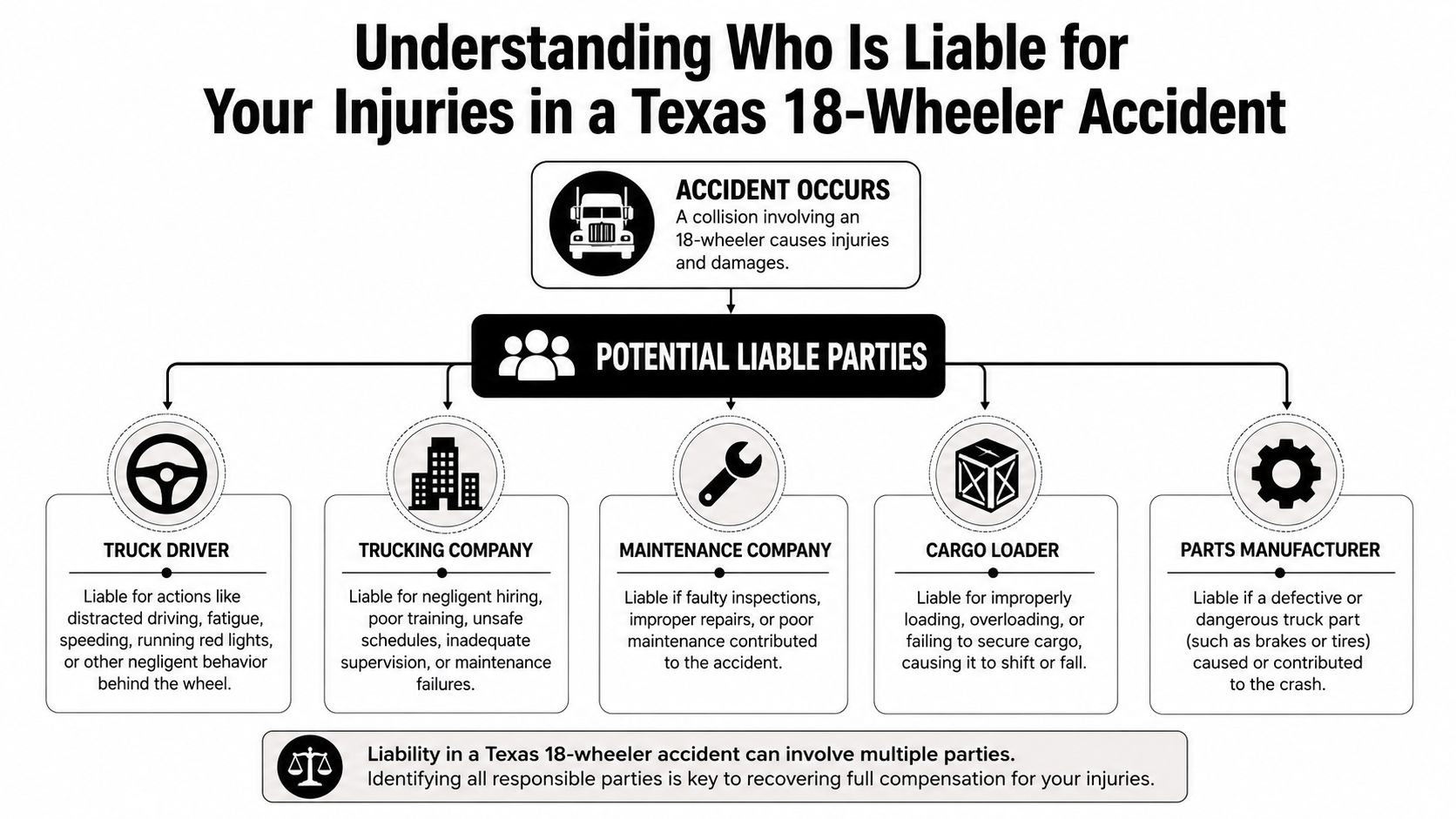
Understanding Who Is Liable for Your Injuries
One of the biggest mistakes after a truck wreck is assuming the case is only about the driver. Sometimes the driver is the main responsible party. Often, the bigger picture matters more.
Liability means legal responsibility for causing harm. In a truck accident claim, the liable party may be the person or company whose carelessness caused the crash or made your injuries worse.
Liability often reaches beyond the driver
In Houston 18-wheeler accidents, liability often extends beyond the driver to include the freight broker, shipper, and maintenance contractor. Texas courts apply comparative fault under Chapter 33 of the Civil Practice & Remedies Code, which means if you are found 20% responsible, your recoverable damages are reduced by that percentage, as explained in this Texas truck liability overview.
That rule matters because trucking cases often involve finger-pointing. The driver may blame the load. The company may blame maintenance. The insurer may blame you.
Plain-English definitions that matter
- Comparative fault means more than one party can share blame, and your compensation can be reduced if you also contributed to the crash.
- Damages means the losses the law allows you to claim, such as medical bills, lost income, pain and suffering, and in fatal cases, wrongful death compensation.
- Statute of limitations means the deadline to file a lawsuit.
- Negligence means failing to use reasonable care.
Texas negligence law often starts with Chapter 33 when fault is disputed. Chapter 41 also matters because it addresses certain damage issues in civil cases, including limits and standards tied to exemplary damages. In everyday terms, most injury claims focus first on proving who acted carelessly, how that caused the crash, and what losses followed.
A real-world example
A Houston driver is rear-ended on I-610 by a commercial truck. At first glance, it looks simple. Later investigation shows the brakes were in poor condition and a maintenance company may have signed off on faulty work. That changes the case.
Or consider a rollover where cargo shifts during a turn. The truck driver may have lost control, but the cargo loader or shipper may also be part of the liability picture if the load was unsafe.
A truck case is often won or lost by identifying every responsible party early, not just the one you can see at the scene.
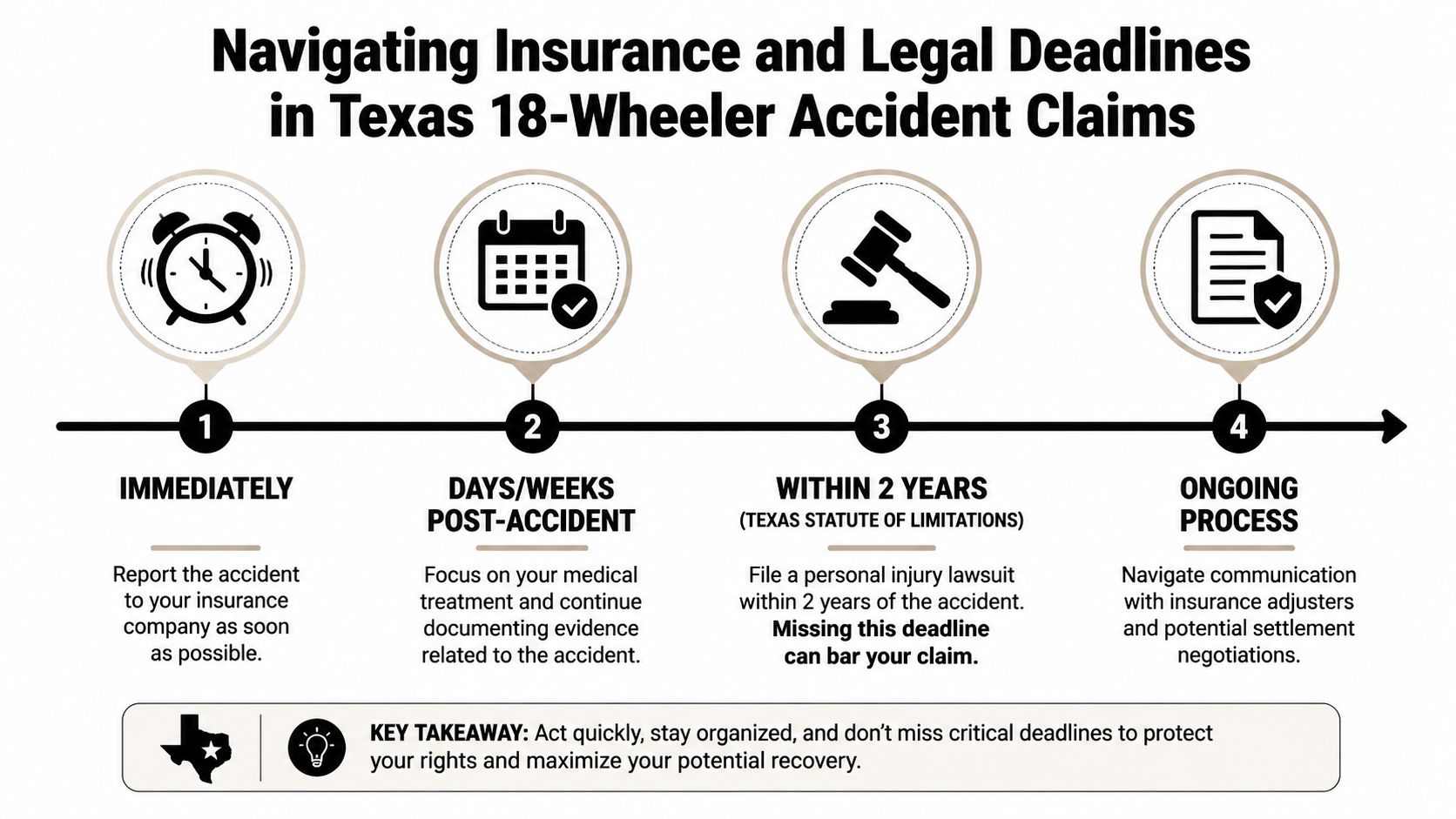
Navigating Insurance and Legal Deadlines in Texas
Once the emergency phase passes, individuals often run into a different problem. The calls start. The forms arrive. Adjusters want statements. Bills keep coming. That's where a careful process helps.
How to handle the insurance side
Your own auto insurance claim may need prompt notice. That's different from giving a detailed recorded statement to the trucking company's insurer. Basic notice is usually appropriate. Broad, speculative conversation is not.
Use this simple approach:
- Report the crash to your insurer and ask what information they need right now
- Keep all communication in writing when possible
- Do not sign medical authorizations that are broader than necessary
- Do not accept a fast settlement before you understand your injuries and future treatment needs
- Keep a file with bills, discharge papers, prescriptions, repair estimates, and missed work records
For a fuller explanation of filing timelines and legal cutoffs, this resource on Texas statutes of limitations can help you understand where insurance claims end and lawsuits begin.
The deadline you cannot miss
Under Texas Civil Practice and Remedies Code § 16.003(a), you have exactly two years from the date of the 18-wheeler crash to file a personal injury lawsuit. For a fatal accident, the same two-year period starts on the date of death. Missing that deadline legally bars the claim, as explained in this Texas passenger rights and filing deadline article.
That is the statute of limitations. In plain English, it is your legal filing deadline.
What damages may be available
If someone else's negligence caused the crash, you may be able to seek damages, meaning compensation for losses such as:
| Type of damage | What it usually covers |
|---|---|
| Medical expenses | ER care, hospital bills, follow-up treatment, rehab |
| Lost income | Time missed from work and reduced earning ability |
| Pain and suffering | Physical pain and daily disruption |
| Property loss | Vehicle damage and related out-of-pocket costs |
| Wrongful death compensation | Losses suffered by eligible family members after a fatal crash |
A family dealing with a fatal truck wreck often has to manage probate questions, insurance pressure, and grief at the same time. That's one reason wrongful death compensation claims should be evaluated carefully and early.
How a Houston Truck Accident Lawyer Can Help You Recover
Truck accident cases are hard for one reason above all others. You are trying to heal while a commercial insurer builds a defense. That imbalance is real.
A lawyer's job is to close that gap. In practical terms, that means preserving evidence, identifying all liable parties, organizing medical proof, valuing damages, dealing with adjusters, and filing suit on time if the insurer won't act fairly. If you're searching for a Houston car accident lawyer or Texas injury attorney after a truck crash, that's the work you should be looking for.
What legal help changes
A strong legal file often includes the crash report, photos, witness statements, treatment records, wage proof, and formal preservation demands. In truck cases, it may also include deeper investigation into company records and responsibility beyond the driver.
Some people also find it helpful to review broader settlement background before speaking with counsel. Total Loss Northwest offers a general truck settlement guide that explains how these cases are commonly evaluated at a high level.
What representation should feel like
It should give you room to breathe. You should know who is handling insurer communication, what records are being gathered, and what deadlines matter next. You should also hear honest advice about trade-offs, including when to keep negotiating and when a lawsuit may be necessary.
The Law Office of Bryan Fagan, PLLC handles Texas personal injury and auto collision matters, including truck crash cases, on a contingency-fee basis. That means injured clients can seek legal help without paying upfront fees, and the focus can stay where it belongs, on medical recovery, financial stability, and protecting the claim.
If your crash involved a denied auto insurance claim, disputed liability, or a fatal loss in your family, legal help can take pressure off you right away. You don't need to have every answer before you call. You only need enough information to begin protecting your rights.
If you or someone you love was hurt in an 18-wheeler crash, contact The Law Office of Bryan Fagan, PLLC for a free consultation. You can get clear guidance on your rights, your next steps, and your options for pursuing compensation for medical bills, lost income, pain and suffering, and wrongful death compensation. You won't pay unless your case is won.