In Texas, during a DWI stop, you must provide three basic documents: your driver's license, proof of insurance, and vehicle registration. You also have a constitutional right to remain silent and refuse to answer other potentially incriminating questions, such as whether you've been drinking or where you're coming from.
A car crash can change your life in seconds, but you don't have to face recovery alone. If you're reading this after seeing flashing lights in your mirror, or after being hit by someone the police suspected of driving drunk, you're probably stressed, angry, and unsure what happens next. That reaction is normal.
The question, do i have to answer questions during a dwi stop in texas, matters for two groups of people. It matters for the driver being questioned, because words spoken on the roadside can become evidence. It also matters for crash victims, because the other driver's statements, refusals, and test results can later affect a personal injury case.
Texas law draws an important line. Some things are required. Some things are optional. Knowing that difference can protect your freedom, your license, and, in a civil case, your ability to prove liability, meaning who is legally responsible for the crash.
The Flashing Lights That Change Everything
It's late. You're heading home on I-45, or maybe you're sitting shaken on the shoulder after another driver slammed into your car. Then the red and blue lights start flashing. Your heart jumps. Your hands tighten on the wheel. Drivers often struggle to think clearly in that moment.
For one Texas driver, the stop may begin with ordinary questions. “Where are you headed?” “Have you had anything to drink?” “How much?” Those questions can sound casual. They aren't casual. They're part of an investigation.
For a crash victim, the same stop may feel completely different. You may be watching from an ambulance, or standing nearby while police question the driver who hit you. In that moment, every statement matters. If the other driver admits drinking, refuses testing, or shows signs of impairment, that can later shape both the criminal case and your injury claim.
Practical rule: Stress makes people talk too much. Rights matter most when you're nervous.
What people often get wrong
Many Texans assume they have to answer every question because an officer asked it. That's not how it works. Texas drivers must cooperate with lawful basic identification requests, but that doesn't mean they must help build a DWI case with their own words.
Others make the opposite mistake. They become argumentative, sarcastic, or physically resistant. That only makes a hard situation worse. The safest approach is calm, respectful, and brief.
A simple roadside encounter can affect much more than a traffic citation. It can affect a DWI prosecution, an auto insurance claim, and a civil lawsuit for injuries. If a Houston driver rear-ended you after leaving a bar, the officer's observations at the scene may become part of the proof your Texas injury attorney uses later.
Your Legal Obligations Versus Your Constitutional Rights
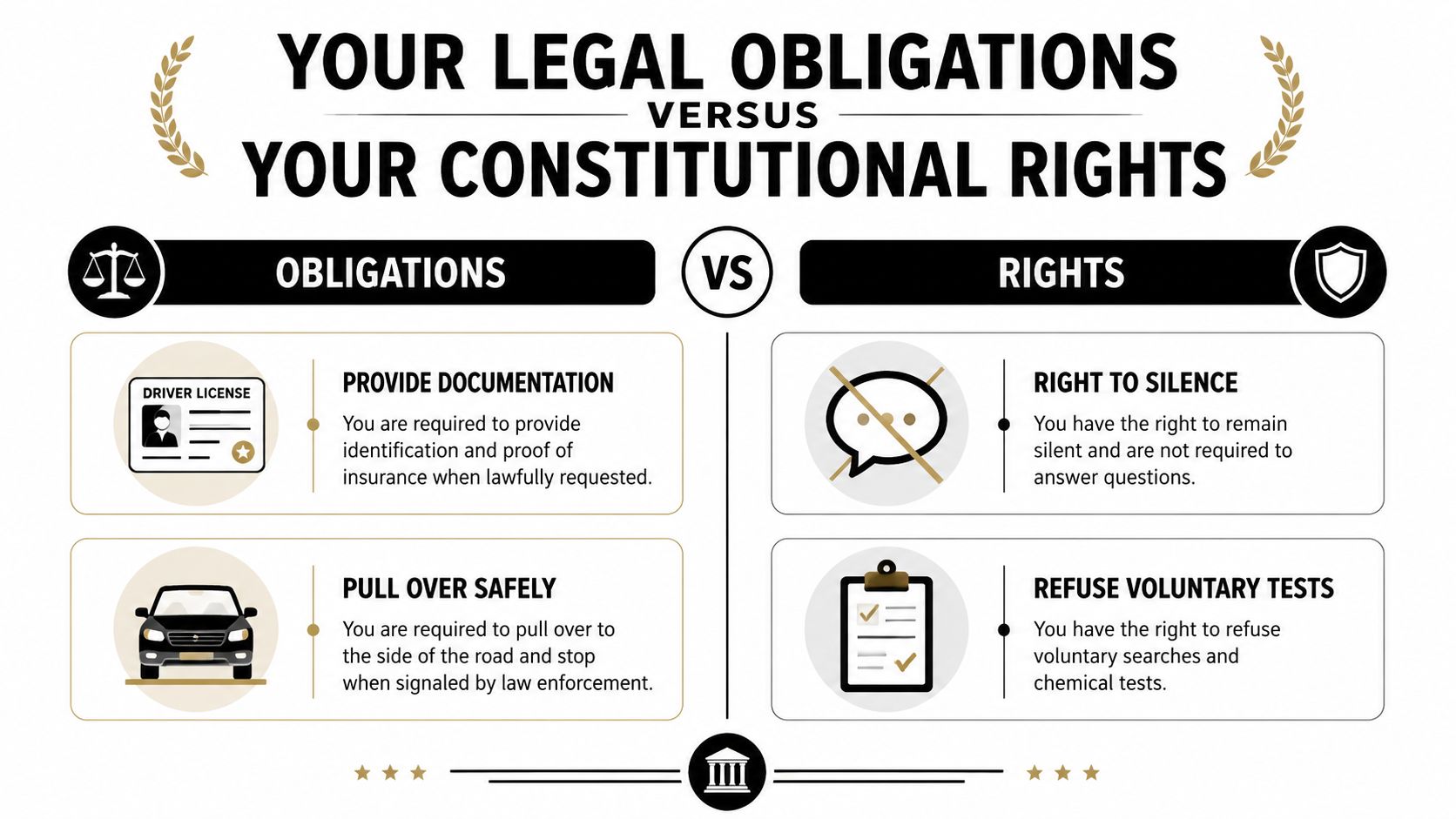
Texas law is clear about what you must hand over during a traffic stop. It's also clear that you don't lose your Fifth Amendment protections just because an officer starts asking questions.
What you must do
Under Texas Transportation Code §521.025, a driver must provide a driver's license, proof of insurance, and vehicle registration. The same source also explains that drivers have a Fifth Amendment right to refuse other questions during a DWI stop, and it notes that Texas had over 85,000 DWI arrests in 2022, with verbal admissions contributing to probable cause in approximately 70% of analyzed cases in the cited discussion of enforcement outcomes (Texas DWI stop rights overview).
That means an officer can lawfully ask for your documents. You should provide them promptly and politely.
What you usually do not have to answer
Questions like these are different:
- Have you been drinking
- Where are you coming from
- Where are you going
- How many drinks did you have
- When was your last drink
Those questions are designed to gather evidence. Even an answer you think sounds harmless can hurt you. “Just two beers” may sound modest. In court, it can still become an admission.
Silence is not an admission of guilt. It's a constitutional protection.
A simple way to respond
You don't need a speech. You don't need attitude. You need a clear sentence.
Try this:
- For questions beyond identification: “I'd like to remain silent.”
- If questioning continues: “I'm invoking my right to remain silent.”
- If you've already answered a few questions: “I don't want to answer more questions without a lawyer.”
If you want more guidance on post-arrest communication, this article on whether you should talk to police after a DWI arrest in Texas covers the risks in plain language.
For crash victims, this distinction matters too. If the drunk driver who hit you gave damaging roadside statements, those statements may help establish liability, meaning legal responsibility for your injuries. If the driver stayed silent, your attorney may rely more heavily on officer observations, witness accounts, and physical evidence.
Field Sobriety Tests Are Not Mandatory
A lot of drivers think roadside balance tests are mandatory. In Texas, they generally aren't. That surprises people because the officer often asks in a way that sounds like a command.

What these tests usually include
Field sobriety tests often involve:
- Horizontal Gaze Nystagmus. The officer watches your eyes follow an object.
- Walk-and-Turn. You're asked to take heel-to-toe steps, turn, and come back.
- One-Leg Stand. You balance on one foot while counting.
These tests may sound simple when read on a page. They can feel very different on a dark roadside with traffic moving past, adrenaline surging, and uneven pavement under your feet.
Why these tests can be misleading
A sober person can struggle with these exercises for many reasons. Nerves, fatigue, age, injuries, bad shoes, poor lighting, and medical conditions can all affect performance. If you've just been in a crash, the problem is even bigger. A person with a sore back, a head injury, or shaky legs may appear impaired when they're hurt.
That's why many defense lawyers view field sobriety tests as risky. They create more observations for the officer to describe later.
Roadside advice: Polite refusal is different from resistance. You can decline without arguing.
A respectful response might be, “Officer, I'm choosing not to do any field sobriety tests.”
That statement is short, calm, and clear.
What not to do during the encounter
Don't turn a refusal into a confrontation. Don't joke. Don't volunteer explanations. Don't try to “win” the stop by talking your way out of it. This guide on what not to do after a DWI arrest in Texas is useful if things have already escalated.
This video also helps illustrate how these encounters can unfold in real life.
For accident victims, field sobriety testing can still matter even if the other driver declines. The officer may document slurred speech, odor of alcohol, bloodshot eyes, balance issues, or confusion. A Houston car accident lawyer can use those observations in a civil claim, even without a roadside test performance.
Understanding Texas Implied Consent Law
Many people find this distinction confusing. The right to stay silent before arrest differs from the rules that apply after arrest.

What implied consent means
Texas has an implied consent law in Transportation Code Chapter 724. The cited source explains that this law requires chemical testing after a lawful DWI arrest and that refusing a post-arrest test brings a 180-day license suspension for a first offense. It also describes the law as part of a public-safety framework shaped after the national drunk-driving crackdowns of the 1970s (Texas implied consent explanation).
In plain English, by driving on Texas roads, you've agreed to certain testing rules if police lawfully arrest you for suspected DWI.
The timeline matters
The key question is when the request happens.
Here's the practical breakdown:
| Stage | What usually applies |
|---|---|
| Before arrest | You may refuse to answer incriminating questions |
| Before arrest | Field sobriety tests are generally voluntary |
| After lawful arrest | Chemical testing rules under implied consent come into play |
That difference matters because many drivers blend all of it together under stress.
Questions, roadside tests, and chemical tests are not the same
People often use the word “breathalyzer” for everything. Legally, that can blur important differences.
- Questions ask you to give words the officer can use.
- Field sobriety tests ask you to perform physical tasks.
- Chemical tests involve breath, blood, or urine after a lawful arrest under the implied consent framework.
Each one has different consequences.
If you remember only one point, remember this. Pre-arrest silence and post-arrest chemical testing are different parts of the law.
Why this matters for injury claims
When an intoxicated driver causes a wreck, the timing of the investigation can affect the evidence available in your civil case. If police obtain a valid chemical test after arrest, that result may strengthen proof that the other driver was impaired. If the driver refuses after arrest, there may be less objective data, but the refusal itself may still matter in later proceedings.
This civil side of the case is separate from the criminal charge. In a Texas injury claim, the focus is compensation for your losses. That includes damages, which means the money a court or insurer may owe for medical bills, lost income, pain and suffering, and other harm caused by the crash.
The Consequences of Refusing a Chemical Test
Once a driver has been lawfully arrested, the decision becomes harder. Refusing a chemical test can protect against one type of evidence while causing a different penalty.
The immediate consequence
The cited Texas source states that refusing a post-arrest chemical test causes an automatic 180-day driver's license suspension for a first-time offender, and that this penalty is administrative and separate from the criminal DWI case. The same source explains that refusal prevents the state from getting objective BAC evidence, and that a BAC over 0.08% is direct proof of intoxication (Texas chemical test refusal consequences).
That distinction is important. A driver can face license consequences even before the criminal case is resolved.
The strategic tradeoff
Refusing means the state may not get a breath or blood result through ordinary consent testing. From a defense perspective, that can matter because it limits one clear piece of evidence.
Submitting means there may be a precise BAC result. If it is above the legal limit, the prosecution has powerful evidence.
This doesn't mean refusal makes the criminal case disappear. It doesn't. Police may still rely on driving behavior, officer observations, body camera footage, witness statements, and anything the driver said earlier.
How to think about the decision
Here is the dilemma in a simple side-by-side view:
| Choice | Main downside | Main effect on evidence |
|---|---|---|
| Submit to test | May create direct BAC evidence | Gives the state objective intoxication proof if results are high |
| Refuse test | Triggers administrative license suspension | Denies the state ordinary consent-based BAC evidence |
A calm understanding of this tradeoff is better than guessing under pressure.
Why this matters to victims and families
If you were hurt by a drunk driver, a test result over the legal limit can be powerful evidence in your personal injury case. If the driver refused, that doesn't end your claim. It changes the proof your lawyer builds.
Your lawyer may instead emphasize officer observations, admissions made before the refusal, crash scene evidence, open containers, witness testimony, and post-crash conduct. In some civil cases, refusal itself may be argued as evidence of consciousness of guilt.
That civil case follows different rules and serves a different purpose. The criminal court decides guilt or innocence under criminal law. The civil claim focuses on compensation and responsibility.
Under Texas Civil Practice & Remedies Code Chapter 33, Texas uses a form of comparative fault. That means fault can be divided among the people involved. If an injured person is partly responsible, recovery can be reduced. In a drunk-driving crash, defense lawyers may still try to argue that the victim contributed to the wreck by speeding, changing lanes unsafely, or failing to react. Chapter 41 also addresses limits and rules for certain categories of damages in civil cases.
How a DWI Stop Impacts a Car Accident Victim's Claim
For an injury victim, the roadside DWI investigation is often the first building block of a civil case. What the other driver said, what they refused, and what the officer documented can all matter.
If a Dallas driver ran a red light and hit a family crossing an intersection, a later BAC result may support a claim that the driver acted negligently. In Texas, negligence means failing to use reasonable care. Liability is the legal responsibility that follows when that failure causes harm.
A strong claim usually includes several categories of damages. Those may include medical expenses, lost wages, property damage, and pain and suffering. In a fatal crash, surviving family members may also pursue wrongful death compensation under Texas law.
Evidence from the stop often becomes evidence in the injury case
A victim's lawyer may use:
- Chemical test results if police obtained them
- Refusal evidence if the driver declined post-arrest testing
- Officer observations from the scene
- Witness statements from passengers or bystanders
- Crash scene facts such as speed, lane position, and impact damage
For practical post-crash steps, resources like Total Loss Northwest's accident guide can help people organize what to do with documentation, towing, and insurance after a collision.
If your crash involved suspected intoxication, this overview of a Texas drunk driving accident claim can help you understand how criminal evidence and civil compensation often intersect.
Insurance companies look for weaknesses
Insurance adjusters don't automatically pay full value. They often look for gaps in proof, delay in treatment, or arguments that you were partly at fault. That's why documentation matters so much.
One issue people often overlook is the statute of limitations, which is the legal deadline to file a lawsuit. If you wait too long, you can lose the right to pursue compensation at all. The exact deadline depends on the type of claim and facts of the case, so getting legal advice early matters.
Protecting Your Rights After a Texas DWI Incident
The minutes after a stop or crash are rarely orderly. That's why simple steps help.
If you were the driver being questioned
Stay calm. Keep your hands visible. Provide the required documents. Beyond that, keep your words limited.
Useful phrases include:
- “Here are my license, registration, and insurance.”
- “I'm invoking my right to remain silent.”
- “I do not want to answer questions without an attorney.”
- “I'm choosing not to do voluntary field sobriety tests.”
Say the words once, clearly and respectfully. Then stop talking.
If you were hit by a suspected drunk driver
Your priorities are different:
- Get medical care first. Adrenaline can hide serious injuries.
- Document what you can. Take photos, save names, and note what you observed.
- Report the crash. A police report can become key evidence.
- Be careful with insurers. An adjuster may sound friendly but still look for statements that reduce your claim.
If a Houston rideshare driver is hit by an impaired motorist on a freeway ramp, the case may involve multiple policies, company coverage questions, and disputes over fault. A Texas injury attorney can sort through those issues while you focus on healing.
Write down what you remember as soon as you can. Small details often matter later.
Texas personal injury law can be difficult to manage alone. Chapter 33 comparative fault rules may affect how much compensation you can recover. Chapter 41 may affect certain damage issues. And insurance companies often push hard against large claims involving catastrophic injury or wrongful death.
If you or someone you love was injured in a crash involving a suspected drunk driver, The Law Office of Bryan Fagan, PLLC can help you understand your rights and next steps. Whether you need guidance on an auto insurance claim, help proving liability, or support pursuing serious injury or wrongful death compensation, the firm offers compassionate, experienced representation across Texas. Contact the team for a free consultation and get clear answers about your options from a trusted Houston car accident lawyer.