A car crash can change your life in seconds, but you don't have to face recovery alone.
If you're searching for “i got arrested for dwi in texas what should i do next”, you're probably dealing with fear, confusion, and a long list of practical worries. Can you drive? What happens to your job? What do you say in court? If the arrest happened after a wreck, are you also being sued?
Start with this: a DWI arrest is serious, but panic makes people do the wrong things. Good decisions in the first hours and days matter. So does understanding that a DWI case may affect more than the criminal charge alone, especially if someone was hurt in a crash.
The First 24 Hours After a DWI Arrest in Texas
After a DWI arrest, individuals are typically taken to a police station or local jail for booking. That usually means fingerprinting, photographs, and basic personal information being recorded. You may also be asked to provide a breath, blood, or urine sample, and if an officer has probable cause, they can seek a warrant for a blood draw, as explained in this overview of steps after a Texas DWI arrest.

A lot of damage gets done in this window because people keep talking. They try to explain, apologize, or talk their way out of it. That almost never helps. What helps is staying calm, being respectful, and using your right to remain silent.
Practical rule: Say, “I want to remain silent and I want a lawyer.” Then stop explaining.
What booking and release usually look like
A DWI arrest in Texas starts two separate legal matters. One is the criminal case. The other is the administrative license case. Those are different tracks with different consequences.
After booking, release may happen when family posts bail or a bondsman gets involved. A bondsman typically charges a fee based on the bond amount, and in some cases a lawyer can challenge a bond that was set too high.
What to say and what not to say
Keep your words short. Give identifying information if required, but don't try to narrate your night.
Avoid these mistakes:
- Don't explain your drinking: Statements like “I only had two beers” still give the prosecution something to work with.
- Don't text your version of events to friends: Texts get forwarded, screenshotted, and taken out of context.
- Don't discuss details with a bondsman: Handle the release process, but save legal facts for your lawyer.
- Don't post on social media: Even a vague joke can later look like an admission.
Your first job after release
Once you're out, get your paperwork together in one place. That includes any citation, bond paperwork, notice of suspension, property receipt, and court information.
Then write down what happened while it's still fresh. Include where you were, when you were stopped, what the officer said, whether field sobriety tests were given, and whether video may exist. Small details often matter later.
If the arrest followed a collision, also preserve crash-related facts. That may matter for insurance, liability, and any later civil claim.
The Critical 15-Day Deadline for Your Driver's License
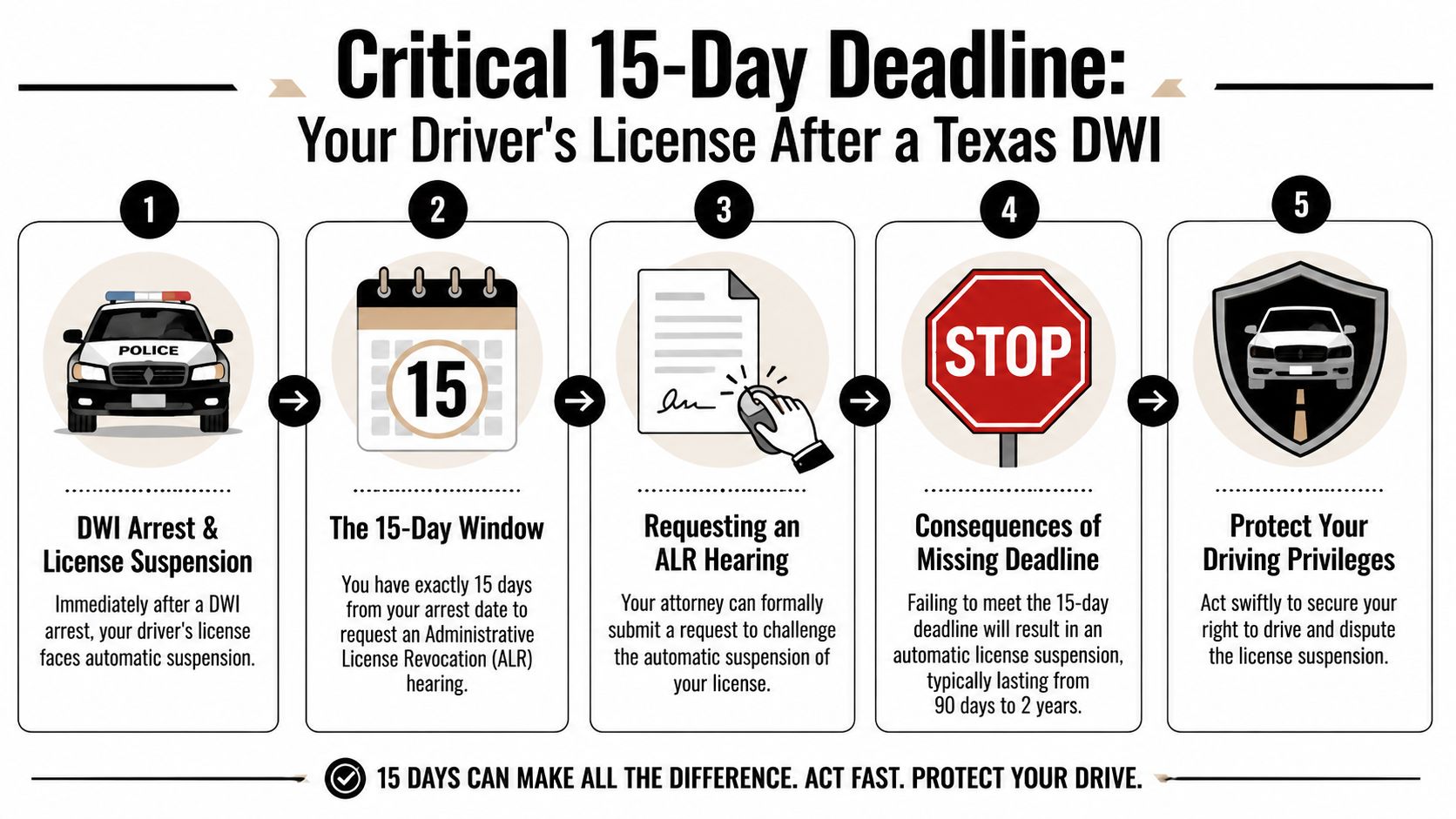
The most urgent deadline after a Texas DWI arrest is not your first court date. It's your deadline to request an Administrative License Revocation hearing, often called an ALR hearing.
Under this guidance on what to do after a Texas DWI arrest, you have 15 days from the date of arrest to request that hearing. If you miss it, the Texas Department of Public Safety will automatically suspend your license.
Why this deadline matters so much
People often focus on the criminal charge because that feels bigger. But losing your ability to drive can hit first and hit hard. It can affect work, school pickups, medical appointments, and your ability to get to court.
If the hearing request is filed on time, you may be able to continue driving while the criminal case moves forward. If it is not filed on time, the suspension process moves ahead automatically.
Missing the ALR deadline is one of the most common unforced errors after a DWI arrest.
What an ALR hearing does
An ALR hearing is not your criminal trial. It is a separate administrative process about your license. That distinction matters because people sometimes assume hiring a lawyer for the criminal case automatically fixes the license issue. It doesn't unless someone handles that hearing request.
Here's the plain-English version:
| Issue | Criminal case | ALR case |
|---|---|---|
| Who brings it | The State of Texas | Texas DPS |
| Main risk | Criminal penalties and record | Driver's license suspension |
| Where it goes | Criminal court | Administrative process |
| What you need | Defense strategy | Fast hearing request |
If you hold a commercial license, the consequences can be even more disruptive. This article on DUI with a CDL explains why commercial drivers need to move even faster.
What works and what doesn't
What works is simple. Contact a lawyer immediately and make sure the ALR request is filed. Ask for confirmation. Save a copy of everything.
What doesn't work is assuming the deadline will be extended, thinking the court date controls your license, or waiting to “see what happens.”
If your question is “i got arrested for dwi in texas what should i do next,” this is the first answer after release: protect your license before the deadline runs out.
What If My DWI Involved a Car Accident?
This is the part many DWI guides barely mention. If your arrest happened after a crash that injured someone, you may be dealing with more than a criminal prosecution. You may also face a civil injury claim from the people hurt in the collision.
A Texas DWI arrest after an injury crash can lead to both criminal charges and a lawsuit by the injured person, and a conviction can establish negligence per se in a civil case, strengthening claims for medical bills, lost wages, and pain and suffering, as discussed in this guide on Texas DWI and what to do.
What liability means in plain English
Liability means legal responsibility. In a crash case, the question is who caused the harm and who has to pay for the damage.
If an injured driver, passenger, pedestrian, or family member brings a claim, they will try to prove that the drunk driver caused the wreck and the injuries that followed. That is where the criminal case and civil case can start to overlap.
Why civil exposure matters
In a personal injury case, the injured person may seek damages, which is the legal term for money meant to cover losses. That can include medical bills, lost wages, and pain and suffering. In a fatal crash, surviving family members may pursue wrongful death compensation.
Texas also uses comparative fault, a rule found in Texas Civil Practice & Remedies Code Chapter 33. In plain English, comparative fault asks whether more than one person shares blame for the crash. If both drivers contributed, the percentage of responsibility can affect recovery. Chapter 41 addresses limits and rules tied to certain damage issues in civil cases.
A criminal charge punishes alleged unlawful conduct. A civil claim focuses on who pays for the harm.
A common real-world example
Take a Houston driver rear-ended on I-45 by someone later arrested for DWI. The injured driver may file an auto insurance claim first. If the insurer disputes fault, medical treatment, or the value of the injury, a Houston car accident lawyer or Texas injury attorney may build a lawsuit using crash reports, medical records, witness accounts, and evidence from the DWI matter where available.
That same framework often appears in claims involving drunk driving accident cases, especially when the collision caused serious injuries.
What to do with the insurance company
If you were the arrested driver, notify your carrier promptly. Most policies require notice. Don't give a detailed recorded statement without legal advice if the crash involved injuries and possible civil exposure.
If you were the person hit by an intoxicated driver, don't assume the insurer will automatically “do the right thing.” Insurers look closely at fault, coverage, medical records, and pre-existing conditions. Keep records of treatment, lost work, out-of-pocket costs, and all communication.
A few terms help:
- Liability: Who is legally responsible.
- Damages: The financial value of losses caused by the crash.
- Comparative fault: Whether both sides share blame under Texas law.
- Statute of limitations: The deadline to file a lawsuit. Miss it, and the claim can be barred.
When a DWI crash causes catastrophic injuries or death, the civil side may become as important as the criminal side. Families often need immediate advice about insurance coverage, evidence preservation, and how to pursue compensation while the criminal process unfolds.
Hiring the Right Attorney and Preparing for Your Consultation
By the time you start calling lawyers, two problems may already be developing at once. The criminal DWI case is moving through the court system, and if there was a crash, insurance and injury issues may be taking shape in the background. The lawyer you hire should be able to spot both early, because decisions made in the first meeting can affect jail exposure, license consequences, and civil risk.
A useful starting point is to look for expert impaired driving legal help that explains why focused DWI representation matters and what to ask before you hire someone.
What to ask in the consultation
Use the consultation to measure judgment, not personality. A good lawyer should be able to explain what needs attention now, what can wait, and where the case is exposed.
Ask direct questions:
- Will you handle both the court case and the license hearing issues? Some lawyers focus only on the criminal file. You need to know who is responsible for each part.
- What evidence do you want from me today? Strong early case work often starts with bond papers, the citation, a timeline, names of witnesses, photos, and any documents tied to a crash.
- How do you handle a DWI case that also has accident exposure? If someone was hurt or property was damaged, statements made in the criminal case can affect insurance claims and a later lawsuit.
- Who will I hear from? Ask whether you will get updates from the attorney, a case manager, or both, and how quickly the office responds.
- What is your first move after I hire you? The answer tells you a lot about whether the lawyer works from a plan or just reacts to court dates.
If you want a better sense of how to vet counsel, these questions to ask a personal injury attorney are also useful when a DWI arrest involves a wreck and possible injury claims.
What to bring with you
Bring paper, screenshots, and names. Memory fades fast after an arrest, and small details often matter later.
A productive consultation usually includes:
- Bond paperwork and release conditions: These show deadlines, restrictions, and court obligations.
- The citation, notice of suspension, and any jail paperwork: Dates, agency names, and alleged facts matter.
- Crash documents: Bring the exchange sheet, photos, tow records, repair estimates, and insurer letters if there was a collision.
- A written timeline: List where you were, what you drank, when you drove, when police stopped you, and what happened after the arrest.
- Medical information: If anyone reported an injury, that changes how the case should be handled from the start.
- Your insurance information: Your lawyer needs to know what coverage may be in play if the arrest involved a crash.
A short video overview can also help you think through what legal representation is supposed to do during the early stage of a case.
One practical note about fit
Some firms focus only on defending the criminal charge. Others, including The Law Office of Bryan Fagan, PLLC, also handle accident and injury matters involving intoxicated drivers. That difference matters if your arrest came after a wreck.
In that situation, your lawyer is not just defending a DWI allegation. The lawyer also has to protect you from avoidable statements, poorly timed insurance communications, and factual positions that may create problems in a civil claim later. That is the part many people miss until the second problem arrives.
Understanding Potential DWI Penalties and Defenses
A DWI arrest is not the same thing as a conviction. That matters because many people assume the case is already over once they leave jail. It isn't.
The criminal process can include arraignment, pre-trial hearings, evidence exchange, negotiations, and sometimes trial. Outcomes depend on the facts, the evidence, and the quality of the legal work done early.
What penalties can be on the table
Texas DWI penalties can include fines, jail time, probation, license consequences, and court-ordered programs. The exact range depends on factors like prior history, the allegations in the charging documents, and whether the arrest involved a crash or injuries.
What matters most at this stage is not guessing your sentence. It's understanding what your lawyer can test.
Where defenses often come from
One major area is the stop itself. Did the officer have a lawful reason to pull you over? Another is the investigation. Were field sobriety tests given correctly? Were observations documented clearly and consistently?
According to this discussion of the Texas DWI process and defense strategy, defense work often focuses on whether officers followed National Highway Traffic Safety Administration standardized field sobriety test protocols, and whether discovery reveals problems with breath-test calibration records or the chain of custody for blood samples.
Small procedural mistakes can become major legal issues when the State's case depends on technical evidence.
Evidence that deserves close review
A careful defense usually looks at several categories of proof:
- Traffic stop evidence: Dashcam footage, bodycam footage, dispatch records, and the officer's stated reason for the stop.
- Field sobriety testing: Whether conditions, instructions, and administration matched the required protocol.
- Chemical testing records: Breath or blood records, maintenance logs, lab paperwork, and specimen handling.
- Narrative consistency: Whether reports, video, and witness accounts line up.
A useful way to think about the case
Here's a practical comparison:
| Evidence type | What prosecutors may argue | What defense may examine |
|---|---|---|
| Officer observations | Signs of impairment | Inconsistencies, omissions, poor conditions |
| Field sobriety tests | Poor performance shows intoxication | Protocol errors, environmental issues |
| Breath or blood results | Scientific proof | Calibration, handling, chain of custody |
| Statements | Admissions | Context, legality, ambiguity |
If your arrest followed a crash, the defense analysis also has to account for how accident stress, injury, fatigue, confusion, or roadside conditions may have affected what happened during the stop and testing process.
The point is not false hope. The point is accuracy. DWI cases can be challenged, and the best time to start that work is early, before evidence disappears and positions harden.
Taking Control of Your Future After a DWI Arrest
A DWI arrest can make your world feel smaller overnight. But your options are usually better when you act quickly and stop guessing.
Protecting your license, organizing your documents, and getting legal advice early are the practical moves that help most. If the arrest came after a wreck, don't ignore the civil side. Questions about liability, comparative fault, damages, insurance, and even wrongful death compensation can move forward while the criminal case is still pending.
If alcohol has become a larger problem than this one night, legal help may need to be paired with personal support. For some people, a practical guide to quitting alcohol is a useful first step toward stability while the legal process plays out.
The worst response is delay. The better response is organized action.
You do not need to have every answer today. You do need to make the next smart decision. That usually means protecting deadlines, preserving evidence, and talking to a lawyer before you speak loosely to insurers, investigators, or anyone else who may later use your words against you.
If you're dealing with the aftermath of a DWI arrest or a crash involving an intoxicated driver, contact The Law Office of Bryan Fagan, PLLC for a free, confidential consultation. You can get clear guidance about your rights, your options, insurance issues, and the steps needed to protect your future.