A car crash can change your life in seconds, but you don’t have to face recovery alone.
You may be reading this while your phone keeps buzzing with calls from an insurance adjuster. Your car may be in a tow yard. Your neck hurts. You’re missing work. Everyone wants answers, and you may not even know yet how badly you’re hurt.
That’s a hard place to be.
A recent accident victim in Houston often goes through the same early spiral. First comes the shock. Then the paperwork. Then the pressure. An adjuster sounds friendly, asks for a recorded statement, and hints that a quick check could make this easier. But easy and fair are not always the same thing.
One of the first legal tools that helps you take back control is a lawyer letter of representation. It’s a formal notice that tells the insurance company, the other side, and anyone else involved that you now have legal counsel. From that moment on, the claim changes. The rules change. The pressure on you changes.
If you’re dealing with soreness after a crash and trying to sort out what symptoms matter, this guide to neck pain after a car accident is a useful plain-English resource alongside legal guidance.
Your First Step Toward Justice After a Texas Car Accident
A Houston driver rear-ended on I-45 may think the hardest part is over once they leave the scene. In many cases, the harder part starts later. Bills arrive. Pain gets worse the next morning. The adjuster calls before the driver has even seen a specialist.
That early window matters.

A lawyer letter of representation is often the first real line of protection after a crash. It doesn’t fix your injuries. It doesn’t erase what happened. But it does something very important. It tells the insurer, in a clear legal way, that you’re no longer standing alone.
Why this first move matters
When you’re injured, you’re vulnerable to mistakes that seem small at the time. You might say, “I’m feeling okay,” because you’re trying to be polite. You might guess about speed, distance, or fault. You might accept a quick payment before you know whether you’ll need more treatment.
A strong legal response starts by slowing that process down.
You don’t need to win every conversation with an insurance company. You need to stop having the wrong conversations before they hurt your case.
What this letter changes for you right away
A letter of representation creates breathing room. It helps you:
- Stop direct pressure: The insurer is put on notice that your lawyer speaks for you on the claim.
- Protect your words: Casual comments don’t get pulled into a claims file as admissions.
- Shift focus back to healing: You can spend your energy on treatment, family, and work recovery instead of fielding legal questions.
In plain terms, this letter is the moment your case starts moving from confusion toward structure. If you’ve been hurt and you feel overwhelmed, that shift can be a major relief.
What Exactly Is a Lawyer Letter of Representation
A lawyer letter of representation is a formal notice your attorney sends to the insurance company and other relevant parties to say, “I represent this injured person. From now on, contact me, not my client.”
That’s the core idea.
It is not a lawsuit. It is not a settlement demand. It is not an admission that anyone was at fault. It is the legal notice that puts a professional barrier between you and the people evaluating, defending, or trying to minimize your claim.
The simplest way to think about it
Think of two different documents.
An engagement letter is the private agreement between you and your lawyer. It defines the attorney-client relationship and the firm-client terms.
A letter of representation goes outward. It tells third parties, especially insurers, that you have counsel and that they must deal with your lawyer instead of dealing directly with you. That distinction matters, and this explanation of attorney letters of representation notes that omitting third-party notice is a serious mistake. The same source states that 90% of early insurer contacts with unrepresented victims yield unfavorable statements that can later be used against them.
What the letter usually includes
A proper letter is straightforward, but every part has a purpose. It commonly includes:
- Your identifying information: Your full name and contact details so the insurer knows exactly whose claim is involved.
- Crash details: The date and location of the collision, plus the claim number if one already exists.
- Notice of representation: A direct statement that you’ve hired counsel.
- Attorney contact information: The insurer now has one official place to send letters, calls, and claim documents.
- A request to route documents to counsel: This helps keep the record organized.
- A preservation notice: This tells the other side to keep evidence instead of losing or destroying it.
What it is not
People often confuse this letter with other legal documents. Here’s the clean version:
| Document | What it does |
|---|---|
| Engagement letter | Creates the attorney-client relationship between you and your lawyer |
| Letter of representation | Notifies outsiders that you now have legal counsel |
| Demand letter | Usually comes later and asks for compensation based on your losses |
Why the distinction matters in a Texas injury case
In a Texas car accident claim, timing matters. Liability, comparative fault, damages, and insurance coverage all start taking shape early.
Here are the plain-English definitions readers usually need:
- Liability: Who is legally responsible for the crash.
- Comparative fault: Whether more than one person shares blame. Under Texas Civil Practice & Remedies Code Chapter 33, your compensation can be reduced if you share responsibility, and your ability to recover depends on your percentage of fault.
- Damages: The losses caused by the crash, such as medical bills, lost income, pain, impairment, and other harm recognized by law.
- Statute of limitations: The legal deadline to file a lawsuit. Waiting too long can cost you the right to bring your claim.
Texas law also matters when damages are argued in serious injury cases. Texas Civil Practice & Remedies Code Chapter 41 addresses certain rules involving damages, including exemplary damages in cases where that issue is legally in play.
That’s why this letter matters so much. It’s small on paper, but it starts protecting every major part of the case.
The Immediate Legal Power of Sending the Letter
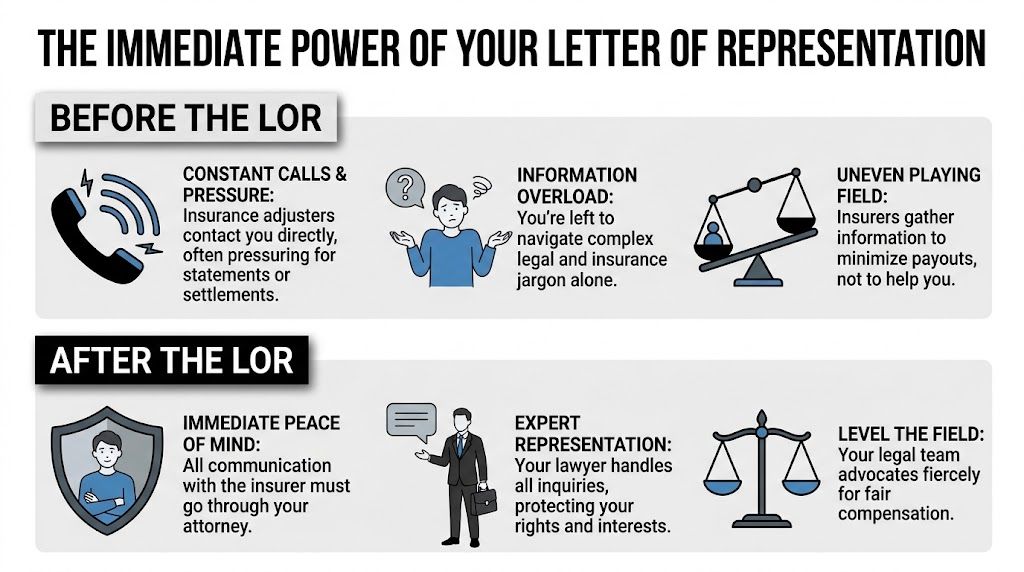
Before the letter goes out, the insurance company often sees an opening. Adjusters may call you at home, email you, ask for a recording, or push for a quick version of events while you’re still shaken.
After the letter is delivered, that window narrows fast.
The rule that changes the conversation
Legal ethics rules, reflected in standards like Missouri Supreme Court Rule 4-4.2 and enforced similarly in Texas, prohibit an opposing party’s representatives from communicating directly with a person they know is represented by counsel. This overview of how a representation letter protects an injury claim explains that once the insurer receives the letter, it is legally and ethically bound to stop direct contact.
That means the adjuster shouldn’t keep calling you about the claim. They shouldn’t try to get a recorded statement from you. They shouldn’t attempt to negotiate around your lawyer.
What “stop contacting you” really means
This isn’t just polite legal etiquette. It changes daily life in practical ways.
Before the letter, your phone may ring with questions you’re not ready to answer. After the letter, the insurer is expected to direct claim communications to your lawyer.
That matters because accident victims often answer questions from a place of pain, fear, or confusion. A person with a concussion, back injury, or medication side effects isn’t in the best position to parse loaded questions about fault or symptoms.
Practical rule: If the other side knows you have a lawyer, they should go through your lawyer for claim communications.
Why this protection is so important after a crash
A recorded statement can sound harmless. It rarely is. The insurer may ask broad questions, then use isolated answers later to argue that you weren’t seriously hurt, weren’t paying attention, or were partly to blame.
In Texas, that matters because comparative fault under Chapter 33 can affect the value of your case. If the insurer can pin more blame on you, it may try to reduce what it pays. That’s one reason an early legal barrier matters so much.
A before and after example
Consider a driver in Houston who is struck in an intersection by someone who ran a red light. The next day, the adjuster asks, “Were you in a hurry?” The driver answers, “Maybe a little.” That answer has nothing to do with the red light, but it can still be used to shape the file.
Once a lawyer letter of representation is in place, those conversations should go through counsel. Your attorney can answer with context, request records, object when needed, and keep the claim from being built around stray comments.
If an insurer keeps contacting you anyway
If someone still calls, emails, or messages you about the claim after receiving the letter, don’t argue with them. Don’t explain the crash. Don’t try to handle it yourself.
Do this instead:
- Save the communication: Keep the voicemail, email, text, or envelope.
- Send it to your lawyer: Forward everything without replying.
- Avoid discussing the facts: Even a short response can create new issues.
That immediate silence from the insurer is one of the first real signs that the balance of power has started to move.
How the Letter Transforms Your Insurance Claim Process
Many people think the main value of a lawyer letter of representation is that it stops phone calls. That’s important, but it’s only part of what happens.
Inside the insurance company, the file itself usually changes.

When a claim becomes attorney-represented, it tends to receive more formal handling. The insurer knows there will be documentation, deadlines, and legal accountability. It also knows someone is now watching for lowball tactics, missing records, and unsupported blame shifting.
What changes behind the scenes
An represented claim is often handled with more care because the insurer expects scrutiny. Your attorney can request claim materials, gather records, and control the flow of information instead of letting the insurer shape the story first.
That shift matters in an auto insurance claim, especially when the injuries are still developing. A person may look stable at the scene and still need weeks of treatment, imaging, or specialist care.
If you want a practical companion piece on insurer tactics, this guide on how to deal with insurance adjusters gives more detail on common pressure points accident victims face.
The evidence preservation piece is critical
A strong letter doesn’t just identify your lawyer. It also tells the other side to preserve evidence.
That can include:
- Vehicle data: Event data recorder or black box information
- Video evidence: Store surveillance, dashcam footage, traffic-area footage
- Physical evidence: Damage photos, vehicle condition, debris documentation
- Business records: In commercial cases, driver logs or internal incident materials
Timing can make or break a case. This discussion of how a letter strengthens an injury claim explains that vehicle black box data and surveillance footage can degrade or be destroyed in 70-80% of untreated claims within 30 days, and that the letter functions as a formal demand to preserve evidence under Texas spoliation principles.
Why Texas spoliation law matters
Texas courts recognize that lost or destroyed evidence can distort a case. The preservation demand in the letter puts the other side on notice. If key material disappears after that, the issue doesn’t just vanish. It can become part of the litigation.
The same source ties this concept to Texas spoliation doctrines and references Brookshire Bros. v. Aldridge, a Texas case often discussed when evidence preservation and loss become major issues.
A letter of representation is often the first document in your claim that tells the insurer, in writing, “Keep the evidence. We may need every piece of it.”
A real-world Texas example
Take a trucking crash outside Houston. Without fast legal notice, data from the truck, dispatch records, or nearby business footage may not be preserved. By the time an injured family realizes what matters, the trail can be thinner.
With prompt legal notice, the attorney can identify what must be retained and make clear that evidence loss won’t be ignored. That doesn’t guarantee fairness by itself, but it puts your case on stronger footing from the start.
Why this affects value, not just procedure
Insurance companies value claims based on proof, credibility, and risk. A represented file usually contains stronger documentation because a lawyer is gathering records, organizing treatment history, protecting damaging communications from happening, and preserving evidence before it disappears.
That’s how a simple letter starts changing the claim process long before a settlement discussion ever begins.
Anatomy of a Strong Letter of Representation Sample Included
A good lawyer letter of representation is concise, but every line has a job. It identifies the case, closes the door on direct insurer contact, and preserves evidence that may otherwise be lost.
Below is a simplified sample. It is for education only.
[Date]
To: Insurance Carrier / Claims Adjuster
Re: Our Client, [Client Name]
Date of Loss: [Accident Date]
Location: [Accident Location]
Claim Number: [If Known]Please be advised that our office represents [Client Name] regarding injuries and damages arising from the above-referenced incident. Effective immediately, please direct all communications, correspondence, and claim documents concerning this matter to our office only.
Please confirm all available liability coverage and any other applicable insurance coverage.
You are instructed to preserve all evidence relevant to this claim, including vehicles, photographs, recorded statements, electronic data, surveillance footage, and any other materials relating to the incident.
Kindly acknowledge receipt of this letter in writing.
Sincerely,
[Attorney Name]
[Law Firm Contact Information]
Key components and why they matter
Here is the basic structure in plain English.
| Component | Purpose & Importance |
|---|---|
| Client name and identifying details | Makes clear who is represented so the insurer cannot claim confusion |
| Date and location of the crash | Ties the letter to the correct incident and claim file |
| Claim number if available | Helps the insurer route the notice correctly |
| Formal notice of representation | Tells the insurer your lawyer now speaks for you on the claim |
| Instruction to send communications to counsel | Cuts off direct contact and centralizes the paper trail |
| Coverage inquiry | Helps identify available insurance and plan the case strategy |
| Preservation demand | Tells the other side to retain evidence that may later prove liability or damages |
| Request for written acknowledgment | Creates a record showing the insurer received notice |
What readers usually misunderstand
Many accident victims assume this letter is just administrative. It isn’t. Each part protects a specific part of your case.
The coverage request matters because your attorney needs to understand what insurance may apply. The preservation language matters because evidence doesn’t wait. The routing instruction matters because one bad phone call can complicate a clean liability case.
For readers who want to compare this notice to a later settlement package, this sample personal injury demand letter helps show how different these documents really are.
How this fits into Texas personal injury law
Texas negligence law focuses on fault and harm. In plain terms, your case asks two core questions. Who caused the crash, and what losses did it cause?
That brings us back to four terms that matter in nearly every case:
- Liability means legal responsibility for the collision.
- Comparative fault under Chapter 33 means the other side may argue you share blame.
- Damages means the physical, financial, and personal losses caused by the crash.
- Statute of limitations means there is a filing deadline, so delay can be dangerous.
In the most serious cases, Chapter 41 can also matter when the law allows exemplary damages to be pursued. That is not part of every case, but it is part of the broader Texas damages framework.
A Houston example
A Houston driver rear-ended in slow traffic may think the case is simple. Then the insurer argues there was little vehicle damage, so the injuries must be minor. A strong file pushes back with treatment records, symptom history, imaging when appropriate, and preserved evidence.
The letter is often the first document that starts that disciplined process.
Your Role After the Letter Is Sent Focus on Your Recovery
Once your lawyer sends the letter, your main job is no longer managing the insurance company. Your job is to recover.
That sounds simple, but many people still feel guilty stepping back. They worry they should answer the adjuster, chase records, or explain what happened one more time. Usually, that only creates risk.
What you should do now
Focus on the parts of the case only you can do well:
- Go to your appointments: Consistent treatment helps your health and creates a clear medical record.
- Follow medical advice: If a doctor recommends therapy, imaging, work restrictions, or follow-up care, take it seriously.
- Keep a simple recovery journal: Write down pain levels, sleep problems, missed events, driving limits, and how injuries affect daily life.
- Save receipts and paperwork: Keep records for prescriptions, co-pays, mileage, and other accident-related losses.
What you should stop doing
You do not need to argue with adjusters, interpret policy language, or guess what your claim is worth.
If anyone still contacts you about the crash, do this:
- Don’t discuss fault, injuries, or settlement.
- Save the message.
- Forward it to your attorney.
Your legal team handles the fight. You handle the healing.
Why this matters for your claim
Insurance cases often turn on consistency. If your records show you took treatment seriously and your symptoms were documented over time, your claim is easier to present accurately and clearly.
That also helps if the insurer tries to minimize your damages later. Your records, your journal, and your treatment history work together. They show what the crash did to your life.
If the crash caused a fatal injury, families may be dealing with a different kind of case involving wrongful death compensation. The same principle applies. Early legal protection helps preserve evidence and communication while the family focuses on immediate needs and grief.
Why You Must Have a Texas Injury Attorney Send This Letter
A person can type a letter and mail it. That does not mean they are getting the same protection as a represented claimant.
In personal injury law, who sends the message matters.

The civil justice system has a real representation gap
Legal access is a major problem in this country. Research on why representation matters describes a civil justice system with twelve to thirteen million unrepresented parties, and it notes that nearly forty percent of Americans abandon civil justice problems entirely because legal services are inaccessible. The same source explains that representation is positively correlated with favorable outcomes.
That matters in a car wreck claim because insurers handle claims every day. Most injured people do not.
Why legal skill changes the outcome
A Texas injury attorney does more than send a notice. Your lawyer evaluates liability, protects against unfair comparative fault arguments under Chapter 33, organizes proof of damages, and prepares the case with the possibility of suit in mind.
That changes how the insurer evaluates risk.
A represented claim tells the insurer there will be evidence requests, legal deadlines, and someone who understands coverage, records, and negotiation. In many cases, that alone changes the tone of the file.
Even delivery method matters
A lawyer also knows how to send and document the notice properly. If you’re curious about secure transmission methods for private records and claim documents, this guide on the best way to send sensitive documents offers practical background on protecting personal information.
For readers looking into whether they need counsel for a serious crash, this overview of a Texas personal injury law firm can help explain what legal representation looks like in practice.
Why a self-sent letter usually falls short
A self-sent letter may notify the insurer that you want to be taken seriously. But a lawyer-sent letter carries legal authority, strategic timing, and follow-through.
It also comes with something the insurer can’t ignore. A professional on the other side who knows Texas negligence law, knows how to document damages, and knows when a claim should move toward litigation.
That’s why a Houston car accident lawyer doesn’t just send paper. The lawyer shifts the advantage.
Frequently Asked Questions About Letters of Representation
Does sending a letter of representation mean I have to file a lawsuit
No. It usually means you’ve protected yourself early while your attorney investigates, gathers records, and deals with the insurer. Many claims resolve without filing suit, but the letter helps prepare your case properly in case litigation becomes necessary.
What if I already gave a recorded statement
Don’t panic. A prior statement does not automatically destroy your case. It does mean your attorney needs to review what was said, compare it to the evidence and medical records, and manage any problems carefully.
How quickly does the letter start helping
The protection starts when the insurer receives it. In practical terms, the effect can be immediate because claim communications should start routing through counsel once notice is received.
Can I still talk to my own insurance company
Possibly, but you should be careful. Routine policy issues are different from claim discussions about fault, injuries, or coverage. When in doubt, send the communication to your lawyer first.
Is this the same thing as a demand letter
No. A lawyer letter of representation announces that you have counsel. A demand letter usually comes later and asks for compensation based on the evidence, your treatment, and your damages.
What should I bring to a consultation
Bring what you have. That may include the crash report, photos, insurance information, medical papers, repair estimates, and any texts, emails, or voicemails from adjusters. You do not need a perfect file to ask for help.
If you were hurt in a crash and need clear answers about your rights, contact The Law Office of Bryan Fagan, PLLC for a free consultation. Whether you’re dealing with a car wreck, truck collision, difficult auto insurance claim, or a family loss involving wrongful death compensation, you can talk with a team that understands Texas injury law and knows how to protect your case from the start. You won’t pay anything upfront, and you can get guidance on what to do next with confidence.