Skip to content
A car crash can change your life in seconds, but you don’t have to face recovery alone.
If you’re reading this after a driver hit you and sped away, you’re probably dealing with more than vehicle damage. You may be in pain. You may be replaying the impact over and over. You may also be wondering how you’re supposed to prove anything when the person who caused the crash disappeared.
That reaction is normal. Hit and run cases feel uniquely unfair because the other driver broke the rules twice. First by causing the crash, and again by leaving you there to deal with the aftermath. The good news is that Texas law still gives you options, and in many cases the most important step is protecting your own auto insurance claim before evidence fades.
Your Life Changed in an Instant You Are Not Alone
A Houston driver gets sideswiped on the way home from work. The other car hesitates for a second, then races through the light and disappears. The victim is left with a shaking hand, a damaged door, and a dozen urgent questions. Was anyone nearby? Did a business camera catch it? Who pays for the ambulance, the ER visit, and the missed work?
That story is common. Hit and run crashes are not rare events that happen to a handful of unlucky people. According to national hit and run crash data, one occurs every 43 seconds in the United States. The same source reports that from 2018 to 2022, more than 4 million people were involved in hit and run crashes, with over 12,000 fatal incidents.
Those numbers matter for one reason. They remind you that what happened to you is part of a larger problem, and there are legal tools built for it. If you need a broader look at the physical and financial side of healing after a wreck, this guide to auto accident recovery after a crash is a helpful place to start.
What counts as a hit and run in Texas
In plain English, a hit and run happens when a driver is involved in a crash and leaves without giving the information and reasonable help the law requires. That can happen in a major freeway collision, a parking lot impact, or a pedestrian crash.
A few legal words come up quickly in these cases:
- Liability means legal responsibility. Who caused the crash, and who should pay for the harm.
- Damages means your losses. That can include medical bills, lost wages, repair costs, pain, and other harm.
- Statute of limitations means the deadline to file a lawsuit.
- Comparative fault means your compensation can be reduced if you were partly at fault.
Under Texas Civil Practice & Remedies Code Chapter 33, Texas follows a modified comparative fault rule. If you are partly responsible, your recovery may be reduced by your share of fault. If your share of fault is too high, recovery may be barred. In real life, that means even in a hit and run case, facts still matter. Insurance companies will look closely at speed, lane changes, traffic signals, and driver statements.
A fleeing driver doesn’t erase your rights. It changes how the case is proved and where recovery may come from.
Texas law also places limits on certain damages in some cases under Chapter 41 of the Texas Civil Practice & Remedies Code, especially where exemplary damages are involved. Most hit and run injury claims, though, turn first on proving fault, documenting injuries, and finding the right source of coverage.
The First 72 Hours What to Do Immediately After a Hit and Run
The first few days matter more than is commonly understood. Texas gives injury victims time to file a lawsuit, but evidence doesn’t wait around. According to Texas hit and run timing guidance, victims generally have a two-year statute of limitations to file suit, yet the strength of the case often depends on what gets preserved in the first 24 to 72 hours.
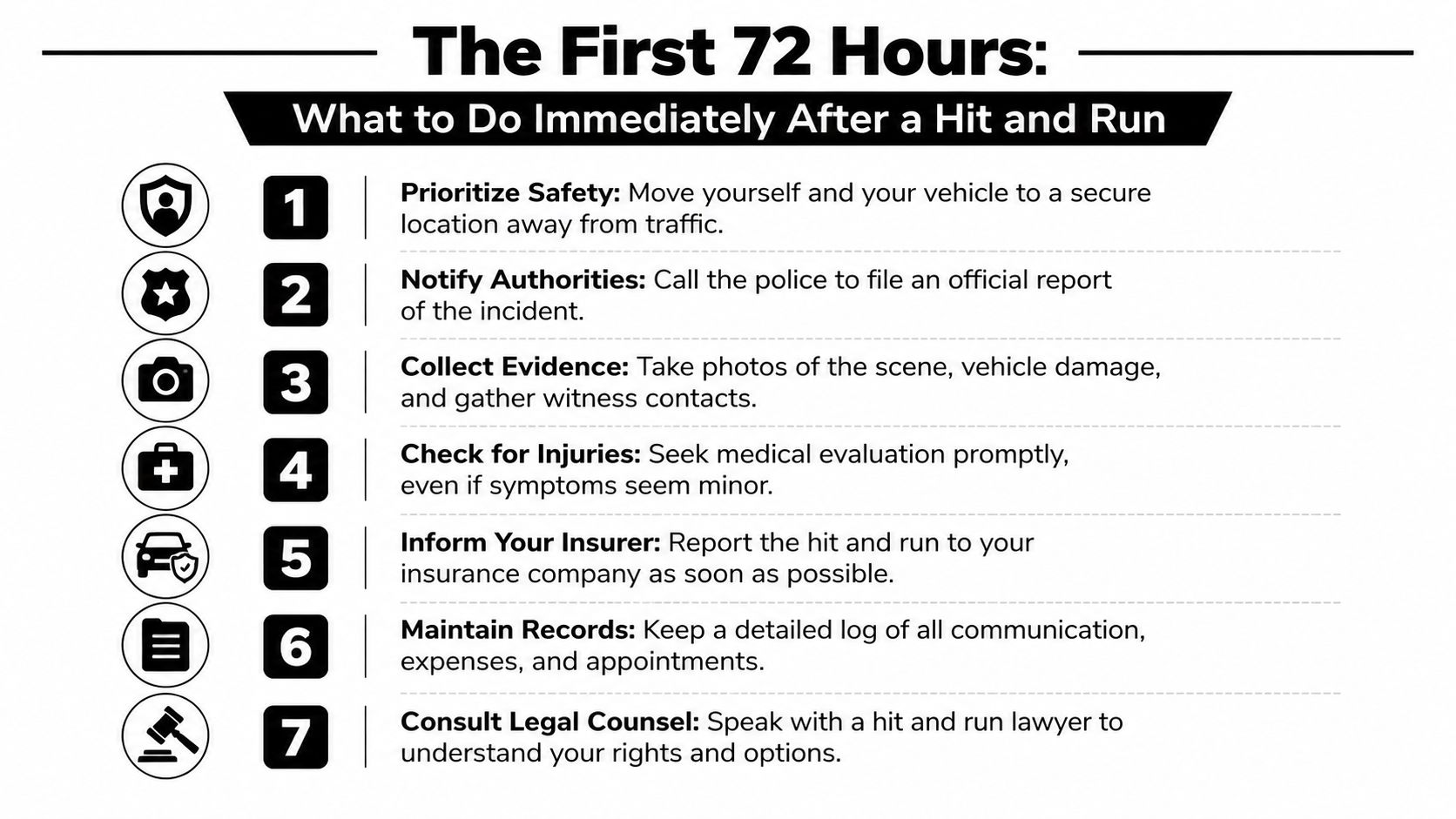
Your immediate checklist
Get to safety first.
Move out of traffic if you can do it safely. Turn on hazard lights. If your car can’t move, stay put and wait for help.Call 911 and insist on a report.
A police report creates an official record that a hit and run happened. That record often becomes central to both injury claims and uninsured motorist claims.Accept medical care early.
Adrenaline masks pain. Neck injuries, concussions, back injuries, and soft tissue trauma often show up later. A prompt exam also creates medical records that connect your injuries to the crash.
What evidence to collect before it disappears
If you’re physically able, gather what you can at the scene. If you can’t, ask a passenger, friend, family member, or later your lawyer.
- Photos of vehicle damage: Capture every angle, skid marks, debris, road signs, and intersection layout.
- Witness names and phone numbers: Independent witnesses can make the difference when the other side questions what happened.
- Details about the fleeing vehicle: Color, make, model, dents, stickers, partial plate, direction of travel.
- Nearby camera locations: Gas stations, apartment gates, traffic cameras, storefronts, and doorbell cameras.
Practical rule: Don’t assume video will still be there next week. Many businesses overwrite footage quickly.
A lot of people also make honest mistakes in this window. They wait a day to report the crash. They skip urgent care because they “feel okay.” They tell the insurer they’re “fine” before they know the extent of their injuries. They repair the car too early and lose physical evidence.
For a more detailed post-crash checklist, review these steps to take after a car accident in Texas.
What not to say
When the insurance company calls, keep it simple. Confirm basic facts, but don’t guess, don’t minimize your pain, and don’t accept blame. Texas comparative fault rules under Chapter 33 can affect the value of a claim if your words are later used against you.
A safe response is short: you were hit, the other driver fled, you’re getting medical care, and you’re still gathering information.
Your Three Paths to Recovery in Texas
Many victims think there’s only one question. Can the police find the driver? In reality, there are usually three different paths after a hit and run, and each serves a different purpose.

Door one is the criminal case
If law enforcement identifies the driver, the state may pursue criminal charges. That matters for accountability, but it does not automatically pay your bills. Criminal court focuses on punishment. Your recovery usually comes through insurance or a civil claim.
Door two is the civil injury case
If the driver is identified, you may bring a personal injury lawsuit against that person. Establishing liability then becomes central. Liability means showing that the other driver caused the crash and your losses.
Under Texas negligence law and Chapter 33, the defense may still argue that you share some fault. For example, if a Houston driver rear-ended on I-45 was also changing lanes at the time of impact, the insurance company may try to shift part of the blame. That doesn’t end the case, but it can affect the outcome.
Door three is often the most important one
For many Texas families, the most practical route is an Uninsured Motorist, or UM, claim through their own policy. As explained in this overview of Texas uninsured motorist options in hit and run cases, UM coverage can allow recovery for bodily injury and property damage when the at-fault driver is unknown, turning an otherwise uncollectable claim into an insurable one.
That’s why quick action matters so much. A hit and run victim may spend days focused on the missing driver while the more urgent issue is preserving the UM claim. In many cases, the policy you already pay for is the safety net.
A plain-English comparison
| Path | Main purpose | Main challenge | What victims should know |
|---|---|---|---|
| Criminal case | Punish the fleeing driver | You don’t control it | Helpful, but not your primary financial remedy |
| Civil lawsuit | Recover damages from the driver | Driver must be identified and collectible | Best when the driver is found and insured |
| UM claim | Recover through your own policy | Insurer may dispute coverage or injuries | Often the key recovery path in Texas hit and run cases |
Your own insurer is not automatically on your side just because you’ve paid premiums for years.
That’s the trade-off many people don’t see coming. A UM claim sounds straightforward, but your insurer may still challenge whether contact happened, whether your injuries came from the crash, or whether your treatment was necessary. That’s where experienced hit and run lawyers and a seasoned Texas injury attorney can make a real difference.
How Hit and Run Lawyers Investigate and Prove Your Case
The legal work in these cases starts long before settlement talks. Good investigation is fast, targeted, and practical. It’s not about doing everything. It’s about preserving the right evidence before it vanishes.

What a lawyer does that victims usually can’t
A hit and run lawyer typically begins with the timeline. Where exactly did the crash happen? Which cameras may have captured the vehicle before or after impact? Which witnesses left before police arrived? Which businesses need immediate preservation requests?
The investigation often includes:
- Sending preservation letters: To stores, apartment complexes, toll road operators, or nearby businesses before footage is overwritten.
- Reviewing the crash report closely: Names, diagrams, road conditions, and officer observations all matter.
- Tracking witnesses: A witness listed as “John, black pickup” in a report isn’t much use unless someone follows up.
- Inspecting vehicle damage: The angle and transfer marks can support how the impact happened.
- Searching for digital evidence: Dashcams, Ring cameras, Tesla footage, fleet records, and phone photos can all help.
If you have a report already, learning how insurers and attorneys read it can help. This guide on how to read a police accident report explains what details tend to matter most.
Why representation changes the outcome
The value of legal help isn’t just convenience. It often affects whether a claim gets paid and how much gets recovered. According to car accident settlement data on represented claims, injured people with legal representation receive settlements nearly 3.5 times higher than those without a lawyer. The same source states that 91% of represented claimants received a payout, compared with 51% of people who handled claims on their own.
Those figures don’t mean every claim becomes a high-value case. They do show a pattern many lawyers see firsthand. Insurance companies take documented, well-prepared claims more seriously.
A short explainer can help if you want to understand how lawyers build and negotiate these cases:
What works and what usually doesn’t
Some approaches help quickly. Others waste precious time.
Usually effective
- Acting early: Fast requests for footage and witness interviews.
- Staying organized: Medical records, wage loss proof, repair estimates, and insurer correspondence in one file.
- Using the right expert when needed: Accident reconstruction or medical opinion support can strengthen disputed claims.
Usually ineffective
- Waiting for police to solve everything: Law enforcement has limits, competing priorities, and less control over your insurance recovery.
- Giving a detailed recorded statement too soon: Small wording errors can become larger disputes later.
- Treating a UM claim casually: These claims are often defended more aggressively than people expect.
Calculating Compensation What Your Hit and Run Claim Is Worth
Once the initial shock fades, the question often comes to mind: What is my case worth? The honest answer is that value depends on your injuries, your proof, your coverage, and how the crash changed your daily life.

Economic damages
Economic damages are the losses you can usually document with bills, receipts, wage records, or repair estimates.
That can include:
- Medical treatment: Emergency care, imaging, follow-up visits, physical therapy, prescriptions.
- Lost income: Missed workdays, reduced hours, or lost earning ability if injuries affect your job.
- Property loss: Vehicle repair or replacement and other damaged personal items.
A Dallas commuter struck on I-35 may start with an ER visit and body shop estimate, then later realize the bigger loss is time away from work and ongoing therapy appointments.
Non-economic damages
Non-economic damages are the human losses that don’t come with a simple invoice. Pain, anxiety, sleep disruption, physical limitations, and the loss of normal routines all fall into this category.
These losses are real even though they’re harder to measure. When injuries affect mobility at home, families often need to think beyond immediate treatment. For practical ideas on safer living spaces during recovery, DME Superstore's home modification guide is a useful resource.
Keep a daily recovery journal. Short notes about pain, missed events, sleep problems, and activity limits can become strong evidence later.
How comparative fault can affect value
Texas uses modified comparative fault under Chapter 33. In plain terms, if you were partly at fault, your compensation may be reduced by your share of responsibility. If your share of fault crosses the legal line, you may not recover from the other side.
That’s why details matter even in a hit and run. Suppose a San Antonio driver is struck by a fleeing SUV while turning left. The defense may argue the turn was unsafe. The injured person may argue the other driver was speeding and fled because they knew they caused the collision. Evidence decides which story holds up.
What about punitive damages and wrongful death compensation
In some especially serious cases, families may ask whether fleeing the scene opens the door to additional damages. Texas Chapter 41 addresses exemplary damages and related limits. These claims are fact-specific and require close legal review.
If the crash caused a fatality, surviving family members may have claims for wrongful death compensation and related losses. Those cases demand immediate legal attention because the emotional and financial stakes are so high.
The Legal Process Contingency Fees and Timelines
One reason people delay calling a lawyer is simple. They assume they can’t afford one. In most Texas personal injury cases, that isn’t how it works.
How contingency fees work
Most hit and run lawyers handle these cases on a contingency fee. That means you pay no upfront attorney’s fee, and the lawyer is paid from the recovery if the case succeeds. If there is no recovery, there is generally no fee for the lawyer’s work under that agreement.
That setup matters because it aligns interests. Your lawyer has a reason to build the strongest claim possible, and you can get help without taking on another bill while you’re already dealing with medical expenses and lost income.
What the timeline usually looks like
No two cases move at the same speed, but the sequence is usually familiar.
Initial consultation
You explain what happened, what injuries you have, what insurance exists, and what deadlines may apply.Investigation and claim setup
The legal team gathers reports, photos, policy information, and medical records. If there is a UM claim, the policy language gets reviewed closely.Medical treatment and documentation
Your case value often can’t be measured until your condition is better understood. Settling too early can leave you paying later costs yourself.Demand and negotiation
The attorney presents liability facts, damages, and supporting records to the insurer and pushes back on denial tactics or low offers.Lawsuit if needed
If the carrier won’t act fairly, filing suit may be the next step. Even then, many cases still resolve before trial.
A good legal process should reduce your stress, not add to it. You should know what’s happening, what’s next, and what decisions are yours.
This is also where a Houston car accident lawyer or Texas injury attorney can provide something valuable beyond paperwork. They can tell you when patience helps, when the insurer is stalling, and when a low offer should be rejected.
Take the Next Step with a Texas Injury Attorney
After a hit and run, individuals often want two things. They want their life to feel stable again, and they want someone to make sense of the process. Both are possible, but timing matters.
You don’t need to know everything today. You do need to protect the things that can be lost early. The police report. The camera footage. The witness names. The medical records. The UM claim notice. These details often decide whether a case stays strong or starts slipping away.
A lawyer’s job is not to make big promises. It’s to give you a clear path. That includes explaining liability, reviewing comparative fault issues under Texas law, identifying available damages, and handling the insurance company so you can focus on healing. It also means being honest about trade-offs. Sometimes the fleeing driver is found. Sometimes the recovery comes through your own policy. Sometimes a family is dealing with catastrophic injuries or a death and needs guidance on wrongful death compensation from the start.
If you were hurt in Houston, Dallas, Austin, San Antonio, or another Texas community, legal help is available. Whether you need a Houston car accident lawyer for immediate guidance or a firm that can step into a complicated auto insurance claim, early action usually gives you the best chance to preserve evidence and protect coverage.
The hardest part is often the first call. Once that step is taken, the process becomes more manageable. Questions get answered. Deadlines become clear. The next move stops feeling like a guess.
If you or someone you love was injured by a fleeing driver, contact The Law Office of Bryan Fagan, PLLC for a free and confidential consultation. You can speak with a Texas legal team that understands hit and run claims, uninsured motorist disputes, serious injury cases, and wrongful death compensation. There’s no obligation, and if the firm takes your case on contingency, you won’t pay attorney’s fees unless money is recovered for you.