A car crash can change your life in seconds, but you don’t have to face recovery alone.
A hit and run car accident adds another layer of fear. You’re hurt, angry, and trying to understand how someone could hit you and disappear. In that moment, the immediate question is: who pays for this now?
In Texas, the answer is often your own Uninsured/Underinsured Motorist coverage, usually called UM/UIM. In a hit-and-run case, building that claim starts immediately. What you do in the first hour can affect your medical care, the police investigation, and your auto insurance claim.
Your First Moments After a Hit and Run in Texas
A car crash is terrifying. A hit-and-run feels like a betrayal. Still, you are not powerless.
Your first job is simple. Get to safety. If your vehicle can move, pull to the shoulder, a parking lot, or another safer area away from traffic. Turn on your hazard lights. If you’re a pedestrian or bicyclist, get out of the roadway if you can do so safely.
Your second job is just as important. Get medical attention. Even if you think you’re “mostly okay,” pain can show up later. Adrenaline often hides symptoms. Neck injuries, concussions, back injuries, and internal injuries don’t always announce themselves at the scene.
Safety first, proof second
You do need evidence, but not at the cost of your health. If you’re dizzy, bleeding, having trouble breathing, or you hit your head, call 911 and wait for help. If you can safely document the scene later, do it then.
Practical rule: If an injury would matter to a doctor tomorrow, it matters to your claim today.
Hit-and-run crashes are not rare or harmless. In 2016, there were 2,049 deaths from hit-and-run crashes in the U.S., a 60% increase from 2009, and fleeing drivers were responsible for 20% of all pedestrian fatalities, according to these hit-and-run crash findings. That is why police, insurers, and lawyers all take prompt reporting seriously.
Start your timeline right away
As soon as you can, note the time, place, and what happened. Use your phone’s notes app. Record what direction the other vehicle went, what lane it used, and anything you remember about the driver or car. Don’t wait until later. Memory fades fast after a shock.
If you want a broader post-crash checklist, review what to do after a car accident in Texas. In a hit-and-run, those basics matter even more because the other driver isn’t there to exchange information.
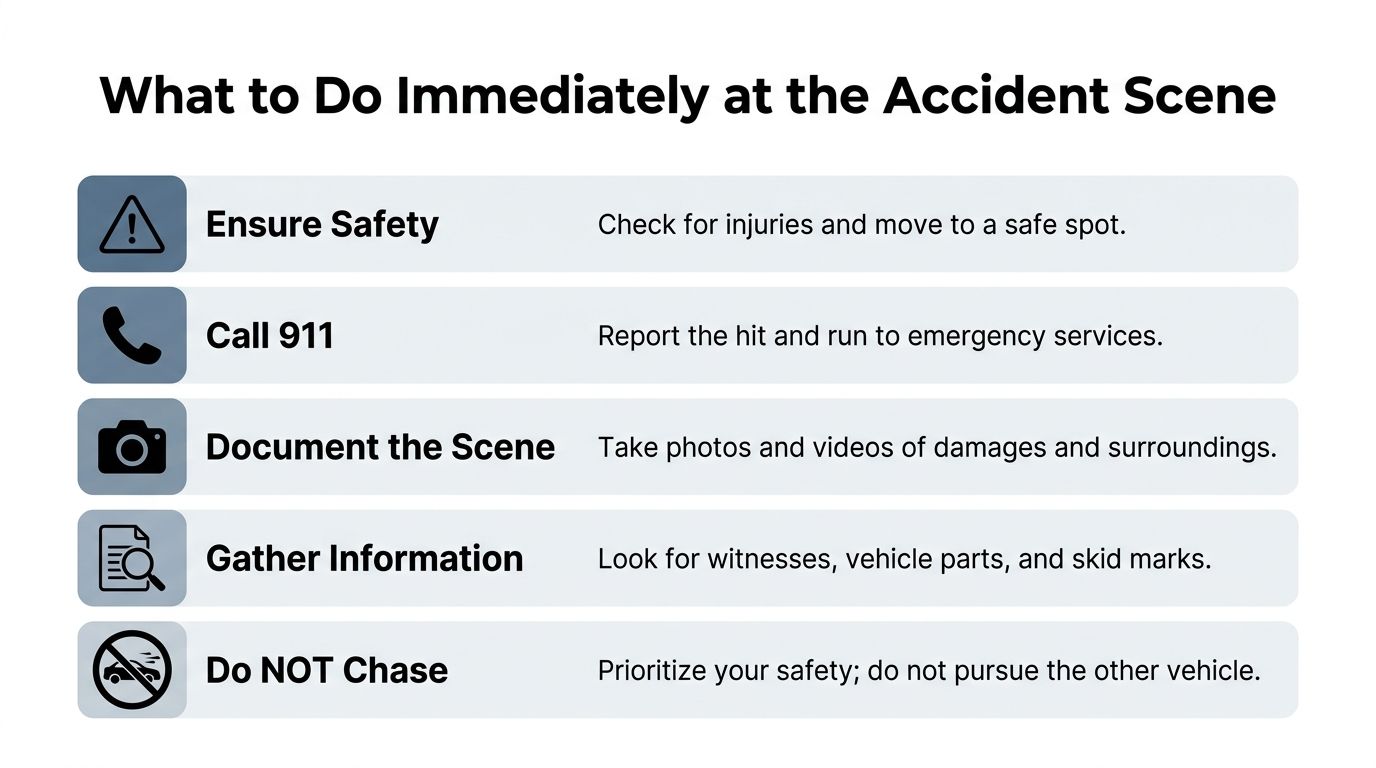
What to Do Immediately at the Accident Scene
Here, you begin building the foundation of your recovery. In many hit-and-run cases, your evidence becomes the backbone of a UM claim.
Start with the most important rule. Don’t chase the other driver. Chasing creates another risk, and it rarely helps. You may miss witnesses, lose the exact crash location, or get into a second collision.
A useful visual checklist can help you stay focused under stress.
What to capture with your phone
If you’re physically able, use your smartphone like an investigator would. Don’t worry about making it perfect. Focus on getting clear, useful details.
- The fleeing vehicle details. Write down or record the color, make, model, body style, and any part of the plate you saw. Even a partial plate or a broken taillight description can matter.
- The direction of travel. Photograph the lane, intersection, exit ramp, or nearby business signs in the direction the driver fled. That can help identify traffic cameras or private security cameras.
- Your vehicle damage. Take close photos and wide photos. Get the bumper, side panels, glass, wheels, and interior if airbags deployed.
- The roadway itself. Photograph debris, skid marks, paint transfer, shattered plastic, and fluid on the pavement. Those details can support reconstruction later.
- Your visible injuries. Bruising, cuts, swelling, torn clothing, and blood on a seatbelt or airbag can all help show force and point of impact.
What works and what doesn’t
Police solve only 8 to 10% of hit-and-run cases globally, according to this discussion of hit-and-run solve rates. That low rate is one reason immediate documentation matters. Detailed photos and witness information can strengthen both the investigation and your insurance claim.
What works:
- Calling 911 quickly
- Getting witness names and phone numbers before they leave
- Taking wide shots and close shots
- Recording your memory while it’s fresh
What doesn’t:
- Guessing about details you didn’t see
- Arguing with bystanders
- Posting your theory of the crash on social media
- Waiting until the next day to gather evidence
A short walkthrough can make the scene steps easier to remember.
Witnesses can change the claim
Independent witnesses often make a major difference. Ask simple questions: What did you see? Which way did the car go? Did you catch any part of the plate? Then get a name and a phone number.
Don’t rely on the police to track every witness down later. If someone is willing to help, get their contact information before they disappear into traffic.
If you spot nearby doorbell cameras, gas station cameras, parking lot cameras, or city traffic cameras, make a note of them. You may need that information quickly because video can be overwritten.
How to Officially Report a Texas Hit and Run
After the scene, the case moves into paperwork, phone calls, and deadlines. This part isn’t glamorous, but it’s where many valid claims get weakened.
First, make sure the crash is reported to law enforcement. If officers came to the scene, ask how to obtain the report number. If they didn’t come, find out what reporting step applies to your situation and do it promptly. A hit-and-run claim without a prompt report often faces more resistance from insurers.
The police report is not optional in practice
Your report creates the official record that a collision happened and that the other driver fled. It also helps tie your injuries and vehicle damage to a specific event at a specific time and place.
If you later need help understanding what the officer included, this guide on how to read a police accident report can help you spot errors, missing details, and useful notations.
In Texas, hit-and-run claims often depend on more than eyewitness memory. According to this overview of advanced hit-and-run crash analysis, over 140,000 hit-and-runs occur annually in Texas, and advanced analysis can help prove liability even without the other driver by examining impact angle and force. That matters because insurers often ask, in one form or another, “How do we know what happened if the driver is gone?”
Open your UM claim carefully
UM/UIM coverage is insurance you bought to protect yourself from irresponsible drivers, including one who hit you and disappeared. In many hit-and-run cases, this is the most realistic path to financial recovery.
When you call your insurer:
- Report the crash promptly.
- State the basic facts clearly.
- Ask whether they are opening a UM claim.
- Ask for the claim number and adjuster name.
- Follow up in writing if possible.
Keep your wording simple. Say you were involved in a hit and run car accident, you were injured, the at-fault driver fled, and a police report was made or requested. Don’t guess about speed, fault, or medical prognosis.
What not to say
A lot of people hurt their own claims by trying to sound reasonable.
Avoid statements like:
- “I’m fine.” You may not know that yet.
- “It was probably partly my fault.” Let the evidence answer that.
- “I just need my car fixed.” You may also have an injury claim.
- “I don’t think I need treatment.” Don’t lock yourself into that before a doctor evaluates you.
The safest statement to an insurer early on is often the truth in its simplest form: the other driver fled, you’re getting evaluated, and you’ll provide additional information as it becomes available.
Your Rights and Compensation in a Hit and Run Case
Most clients want plain English here. They don’t want legal jargon. They want to know what they can recover and what rules apply.
Start with liability. Liability means legal responsibility. In a hit-and-run, the fleeing driver is usually the person whose negligence caused the crash. Negligence means failing to use reasonable care, such as speeding, texting, running a light, or leaving the scene instead of stopping.

Texas comparative fault and why it matters
Texas follows a comparative fault system under Texas Civil Practice & Remedies Code Chapter 33. In plain terms, that means fault can be divided between people. If an insurer claims you were partly responsible, your recovery can be reduced by your share of fault. If your share is too high under Texas law, recovery can be barred.
That is why your first statements, photos, and medical records matter so much. In a hit-and-run case, the missing driver doesn’t get a free pass to blame you without proof. But insurers may still test that argument, especially if the scene wasn’t documented well.
What damages can include
Damages means the losses the law allows you to recover. In a UM case, that can include economic losses and human losses.
| Type of damages | What it means in plain English |
|---|---|
| Medical bills | Emergency care, follow-up visits, therapy, medication, imaging, and future treatment tied to the crash |
| Lost wages | Income you lost because you couldn’t work |
| Pain and suffering | Physical pain, discomfort, and the way the injuries affect daily life |
| Mental anguish | Fear, anxiety, sleep problems, and emotional distress after the event |
| Property damage | Repair or replacement issues involving your vehicle and related losses |
Texas also addresses damages and legal limits in Texas Civil Practice & Remedies Code Chapter 41, which deals with certain damage rules in civil cases. The exact value of a case depends on the facts, the injuries, the coverage, and the evidence.
A common example helps. If a Houston driver is rear-ended on I-45 and the other motorist speeds away, that person’s UM coverage may be the source of payment for the ambulance bill, emergency room care, physical therapy, missed work, and pain tied to the crash.
A few terms you should know
- Statute of limitations means the deadline to file a lawsuit. In Texas personal injury cases, that is generally two years from the date of the crash.
- Wrongful death compensation refers to damages certain family members may pursue when a loved one is killed by another person’s negligence.
- Auto insurance claim means the formal request for benefits under an insurance policy.
In serious cases, every source of recovery matters. According to AAA Foundation reporting on fatal hit-and-run crashes, fatal hit-and-run crashes are at a record high, and in Texas, 1 in 5 cyclist fatalities and 1 in 4 pedestrian fatalities involve a fleeing driver. That is one reason robust UM claims are so important.
It also helps to understand your policy before a crash happens. If you want a plain-language overview of coverage basics, these insights on car insurance for owners are a useful starting point. For hit-and-run victims specifically, this page on Texas uninsured and underinsured motorist coverage explains how that protection can apply after the at-fault driver disappears.
Criminal Consequences for the Fleeing Driver
People often assume the criminal case and the injury case are the same. They are not.
The criminal case is handled by police and prosecutors. Its purpose is punishment. In Texas, leaving the scene after an injury crash can lead to serious charges, often described as failure to stop and render aid. If officers identify the driver, the state decides whether to file charges.
Your civil case is different. Its purpose is compensation. That is the claim for your medical bills, lost income, pain, property damage, and, in fatal cases, wrongful death compensation.
Why this distinction matters
You do not have to wait for an arrest to pursue your insurance claim. You also do not need a conviction to make a UM claim. Those are separate paths.
That distinction matters because many victims feel stuck when police haven’t found the driver yet. In reality, a Texas injury attorney can often move the insurance side forward while the investigation continues.
A slow criminal investigation does not erase your civil rights.
Less common paths to recovery
In some cases, the fleeing driver is not the only issue. The roadway itself may have played a role. Poor lighting, missing crosswalk markings, damaged signals, or a dangerous intersection layout can become part of the legal analysis.
According to this discussion of negligent infrastructure design claims, a little-known strategy involves claims against government entities for road design issues that contributed to a hit-and-run, and that claim type has risen 22% in urban Texas. These cases are not routine. They also involve strict rules and shorter notice requirements in many situations. But when the facts support them, they can open another path to recovery.
What usually does not work
Victims sometimes expect the criminal court to order full payment for everything they lost. That usually isn’t the practical route for a complete financial recovery. Criminal courts focus on punishment, not full civil damages.
A stronger approach is to treat the criminal case as one track and your civil case as another. If the driver is found, that can help. If the driver isn’t found, your claim still needs evidence, medical support, and a careful presentation to the insurer.
How a Houston Car Accident Lawyer Can Help You Recover
A hit-and-run claim sounds simple until you’re living through it. You’re trying to heal, answer adjuster calls, fix your car, find treatment, and explain the crash over and over while the other driver is gone.
That’s where legal help becomes practical, not abstract. A Houston car accident lawyer can gather the evidence before it disappears, organize the medical proof, review your policy for UM/UIM benefits, and push back when an insurer questions liability, treatment, or value.
What a lawyer actually does in these cases
A good lawyer doesn’t just “file paperwork.” The work usually includes:
- Preserving evidence early by obtaining photos, witness statements, video leads, and report details
- Managing insurer communication so you don’t get boxed into an incomplete statement
- Building the damages case with medical records, billing records, wage loss proof, and a clear timeline
- Using experts when needed to analyze crash damage and support how the event occurred
- Negotiating or litigating if the carrier undervalues the claim
The Law Office of Bryan Fagan, PLLC handles Texas motor vehicle injury cases, including uninsured motorist disputes and hit-and-run claims, along with related matters involving car wrecks, truck crashes, and wrongful death cases.
When to call for help
You should strongly consider speaking with a lawyer if:
- You have physical injuries
- The insurer wants a recorded statement
- There is any dispute about fault
- You’re missing work
- The crash involved a pedestrian, bicyclist, or fatality
- You suspect camera footage or business records need to be preserved quickly
If your injuries are serious, delay can cost you a significant advantage. Witnesses become harder to find. Video can vanish. The insurer begins shaping the file before you do.
For many people, the biggest relief is simple. Once a lawyer steps in, you don’t have to carry every part of the process alone. You can focus on treatment while your legal team focuses on proving liability, documenting damages, and moving the claim forward.
You’ve been through enough. If you were hurt in a hit and run car accident, contact The Law Office of Bryan Fagan, PLLC for a free, confidential consultation. We can review your rights, explain your UM/UIM options, and help you pursue compensation for medical bills, lost wages, pain and suffering, and, when a family has lost a loved one, wrongful death compensation.