Skip to content
A car crash can change your life in seconds, but you don’t have to face recovery alone.
You may be reading this from a hospital room, from your kitchen table with discharge papers spread out in front of you, or while worrying about someone you love who “looked okay” after a wreck but now seems different. Maybe they’re forgetting simple things. Maybe they’re unusually irritable, exhausted, dizzy, or struggling to find words. That kind of change is frightening, especially when no one at the scene saw a visible wound.
A contra coup brain injury can be part of that confusion. It’s a serious brain injury caused by forceful movement inside the skull, and one of the hardest parts is that the full damage isn’t always obvious right away. Families often know something is wrong before scans or insurance adjusters catch up.
Your Life Changed in an Instant But You Are Not Alone
A Houston driver rear-ended on I-45 may step out of the car, talk to police, and even decline an ambulance because they think they’re just shaken up. Later that night, the headache starts. The next morning, they can’t focus on a simple conversation. A few days later, their spouse notices mood swings, poor memory, and a strange blank stare that wasn’t there before.
That’s how many serious brain injuries begin. Not always with dramatic signs at the crash scene, but with symptoms that grow, shift, and disrupt daily life.
The fear is real. You want answers. You want to know whether this is temporary or permanent. You want to know how to protect your family if work, driving, childcare, or basic routines suddenly become difficult.
Brain injuries often feel “invisible” to everyone except the person living with them and the family watching the changes day by day.
Recovery also doesn’t happen in one lane. Medical treatment matters. Rest matters. Documentation matters. In some cases, supportive rehabilitation resources outside the hospital can also help families understand options for physical recovery and pain management. If you’re exploring broader rehab support, some people also look into resources on how to find expert athletic injury relief when rebuilding strength and function after trauma.
Why families feel lost so quickly
There are a few reasons this injury is so overwhelming:
- Symptoms can change. A person may seem alert one hour and profoundly confused the next.
- The injury may not be obvious. A normal first impression doesn’t rule out brain trauma.
- Insurance companies focus on paperwork. Families are focused on survival, appointments, and answers.
- The losses are bigger than bills. Brain injuries can affect memory, judgment, sleep, mood, and relationships.
If this is happening to your family, you’re not overreacting. You’re responding to a serious medical and legal problem that deserves careful attention.
Hope starts with understanding
The first step is naming what may have happened. Once you understand how a contra coup brain injury works, the symptoms and the legal process start to make more sense. And when things make more sense, you can make stronger decisions for your health, your claim, and your future.
What Is a Contra-Coup Brain Injury
A contra coup brain injury happens when the brain moves inside the skull during a violent impact. Doctors often use the term coup-contrecoup. “Coup” means the place where the force first hits. “Contrecoup” means the opposite side, where the brain rebounds and strikes after the initial impact.
Think of an egg. If you shake it hard, the yolk shifts inside the shell. Your brain is far more complex and delicate than an egg yolk, but the basic idea helps. In a crash, your skull can stop suddenly while your brain keeps moving for a split second. That movement can cause injury in more than one place.
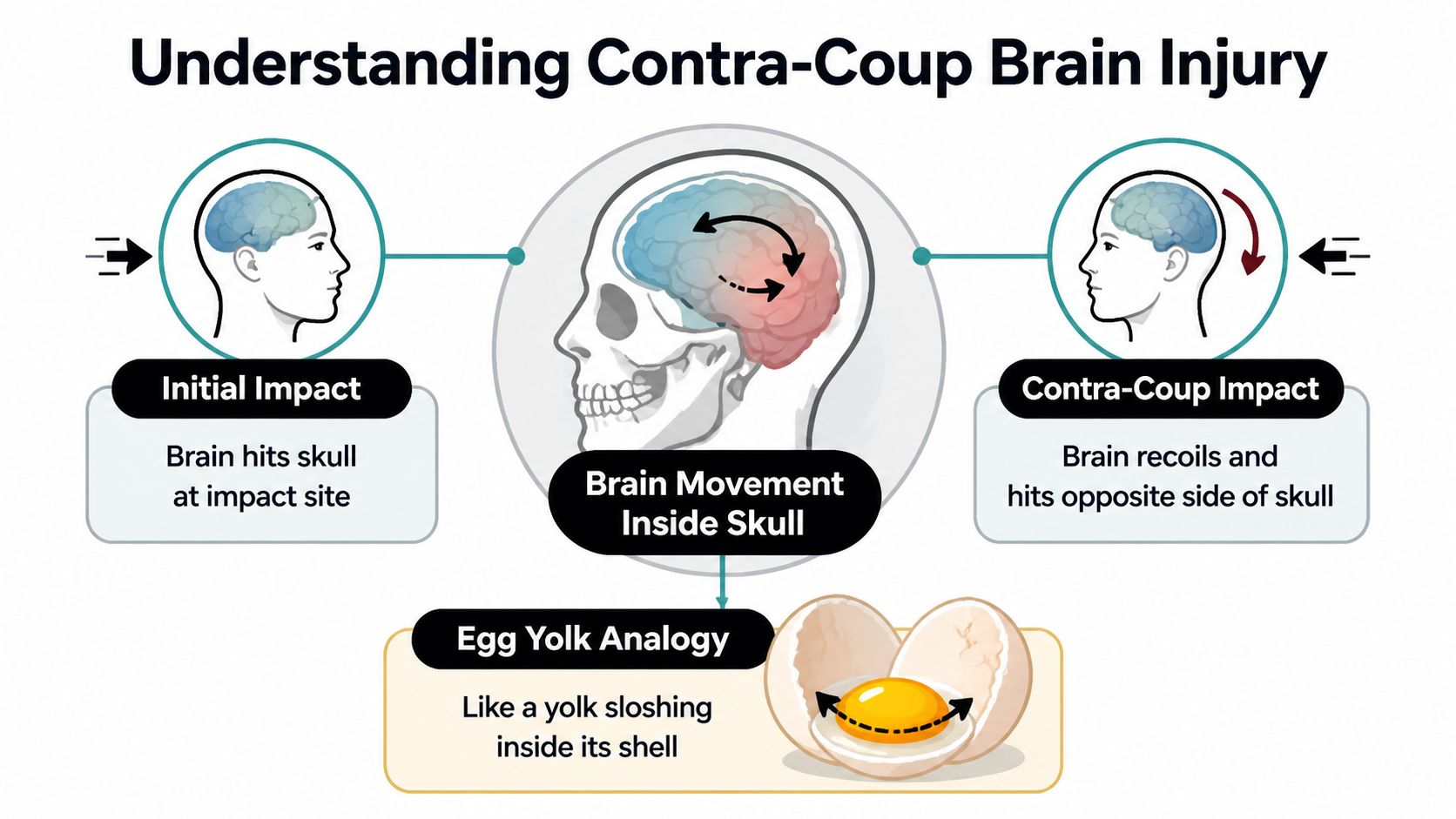
Coup and contrecoup in plain language
Here’s the simple version:
- Coup injury means damage at the point of impact.
- Contrecoup injury means damage on the opposite side of the brain after rebound.
- Contra coup brain injury is often used by families to describe that opposite-side injury.
This matters in car accidents because your head doesn’t need to hit an object in a dramatic way for the brain to move violently. A sudden stop in a rear-end crash, head-on collision, or T-bone wreck can create enough force to injure the brain inside the skull.
These injuries are not rare in serious trauma. According to this explanation of coup-contrecoup brain injuries, they are found in 20-30% of severe head injuries and contribute to about 30% of all injury deaths.
Why the opposite side can be worse
Many readers find this concept confusing. People assume the worst damage must be where the head was struck. But with this type of injury, the rebound can be just as harmful, and sometimes more harmful, than the first blow.
For example, in a Dallas intersection crash, a driver’s head may snap to one side from the impact. The first force affects one area. Then the brain rebounds and strikes the opposite side. That second impact can affect thinking, memory, speech, balance, or emotional control depending on which parts of the brain are involved.
Simple takeaway: The outside of the head may show very little, while the inside of the brain has been injured in two separate areas.
Why the term matters legally
The name matters because it helps explain why symptoms may seem scattered. One person may have headaches and dizziness. Another may have memory problems and emotional changes. Another may have both.
That doesn’t make the injury less real. It means the brain was affected in a complicated way. Understanding that complexity is often the first step in getting proper testing, treatment, and a fair auto insurance claim.
Symptoms and Red Flags to Watch For After a Crash
The most important thing to know is this. You can have a serious brain injury even if you walked away from the crash.

Some symptoms appear right away. Others show up hours later or over the next few days. That delay is one reason families feel dismissed at first. They know something has changed, but the timeline doesn’t look neat or simple.
A medical study discussed in this contrecoup injury source found an overall 43% mortality rate for contrecoup brain injuries, rising to 70% in patients with a low Glasgow Coma Scale score. That’s why any possible symptom after a Texas auto accident deserves immediate medical attention.
Physical signs that need attention
Watch for symptoms like these after a crash:
- Headache that doesn’t improve or gets worse
- Dizziness or poor balance
- Nausea or vomiting
- Sensitivity to light or noise
- Blurred vision or other visual changes
- Seizures
- Unusual fatigue or trouble staying awake
A person might call these “just concussion symptoms.” That can delay treatment. Any worsening symptom after a wreck needs prompt evaluation.
Cognitive and emotional changes families often notice first
The hidden effects are often the most disruptive. A loved one may not describe them well, but family members notice them quickly.
- Confusion about time, place, or simple tasks
- Short-term memory problems
- Trouble finding words
- Poor concentration
- Mood swings
- Anxiety, panic, or unusual sadness
- Irritability or personality change
- Sleep problems
Those changes can affect work, parenting, school, finances, and relationships long before the outside world understands what happened.
Here’s a short overview that may help you recognize those warning signs in context:
When to seek emergency care
Get immediate medical help if the injured person has severe confusion, repeated vomiting, a seizure, loss of consciousness, worsening headache, or behavior that seems dramatically different from normal.
If your gut tells you something is wrong, treat that instinct seriously. Families often spot brain injury symptoms before anyone else does.
Why this matters for your claim
Medical care protects your health first. It also creates a timeline. If symptoms are documented early, it becomes harder for an insurance company to argue that your problems came from something else. That matters when the injury is subtle, delayed, or “invisible” on the surface.
How Doctors Diagnose and Treat Contra-Coup Injuries
The medical process can feel rushed and confusing, especially in the emergency room. Knowing what doctors are looking for can make the experience less overwhelming.
A doctor usually begins with a neurological exam. They may ask simple questions, test memory, check balance, look at eye movement, and evaluate speech and alertness. After that, imaging often becomes the next step.
Why the first scan may not tell the whole story
CT scans are commonly used first because they’re fast and helpful in emergencies. They can show bleeding, swelling, or obvious contusions. But a first CT scan doesn’t always capture the full picture of a contra coup brain injury.
According to Radiopaedia’s discussion of coup-contrecoup injury, experts recommend serial neuroimaging within 72 hours after the accident because CT scans can miss occult contusions in 20-30% of moderate TBIs that only appear later. In legal cases, that repeat imaging can be critical.
Practical rule: If symptoms continue or worsen, ask whether follow-up imaging is needed. A normal early scan doesn’t always end the story.
That need for quick assessment is one reason trauma teams focus so much on early response. If you want a plain-English overview of why the first treatment window matters so much after a serious injury, this article on the medical golden hour for patient transport gives helpful context.
Common parts of treatment
Treatment depends on the severity of the injury. Some people need emergency intervention for bleeding or swelling. Others need close observation, medication, rest, and structured follow-up care.
Recovery often includes:
- Emergency care to stabilize breathing, bleeding, and brain pressure
- Neurology follow-up for headaches, seizures, cognitive changes, or persistent symptoms
- Physical therapy for balance, dizziness, weakness, and coordination problems
- Occupational therapy for daily tasks like cooking, driving, work skills, and attention
- Speech or cognitive therapy for memory, language, and executive function
- Mental health support for anxiety, depression, trauma reactions, or emotional dysregulation
Some families also find it helpful to learn more about the broader treatment path after a wreck through guides on motor vehicle accident treatment options.
The recovery road is rarely straight
A person may improve in one area and struggle in another. Headaches may get better while memory issues remain. Physical strength may return while emotional control does not. That uneven recovery is common in brain trauma.
Keep a symptom journal. Bring it to appointments. Write down missed work, new medications, dizziness episodes, emotional changes, and problems with concentration. Those details help doctors adjust treatment, and they may also become important evidence later.
Who Is Liable for Your Brain Injury in Texas
In Texas, a personal injury claim usually begins with negligence. In plain English, negligence means someone failed to use reasonable care and caused harm. A driver who texts behind the wheel, speeds through traffic, follows too closely, runs a red light, or drives drunk may be negligent if that conduct causes a crash.
If that crash causes a contra coup brain injury, the legal question becomes more than “Was there a wreck?” It becomes “Whose conduct caused the impact, and can we connect that impact to the brain injury symptoms now disrupting your life?”

How liability works after a Texas crash
Liability means legal responsibility for the harm. In a Houston T-bone crash, for example, a driver who runs a red light may be liable for the injured person’s losses.
Texas also uses a modified comparative fault system under Texas Civil Practice & Remedies Code Chapter 33. In simple terms, that means you can still recover damages if you were partly at fault, as long as you were not 51% or more responsible. If you were partly responsible, your recovery can be reduced by your share of fault.
Here’s a simple example:
| Situation | What it can mean |
|---|---|
| Other driver ran the red light | Their insurer may owe for your damages |
| You were speeding slightly too | Your compensation may be reduced |
| You were found 51% or more at fault | Texas law can bar recovery |
Why insurers fight brain injury cases hard
Insurance companies often accept that a crash happened while disputing the seriousness of the injury. That’s especially common when the injured person has “invisible” symptoms like memory loss, headaches, poor focus, or emotional changes.
As explained in this discussion of proving contrecoup injury causation, attorneys may use crash reconstruction to show delta-V forces exceeded 30mph, biomechanics experts to explain the injury mechanism, and functional MRI to reveal axonal tears that standard imaging misses.
That kind of evidence matters because insurers often argue:
- The symptoms are subjective
- The scan was normal at first
- The person already had anxiety, migraines, or another condition
- The crash wasn’t severe enough to cause this level of impairment
Texas law also affects damages
While Chapter 33 addresses fault, Texas Civil Practice & Remedies Code Chapter 41 deals with certain rules on damages, including limits that may apply in some cases involving exemplary damages. Most injured families are focused first on actual losses such as medical care, lost income, and suffering. But the legal framework still matters because it shapes how claims are evaluated and argued.
The legal fight in a brain injury case is often about proof, not just blame.
A good case shows both. It shows who caused the crash and how that crash changed your ability to live, work, think, and function.
Compensation You Can Claim for a Brain Injury
In a Texas injury case, damages means the losses the law allows you to claim. Some are financial and easy to identify. Others are personal and harder to measure, but just as real.
A fair claim should reflect the whole injury, not just the first ambulance bill.
Economic damages and future needs
Economic damages are the financial losses connected to the crash. These often include emergency care, hospital bills, follow-up visits, medication, rehabilitation, lost wages, and reduced future earning ability.
For a serious brain injury, future losses can be just as important as past bills. A person may need months or years of therapy, ongoing neurological care, home support, transportation help, or job retraining. That’s why lawyers often work with treating doctors and outside experts to build a life care plan, which is a detailed projection of future medical and daily living needs.
If you want a clearer picture of how these categories are evaluated, this guide on how damages are calculated after an accident can help.
Non-economic damages and invisible harm
Non-economic damages are the human losses that don’t come with a simple receipt. They may include pain, mental anguish, physical impairment, emotional distress, and loss of enjoyment of life.
These damages are often central in a contra coup brain injury claim because the hardest consequences may be invisible. A person may no longer trust their memory. They may fear driving. They may become easily overwhelmed in noisy places. Their marriage, parenting, confidence, and independence may all change.
That’s not minor. That’s harm.
Why work-related losses are often bigger than expected
One of the most common mistakes in brain injury claims is focusing only on missed paychecks from the first few weeks. The bigger question is whether the person can return to the same kind of work at the same level.
The long-term effects can be severe. According to NCBI’s discussion of contrecoup pathology, vestibular nucleus damage in a brainstem contrecoup injury can cause persistent vertigo affecting 60% of survivors. That can make driving, standing for long periods, operating machinery, or working in busy environments much harder. The same source notes that in a Houston wrongful death claim, autopsy correlation of contrecoup pathology can support pain and suffering awards that may exceed $2 million.
Wrongful death compensation
When a family loses someone after a severe crash, the case may involve wrongful death compensation. That can include losses tied to the death itself and, in some cases, claims connected to the pain and medical suffering before death.
A wrongful death case is never just about numbers. It’s about accountability, financial stability for the family, and recognition that a life was wrongfully taken.
A strong claim tells the full story. Not only what the crash cost last week, but what it will continue to cost your family over time.
Steps to Protect Your Rights After a Crash
When a brain injury is possible, the steps you take in the days after the crash can affect both your health and your legal rights. You don’t need to do everything perfectly. You do need to act carefully.

What to do first
Start with medical care. If you have headaches, confusion, dizziness, memory trouble, vision changes, or any unusual symptoms after a wreck, get evaluated right away. Then follow every instruction your doctors give you.
After that, focus on preserving the story of what happened.
Get checked and keep going back if symptoms continue
Don’t stop care because you’re busy or because an insurer says you should be improving. Brain injury symptoms often evolve.Report the crash
Call law enforcement if you haven’t already. Make sure there is an official report.Notify your own auto insurer
If you’re opening an auto insurance claim, give basic facts. Keep it simple and accurate.
What to document
Insurance companies build cases from records. You should too.
- Keep every medical record you receive
- Save bills and receipts for treatment, prescriptions, and travel
- Take photographs of the vehicles, injuries, and scene if possible
- Write down symptoms daily in a notebook or phone
- Track work problems such as missed days, reduced duties, or mistakes caused by concentration issues
- Preserve messages from insurers, adjusters, and witnesses
What not to do
Don’t give the other driver’s insurance company a recorded statement without legal advice. Don’t guess about your injuries. Don’t say “I’m fine” just to end an awkward phone call. And don’t accept a quick settlement before you understand the medical picture.
A brain injury case often looks smaller in the first week than it does after a month of missed work, repeat appointments, and growing cognitive symptoms.
Why timing matters
Texas law gives you a limited time to bring many injury claims. That deadline is called the statute of limitations. In plain English, it’s the legal time limit for filing suit. Missing it can seriously damage your rights.
You also strengthen your case when you act early. Witnesses are easier to find. Crash evidence is fresher. Medical records are more complete. And your Texas injury attorney has more time to investigate liability, insurance coverage, and damages.
Your Legal Questions Answered
When your family is dealing with a brain injury, the legal process can feel just as confusing as the medical one. These are some of the questions people ask most often.
Texas Car Accident Claim FAQs
| Question | Answer |
|---|---|
| What if the CT scan was normal at first? | A normal first scan doesn’t always rule out a brain injury. Ongoing symptoms still matter, and follow-up evaluation may be necessary. |
| What does liability mean? | Liability means legal responsibility. In a car crash case, it asks who caused the wreck and should pay for the harm. |
| What is comparative fault? | Comparative fault means more than one person may share blame. Under Texas law, your compensation can be reduced by your percentage of fault, and recovery may be barred if you were 51% or more at fault. |
| What are damages? | Damages are the losses you can claim, including medical costs, lost income, pain, mental anguish, and other effects of the injury. |
| What is the statute of limitations? | It’s the deadline for filing a lawsuit. Waiting too long can put your case at risk. |
| Do I have a case if my symptoms are mostly memory or mood problems? | Possibly, yes. Brain injury cases often involve cognitive and emotional symptoms, not just visible wounds. The key is documenting them carefully. |
| Should I talk to the insurance adjuster? | You should be cautious. Basic reporting is one thing. A detailed recorded statement to the other side is another. |
| Do I need a lawyer for an auto insurance claim? | Not every claim requires a lawyer, but serious brain injury claims often do because proof, medical records, and future losses are heavily disputed. |
Common concerns in plain English
A lot of families ask whether they’re “overreacting” by calling a Houston car accident lawyer when the injured person is home and not in intensive care. The answer is no. Brain injuries often create long-term problems that don’t look dramatic on day one.
Others worry that being partly at fault means they can’t recover anything. That’s not always true under Texas comparative fault rules. The facts matter, and small details can change the outcome.
Some people also feel guilty about pursuing compensation. But a legal claim isn’t about taking advantage of the system. It’s about asking the at-fault party, or the insurer standing in their place, to cover the harm caused by negligence.
When legal help becomes especially important
You should strongly consider speaking with a lawyer if:
- Symptoms are ongoing and affecting work or home life
- The insurer is minimizing the injury
- The crash involved a truck, rideshare vehicle, or uninsured driver
- You’re hearing terms you don’t understand, like comparative fault or recorded statement
- A loved one died, and your family may need wrongful death compensation
- You need help finding focused legal guidance, such as speaking with a brain injury attorney in Houston
You don’t need to have every answer before asking for help. You just need to take the next informed step.
If you or someone you love is dealing with a contra coup brain injury after a crash, The Law Office of Bryan Fagan, PLLC is here to help. Our team understands how hard it is to prove invisible cognitive and emotional harm, especially when insurance companies try to downplay what your family is living through every day. A Houston car accident lawyer from our firm can explain your rights, investigate liability, handle the auto insurance claim process, and pursue the full damages available under Texas law. We offer free consultations, and you won’t pay unless we win your case. Reach out today to speak with a compassionate Texas injury attorney about your options.