Skip to content
A car crash can change your life in seconds, but you don’t have to face recovery alone.
Maybe you’re reading this from an urgent care waiting room. Maybe your car is in a tow yard, your phone keeps buzzing with insurance calls, and you still don’t fully remember how the impact happened. That confusion is normal. So is the fear about medical bills, missed work, and what happens next.
Across the country, crashes remain a daily reality. In 2024, an estimated 39,345 people died in motor vehicle traffic crashes in the United States, with over 6,500 people injured daily on average, and the average auto liability claim for bodily injury reached $27,373 in 2024, up 8% from the prior year, according to Clio’s roundup of personal injury law statistics. Those numbers matter because they show two things at once. First, you are not alone. Second, the financial stakes after a wreck can be serious, especially in busy Texas traffic corridors.
Good auto accident legal advice starts with simple, steady guidance. Protect your health. Protect the facts. Don’t let an insurance company rush you before you understand your rights. If you want a broader look at what recovery can involve after a crash, this guide to auto accident recovery in Texas is a helpful next read.
A Car Crash Changes Everything But You Are Not Alone
A Houston driver rear-ended on I-45 may walk away saying, “I think I’m okay,” only to wake up the next morning with neck pain, a pounding headache, and no idea how to pay for treatment. A parent hit in Dallas-Fort Worth may be less worried about the dented bumper than about getting kids to school while the car is in the shop. A spouse in San Antonio may be wondering whether this is now an insurance problem, a legal problem, or both.
It’s often all of those at once.
The hardest part of the first few days is that everything feels urgent. Your body hurts, your schedule is broken, and the insurance process starts before you’ve had time to think. That’s why clear legal guidance matters. Not because every case goes to court, but because early choices can affect your medical care, your auto insurance claim, and your family’s financial stability.
You don’t need to know every law on day one. You need to avoid the mistakes that make recovery harder.
In Texas, many accident victims are dealing with more than car repairs. They’re trying to document injuries, sort out fault, and understand whether they may have a claim for medical bills, lost income, pain and suffering, or in the worst cases, wrongful death compensation. If you’re feeling overwhelmed, that doesn’t mean you’re doing anything wrong. It means you’re in the middle of a difficult event for which individuals are typically unprepared.
Your First 24 Hours What To Do Immediately After A Crash
The first day matters because evidence disappears fast. Cars get moved. Skid marks fade. Witnesses leave. People forget small details that later become important.
If you can think of the first 24 hours as a checklist instead of a crisis, you’ll protect yourself much better.
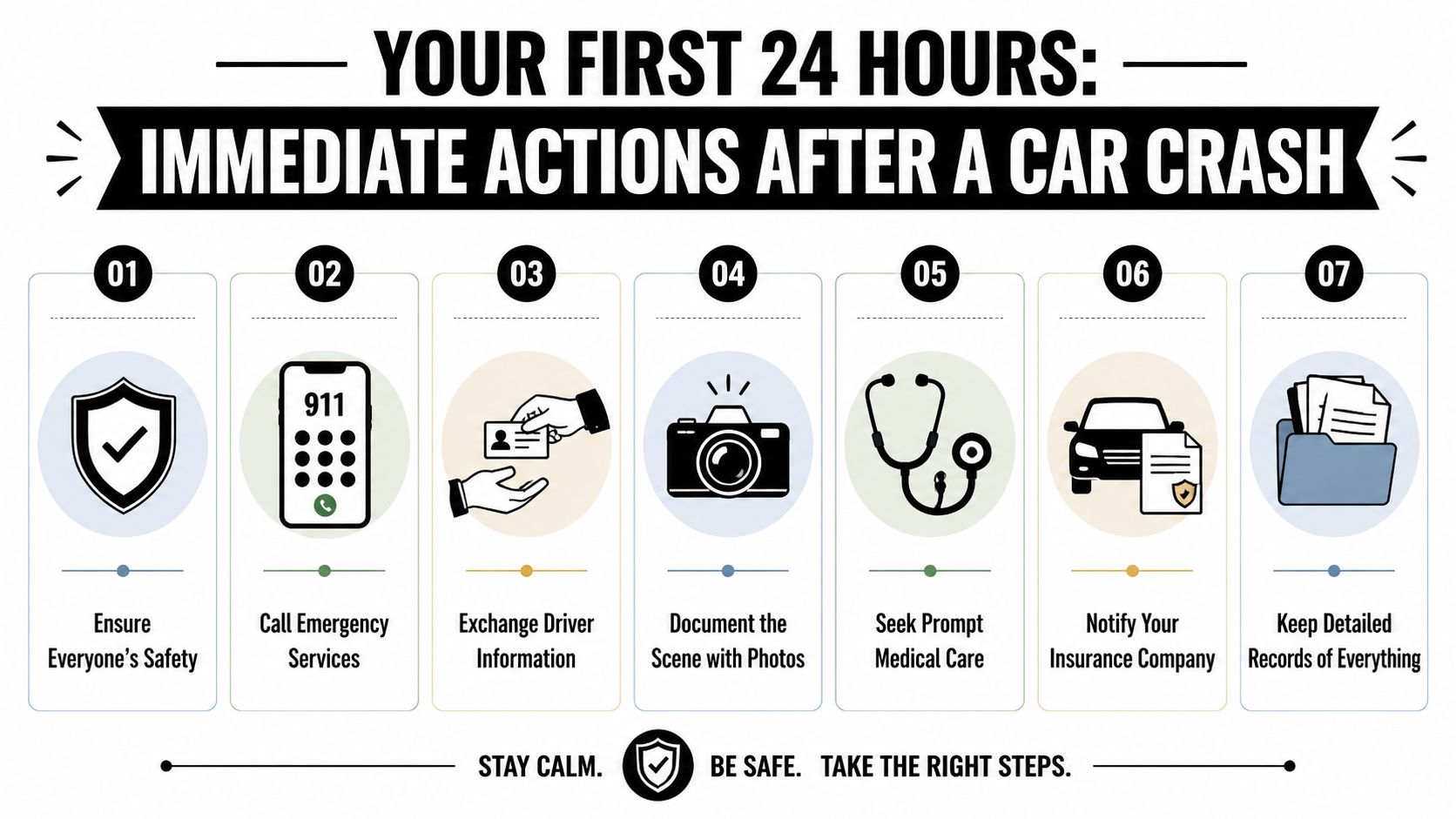
Start with safety
Your first job is not proving fault. It’s keeping people alive and preventing another impact.
- Check for injuries. Look at yourself first, then passengers, then others if you can do so safely.
- Move to safety if possible. If the vehicles can be moved and it’s safe, get out of active traffic lanes.
- Call 911. Ask for police and medical help if anyone may be hurt.
If you’re shaken up, keep your words simple. Give your location, how many vehicles were involved, and whether anyone appears injured.
Exchange information without arguing
You need identifying details, not a roadside debate.
Collect:
- Driver details. Full name, phone number, address if available.
- Insurance information. Carrier name and policy details from the card.
- Vehicle details. Make, model, color, and license plate.
- Possible witnesses. Names and contact information from anyone who saw what happened.
Don’t apologize just to be polite. Don’t say, “I didn’t see you,” “I may have been going a little fast,” or “I’m fine.” Those statements can be misunderstood later.
Practical rule: Exchange facts, not opinions.
Photograph what people forget
Drivers often take a few close-ups of the damaged bumper and stop there. That’s not enough.
Take photos and video of:
- Vehicle positions. Show where each car ended up before they’re moved, if it’s safe.
- Damage from multiple angles. Front, rear, sides, inside the vehicle if relevant.
- The bigger scene. Traffic lights, stop signs, lane markings, debris, skid marks, and nearby businesses that may have cameras.
- Road and weather conditions. Wet pavement, glare, construction zones, potholes, standing water.
- Visible injuries. Bruising, cuts, swelling, airbag burns, seat belt marks.
A short video walking around the scene can help capture distances and layout better than still photos alone.
Get the officer’s information
If law enforcement responds, ask for:
- Officer name
- Agency
- Report number
- Instructions for obtaining the report
That report won’t decide your entire case, but it can become an important part of your file.
Seek medical care the same day if you can
Some injuries don’t show up right away. Adrenaline can hide pain for hours. If you hit your head, lost consciousness, feel dizzy, have neck or back pain, chest pain, numbness, or worsening soreness, get evaluated promptly.
Even if your symptoms seem small, a same-day or next-day visit helps connect the injury to the crash.
Report the collision to your insurer
Tell your insurance company that a crash happened. Keep it short and factual. If you need help understanding basic reporting steps, this guide on how to report a car accident in Texas can help.
Create one crash folder before the day ends
Use your phone, a notes app, or a physical folder. Put everything in one place:
- Photos and videos
- Police details
- Claim numbers
- Tow and storage receipts
- Medical paperwork
- A short written summary of what you remember
Write down what happened while it’s fresh. Include time, location, direction of travel, lane position, weather, and anything the other driver said.
Navigating Medical Care and Insurance Reporting
The days after a crash usually split into two tracks. One is your health. The other is paperwork and phone calls. Both matter, and both can affect your claim.
Why medical care matters even when you think you’re okay
Many people wait because they don’t want to seem dramatic. Others assume soreness is normal and will pass. Sometimes it does. Sometimes it’s the early sign of a more serious problem.
Prompt medical care does two things. It helps you get diagnosed and treated. It also creates a record that links your symptoms to the collision.
This is especially important after lower-speed wrecks. Some crashes look minor but still lead to whiplash, back strain, concussion symptoms, or shoulder injuries from the seat belt and steering wheel. If your windshield was damaged in the impact, practical resources about insurance claims for windshields can also help you understand the property-damage side while you focus on your health.
What to tell your doctor
Be complete. Don’t just mention the worst pain.
Tell the provider:
- Where the crash happened on your body. Head, neck, back, shoulder, knee, chest.
- What symptoms started right away. Pain, dizziness, ringing in ears, numbness, nausea.
- What changed later. Stiffness the next morning, headaches, sleep problems, trouble concentrating.
- How daily life is affected. Driving, lifting, working, caring for children, sleeping.
If you skip symptoms because they seem minor, those gaps can create confusion later.
Tell medical providers about every symptom that started after the crash, even if it seems small.
What to say when you report the crash to insurance
Insurance reporting should sound calm and plain. Think of it as giving a basic incident log, not arguing your case.
You can say:
“I’m reporting a motor vehicle collision that happened on [date] at [location]. My vehicle was involved with another driver. Police responded, and I’m seeking medical evaluation. I’m not prepared to discuss fault in detail at this time.”
That gives the insurer what they need to open the claim without handing them unnecessary opinions.
What to avoid saying
These phrases cause trouble:
- “I’m fine.” You may not know that yet.
- “It was partly my fault.” Fault is a legal and factual issue, not a quick roadside guess.
- “I didn’t see them.” That can be used against you.
- “I only need my car fixed.” You don’t know the full extent of your injuries on day one.
- Any speculation. Don’t guess about speed, timing, or who had the better opportunity to avoid the crash.
If the other driver’s insurer calls, you do not have to let the adjuster control the conversation. You can identify yourself, confirm the date of loss, and say you are still receiving care and are not ready to give a detailed statement.
A simple way to organize the paper trail
A lot of strong claims are weakened by poor organization, not weak facts.
Use this system:
| Item | What to save |
|---|---|
| Medical file | Visit summaries, imaging orders, prescriptions, bills |
| Insurance file | Claim numbers, adjuster names, emails, letters |
| Expense file | Towing, rental car, medication, parking, out-of-pocket costs |
| Work file | Missed days, reduced duties, lost pay records |
| Personal notes | Daily pain levels, sleep problems, activity limits |
Don’t rush a recorded statement
Adjusters often sound friendly because that’s their job. Friendly doesn’t mean neutral. A recorded statement can lock you into wording before you know the full medical picture.
If you feel pressured, keep it simple.
“I’m still getting medical care and gathering information. I’m not comfortable giving a recorded statement right now.”
That isn’t rude. It’s careful.
Understanding Your Legal Rights and Deadlines in Texas
Texas law can feel intimidating until you break the terms into ordinary language. Once you do, the basic ideas are manageable.

Four legal terms you should know
Liability means legal responsibility. If a driver caused the crash, that driver may be liable for the harm that followed.
Negligence means failing to use reasonable care. In a crash case, that can include running a red light, following too closely, distracted driving, or driving while impaired.
Damages means the losses caused by the wreck. That can include medical bills, lost wages, property damage, pain and suffering, and other harm recognized by law. Texas personal injury law, including Chapters 33 and 41 of the Texas Civil Practice and Remedies Code, shapes how fault and damages are handled.
Statute of limitations means the deadline for filing a lawsuit. If you miss it, you can lose the right to bring the claim in court. For a closer look at timing issues, review this guide on Texas statutes of limitations.
How Texas comparative fault works
Texas uses a modified comparative fault system. Under Texas Civil Practice and Remedies Code § 33.001, you cannot recover damages if you are 51% or more at fault for the crash, as explained in this discussion of the Texas 51% Bar Rule and proportionate responsibility.
That rule matters because fault is not always all-or-nothing.
Take a common example. A driver in Houston is going a little over the speed limit through an intersection. Another driver runs a red light and crashes into that vehicle. The insurance company may argue the speeding driver shares some blame. If the evidence shows the speeding driver was partly responsible, recovery may be reduced. But if the insurer can push that blame to 51% or more, the claim can be barred completely.
That is why early evidence matters so much:
- Scene photos can show lane position and signal placement.
- Dashcam footage can show who entered the intersection first.
- Witness statements can support your version before memories fade.
- Vehicle data and phone records can help test distracted-driving claims.
A small statement made early can become a large fault argument later.
Why insurance companies focus on blame
In plain English, insurers often look for anything they can use to say you contributed to your own injuries. That doesn’t mean they’re always wrong. It does mean you should be careful about casual admissions, missing records, and inconsistent stories.
A Texas injury attorney looks at the details with that 51% threshold in mind. If the other side says you failed to keep a proper lookout, changed lanes unsafely, or reacted too slowly, the response has to be based on evidence, not frustration.
What Chapter 41 means in practical terms
Chapter 41 of the Texas Civil Practice and Remedies Code deals with certain damage issues, including limits and standards that can affect some types of recovery. Most readers don’t need to memorize the statute. What matters is understanding that Texas law does not merely ask whether you were hurt. It also governs what kinds of damages may be available and how they must be proven.
That’s one reason careful documentation matters from the start. Medical records, work records, photographs, and witness accounts help connect the legal rules to the actual harm in your life.
When and Why to Hire a Texas Car Accident Lawyer
It is 8:30 p.m. You are home from the ER, your phone keeps buzzing, your car may be totaled, and an insurance adjuster wants a recorded statement before you have even had time to catch your breath. That is often the moment people start asking whether they need a lawyer.
In Texas, the answer usually turns on pressure and complexity. If fault is being challenged, your injuries are still unfolding, several vehicles are involved, or a company vehicle, truck, or rideshare driver is part of the crash, legal help can protect more than a claim. It can protect your household budget, your time, and your ability to make decisions without being rushed.

A lawyer's role includes:
A car accident case has two tracks at once. One is the human track: treatment, pain, work issues, family stress. The other is the insurance track: statements, deadlines, records, fault arguments, and money. A lawyer helps keep those tracks from colliding.
A Houston car accident lawyer or other Texas injury attorney may help by:
- Looking past the police report. That can mean following up with witnesses, requesting video, inspecting vehicles, and preserving digital evidence before it disappears.
- Taking over insurance communication. You do not have to field every call or worry that one unclear answer will be used against you later.
- Valuing the claim with a longer view. The full cost of a crash may include future care, reduced ability to work, and the daily ways an injury changes your life at home.
- Checking every possible source of coverage. That matters in rideshare cases, trucking cases, employer-related crashes, and uninsured or underinsured motorist claims.
- Building the case for settlement or suit. Many claims resolve outside court, but serious cases are stronger when prepared as if a lawsuit may be necessary.
One available option for people seeking representation is The Law Office of Bryan Fagan, PLLC, which handles Texas motor vehicle injury claims on a contingency-fee basis. That means clients do not pay attorney’s fees unless there is a recovery.
When legal help matters more
Some situations deserve early legal advice because the insurance company has more room to limit or deny payment.
- Fault is disputed. Texas claims often turn on how the story is framed and what evidence supports it.
- Your injuries are serious or slow to improve. A quick settlement can look very different once follow-up care, therapy, or missed work stack up.
- A business is involved. Commercial policies and company defendants usually bring more records, more adjusters, and more defenses.
- A loved one died in the crash. Families may be dealing with grief, bills, and legal questions at the same time.
- The insurer is pushing speed. Fast offers often arrive before the full medical picture is clear.
This video gives a general overview of why legal guidance matters after a wreck:
Why timing matters
Early legal advice gives you a better chance to protect the pieces that are easiest to lose. Video can be deleted. Witness memories can fade. An offhand comment to an adjuster can turn into an argument that you were partly to blame.
That does not mean a delay ruins every case. It means earlier help often gives you more room to make careful choices.
For many families, that is the value. A lawyer is not only there to file papers or argue over numbers. A good lawyer helps create order during a week that feels chaotic, so you can focus on treatment, work, and the people depending on you.
Common Pitfalls That Can Jeopardize Your Claim
Some claim problems don’t come from the crash itself. They come from assumptions people make afterward.

The fender bender mistake
Many people think a low-speed wreck can’t lead to a real injury claim. But in Texas, up to 25% of “non-injury” accidents result in victims reporting delayed symptoms like whiplash within 72 hours, according to this discussion of Texas car accident claim issues.
That means the quick property-damage settlement can become a trap if you sign too early.
The uninsured driver problem
The same source notes that Texas’s uninsured motorist rate is near 14.5%. When the at-fault driver has little or no coverage, the case often shifts into a different kind of insurance dispute. You may still have options, but the process usually becomes more technical and more frustrating.
The no-contact crash problem
A no-contact crash happens when another driver forces you into a wreck without hitting your car. A common example is a driver who swerves into your lane on a Houston freeway, causing you to veer into a barrier. The other driver keeps going and later claims no collision means no liability.
That assumption is wrong. These cases can still be valid, but proof becomes harder. The same Texas source states that victims in no-contact accidents may recover 40% less without specialized legal help to prove liability.
If another driver caused you to crash, lack of contact does not automatically end the case.
A short list of avoidable mistakes
- Settling before symptoms are clear
- Missing follow-up appointments
- Posting about the crash on social media
- Giving detailed recorded statements too early
- Assuming no visible damage means no legal claim
Auto accident legal advice is often less about dramatic courtroom moments and more about avoiding these quiet mistakes before they cost you your advantage.
Your Questions Answered and Your Path to Recovery
After a wreck, people want straight answers. Here are a few.
How much is my case worth
It depends on the facts. Liability, the seriousness of your injuries, the medical care you need, lost income, insurance coverage, and how the crash affects your daily life all matter. A rear-end collision with a short recovery looks different from a multi-vehicle crash involving surgery or permanent limitations.
How long will the claim take
Some claims move faster than others. Cases often take longer when treatment is still ongoing, when fault is disputed, or when the insurer challenges parts of the medical record. In general, it’s usually better to understand the full picture before resolving a claim than to rush and discover later that the settlement was too small.
What if I was partly at fault
Partial fault does not automatically end your case. But in Texas, fault matters a great deal because of the 51% rule discussed earlier. That’s why evidence, consistent statements, and careful claim handling are so important.
What does a lawyer cost
Many car accident lawyers work on a contingency-fee basis. That usually means you pay no attorney’s fee unless money is recovered for you. Ask for the fee agreement in writing and make sure you understand how case expenses are handled.
Do I need legal help for a truck accident or wrongful death case
Those cases are often more complicated than a standard two-car collision. Trucking claims can involve company records, multiple insurance policies, and federal or industry issues. Fatal crashes can raise separate questions about wrongful death compensation and who may bring the claim.
If you’re looking for auto accident legal advice because life feels upside down right now, the goal is not to become a legal expert overnight. The goal is to protect your health, your rights, and your family’s future one step at a time.
If you were hurt in a crash and need clear guidance about your options, contact The Law Office of Bryan Fagan, PLLC for a free consultation. You can talk through what happened, learn what Texas law may allow in your situation, and get help dealing with the insurance process without added pressure.